
TL;DR:
- Modern logistics IT reduces costs and increases visibility using AI, digital twins, and integrated platforms.
- Robust security strategies like Zero Trust, segmentation, and AI anomaly detection protect supply chains.
- Seamless system integration with phased migration and digital simulations minimizes operational disruption.
Logistics managers frequently cite IT upgrades as a source of disruption, cost overruns, and operational risk. The evidence tells a different story. Leading supply chains are using advanced IT solutions to reduce costs by millions, automate warehouse operations, and maintain continuous visibility across complex, multi-modal networks. The tools available today, from AI-powered transport management systems to Zero Trust security frameworks, are purpose-built for the demands of modern logistics. This article sets out the core technologies, real-world performance data, security essentials, and integration best practices that managers need to act on now.
Table of Contents
- Understanding IT solutions for logistics: Core technologies and approaches
- Driving efficiency: Real-world impact of IT solutions in logistics
- Securing the supply chain: IT security strategies for logistics
- Overcoming integration hurdles: Best practices for connectivity and system migration
- Why seamless orchestration, and not just technology, defines logistics leadership
- Enhance your logistics with expert IT support
- Frequently asked questions
Key Takeaways
| Point | Details |
|---|---|
| Modern IT drives efficiency | Smart technologies like AI and digital twins can boost logistics productivity by up to 30% while significantly cutting costs. |
| Security is non-negotiable | Zero Trust, network segmentation, and proactive monitoring are vital to protect supply chains from today’s cyber-physical threats. |
| Integration needs planning | Careful system planning and phased migrations help ensure seamless connectivity and minimise disruptions during IT upgrades. |
| End-to-end orchestration wins | The most successful logistics operations synchronise tools, processes, and people, not just technology. |
Understanding IT solutions for logistics: Core technologies and approaches
Modern logistics IT is not a single product or platform. It is a layered architecture of interconnected systems, each serving a distinct operational function while contributing to end-to-end supply chain visibility and control.
The principal technologies driving this transformation include:
- AI and machine learning (ML): Used for predictive demand forecasting, route optimisation, and inventory balancing. These systems learn from historical data and adjust recommendations in real time.
- Digital twins: Virtual replicas of physical warehouse and transport environments. Managers use them to simulate operational changes before committing resources.
- Transport Management Systems (TMS), Warehouse Management Systems (WMS), and Enterprise Resource Planning (ERP): These platforms handle scheduling, inventory tracking, order fulfilment, and financial integration. When connected, they provide a single source of operational truth.
- Edge computing: Processing data locally, at the point of capture, rather than routing everything to a central cloud. This is critical in logistics environments with intermittent connectivity, such as remote distribution centres or cross-border freight routes.
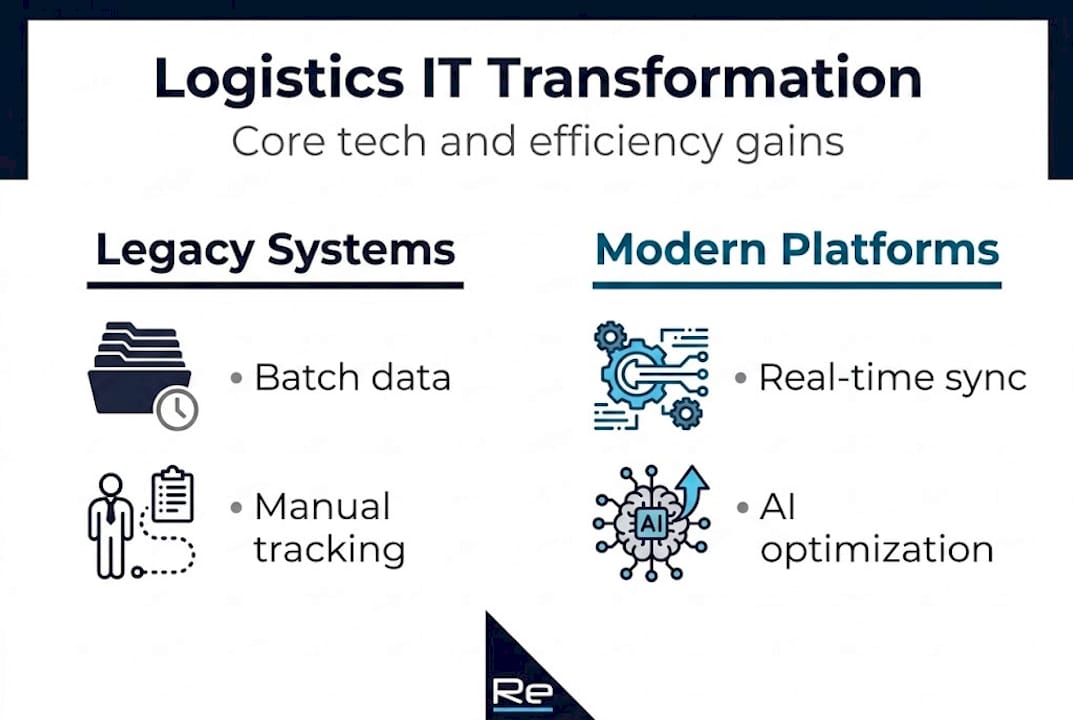
The distinction between legacy systems and modern, integrated platforms is significant. Legacy environments typically rely on siloed databases, manual data entry, and batch processing. Modern platforms operate in real time, share data across systems automatically, and support AI for warehousing logistics at scale.
| Capability | Legacy systems | Modern IT platforms |
|---|---|---|
| Data processing | Batch, periodic | Real-time, continuous |
| System integration | Manual, point-to-point | API-driven, automated |
| Visibility | Partial, siloed | End-to-end, unified |
| Scalability | Limited, expensive | Cloud-native, elastic |
| Decision support | Reactive, manual | Predictive, AI-assisted |
The core methodologies powering these platforms include AI and ML for predictive demand, route, and inventory optimisation; digital twins for scenario simulation; TMS, WMS, and ERP integration for end-to-end orchestration; and edge computing for real-time decisions in low-connectivity environments.
Phasing in these technologies matters. Wholesale replacement of core systems carries significant risk. A structured, incremental approach, starting with a WMS upgrade or adding an AI routing layer to an existing TMS, reduces operational disruption while generating measurable quick wins.
Pro Tip: Pilot new technologies in a single warehouse or transport lane first. Measure performance against a defined baseline for 60 to 90 days before scaling. This controls risk and builds the internal case for broader investment.
Driving efficiency: Real-world impact of IT solutions in logistics
With the main technologies clear, let us look at what happens when logistics firms put these tools to work.
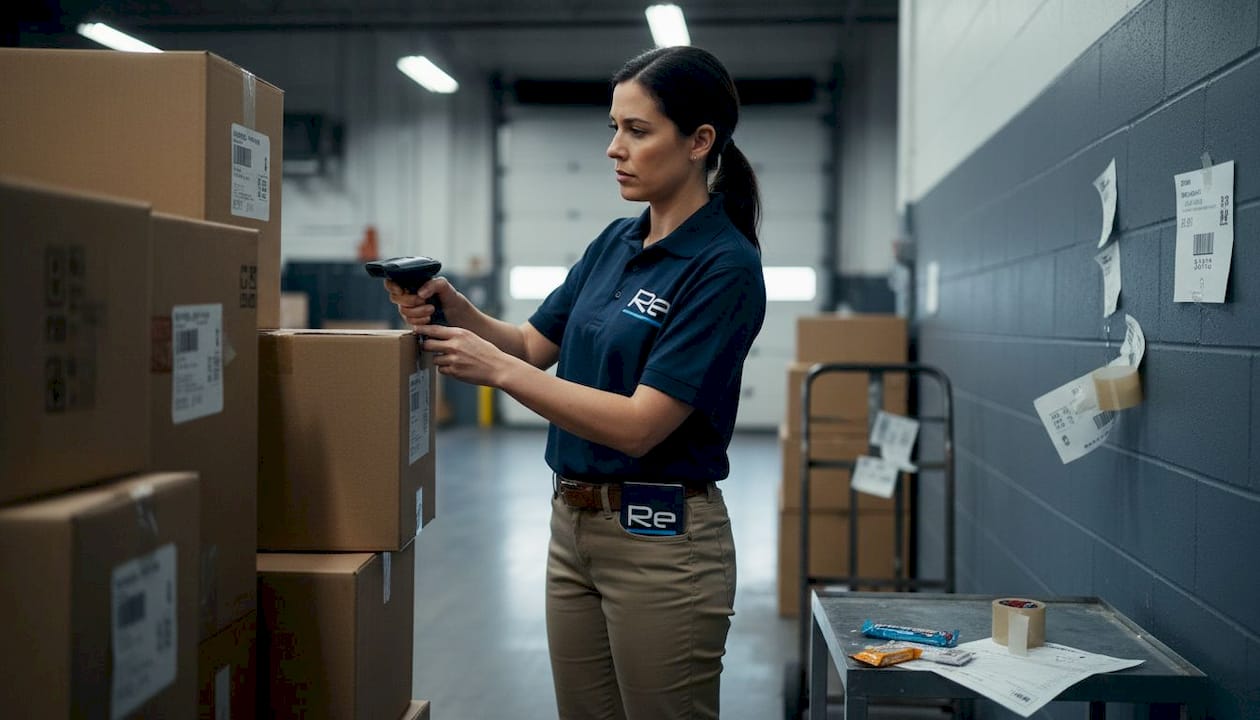
The performance data from organisations that have deployed modern IT solutions is compelling. These are not marginal improvements. They represent structural changes to how warehouses operate and how freight moves.
Consider three documented outcomes:
-
Neural route optimisation: AI-powered iTMS solutions from providers like Intuceo use neural networks to optimise routes dynamically, reducing dead-miles and fuel consumption by up to 20%. Freight audit capabilities within the same platform have identified annual savings of $4 million for individual operators, while predictive asset orchestration prevents network disruptions before they cascade.
-
Warehouse simulation and robotics optimisation: Intel’s warehouse simulation using AnyLogic digital twin technology achieved a 30% productivity increase, with 15% more boxes picked and 40% more placed through optimised tote placement and improved robot utilisation. Critically, these gains came before a single physical change was made on the warehouse floor.
-
AI-driven WMS and pick path optimisation: Flexport’s deployment of Logiwa AI WMS delivered 100% network growth capacity, a 15% improvement in pick rates, and $1,300 in savings per 10,000 order lines through optimised pick paths and automated inventory placement.
These results share a common pattern. The steps each organisation took followed a recognisable sequence:
- Baseline assessment: Quantify current performance across key metrics including cost per mile, pick rates, fulfilment accuracy, and downtime frequency. Without a baseline, it is impossible to measure or attribute gains.
- Targeted deployment: Select the IT solution most directly aligned to the identified performance gap. Route inefficiency calls for AI-powered TMS. Warehouse productivity gaps call for WMS with simulation and robotics integration.
- Iterative optimisation: Use the data generated by the new system to refine configurations, retrain AI models, and adjust workflows on an ongoing basis. The initial deployment is the starting point, not the endpoint.
| Organisation | Solution deployed | Primary outcome |
|---|---|---|
| Intuceo client | AI-powered iTMS | Up to 20% reduction in dead-miles, $4M freight audit savings |
| Intel | AnyLogic digital twin WMS | 30% productivity increase, 40% improvement in tote placement |
| Flexport (Logiwa) | AI WMS with pick path optimisation | 100% network growth, $1,300 saved per 10K order lines |
These results are not unique to large enterprises. The underlying technologies are increasingly accessible to mid-sized operators, and the return on investment case, particularly around fuel, labour, and fulfilment accuracy, is strong across scales. Reviewing warehousing logistics case studies provides further context for applying these models within your own organisation.
Securing the supply chain: IT security strategies for logistics
Efficiency gains matter, but without robust security, they are short-lived. Let us look at what it takes to protect your upgraded logistics IT environment.
Logistics operations present a distinct threat profile. They combine IT systems (business networks, WMS, ERP) with operational technology (OT) environments, including warehouse automation, telematics, and connected vehicles. This convergence creates attack surfaces that many conventional security frameworks were not designed to address.
The security best practices most relevant to logistics in 2026 include:
- Zero Trust architecture: Continuous authentication, mutual TLS (mTLS), and short-lived access tokens ensure no device or user is trusted by default, regardless of network location.
- Network and OT segmentation: Isolating operational technology from corporate IT networks limits the blast radius of any breach. A ransomware attack that penetrates a business network should not be able to reach warehouse automation systems.
- Multi-factor authentication (MFA) and role-based access control (RBAC): Requiring multiple verification factors and limiting system access to job-relevant permissions reduces credential-based attack risk significantly.
- Just-in-time (JIT) privilege elevation: Temporary, time-limited access for maintenance and administrative tasks prevents persistent privileged accounts from becoming persistent liabilities.
- AI-SIEM anomaly detection: Security information and event management platforms powered by AI can identify unusual patterns, such as abnormal data transfers or unexpected login locations, far faster than manual monitoring.
- Immutable event logging: Forensic-grade logs that cannot be altered or deleted are essential for post-incident investigation and regulatory compliance.
- Immutable backups: Offline, write-once backups ensure that ransomware encryption of live systems does not destroy the organisation’s ability to recover.
“Implementing Zero Trust with continuous authentication, combined with network segmentation and AI-driven anomaly detection, represents the most impactful security posture for logistics operations in 2026.”
The evolving threat landscape in logistics includes legacy OT-IT bridging that creates pivot points for ransomware, multi-modal visibility gaps that produce security blind spots, data sovereignty requirements in global operations that demand geo-fencing, and cargo theft enabled by telematics spoofing at the cyber-physical boundary.
Pro Tip: When connecting OT and IT networks, treat the integration point as a high-risk boundary. Deploy dedicated firewalls, monitor all traffic crossing that boundary, and never assume that physical separation of legacy OT systems means they are protected from network-borne threats.
Understanding and applying Zero Trust for logistics environments is an important starting point. For a broader view of how secure network design applies in operational settings, the principles remain consistent: verify everything, trust nothing, and segment aggressively.
Overcoming integration hurdles: Best practices for connectivity and system migration
Knowing the threats, let us focus on integrating new IT safely, ensuring your systems stay connected, secure, and effective across every handoff.
Integration is where many logistics IT projects encounter their most serious difficulties. New platforms rarely exist in isolation. They must connect with legacy systems, third-party logistics providers, customs platforms, and increasingly, cloud-based analytics environments. Each connection is a potential point of failure, security risk, or data integrity issue.
The primary integration hurdles managers face include:
- Legacy OT-IT bridging: Older operational systems often lack modern API capabilities, making integration complex and creating security vulnerabilities as noted above.
- Data sovereignty and geo-fencing: Global logistics operations must comply with different data residency regulations. Hybrid cloud security strategies that enforce data sovereignty at the storage and processing layer are essential.
- Multi-modal visibility gaps: When freight moves across air, sea, road, and rail, different carrier systems rarely share a common data standard. These gaps create dark zones where visibility is lost and security monitoring breaks down.
- Downtime risk during migration: Switching core platforms like a WMS or TMS during peak trading periods without a tested rollback plan can bring operations to a halt.
- Hybrid cloud transitional risk: Legacy OT-IT bridging and hybrid cloud migrations expose transitional vulnerabilities that attackers actively target during change windows.
A structured integration roadmap reduces these risks considerably:
- Inventory all current systems and data flows: Map every integration point, data source, and dependency before committing to a migration plan. Include both IT and OT environments.
- Classify systems by criticality and migration complexity: Prioritise stable, non-critical systems for early migration. Reserve core fulfilment and transport platforms until the process is proven.
- Deploy digital twins for simulation: Before migrating live systems, model the target architecture using digital twin or sandbox environments. Identify failures in simulation, not production.
- Implement phased cutover with parallel running: Run old and new systems simultaneously for a defined period, comparing outputs and validating accuracy before decommissioning the legacy platform.
- Enforce security controls at every integration boundary: Apply Zero Trust principles to all new connections. Do not inherit the security assumptions of the legacy environment.
- Conduct post-migration compliance review: Verify that data sovereignty requirements, audit logging, and access controls meet regulatory standards in all operating jurisdictions.
Understanding bridging IT and OT in operational environments provides practical reference points for logistics managers planning this transition. For teams moving workloads to cloud infrastructure, a hybrid cloud guide offers further detail on architecting secure, compliant hybrid environments.
Why seamless orchestration, and not just technology, defines logistics leadership
There is a persistent assumption in logistics that investing in the right technology is sufficient to deliver competitive advantage. It is not. The organisations that lead in supply chain performance are not necessarily those with the most advanced tools. They are the ones that have aligned those tools with process, governance, and cultural change.
End-to-end orchestration requires moving beyond siloed deployments. A cloud-native microservices-based platform, as recognised in Gartner’s 2026 Magic Quadrant leadership analysis, consistently outperforms legacy systems migrated to cloud precisely because it was designed for integration, not retrofitted for it. AI-first predictive operations outperform reactive, manual workflows not because AI is inherently superior, but because it operates at a speed and scale that human teams cannot match in isolation.
The real differentiator is process alignment. Technology must be orchestrated intelligently across the supply chain, not deployed as isolated point solutions. Leadership teams that treat IT adoption as a cultural and strategic priority, not merely a technical procurement exercise, consistently deliver better outcomes.
Future-proofing IT infrastructure requires both the right tools and the right operating model. One without the other produces a capable system that nobody uses effectively or an enthusiastic team without the platforms to execute.
Enhance your logistics with expert IT support
If you are ready to apply high-impact IT strategies to your own logistics operation, expert support is at your fingertips.
Re-Solution works with logistics and warehousing businesses to design, deploy, and manage the IT infrastructure that underpins supply chain performance. From Network as a Service solutions that provide scalable, resilient connectivity across distribution sites, to deep expertise in security architecture and compliance, we bring over 35 years of Cisco partnership experience to every engagement.
Whether you are looking to modernise ageing network infrastructure, explore what IT infrastructure explained means for your specific operation, or take concrete steps to modernise IT connectivity across your logistics network, our team is ready to help you build a solution that fits your environment, your compliance requirements, and your growth plans.
Frequently asked questions
What is the most impactful IT solution for logistics efficiency gains?
AI-powered transport optimisation delivers the highest efficiency returns, with route optimisation reducing dead-miles by up to 20%, while warehouse simulation using digital twins has achieved productivity increases of 30% at facilities including Intel.
How can logistics teams protect against ransomware and data breaches?
Zero Trust security controls, combined with network segmentation, MFA, RBAC, and AI-driven anomaly detection, provide the most effective defence against the ransomware and cyber-physical threats targeting logistics environments in 2026.
Which trends are shaping IT adoption in logistics through 2026 and beyond?
AI adoption in logistics is projected to grow from 28% to 82% by 2029, with hybrid cloud migration and seamless end-to-end orchestration emerging as the defining priorities for competitive supply chain operations.
How do managers avoid downtime during IT system integration?
Phased rollouts with parallel running, digital twin simulation of the target architecture, and a structured migration checklist that addresses legacy OT-IT bridging and data sovereignty requirements are the most reliable methods for avoiding disruption during system transitions.
Recommended
- Warehousing & Logistics | Cisco Cloud, Security & Datacenter Experts
- Maximise manufacturing efficiency with modern IT solutions
- Drive hospitality success with innovative IT solutions
- Future Operation | Cisco Cloud, Security & Datacenter Experts