
TL;DR:
- Integrated security combines physical and digital systems into a unified, manageable framework.
- IoT and AI technologies enhance threat detection, reduce false alarms, and improve operational efficiency across sectors.
- Successful integration requires organizational buy-in, ongoing training, compliance alignment, and outcome-focused metrics.
Security threats are no longer purely physical or purely digital. They operate across both domains simultaneously, and organisations that manage them separately are taking on unnecessary risk. The integrated security services market was valued at $15.8 billion in 2021 and is projected to reach $55.5 billion by 2031, growing at a compound annual rate of 13.7%. That growth is being driven by cyber and physical threats, smart city infrastructure, and connected supply chains. For IT decision-makers in education, manufacturing, logistics, and hospitality, this shift is not an abstract trend. It is a practical challenge requiring a clear, coordinated response.
Table of Contents
- What are integrated security solutions?
- Core components and technologies in integrated security
- Compliance and standards: Managing risk across sectors
- Benefits and implementation strategies for IT decision-makers
- A fresh perspective: Avoiding common pitfalls in integrating security
- Connect with experts for tailored integrated security solutions
- Frequently asked questions
Key Takeaways
| Point | Details |
|---|---|
| Unified approach | Integrated security solutions combine physical and digital controls for optimal efficiency and compliance. |
| Sector benefits | IoT and AI-driven integration reduces false alarms, streamlines operations, and boosts safety especially in education and logistics. |
| Compliance made easier | Security integration aligns with standards like ISO 28000, helping reduce audit risk in manufacturing and supply chain settings. |
| Strategic implementation | Interactive platforms, pilot testing, and cross-department collaboration help IT leaders get maximum value from integration. |
What are integrated security solutions?
Integrated security solutions combine physical security systems, such as access controls, CCTV, and environmental sensors, with digital security infrastructure, including network access control, identity management, and threat analytics. Rather than running these as separate functions managed by separate teams, integration brings them together into a single, manageable framework.
The purpose is straightforward: reduce complexity, reduce risk, and improve compliance. When your access control system, intrusion detection platform, and network monitoring tools all feed into a unified dashboard, your security team gains situational awareness that simply is not possible with fragmented systems. Incidents can be correlated across physical and digital events. A badge access anomaly can be linked immediately to unusual network activity, which is something that siloed systems cannot achieve.
Across sectors, the components that make up these solutions typically include:
- IoT sensors and connected devices for environmental and perimeter monitoring
- AI-driven video analytics for real-time threat detection and behavioural analysis
- Access control systems including biometric readers, smart card systems, and mobile credentials
- Network access control (NAC) platforms to govern who and what connects to the network
- Security information and event management (SIEM) tools to correlate and analyse data across systems
- Risk management and compliance dashboards to support audit readiness
This type of unified approach is becoming critical across educational campuses, manufacturing facilities, logistics networks, and hospitality environments. Each of these sectors faces a distinct set of threats, regulatory requirements, and operational constraints. Integration does not deliver one generic solution. It delivers a framework that can be configured around the specific demands of each environment. You can explore a broader view of how this applies across sectors in this security services overview.
“True integration is not about connecting more systems. It is about creating meaningful relationships between data points that individually tell a partial story, but collectively reveal the complete picture.”
Pro Tip: When evaluating integrated security platforms, prioritise those built on open standards and application programming interfaces (APIs). Proprietary lock-in limits your ability to scale, adapt, or bring in best-of-breed tools as threat landscapes evolve. Vendor flexibility is not just a commercial consideration. It is a security requirement.
The integrated security services market trajectory reflects just how quickly this shift from siloed to unified is happening. Organisations that delay integration risk operating with blind spots that modern adversaries are well equipped to exploit.
Core components and technologies in integrated security
With a clear definition in mind, it is vital to understand the technologies and components that underpin these solutions. At the foundation of any effective integrated security deployment are three converging technologies: the Internet of Things (IoT), artificial intelligence (AI), and unified platform architecture.
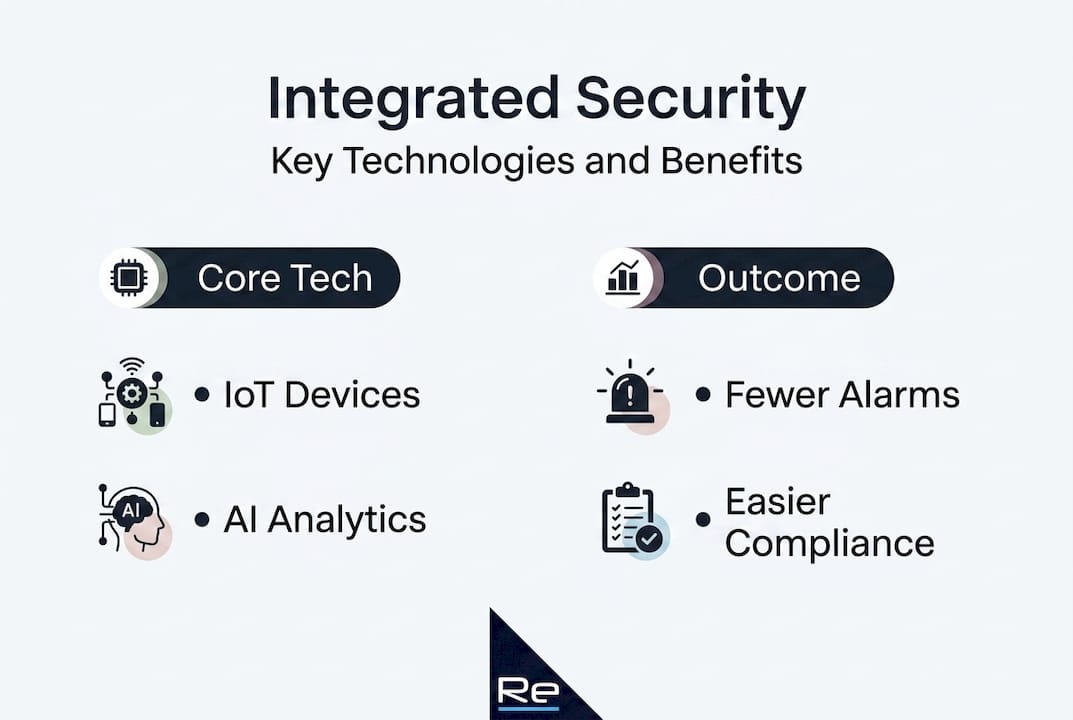
IoT devices provide the sensory layer. Cameras, door readers, environmental monitors, and motion detectors all generate continuous streams of operational data. On their own, these devices produce enormous volumes of raw information. The challenge is turning that information into actionable intelligence. This is where AI analytics play a decisive role. Machine learning models trained on behavioural patterns can identify anomalies in real time, triggering alerts only when evidence meets a defined threshold.

The practical outcomes are significant. IoT and AI analytics in educational environments reduce false alarms by 60 to 80 per cent and enable predictive maintenance across campus infrastructure. For IT managers responsible for large, multi-building campuses with limited security staffing, that reduction in false positives is not a minor efficiency gain. It is a fundamental improvement in how security resources are deployed.
The table below illustrates how IoT and AI integration delivers measurable value across key sectors:
| Sector | False alarm reduction | Compliance benefit | Operational efficiency gain |
|---|---|---|---|
| Education | 60-80% | GDPR and safeguarding audit readiness | Predictive maintenance of campus infrastructure |
| Manufacturing | 40-60% | ISO 27001 and ISMS alignment | Reduced downtime through condition monitoring |
| Logistics | 30-50% | ISO 28000 supply chain security compliance | Real-time asset tracking and incident correlation |
| Hospitality | 35-55% | PCI DSS and data protection compliance | Unified guest access and network management |
Beyond IoT and AI, platform integration is the architectural element that makes these gains sustainable. Systems must be able to communicate across vendors, protocols, and data formats. This is why reviewing the latest network security trends matters for any organisation planning integration. The direction of travel is clear: cloud-native platforms, Zero Trust architecture, and AI-augmented security operations are now the baseline expectation rather than advanced capability.
Sector-specific implementation requires additional consideration. In manufacturing, layered physical and network security must account for operational technology (OT) systems, which often run on legacy protocols. In logistics, GPS-enabled asset tracking must integrate with warehouse access control and fleet management systems. Understanding how AI security challenges affect your specific environment shapes which components you prioritise during deployment.
Pro Tip: Before deploying new IoT or AI components, conduct a compatibility audit of your existing infrastructure. Legacy systems do not always need replacement. Many can be connected through middleware or integration layers, preserving investment while enabling unified operation.
Compliance and standards: Managing risk across sectors
Technology integration is only half the story. Understanding compliance is essential for real-world application, and the regulatory landscape varies considerably across sectors. Getting integration right means aligning your technical architecture with the specific standards your organisation is expected to meet.
For logistics and supply chain operations, ISO 28000 provides the foundational standard for security management. This standard integrates with Quality Management Systems (QMS) and Information Security Management Systems (ISMS), creating a framework that spans physical security, information security, and operational risk across production, storage, and transportation environments. Organisations operating across multiple nodes of a supply chain need a security posture that is consistent and auditable at every point.
The table below maps key compliance frameworks to sector-specific requirements:
| Sector | Primary standard | Supporting frameworks | Key compliance risk |
|---|---|---|---|
| Education | GDPR, Keeping Children Safe | ISO 27001, ISMS | Data protection and safeguarding |
| Manufacturing | ISO 27001, Health and Safety | QMS, ISMS | OT/IT security boundary and incident response |
| Logistics | ISO 28000 | QMS, ISMS | Supply chain continuity and cargo integrity |
| Hospitality | PCI DSS, GDPR | ISO 27001 | Guest data protection and payment security |
To align integration with compliance frameworks effectively, follow these steps:
- Map your regulatory obligations by sector, geography, and data type before selecting any platform or technology component.
- Identify compliance gaps through an infrastructure audit that cross-references your current security posture against the relevant standards.
- Select integration platforms that generate the audit trails, access logs, and event reports your compliance team requires.
- Engage legal and compliance stakeholders during system design, not after deployment. Retrospective compliance is significantly more expensive than building it in from the outset.
- Test and document your integrated systems against compliance requirements on a scheduled basis, treating compliance as an ongoing operational function rather than a periodic review.
Organisations that build compliance into their integration architecture from day one consistently demonstrate faster audit readiness and lower remediation costs than those that address it after deployment.
A layered security approach, particularly in manufacturing, illustrates how this works in practice. Layering physical access controls, network segmentation, and endpoint monitoring creates multiple points of validation, which satisfies audit requirements and reduces the probability of a single point of failure becoming a compliance incident.
The integrated approach does not just simplify compliance. It actively reduces compliance gaps by eliminating the inconsistencies that arise when physical and digital security teams operate independently. When both domains share a common data architecture, reporting becomes consistent and reliable.
Benefits and implementation strategies for IT decision-makers
Once compliance and technical requirements are understood, the focus shifts to what success looks like and how to achieve it. For IT decision-makers, the case for integration rests on three pillars: operational efficiency, measurable risk reduction, and long-term cost management.
Unified security platforms cut costs and improve return on investment through operational efficiency, particularly when Physical Security Information Management (PSIM) systems are selected to support Security Operations Centre (SOC) integration. PSIM platforms aggregate data from disparate physical and digital security tools, giving SOC analysts a single interface through which to investigate, correlate, and respond to incidents.
The tangible benefits of integration for IT leaders include:
- Reduced false alarms, which free security staff to focus on genuine threats rather than investigating system noise
- Faster incident response, enabled by automated correlation between physical events and network anomalies
- Improved data quality, as unified platforms eliminate duplicate data entry and inconsistency between systems
- Lower total cost of ownership, through consolidated licensing, reduced hardware duplication, and streamlined maintenance
- Enhanced compliance posture, with centralised audit trails, automated reporting, and consistent access controls across environments
- Scalability, allowing the security architecture to grow with the organisation without requiring a complete rebuild
Understanding the wider context of IT infrastructure challenges helps frame why integration delivers such clear returns. Fragmented infrastructure creates management complexity, increases the attack surface, and makes it harder to demonstrate compliance to auditors and regulators. Integration addresses all three.
For practical implementation, the strategy should be phased. Begin with a high-risk environment, such as a manufacturing floor, a student services building, or a logistics hub entrance. Demonstrate measurable outcomes in that environment before extending the platform across the broader estate. This approach manages risk, provides proof points for internal stakeholders, and allows the implementation team to refine processes before scaling.
Engaging stakeholders across departments early is equally important. Security integration affects facilities management, IT, HR, finance, and legal. Each team has different requirements and different concerns. A deployment that satisfies the IT team but creates reporting friction for the compliance function will face resistance during rollout and post-deployment. Understanding how Cisco ISE functions in live environments gives useful context for how proof-of-concept deployments can validate the platform before full commitment.
Pro Tip: Set measurable success metrics before you begin. Incident reduction rates, compliance audit scores, and response time improvements are all quantifiable. Avoid evaluating integration success against feature lists alone. Features do not demonstrate value. Outcomes do.
A fresh perspective: Avoiding common pitfalls in integrating security
The most common mistake organisations make when pursuing integration is treating it as a technology procurement exercise rather than an organisational change programme. They acquire a capable platform, connect several systems, and then discover that the real barriers are human: teams that do not share data, processes that were never designed to interoperate, and leadership that has not committed to the cultural shift integration requires.
Fragmented adoption is a real and persistent problem. Departments implement their own tools, often without consulting IT or security leadership, and then integration projects inherit a patchwork of incompatible systems rather than a clean slate. This patchwork approach is significantly more costly to remediate than a properly governed initial deployment would have been.
True integration demands cross-department buy-in from the outset. It requires ongoing training, not just at launch but as systems evolve and new threats emerge. It also requires a trusted partner relationship with vendors and implementers who understand your sector’s specific compliance and operational context. A relevant Cisco ISE case study demonstrates what structured, outcome-focused implementation looks like when it is done with sector expertise behind it.
IT leaders should prioritise solution flexibility and ongoing partner relationships over one-time procurement decisions. The threat landscape does not stand still, and neither should your integration architecture.
Pro Tip: Focus your measurement on incident reduction rates and compliance scores. These metrics reflect genuine security improvement. A feature-rich platform that does not move these numbers is not delivering integration. It is delivering complexity.
Connect with experts for tailored integrated security solutions
Re-Solution brings over 35 years of experience as a trusted Cisco partner, helping organisations across education, manufacturing, logistics, and hospitality build integrated security frameworks that work in practice, not just in principle.
Whether you are at the early planning stage or ready to move from assessment to deployment, Re-Solution provides guidance tailored to your sector’s specific compliance requirements and operational environment. Explore smart security solutions designed for safety and compliance, or review how Network as a Service can support your connectivity and security objectives. To discuss your specific requirements with an expert, get in touch directly with the Re-Solution team.
Frequently asked questions
How do integrated security solutions reduce operational costs?
Unified platforms eliminate the need for duplicate systems and reduce management overhead, driving down total cost of ownership while improving the quality of security data available to operations teams.
Which compliance standards are relevant for logistics and manufacturing?
ISO 28000, QMS, and ISMS are the primary frameworks for logistics and manufacturing, providing structured security management across production, storage, and transport operations.
How does IoT and AI integration improve campus security?
IoT and AI analytics reduce false alarms by 60 to 80 per cent in educational environments and enable predictive maintenance, allowing campus security teams to operate more efficiently with greater situational awareness.
What should IT leaders prioritise when integrating security systems?
Scalability, compliance alignment, and platform flexibility are the foundational priorities. Avoid fragmented adoption by securing cross-department commitment before deployment begins, and measure success against incident reduction and compliance outcomes rather than feature counts.
Recommended
- Top smart security solutions: safety and compliance 2026
- Network infrastructure checklist: optimise compliance
- Secure network design: proven examples for robust protection
- Network Access Controller Guide | Secure Network | Re-Solution