TL;DR:
- Regulatory pressure, AI advancements, and data localisation shape industry privacy demands beyond mere compliance, requiring adaptable frameworks. Organisations must integrate privacy, data quality, and AI governance into their operational models to manage risks effectively across complex network infrastructures. Partnering with experienced providers like Re-Solution can help industries build compliant, secure, and future-proof network systems.
Regulatory pressure is intensifying, AI is rewriting the rules, and data privacy in industry has moved well beyond the territory of legal teams and annual audits. For IT decision-makers in education, manufacturing, logistics, hospitality, and property development, the challenge is no longer simply achieving compliance. It is building network infrastructure and governance models that can absorb regulatory change, manage AI-driven complexity, and protect business data confidentiality without grinding operations to a halt. This article explains what is driving that shift, which regulations demand your attention now, and how to build frameworks that hold up in practice.
Table of Contents
- How AI and data localisation reshape privacy demands in industry
- Navigating evolving privacy laws and enforcement risks
- Practical frameworks for managing data privacy risks in connected industries
- Addressing industrial network complexities and consent challenges
- Rethinking data privacy governance: a proactive, integrated model for industry
- How Re-Solution supports your industry data privacy needs
- Frequently asked questions
Key Takeaways
| Point | Details |
|---|---|
| AI drives privacy expansion | The rapid adoption of AI compels organisations to enhance privacy frameworks as a strategic imperative. |
| Data localisation challenges | Requirements to store data locally increase cost and complexity, affecting cross-border service delivery. |
| Legal risks are rising | Recent enforcement actions underline the importance of proper consent and data minimisation. |
| Frameworks enable control | Using structured privacy frameworks supports compliance and operational risk management. |
| Continuous risk assessment | Privacy assessments must be ongoing processes integrated into deployment and development. |
How AI and data localisation reshape privacy demands in industry
Building on the overview, the most consequential forces reshaping privacy demands in industrial networks today are AI adoption and data localisation requirements. Neither is a future concern. Both are already affecting architecture decisions and compliance budgets.
AI systems process vast volumes of personal and operational data, creating governance complexity that most organisations were not designed to handle. 90% of companies said AI is a catalyst driving expanded privacy programmes, and 93% plan further investment to keep up with AI complexity. That level of consensus is significant. It signals that AI governance is not a niche concern for tech-forward organisations. It is a baseline expectation.
What this means practically is that privacy programmes must operate as end-to-end models, not isolated compliance functions. Data quality, model inputs, output accountability, and audit trails all require coordination across IT, legal, and operations. Organisations that treat AI governance as an extension of their existing data handling best practices are better positioned than those building it as a separate track.
Data localisation adds a second layer of pressure. Jurisdictions across the EU, Asia-Pacific, and parts of the Middle East now require data to be stored and processed within their borders. 81% of organisations reported heightened demand for data localisation, and 85% said localisation adds cost, complexity, and risk for cross-border service delivery. For a logistics business operating across multiple countries, or a hospitality group managing guest data across international properties, this is a direct infrastructure problem.
Key architectural considerations for addressing localisation demands include:
- Selectable deployment modes: Design networks to support both local and cloud-hosted processing, switchable by jurisdiction.
- Data residency tagging: Apply metadata that identifies where data was collected and where it can legally be processed.
- Vendor contracts: Ensure cloud and managed service providers can guarantee regional data residency with documented evidence.
- Harmonised standards planning: Most organisations support harmonised standards for cross-border data transfers, but policy consensus is slow. Architecture must bridge that gap now.
Understanding how to protect against AI threats at the network layer is increasingly inseparable from managing the privacy implications of AI processing itself.
Navigating evolving privacy laws and enforcement risks
Understanding these external pressures informs the frameworks organisations adopt. The regulatory landscape has changed significantly, and enforcement is no longer theoretical.
A useful reference point is a $12.75 million settlement against General Motors for insufficient disclosures and consent on geolocation data, which set a new enforcement precedent under California consumer privacy law. The case is instructive not because of its scale, but because of its focus. Regulators did not merely penalise poor security. They penalised inadequate consent mechanisms and lack of transparency around what data was collected and why. That distinction matters enormously for industries collecting location, biometric, or behavioural data as part of normal operations.
As of 2026, 20 US states have comprehensive privacy laws, each with overlapping but distinct obligations. For organisations operating across state lines, this creates compliance complexity that cannot be resolved with a single policy document.
The practical steps for managing this regulatory environment are:
- Map your data flows. Understand exactly what personal data you collect, from whom, and where it goes. This is the foundation of any compliance posture.
- Audit consent mechanisms. Test opt-in and opt-out processes as a user would experience them, not just as they appear in documentation.
- Conduct privacy risk assessments. California’s CCPA and several other state laws require assessments before processing that presents significant risk, particularly for automated decision-making.
- Monitor downstream data sharing. Third-party integrations, analytics platforms, and SaaS tools are frequent sources of unintentional disclosure.
- Document everything. Regulators increasingly expect evidence of process, not just policy.
The impact of data privacy laws is no longer limited to fines. Injunctions, operational restrictions, and reputational damage now represent equally serious business risks for organisations that fall behind.
The privacy challenges of 2025 did not disappear with the year. Many of those issues, including consent fatigue, third-party risk, and inconsistent enforcement, have intensified in 2026.
Practical frameworks for managing data privacy risks in connected industries
With this regulatory context established, let’s examine how specific frameworks help industrial organisations operationalise privacy risk management across networked systems.
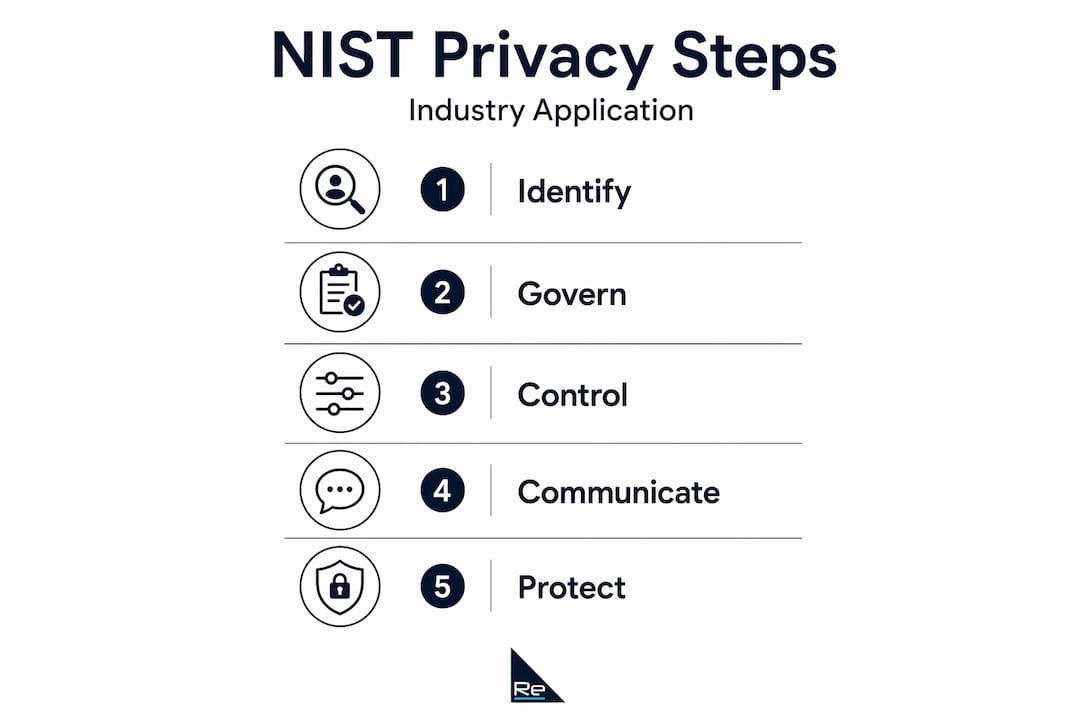
The NIST Privacy Framework provides a structured approach built around five core functions. NIST’s five functions support managing privacy risk across the data lifecycle and map to India’s Digital Personal Data Protection Act compliance requirements, demonstrating its cross-jurisdictional applicability.
| NIST function | Description | Industry application |
|---|---|---|
| Identify | Map data assets and privacy risks | Inventory OT/IT data flows in manufacturing |
| Govern | Establish policies and accountabilities | Define data ownership in hospitality systems |
| Control | Implement technical and procedural safeguards | Apply access controls to student records in education |
| Communicate | Manage transparency and disclosure | Notify guests of data collection in hospitality |
| Protect | Prevent privacy events through security measures | Segment logistics fleet tracking networks |
Frameworks like NIST work because they create repeatable processes that connect legal obligations to technical controls and operational decisions. Organisations without a structured approach tend to address privacy reactively, typically after a breach or an enforcement action.
For sectors with specific regulatory contexts, voluntary programmes add credibility. The DataGuard Energy Data Privacy Programme provides an industry-driven model for utilities and related sectors to demonstrate commitment to energy data privacy. While sector-specific, the principle applies broadly: voluntary codes signal intent and build consumer trust in ways that minimum compliance does not.
Pro Tip: When selecting a privacy framework, prioritise one that maps explicitly to the regulations affecting your sector rather than adopting a generic model. The NIST Privacy Framework’s mapping to multiple national laws makes it particularly useful for organisations with international footprints.
For sector-specific guidance, reviewing privacy best practices in education and manufacturing provides concrete starting points for each environment.
Addressing industrial network complexities and consent challenges
These operational realities underline the critical role of practical governance decisions. Connected industrial environments introduce privacy risks that standard IT frameworks do not fully anticipate.
One of the least visible risks in manufacturing and logistics settings is what practitioners refer to as shadow pipelines. Privacy risks arise from shadow pipelines replicating data across OT and IT systems without proper consent or disclosure. When a factory floor sensor feeds data into an analytics platform that also handles HR records, the data governance boundaries blur. The consent obtained for operational monitoring may not extend to the secondary use cases created by that pipeline.
Key considerations for managing industrial network privacy risks include:
- Boundary-by-boundary data mapping: Inventory every point where OT systems hand data to IT systems. Each boundary is a potential consent and disclosure gap.
- Segmented network design: Use VLAN segmentation and Zero Trust Network Access (ZTNA) to enforce data handling boundaries at the architecture level.
- Vendor due diligence: Third-party OT software vendors must demonstrate privacy controls equivalent to your own standards.
- Role-based access control: Limit which personnel and systems can access data from each operational zone.
Consent management in connected environments requires more than a privacy notice. It requires technical controls that reflect what the notice says. Data protection impact assessments should be continuous processes gating system updates, not one-time documents. A DPIA completed at system launch is outdated the moment a new AI feature or third-party integration is added.
Operationalising DPIAs means building them into your release management process. Before any new system feature goes live, particularly those involving automated decisions or sensitive data categories, a DPIA review should be a formal gate. This is not bureaucratic overhead. It is the mechanism that prevents consent and disclosure failures from reaching production environments.
Pro Tip: Assign DPIA ownership to a named individual within your IT team rather than leaving it as a shared responsibility. Shared ownership consistently results in assessments being delayed until after deployment, which is precisely when they are least useful.
Detailed guidance on embedding these processes is available through resources on data privacy in IT management.
Rethinking data privacy governance: a proactive, integrated model for industry
The conventional approach to privacy governance in industry still dominates: appoint a data protection officer, publish a privacy policy, complete annual training, and file the paperwork. That model was always inadequate. In the AI era, it is actively dangerous.

Privacy should be treated as an end-to-end operating model problem encompassing data quality and governance, because AI amplifies governance needs at every stage of the data lifecycle. Organisations feeding poor-quality or improperly consented data into AI systems are not just creating compliance exposure. They are building systems that produce unreliable outputs, which then create further legal and operational risk.
What the best-performing organisations do differently is integrate privacy governance with data quality programmes, AI model governance, and network security controls into a single operating model. These are not three separate workstreams. They share the same underlying data infrastructure, the same consent requirements, and the same regulatory obligations.
Data security and privacy are distinct but both essential; technical security controls and governance controls must coexist and be balanced. This is a point that gets lost when organisations treat privacy as a legal function and security as an IT function. The two teams are often working on the same systems with different vocabularies and different success metrics. Bridging that gap is a leadership responsibility, not a technical one.
The organisations that will face the least regulatory exposure over the next three years are those where IT leadership has actively built privacy accountability into network design decisions, procurement processes, and change management gates. Transparency with customers is not just an ethical position. It is a measurable competitive advantage in sectors where data trust is a differentiator, including education, healthcare-adjacent property development, and hospitality.
Understanding the importance of data privacy at the infrastructure level is where that integration begins.
How Re-Solution supports your industry data privacy needs
With these insights in mind, partnering with an experienced provider accelerates the transition from reactive compliance to integrated governance.

Re-Solution works with organisations across education, manufacturing, logistics, hospitality, and property development to design and implement network infrastructure that supports data privacy compliance from the ground up. As a Cisco partner with over 35 years of experience, Re-Solution brings technical depth in network segmentation, data localisation architecture, Zero Trust security, and compliance-aligned managed services. Whether you are addressing the demands of GDPR, UK data protection law, or multi-jurisdictional obligations, the right network foundation makes governance possible. Explore how Re-Solution can help you modernise your IT infrastructure for 2026 and beyond, or start by reviewing network solutions explained and IT infrastructure fundamentals to understand where your architecture stands today.
Frequently asked questions
What is data localisation and why does it matter for industry privacy?
Data localisation requires storing and processing data within specific jurisdictions, which directly affects network design, cloud strategy, and cross-border service delivery. 81% of organisations reported heightened demand for localisation, confirming it is now a mainstream infrastructure concern rather than an edge case.
How do privacy risk assessments help comply with new regulations?
They identify and mitigate risks before high-risk data processing begins, reducing enforcement exposure significantly. CCPA regulations require comprehensive privacy risk assessments before processing that presents significant risk, a standard increasingly mirrored in other jurisdictions.
What makes consent mechanisms operationally effective?
Effective consent mechanisms must be tested in real user environments and provide genuinely functional opt-in and opt-out options, not just visible ones. Regulators test consent flows for operational effectiveness, not design conformance, which means documentation alone will not satisfy scrutiny.
How can industries manage privacy risks from connected operational technology?
By mapping data flows at every OT/IT boundary, conducting continuous impact assessments, and integrating privacy controls directly into system architecture. Shadow pipelines between OT and IT systems are a frequent source of undisclosed data replication that creates both consent gaps and industry data breach risks.
Recommended
- Data privacy in IT: A clear guide for managers and leaders
- IT compliance: A practical guide for education and manufacturing
- Why Data Security Matters in 2025 | Re-Solution