
TL;DR:
- Network access control (NAC) enforces network connection policies based on device and user identity, posture, and context. Deployment should begin with monitoring and gradual enforcement, integrating with endpoint management platforms like Microsoft Intune to ensure device compliance. In OT environments, microsegmentation complements NAC by dynamically managing legacy devices lacking 802.1X support for effective security.
Network access control (NAC) is defined as a security technology that enforces policies governing which devices and users can connect to a network, based on identity, device compliance, and contextual criteria. Defining NAC solutions accurately matters because modern networks span on-premises switches, wireless access points, VPNs, and cloud environments, creating multiple entry points that perimeter firewalls alone cannot govern. Tools like Cisco Identity Services Engine (ISE), Microsoft Intune, and NetWitness each address different aspects of access enforcement, from port-level authentication to endpoint compliance validation. Understanding what NAC solutions are, and how they function across these environments, is the foundation for any credible network security strategy.
How do NAC solutions work?
NAC solutions enforce security policies controlling device and user access both before and after admission, dynamically verifying compliance at entry points such as switches, wireless controllers, and VPNs. This means access decisions are not a one-time gate at login. They are continuous evaluations that respond to changing device state throughout a session.
The core authentication mechanism underpinning most NAC deployments is IEEE 802.1X, which defines three roles:
- Supplicant. The endpoint device requesting access, such as a laptop or mobile phone.
- Authenticator. The network device, typically a switch or wireless access point, that controls port access.
- Authentication server. The backend system, commonly a RADIUS server, that validates credentials and returns an access decision.
When a supplicant successfully completes EAP (Extensible Authentication Protocol) authentication, the authenticator transitions the port to an authorised state and permits traffic. A failed or incomplete authentication keeps the port blocked, preventing the device from reaching internal resources.
Continuous monitoring post-access is what separates NAC from simple authentication. A device that passes initial checks but later fails a posture assessment, perhaps because its antivirus definitions become outdated, can be quarantined or restricted without manual intervention. This ongoing validation is central to reducing lateral movement within corporate networks.

Pro Tip: Deploy NAC initially in monitor mode rather than enforcement mode. This lets you observe what would be blocked without disrupting operations, giving you accurate data to refine policies before enforcement goes live.
What features define effective NAC solutions?
Effective NAC solutions are not single-function tools. They combine several processes that together govern the full lifecycle of a device’s network presence. The following capabilities define what a mature NAC deployment looks like in practice.
- Policy lifecycle management. NAC platforms allow administrators to define, update, and retire access rules based on user roles, device types, and business requirements. Policies must be versioned and auditable to support compliance frameworks such as ISO 27001 or Cyber Essentials.
- Device discovery and profiling. Before a device can be assessed, it must be identified. NAC solutions use techniques including DHCP fingerprinting, MAC address analysis, and traffic behaviour inspection to classify devices automatically, including unmanaged endpoints that lack agents.
- Posture assessment. Posture checks assess antivirus status, patch levels, firewall configuration, and disk encryption state. Devices that fail these checks are redirected to a remediation VLAN rather than granted full access.
- Guest and BYOD access management. NAC solutions create controlled pathways for visitors and personal devices, granting internet access without exposing internal resources. Captive portals, sponsor-based approval workflows, and time-limited credentials are standard mechanisms.
- Incident response and isolation. When a device exhibits anomalous behaviour or fails a mid-session posture check, NAC can automatically restrict or quarantine it. This incident response capability limits the blast radius of a compromised endpoint before human intervention occurs.
- Integration with SIEM and EDR platforms. NAC complements other security layers but requires integration with identity, endpoint, and monitoring tools for contextual enforcement. Feeding NAC events into a SIEM such as Microsoft Sentinel or Splunk creates a correlated view of access activity across the environment.
Pro Tip: Map your device inventory before configuring posture policies. Organisations that skip this step frequently find that legitimate devices fail checks due to undocumented configurations, generating alert fatigue from day one.
How does NAC integrate with Microsoft Intune for device compliance?
One of the most practical NAC solution examples in enterprise environments is the integration between a NAC platform and Microsoft Intune, Microsoft’s cloud-based mobile device management (MDM) and unified endpoint management (UEM) service. This integration creates a closed loop between network admission and endpoint compliance.
The workflow operates as follows:
- Device connects to the network. The NAC solution detects the device and initiates an access request evaluation.
- NAC queries Intune for compliance status. Using Intune’s compliance retrieval service, the NAC platform forwards the device’s identity and receives a real-time compliance verdict.
- Access decision is applied. Unenrolled or non-compliant devices are redirected to a remediation portal or restricted VLAN. Compliant, enrolled devices receive full network access.
- Certificate-based authentication confirms identity. Intune-managed devices can be issued certificates via SCEP or PKCS profiles, which the NAC platform validates during 802.1X authentication, removing reliance on username and password credentials.
This integration is particularly relevant for organisations adopting Conditional Access policies within Microsoft Entra ID (formerly Azure AD). NAC acts as a network-layer enforcement point that mirrors the identity-layer controls already in place within the Microsoft 365 environment. The result is that device trust is validated at both the identity plane and the network edge, closing a gap that identity-only controls leave open.
Effective NAC policy must be role-based and context-aware, limiting access precisely according to business needs and device health. The Intune integration makes this achievable at scale without requiring manual device vetting for each connection request.
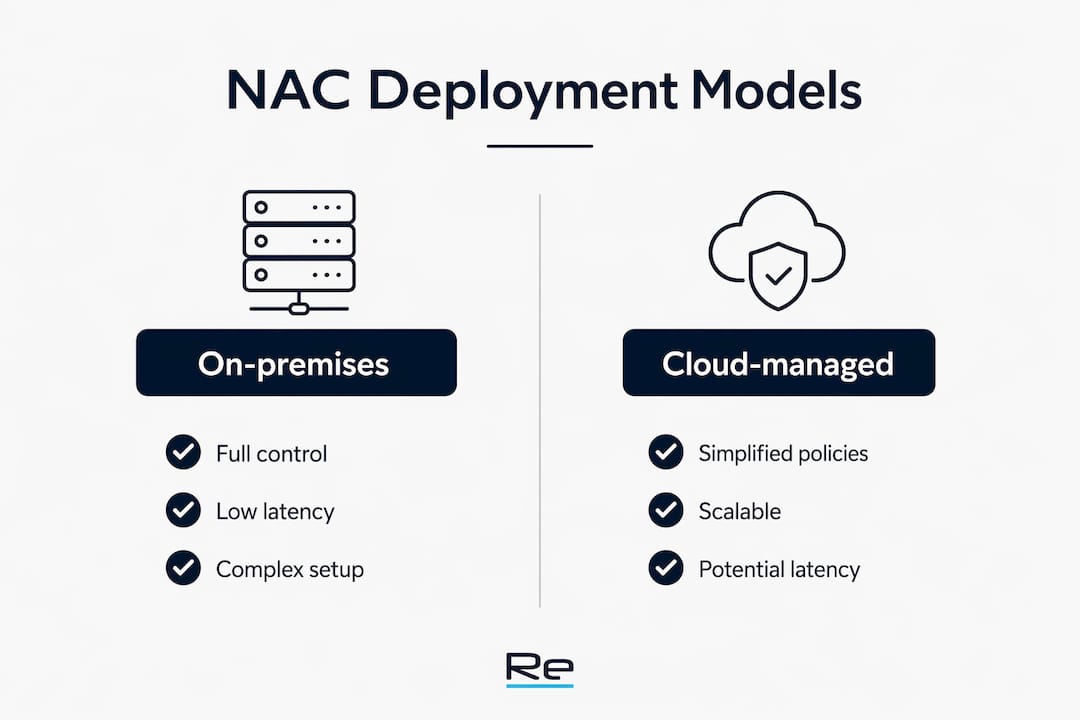
What are NAC deployment models and their trade-offs?
NAC deployment models include on-premises for local control, cloud-managed for simplified policy administration, and hybrid for combined benefits across distributed sites. The right choice depends on your network topology, the diversity of your device estate, and your team’s operational maturity.
| Deployment model | Strengths | Limitations |
|---|---|---|
| On-premises | Full local control, low latency enforcement, suits air-gapped environments | Higher capital cost, requires dedicated infrastructure and maintenance |
| Cloud-managed | Centralised policy administration, scales across distributed sites, lower hardware overhead | Dependent on internet connectivity, may introduce latency at enforcement points |
| Hybrid | Combines local enforcement with centralised management, suits multi-site organisations | Increased architectural complexity, requires careful synchronisation of policies |
Operational challenges become pronounced in OT (operational technology) and industrial environments. Traditional NAC using 802.1X often fails in OT settings because legacy devices such as PLCs, SCADA controllers, and industrial sensors lack 802.1X supplicants entirely. Port-based controls cannot be applied to devices that do not support the protocol, leaving significant portions of the network unprotected.
Identity-based microsegmentation addresses this gap directly. Rather than relying on port authentication, microsegmentation platforms discover and classify OT devices agentlessly, mapping policy to each device’s role and communication requirements. Microsegmentation platforms enforce IEC 62443-compliant network zones dynamically without requiring a network redesign. This makes them a practical complement to NAC in environments where legacy devices are unavoidable.
For IT environments, phased rollout remains the most reliable implementation approach. Operational challenges with NAC projects frequently arise when teams attempt a full cutover prematurely rather than beginning with a visibility-first phase. Starting with passive monitoring across all enforcement points gives you an accurate picture of your device estate before any access restrictions are applied. This prevents the business disruptions that derail NAC projects and erode stakeholder confidence.
You can explore the Meraki vs Cisco ISE comparison to understand how different NAC platforms handle authentication and policy enforcement across these deployment scenarios.
Key takeaways
NAC solutions are most effective when deployed in phases, integrated with endpoint management platforms, and extended with microsegmentation in environments where 802.1X cannot reach.
| Point | Details |
|---|---|
| NAC definition | NAC enforces access policies based on identity, device posture, and context at every network entry point. |
| 802.1X is the core mechanism | Supplicant, authenticator, and authentication server roles control port states and traffic permission. |
| Intune integration closes the loop | NAC paired with Microsoft Intune validates device compliance before granting network admission. |
| OT environments need microsegmentation | Legacy OT devices lacking 802.1X support require agentless, identity-based microsegmentation to fill NAC gaps. |
| Phased deployment prevents disruption | Begin in monitor mode to build device visibility before applying enforcement policies. |
Why NAC strategy needs to match organisational reality
Having worked across a range of network environments, the pattern I see most often is organisations treating NAC as a binary problem: either you have it or you do not. That framing leads to two predictable failures. The first is the team that deploys NAC in full enforcement mode across all VLANs on day one, blocks half the device estate, and spends the next fortnight in firefighting mode. The second is the team that never moves past monitor mode because the device inventory is too messy to feel confident enforcing anything.
The more productive framing is to treat NAC as a programme of progressive control, not a product you switch on. Start with visibility. Understand what is on your network before you decide what should be blocked. Then apply enforcement incrementally, beginning with the highest-risk segments such as guest networks and unmanaged device zones, before extending to managed endpoints.
The integration angle is also underappreciated. NAC on its own is a control point. NAC connected to Microsoft Intune, a SIEM, and an EDR platform becomes a genuine enforcement layer with context. That context is what separates a policy that blocks a device because it failed a check from one that understands why it failed and routes it to the right remediation path. If you are building a network access policy workflow, design the integrations first, not last.
Finally, do not underestimate the OT challenge. Industrial networks are not going to be retrofitted with 802.1X-capable devices on any realistic timeline. Microsegmentation is not a workaround. For those environments, it is the correct primary tool, with NAC handling the IT perimeter alongside it.
— Jacob
How Re-Solution supports your NAC and network security strategy

Re-Solution has delivered Cisco IT infrastructure and network security solutions for over 35 years, working with organisations across education, manufacturing, hospitality, and logistics. If you are assessing NAC deployment options, integrating with Microsoft Intune, or addressing OT network security gaps, Re-Solution provides the technical expertise to design and implement the right architecture for your environment. Explore Re-Solution’s NaaS and network security services to understand how managed network access control fits within a broader connectivity and compliance strategy. For a structured starting point, the IT infrastructure guide covers the foundational decisions that shape any NAC deployment.
FAQ
What is a NAC solution in simple terms?
A NAC solution is a security system that controls which devices and users can connect to a network, based on identity, device health, and policy rules. It enforces these controls at entry points such as switches, wireless access points, and VPNs.
What are common NAC solution examples?
Cisco Identity Services Engine (ISE), Cisco Meraki, and platforms integrated with Microsoft Intune are widely deployed NAC solutions in enterprise environments. Each enforces access policies using 802.1X authentication and device posture assessment.
What are the main benefits of NAC solutions?
NAC solutions reduce threat exposure by preventing non-compliant or unauthorised devices from accessing internal resources, and by continuously monitoring device state throughout a session. They also support regulatory compliance by providing auditable access records.
How does NAC handle devices that fail compliance checks?
Devices that fail posture assessments are typically redirected to a quarantine or remediation VLAN, where they can receive software updates or configuration corrections before being granted full network access.
Can NAC solutions work in OT and industrial environments?
Traditional 802.1X-based NAC has significant limitations in OT environments because legacy industrial devices often lack supplicant support. Identity-based microsegmentation, which classifies and segments devices agentlessly, is the recommended approach for those networks.
Recommended
- Network Access Controller Guide | Secure Network | Re-Solution
- Meraki Access Control vs Cisco ISE | Re-Solution Experts
- Cisco Access Manager: Zero Trust Security Made Easy for Modern Networks | Cisco Cloud, Security & Datacenter Experts
- Network Access Controller Guide | Secure Network | Re-Solution