The recommended approach for any block company procuring smart-building connectivity is a single, converged Cisco network built on a PoE-first design, with Cisco Spaces as the analytics and sensor platform. Cisco positions this converged architecture as the foundation layer from which occupancy data, environmental telemetry, access control and energy management all operate. The three immediate next steps are: commission a professional site survey, scope a proof-of-concept (PoC) across one block or 10–20 homes, and issue an RFQ that requires Cisco partner certifications as a minimum threshold.
Minimum deliverables to require in any initial quotation:
- A written site survey report covering cabling, PoE power budget and riser access
- A defined PoC scope with measurable success criteria
- A documented security baseline (VLANs, segmentation, GDPR data flows)
- High-level project timeline from survey to managed operations
Re-solution is a Cisco-certified partner with over 35 years of infrastructure delivery experience. To commission a survey or PoC, contact Re-solution via the network audit service.
Pro Tip: Request a telemetry sample from the PoC before committing to a full roll-out. Real sensor data from your own buildings is the most persuasive input for a business case.
Key takeaways
A converged Cisco network, built PoE-first and integrated with housing management systems, is the procurement foundation every block company should specify before deploying any sensors or smart-building services.
| Point | Details |
|---|---|
| Network first, sensors second | Design and segment the Cisco network before deploying any environmental or occupancy sensors. |
| Run a PoC before portfolio roll-out | Pilot across one block or 10–20 homes to validate telemetry, integration and security baseline. |
| Require Cisco partner credentials | Certifications and housing association references are the minimum threshold for shortlisting a provider. |
| Awaab’s Law demands continuous telemetry | Environmental sensors feeding housing management systems are now an operational compliance requirement. |
| Re-solution as certified delivery partner | Re-solution provides survey, PoC, managed NaaS and security services for block companies across the UK. |
Table of Contents
- Why the network must be the foundation for smart blocks
- What does a Cisco smart-building stack look like for a block co?
- Block-specific technical and operational requirements
- Practical deployment roadmap: survey to managed operations
- How to choose a Cisco partner for your block
- Security, privacy and regulatory compliance for UK blocks
- UK housing case study: measurable outcomes from sensor-led networks
- Why starting small and securing the network first is the right approach
- Re-solution: Cisco-certified smart-building networks for block companies
- Sources
Why the network must be the foundation for smart blocks
The network is the sensor and control plane for every smart-building function — not a supporting utility. Without a converged, managed network, environmental sensors, occupancy systems and access control each require separate connectivity, separate management and separate contracts. That fragmentation drives up cost and creates the data silos that prevent proactive maintenance.

PoE consolidates power and data for lights, cameras, shading motors and IoT sensors through Cisco switches, removing the need for separate electrical circuits at each device location. For retrofit blocks, that reduction in cabling complexity directly lowers CapEx and shortens installation time.
The regulatory case is equally pressing. Awaab’s Law, which came into force under the Social Housing (Regulation) Act 2023, requires landlords to investigate and remediate damp and mould within defined timeframes. Continuous environmental telemetry — humidity, temperature, CO₂ — is the only way to detect conditions before a formal complaint is raised. Selwood Housing now monitors 250+ properties with 2,000+ connected devices, with sensors installed in line with BS 40101, demonstrating that this is operationally achievable at portfolio scale.
Key network-as-foundation benefits for block companies:
- Single managed network replaces multiple isolated building systems
- PoE reduces cabling runs and eliminates separate power circuits for sensors
- Unified platform prevents duplicated internet lines across a portfolio
- Environmental telemetry supports Awaab’s Law compliance obligations
- Converged data feeds housing management systems directly
Pro Tip: Segment the network from day one. Tenant Wi-Fi, building IoT devices and management systems should sit on separate VLANs. Retrofitting segmentation later is significantly more disruptive and costly.
What does a Cisco smart-building stack look like for a block co?
The core stack comprises Cisco Catalyst switches, Cisco Meraki access points, PoE-powered sensors and lighting, Cisco Spaces for analytics, and Webex Control Hub with ThousandEyes for management and observability. Each component has a defined role in the block environment.
| Component | Primary outcome for blocks |
|---|---|
| Cisco Catalyst switches | PoE distribution, VLAN segmentation, core switching for risers |
| Cisco Meraki APs | Tenant and building Wi-Fi, cloud-managed, location analytics |
| PoE sensors (environmental, occupancy) | Damp/mould detection, occupancy data, energy monitoring |
| Cisco Spaces | Unified analytics: occupancy, asset tracking, environmental dashboards |
| Webex Control Hub | Centralised device and policy management across the portfolio |
| ThousandEyes agents | Network observability, fault detection across distributed sites |
Cisco’s London office transformation across a 2,000 m² showcase demonstrated measurable energy savings and space optimisation using exactly this PoE-first, network-as-sensor approach. The same architecture scales down to individual residential blocks.
Vendors must also cover cloud licences (Meraki, Cisco Spaces subscriptions), integration with CAFM or housing management systems, and any bespoke API work needed to push sensor data into repairs workflows. For space utilisation and hybrid-use analytics, Cisco Spaces provides the dashboards procurement teams should specify by name in tender documents.
Block-specific technical and operational requirements
The five must-have requirements for any block company procurement are: continuous environmental telemetry, occupancy monitoring, PoE power design per riser, secure multi-tenant network segmentation, and integration with repairs or CAFM systems.
Technical and functional requirements for tender documents:
- Environmental sensors: humidity, temperature and CO₂ at minimum 15-minute cadence
- Data retention: minimum 12 months of sensor history for compliance audit trails
- Encryption: TLS 1.2 or higher for all sensor-to-cloud data flows
- Tenancy-level VLANs: each tenancy isolated; no lateral traffic between units
- PoE power budget: calculated per riser with headroom for future sensor density increases
- CAFM integration: automated alerts to repairs teams when thresholds are breached
- Battery-backed sensors: required in locations where mains PoE is not feasible
For retrofit projects on older stock, a full rewire is rarely necessary. Cloud-managed Wi-Fi and LoRaWAN gateways make monitoring older estates feasible at lower disruption and cost, enabling a phased approach that starts with the highest-risk properties. The IoT in smart buildings guide covers sensor selection and deployment patterns in detail.
Pro Tip: For period properties with structural constraints, specify LoRaWAN gateways as an alternative to PoE sensor runs. A single gateway can cover an entire block, and devices are battery-powered with multi-year lifespans.
Where retrofit works affect ventilation — for example, insulation upgrades — PAS 2035 compliance may require an assessor to specify ventilation measures. Tender documents should confirm whether the network scope interacts with any active PAS 2035 retrofit programme. Landlord and resident consent for data collection must also be documented before sensors go live.
Practical deployment roadmap: survey to managed operations
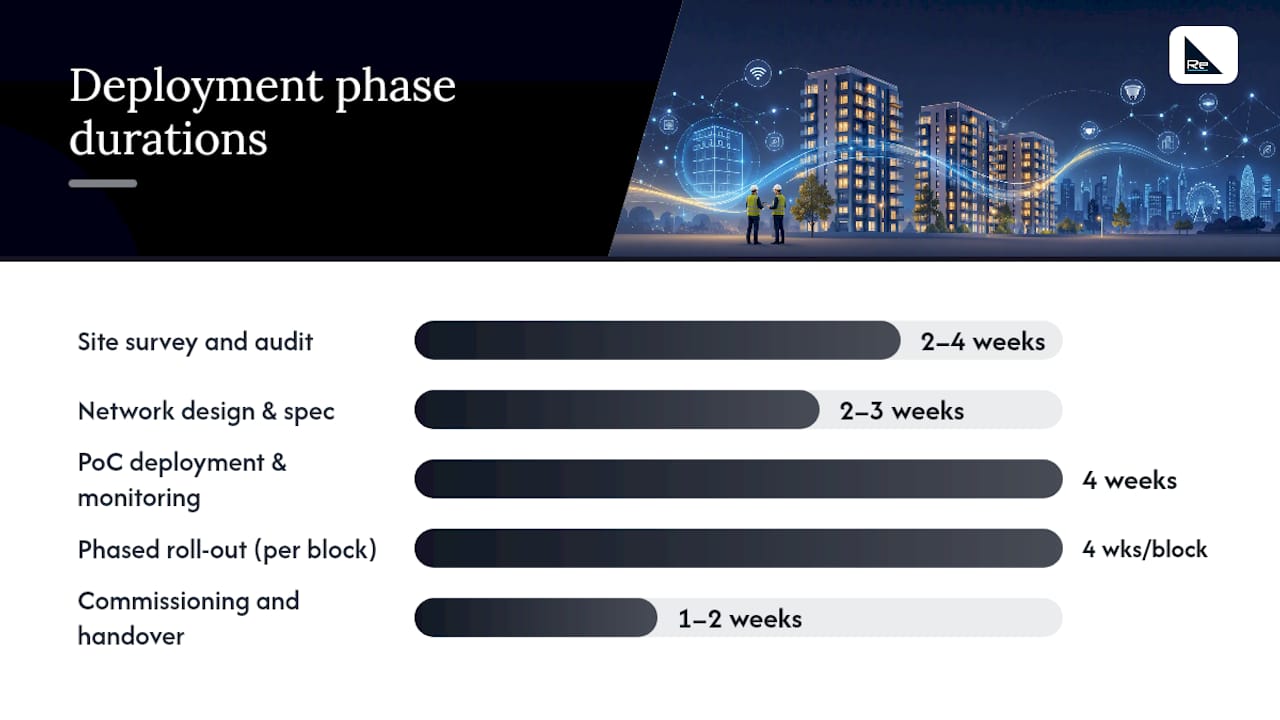
The recommended sequence is survey, design, PoC (one block or 10–20 homes), phased roll-out, commissioning and managed operations. Running a PoC before committing to portfolio-wide deployment is the single most effective risk reduction step available.
| Phase | Typical duration |
|---|---|
| Site survey and audit | 2–4 weeks |
| Network design and specification | 2–3 weeks |
| PoC deployment and monitoring | 4 weeks |
| Phased roll-out (per block) | 4 weeks per block |
| Commissioning and handover | 1–2 weeks |
| Transition to managed operations | Ongoing from commissioning |
Main cost drivers to budget for:
- Structured cabling and PoE switch installation (the largest single cost in retrofits)
- Sensor density and cloud licence fees (Meraki, Cisco Spaces subscriptions)
- CAFM and housing management system integration, including bespoke API development
- Labour for retrofit access, particularly in occupied properties
- ThousandEyes and observability tooling for distributed portfolio monitoring
Pilot scope template for RFQ inclusion:
- Objectives: validate environmental telemetry accuracy, confirm CAFM integration and measure PoE power consumption against budget
- Success criteria: 95% sensor uptime over the pilot period; automated alert delivered to repairs team within 30 minutes of threshold breach
- Telemetry to collect: temperature, humidity, CO₂, occupancy presence, network device inventory
- Review point: joint review at week 6 with telemetry sample, fault log and integration test results
For new-build blocks, coordinated multi-utility delivery including fibre should be planned at the development stage to avoid costly retrospective ducting. Aligning network infrastructure with energy statement requirements for flats and apartment blocks also supports planning and Building Regulations submissions.
How to choose a Cisco partner for your block
The single most important trait in a provider is proven Cisco partner credentials combined with direct housing association or block management experience. Certifications confirm technical competence; housing references confirm that the partner understands tenancy constraints, occupied-property working and CAFM integration.
RFQ questions to include:
- What Cisco partner tier do you hold, and which product authorisations are current?
- Can you provide two references from UK housing associations or block management portfolios?
- How do you design PoE power budgets for retrofit risers in occupied buildings?
- Which CAFM or housing management systems have you integrated with, and how?
- What is your SLA for P1 faults, and do you operate a 24/7 NOC?
- How do you manage device firmware patching and lifecycle across a distributed portfolio?
Suggested scoring criteria:
- Cisco certifications and current product authorisations (25%)
- Housing association or block management references with measurable outcomes (20%)
- Technical approach: PoE design, segmentation, CAFM integration (25%)
- Support model and SLA commitments (15%)
- Pricing model and total cost of ownership (15%)
Red flags to reject a proposal:
- No pilot or PoC offer included in the proposal
- No explicit network segmentation plan for multi-tenant environments
- Vague or absent device lifecycle and firmware patching plan
- References limited to commercial offices with no residential or housing experience
Pro Tip: Ask every shortlisted partner to walk through their segmentation design for a multi-tenancy block. A partner who cannot explain tenancy-level VLAN isolation clearly is unlikely to implement it correctly.
Security, privacy and regulatory compliance for UK blocks
Build GDPR-aware data flows and strong network segmentation from day one — retrofitting either is expensive and disruptive. Every sensor deployment in a residential block involves personal data, and the ICO expects data minimisation, purpose limitation and documented consent before collection begins.
Required controls for block deployments:
- Tenancy-level VLANs isolating resident traffic from building IoT and management systems
- Role-based access control for the management plane (Webex Control Hub, Meraki dashboard)
- Full device inventory with automated firmware patching schedules
- Data retention policies aligned to the minimum period required for compliance audit trails
- Documented consent mechanisms for any sensor data that can identify individual occupants
- Network segmentation via Cisco ISE to enforce policy at the device level
Awaab’s Law creates a direct operational expectation for environmental monitoring: landlords who cannot demonstrate continuous telemetry will find it harder to evidence timely investigation and remediation. Selwood’s deployment shows that BS 40101-aligned sensors feeding a housing management system is the current best-practice model.
Pro Tip: Configure occupancy sensors to report presence/absence rather than identity. Anonymised occupancy data satisfies analytics requirements without creating a personal data processing obligation under UK GDPR.
UK housing case study: measurable outcomes from sensor-led networks
Langstane Housing Association, working with Switchee and Union Technical, achieved proactive identification of homes falling below 18°C in its granite-built Scottish portfolio, enabling targeted retrofit interventions before conditions deteriorated. The project, supported by government-backed funding_2024_01_16_13_42_01.pdf), used Switchee smart thermostats and dashboards integrated with the housing management system to flag at-risk properties.
Project details:
- Scope: granite-built residential properties requiring insulation and monitoring
- Core components: Switchee smart thermostats, cloud-connected dashboards, housing management system integration
- Partner roles: Switchee (device and analytics platform), Union Technical (retrofit delivery and PAS 2035 compliance)
- Measured outcome: proactive identification of sub-18°C homes, enabling targeted interventions before formal complaints were raised
- Data flow: thermostat telemetry fed directly into housing management workflows, triggering repair and retrofit referrals
At a different scale, Selwood Housing’s deployment of 2,000+ connected devices across 250+ properties demonstrates that portfolio-wide environmental monitoring is operationally achievable and directly supports Awaab’s Law compliance. Both cases show that telemetry feeding housing management workflows is what converts sensor data into maintenance outcomes.
Why starting small and securing the network first is the right approach
The most common mistake in block smart-building projects is deploying sensors before the network is properly designed. Sensors installed on a flat, unsegmented network create both a security liability and a data quality problem: devices from different vendors share the same broadcast domain, firmware updates are unmanaged, and telemetry arrives in formats that housing management systems cannot consume without significant integration work.
The right sequence is network design first, then sensor deployment, then CAFM integration. That order also makes the PoC genuinely useful: you get clean telemetry, a tested integration path and a security baseline that scales to the full portfolio without rework. Re-solution’s approach, grounded in Cisco partner credentials and over 35 years of infrastructure delivery, is to treat the PoC as a governance exercise as much as a technical one. IT, estates and housing management teams should all sign off on the pilot success criteria before a single sensor goes live. Training building staff to interpret dashboards and act on alerts is not an afterthought; it is the step that determines whether the investment delivers measurable outcomes or sits unused.
Re-solution: Cisco-certified smart-building networks for block companies
Re-solution delivers the full procurement journey for block companies: site survey and audit, PoC design and delivery, full portfolio roll-out, and ongoing managed Cisco network operations including NaaS subscription models that convert CapEx to a predictable monthly cost.

Services available for block companies:
- Site survey and network audit with written report and PoE power budget
- PoC scoping and delivery (single block or 10–20 homes)
- Full portfolio roll-out with Cisco Catalyst, Meraki and Cisco Spaces
- Managed operations and NaaS with defined SLAs and 24/7 NOC support
- Security and compliance review covering GDPR data flows, segmentation and device lifecycle
To commission a site survey or discuss a PoC scope, contact Re-solution via the professional services page or request a network audit directly. Re-solution’s Cisco certifications, housing sector references and documented delivery approach are available on request.
Sources
- Cisco Smart Building solutions
- Selwood’s IoT-powered compliance & innovation with Aico
- Multi-utility solutions for housebuilders & developers | GTC
Recommended
- Cloud networking in hospitality: a guide for IT leaders
- The role of networking in smart buildings
- Benefits of digital connectivity for UK IT decision makers
- DfE Wireless Standards & Cisco Meraki | Cisco Cloud, Security & Datacenter Experts