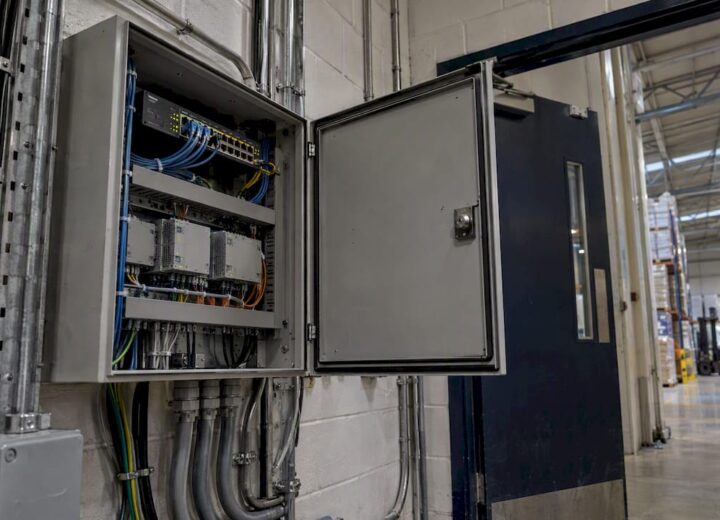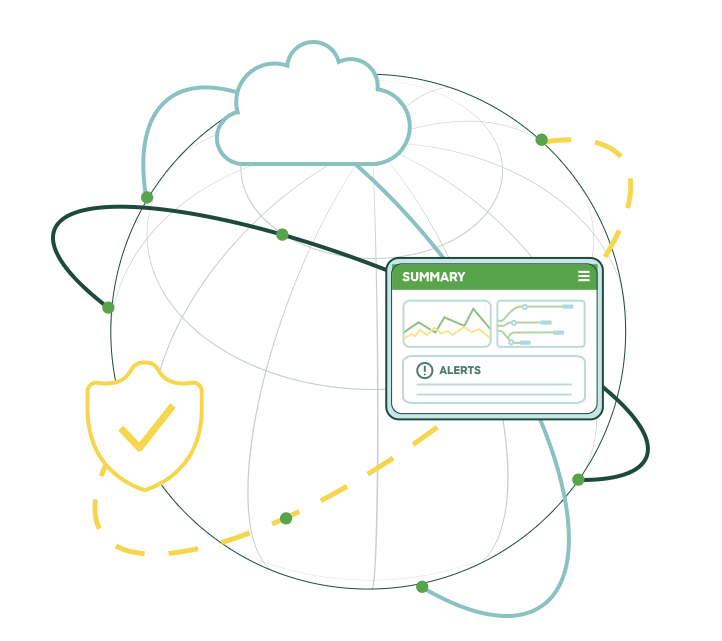
SD-WAN gives hotels, restaurants, pubs and venue groups one centrally managed network across every site. It uses several connections at once (fibre, broadband, 4G or 5G) and steers each application over the best available path. For hospitality, the practical result is that card payments, bookings, kitchen systems and guest Wi-Fi stay online when a single line fails, and IT can change policy for every venue from one place.
This guide explains how SD-WAN works in a hospitality setting, where it pays off, how to protect payment data on a shared network, and what to assess before you commit.
TL;DR
- SD-WAN places a software-managed overlay on top of your existing broadband, fibre, MPLS or cellular links, so traffic can move between them automatically.
- The strongest hospitality case is resilience: payments, pay-at-table and ordering keep trading when a fixed line drops.
- Central control replaces site visits for patching, policy changes and new-site rollouts, which matters most for estates of dozens or hundreds of venues.
- Guest Wi-Fi must be segmented away from payment systems, and the SD-WAN design should enforce that separation.
- Before buying, audit your sites, survey the wireless, and decide who runs the network day to day.
Table of Contents
- What SD-WAN does for a hospitality network
- Where the benefits show up
- Securing payments and guest Wi-Fi
- What to assess before you deploy
- A phased approach that suits hospitality
- How the main options compare
- Perspective
- How Re-Solution helps hospitality operators
- FAQ
- Sources
What SD-WAN does for a hospitality network
A traditional multi-site network ties each venue back to head office over a private circuit such as MPLS, with a single broadband line as backup. SD-WAN changes the model. TechTarget describes SD-WAN as a virtual overlay that abstracts the underlying connections, whether MPLS, broadband, fibre, wireless or 5G, while centralising network control and managing application traffic in real time.
Three components do the work:
- Controller: holds the central policy and decides how each type of traffic should be treated.
- Edge device at each site: enforces that policy where the venue network meets the WAN, often with firewall protection built in.
- Orchestrator or dashboard: pushes configuration and policy changes out to every edge device.
Cisco explains that SD-WAN steers traffic during failure scenarios using real-time decisions based on centralised policy, rather than relying on a standby link that sits idle until something breaks. For a venue, that means a card terminal session can move from a failing fibre line to a 5G link without the till operator noticing.
Why hospitality is different from a standard office WAN
A hotel or restaurant has traits that a head-office network does not:
- Revenue depends on the network being up during service, often in evenings and at weekends when support cover is thinnest.
- Guests and staff share the same buildings, so public Wi-Fi and payment systems sit close together.
- Sites are numerous, small and often without any on-site IT staff.
- Many devices are connected: tills, handhelds, kitchen display screens, door locks, music, CCTV and building controls.
SD-WAN suits this profile because it removes the need for an engineer on site for routine changes and makes every venue look the same to the people managing it.
Where the benefits show up
Payments and trading continuity
The clearest UK evidence comes from restaurant groups. A Nando’s UK case study describes around 500 restaurants where payments, kitchen IoT, digital ordering and Wi-Fi all depended on connectivity, and where legacy MPLS with a single broadband line caused outages and limited security control. After the move, cellular could act as a primary or parallel connection, new sites could be brought up in minutes with zero-touch provisioning, and the estate moved to an active-active model. The same study reports that payment and pay-at-table services stayed online when a fixed line failed.
Mitchells & Butlers, a large UK operator of restaurants, pubs and bars, took a similar route. Its head of architecture and security says in a Cisco Meraki customer story that if a corporate services connection is lost, the business wants to keep trading over the guest wireless network and remain secure.
The lesson for any operator is that resilience is a design decision. It is not delivered by the product name alone. Our guide to SD-WAN failover design covers how to set failover thresholds, path selection and testing so that a switchover is invisible at the till.

Central management across many venues
With template-driven configuration, a change made once reaches every site. That covers firewall rules, Wi-Fi settings, application priorities and software updates. For a group opening or refitting venues, zero-touch provisioning means a pre-configured device can be plugged in by non-technical staff and pick up its settings automatically. This shortens rollouts and cuts the number of engineer visits, which is where much of the practical saving sits in a hospitality estate.
Cost and capacity
Moving away from MPLS is often the commercial driver. One UK retail rollout across hundreds of sites is expected to save approximately 50% against its previous MPLS arrangement while providing up to 1 Gbps per site. Retail is not hospitality, and your own result will depend on current circuit costs, contract end dates and the connections available at each address. Treat figures like this as a reason to build a business case, not as a forecast for your estate.

Securing payments and guest Wi-Fi
Guest Wi-Fi and card payments often share a building, and sometimes share a router. SD-WAN does not remove the risk by itself; the design has to.
The principles are well established:
- Separate guest traffic from everything else. Guests belong on their own VLAN with their own policy, routed straight to the internet.
- Isolate the cardholder data environment. Tills and payment terminals should sit in a segment that guest and general staff traffic cannot reach.
- Enforce the separation in the firewall at the site edge, and monitor it, not only at head office.
- Keep one policy template so every venue is configured identically and drift is easy to spot.
PCI DSS expects network controls that restrict traffic to and from the cardholder data environment to what is necessary, and assessors will want evidence of that. Our article on PCI network segmentation sets out how to document it in a way that stands up in assessment, and our SD-WAN security checklist maps controls to NCSC and ENISA guidance.
Central ownership of the firewalls and switches also improves day-to-day security. The Nando’s study reports that remote vulnerability scanning and patch orchestration across the estate brought endpoint vulnerabilities down to single figures. The principle applies to any group: when you can see and patch every site from one console, vulnerabilities stop accumulating unnoticed in small venues.
The payment device itself matters too. Handheld and countertop terminals that run on their own mobile data, such as POS terminals with 4G and Wi-Fi options, give a venue an extra route to take payments if the main line is down. Whichever terminal type you use, confirm with your acquirer how it fits your PCI scope before you design around it.
What to assess before you deploy
Most failed or disappointing rollouts trace back to skipped groundwork. Work through these questions first.
1. What is actually at each site?
List the circuits, routers, switches, access points and connected devices at every venue, along with contract end dates. A network audit gives you this baseline and shows where cabling, switches or old firewalls will limit the benefit of SD-WAN. Our network audit checklist shows what evidence to gather.
2. Which connections are available at each address?
UK coverage is uneven. A city-centre hotel may have a choice of full-fibre providers, while a rural inn or a seasonal venue may rely on a slower line plus 4G or 5G. Check the options at every postcode, and test cellular signal indoors at the point where the router will sit. Choose at least two diverse paths per site, ideally from different carriers and different technologies.
3. Does the Wi-Fi hold up?
SD-WAN steers traffic between sites and the internet, but it cannot fix poor wireless inside the building. Thick walls, atria, outdoor terraces and high-density function rooms all cause problems. A wireless survey before rollout shows where coverage and capacity fall short, and our piece on why invest in a wireless site survey explains what a good one delivers.
4. Which applications need priority?
Rank traffic by business impact. A typical order for a restaurant or hotel is:
- Card payments and pay-at-table
- Reservations, property management and ordering systems
- Kitchen displays and stock systems
- Staff voice and video
- Guest Wi-Fi and streaming
This ranking becomes your policy. When capacity is tight, guest streaming gives way to payments, not the other way round.
5. How will you handle security and compliance?
Decide where traffic is inspected, how guest and payment networks are separated, and who reviews logs. If you handle card data, involve your PCI assessor early. If you hold guest personal data, your UK GDPR obligations apply to how it moves across the WAN as well as where it is stored.
6. Who will run it?
Small IT teams rarely have capacity for round-the-clock monitoring across dozens of venues. Decide whether you will run it in house, buy a managed service or use a subscription model. Our guide on procurement checks for outsourced network management lists what to confirm in a contract, such as response times, change control and reporting.
7. Which design pattern fits?
A 20-room guesthouse, a 300-bedroom hotel and a high-street restaurant do not need the same design. See our branch network design profiles for how to size site types, and our Cisco SD-WAN design decisions for choices to settle before rollout.
A phased approach that suits hospitality
Hospitality cannot easily stop trading for a migration, so phase the work.
- Baseline and design (weeks 1 to 3): audit, survey and agree policy templates.
- Pilot (weeks 3 to 8): deploy at two or three representative sites, for example one busy venue and one with weak connectivity. Test failover deliberately outside service hours.
- Rollout in waves: group sites by region or circuit contract end date. Use zero-touch devices and a standard installation checklist.
- Operate and improve: review application performance, link utilisation and security events monthly.
Our UK SD-WAN pilot guide sets out an architecture and checklist for running a pilot in six to ten weeks. Schedule works around peak trading, such as Christmas, summer events and bank-holiday weekends.
How the main options compare
| Approach | Best for | Main consideration |
|---|---|---|
| Traditional MPLS with broadband backup | Very small estates with stable requirements | Higher circuit cost, limited failover intelligence, slow to change |
| Self-managed SD-WAN | Groups with a capable in-house network team | Needs 24/7 monitoring capacity and design skills |
| Managed SD-WAN | Multi-site groups with a small IT team | Agree service levels, change control and reporting clearly |
| Network as a Service | Operators who prefer predictable subscription costs | Confirm what hardware, support and refresh the subscription includes |
If cost structure is your main question, our overview of NaaS pricing models explains how to compare quotes on a like-for-like basis.
Perspective
We see the same pattern in hospitality estates again and again. The network was built venue by venue, each with its own router, its own broadband line and its own quirks. Then the business adds digital ordering, pay-at-table, guest streaming and smart room controls, and the old model stops coping.
Our view is that SD-WAN is most valuable when it is treated as an operating model and not as a box. That means a standard design for each site type, guest and payment networks separated by default, and one team accountable for the whole estate. Our 35+ years of Cisco experience is why we start with an audit and a wireless survey: the WAN is only as good as the switching, cabling and Wi-Fi behind it.
For operators who want cloud-managed simplicity, Meraki SD-WAN gives centralised visibility and policy across every venue. For those who want to avoid managing it themselves, we can run the network under a managed service. Either way, the design should be agreed around how each venue trades, not around the hardware.
Jacob
How Re-Solution helps hospitality operators
We are a Cisco partner with over 35 years of experience, and we work with hospitality businesses on connectivity, security and compliance across multi-site environments. Our hospitality page outlines the sector work in more detail. Depending on where you are, we can start with a network audit or wireless survey, design and deliver the project through professional services, and then run it as a managed service or through Network as a Service.
To discuss your estate, contact Re-Solution and tell us how many venues you run and what trading looks like on a busy night.
FAQ
Is SD-WAN worth it for a single hotel or restaurant?
For a single site, the main gains are automatic failover between two connections and better control of traffic priority. The case strengthens with each additional venue because central management and standard templates save the most time at scale. A single-site operator should compare SD-WAN with a well-designed dual-connection firewall setup and choose on resilience needs and support capacity.
Can SD-WAN keep card payments working during an outage?
Yes, if the design allows it. SD-WAN can move payment traffic to a second link, including 4G or 5G, when the primary fails. One UK restaurant group reports that payment and pay-at-table services stayed online during a fixed-line failure after adopting this approach. Test failover at each site type before you rely on it.
Does SD-WAN replace guest Wi-Fi?
No. SD-WAN manages how site traffic reaches the internet and other sites, while Wi-Fi is the wireless access inside the building. The two work together: the guest network should be separated from payment and staff systems, and the WAN policy decides how much capacity guests can use.
Is SD-WAN still widely used?
Yes. It is now a standard way for multi-site organisations to connect branches, and large UK hospitality and retail groups use it to replace or supplement MPLS. Cloud-managed versions have also made it practical for smaller groups.
How long does a rollout take?
A pilot can run in roughly six to ten weeks, and further sites follow in waves. With zero-touch provisioning, individual venues can go live quickly once circuits are in place. Circuit lead times, rather than the SD-WAN equipment, are usually the slowest part.
Sources
- What is SD-WAN (software-defined WAN)? Ultimate guide, TechTarget
- What Is SD-WAN? Cisco
- How Nando’s built always-on connectivity across 500 restaurants
- Mitchells & Butlers, Cisco Meraki customer story
- Major UK retailer selects OMNIA solutions, The Retail Bulletin
Recommended
- Cloud networking in hospitality: a guide for IT leaders
- UK SD‑WAN Pricing: Componentised Budgets for 3, 25, 100 Sites
- UK SD‑WAN migration: pilot criteria plus Re‑Solution pricing
- UK SD‑WAN Pilot in Six to Ten Weeks: Architecture and Checklist