TL;DR:
- Network segmentation in shared spaces involves dividing networks into isolated zones with Layer 3 controls to enforce access boundaries. Zero Trust architecture requires continuous authentication and verification, replacing reliance on perimeter defenses. Ongoing monitoring and disciplined policy management are essential to maintain effective, compliant shared workspace cybersecurity.
Network security for shared spaces is defined as the practice of enforcing segmentation, access controls, and continuous verification to isolate and protect each tenant or user zone within a shared environment. The industry standard term for this approach is Zero Trust Network Architecture (ZTNA), formalised in NIST SP 800-207, which establishes that no network location confers implicit trust. For IT managers overseeing co-working offices, multi-tenant buildings, or shared campus networks, this principle is the foundation of every security decision. Cisco solutions, Microsoft Azure, and frameworks like HIPAA all reinforce the same conclusion: segmentation without continuous verification is incomplete protection.
How does network segmentation reduce risk in shared workspaces?
Network segmentation is the practice of dividing a shared network into isolated zones so that a breach in one area cannot propagate freely across the entire environment. In shared workspaces, this means separating tenant traffic, guest Wi-Fi, corporate systems, and operational technology into distinct VLANs or subnets with enforced boundaries between them. The goal is to limit lateral movement, which is the technique attackers use to traverse from an initial foothold to higher-value targets.
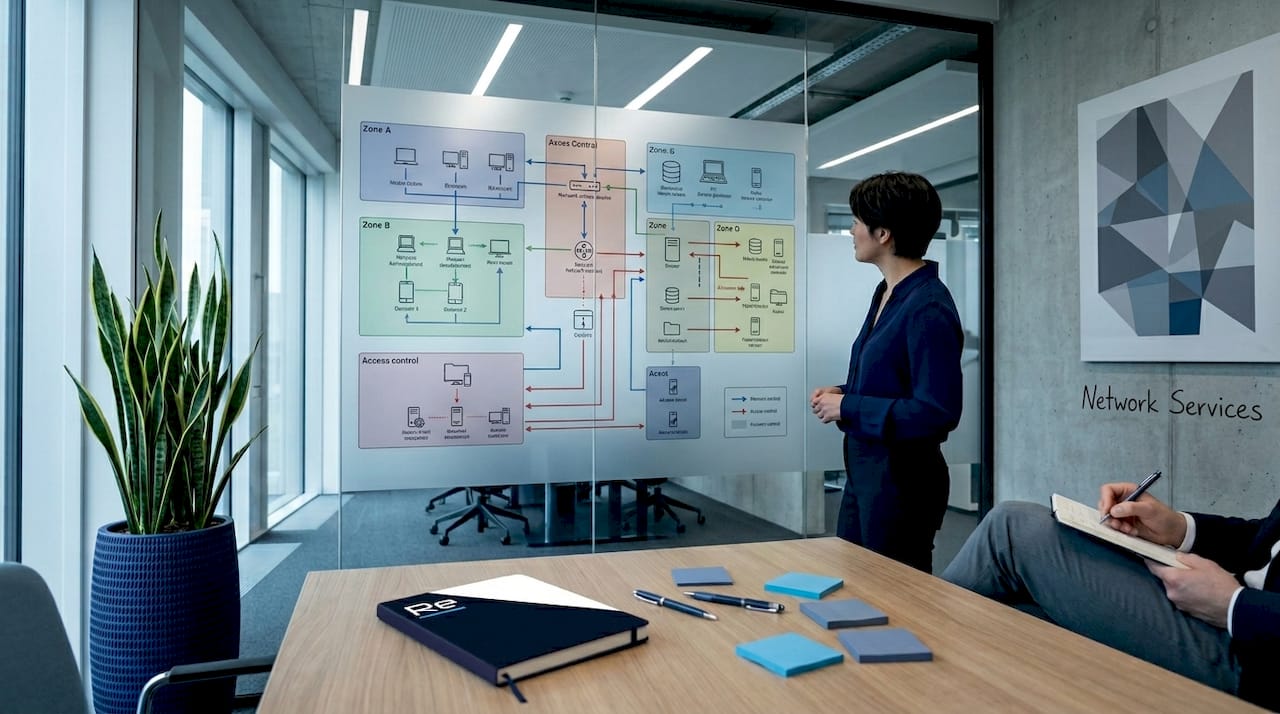
VLAN isolation is the most common starting point, but it is not sufficient on its own. VLAN isolation alone is insufficient without enforcing inter-zone traffic controls at the firewall or Layer 3 level to meet auditor expectations. This means stateful firewalling must sit between every zone, inspecting and permitting only explicitly authorised traffic rather than relying on Layer 2 separation.
Microsegmentation takes this further by applying policies at the individual workload level. Microsegmentation dynamically adapts security policies to workload behaviour, providing the most granular control within Zero Trust architectures. For a co-working environment hosting a mix of startups, professional services firms, and healthcare providers, this level of granularity means each tenant’s workloads operate under policies tailored to their risk profile.
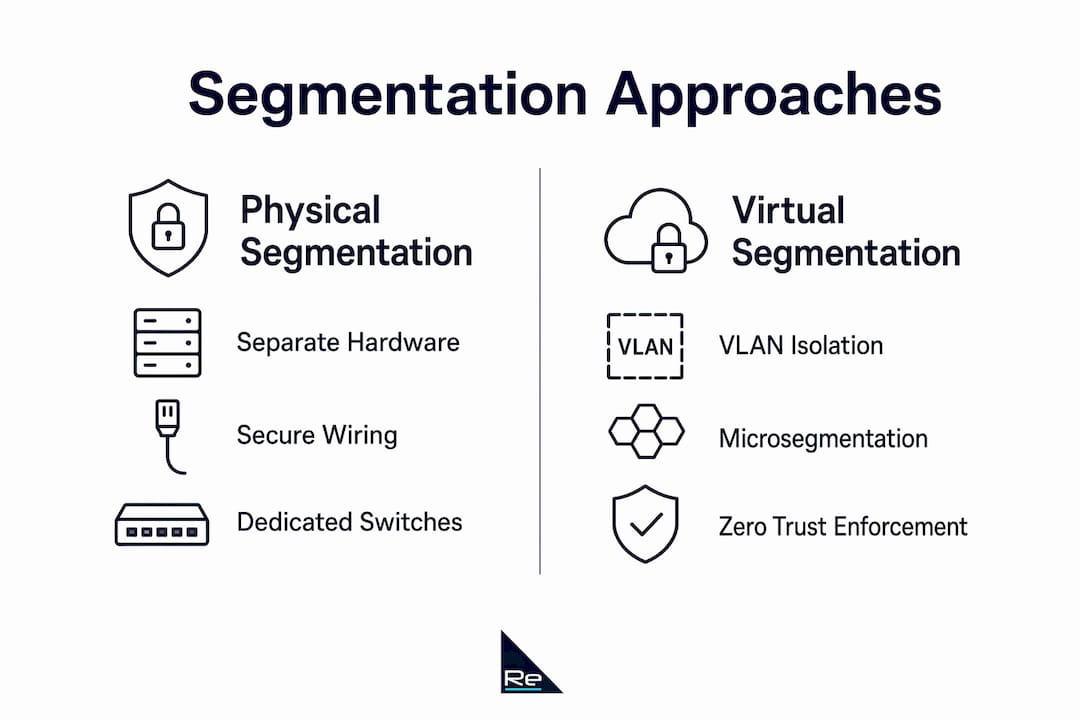
The table below compares the three primary segmentation approaches available to IT managers in shared environments:
| Approach | Mechanism | Best suited for | Key limitation |
|---|---|---|---|
| Physical segmentation | Separate hardware per zone | High-security, regulated tenants | High cost and inflexibility |
| VLAN segmentation | Logical separation at Layer 2 | General multi-tenant environments | Requires Layer 3 enforcement to be effective |
| Microsegmentation | Per-workload policy enforcement | Mixed-risk, dynamic environments | Operational complexity of rule management |
Segmentation combined with Zero Trust stops lateral movement by requiring per-session authentication and continuous policy enforcement. This shifts the security model from perimeter defence to identity and context-based access, which is far more appropriate for environments where dozens of organisations share the same physical infrastructure.
Pro Tip: When preparing for an audit, document every segmentation boundary with a corresponding firewall rule set. Auditors specifically look for evidence that inter-zone controls are statefully enforced, not just that VLANs exist on the switch configuration.
What compliance frameworks apply to shared workspace cybersecurity?
Compliance requirements directly shape how IT managers must design and document network segmentation in shared environments. HIPAA is the most prescriptive framework for healthcare-adjacent tenants. HIPAA requires risk-based segmentation with identity controls to protect electronic protected health information (ePHI), though it does not mandate a specific network topology. The practical implication is that any shared network hosting a healthcare provider must isolate ePHI systems from all other tenant traffic and enforce access controls based on role and identity.
GDPR, while not prescribing network architecture, requires that personal data be protected through appropriate technical measures. In a shared office environment, this means ensuring that one tenant’s data cannot be accessed by another tenant’s devices or users, even inadvertently. Segmentation is the technical control that makes this enforceable.
The following controls are the minimum baseline for compliance-aligned shared network security:
- Access logging and audit trails: Every cross-zone access attempt must be logged with timestamps, source identity, and outcome. This is non-negotiable for HIPAA and strongly recommended for GDPR accountability.
- Policy documentation: Firewall rules, VLAN assignments, and access control lists must be documented and version-controlled. Undocumented rules are a common audit finding.
- Vendor and third-party access controls: Any third party with access to the network, including managed service providers and facilities contractors, must operate under a formal access agreement with defined scope and time limits.
- Data classification alignment: Network zones should map to data classification tiers. Systems handling sensitive or regulated data must sit in higher-security zones with stricter inter-zone policies.
- Regular segmentation testing: Penetration testing and segmentation validation should occur at least annually, with results documented and remediation tracked.
For healthcare tenants specifically, the secure handling of sensitive data requires that ePHI systems be placed in dedicated segments with no direct routing to guest or general-purpose zones. Vendor agreements must explicitly address how third parties interact with these segments, including API security and data retention policies.
Managing device and third-party access in co-working networks
Shared workspaces present a device management challenge that traditional enterprise networks do not face. On any given day, a co-working space like The Colosseum Charleston might host dozens of unmanaged laptops, mobile devices, casting systems, and visitor management terminals, all connecting to the same physical infrastructure. Each category carries a distinct risk profile and requires a distinct network placement strategy.
Casting devices are a frequently overlooked attack surface. Casting devices in shared networks should be isolated in dedicated VLANs with controlled Layer 3 firewall rules to avoid unintended exposure. Cisco recommends enabling Bonjour forwarding selectively and avoiding broad multicast or mDNS permissions. Only the specific ports required for casting functionality should be open, and proxy-based approaches are preferable to permitting raw multicast across zone boundaries.
Visitor management systems introduce a different category of risk. These systems have migrated from standalone hardware to IP-connected platforms that interact with access control, HR, and identity systems. Visitor management systems on IP networks require encryption, authentication, and regular security updates to mitigate risks in shared spaces. IT teams must evaluate vendor security posture carefully, covering API security, data retention policies, and the scope of network access the system requires.
The following practices govern secure device and third-party access in shared environments:
- Place all visitor-facing systems, including reception terminals and guest Wi-Fi portals, in a dedicated DMZ segment with no direct routing to tenant or corporate zones.
- Require certificate-based authentication for any managed device connecting to tenant segments, and enforce network access control (NAC) policies to block non-compliant endpoints.
- Evaluate every third-party vendor’s network access scope before granting credentials. Time-limited, least-privilege access is the standard, not the exception.
- Disable mDNS and multicast forwarding by default across zone boundaries. Enable it only where a specific, documented use case requires it, and restrict it to the minimum required scope.
Pro Tip: Operational efficiency and strict access controls are not mutually exclusive. Use Cisco Identity Services Engine (ISE) or a comparable NAC solution to automate device profiling and policy assignment. This removes the manual overhead of managing device access while maintaining consistent enforcement.
What are the best practices for implementing shared network security?
Practical implementation of shared workspace cybersecurity requires a combination of architecture decisions, tooling choices, and ongoing operational discipline. The starting point is always a clear network design that maps zones to business functions and risk levels. Re-solution’s guidance on secure network design provides concrete patterns for enforcing boundaries in multi-tenant environments.
Cloud networking tools extend these principles into hybrid and cloud-hosted environments. Azure virtual networks enable private communication with Network Security Groups filtering traffic in and out of subnets, which is directly applicable to shared space network segments that extend into cloud infrastructure. Private DNS zones facilitate name resolution across virtual networks, maintaining separation between tenant environments even when workloads are cloud-hosted.
Zero Trust Network Access (ZTNA) is the access model that ties these controls together. Rather than granting broad network access after a single authentication event, ZTNA enforces per-session verification based on user identity, device posture, and context. Cisco’s Zero Trust implementation provides the policy engine and enforcement points needed to apply this model consistently across a shared environment. For IT managers, this means replacing legacy VPN-based remote access with identity-aware, least-privilege connectivity.
Continuous monitoring of east-west traffic is the operational control that validates whether segmentation is working as intended. Static segmentation can degrade over time as firewall rules accumulate and exceptions are granted without review. Active network visibility tools detect reconnaissance activity, credential harvesting, and anomalous cross-segment access attempts before they escalate. The table below summarises the key implementation controls and their primary function:
| Control | Primary function | Tooling examples |
|---|---|---|
| VLAN segmentation with Layer 3 enforcement | Zone isolation and traffic control | Cisco Catalyst, Meraki |
| ZTNA | Per-session, identity-based access | Cisco Secure Access, Azure AD |
| NAC | Device compliance enforcement | Cisco ISE |
| East-west traffic monitoring | Lateral movement detection | Cisco Secure Network Analytics |
| Private DNS management | Tenant name resolution isolation | Azure Private DNS, Cisco Umbrella |
Network data security integrated with SASE solutions provides an additional layer by governing data sharing risks across diverse endpoints. For shared workspaces with tenants operating across multiple cloud platforms, SASE consolidates network security and access policy into a single control plane, reducing the operational complexity of managing separate point solutions.
Setting up device trust is the final piece of the implementation puzzle. Without verified device posture feeding into access decisions, even the most well-designed segmentation architecture can be undermined by a compromised or non-compliant endpoint connecting from within a trusted zone.
Key takeaways
Effective network security for shared spaces requires segmentation, Zero Trust verification, and continuous monitoring working together as a unified architecture rather than independent controls.
| Point | Details |
|---|---|
| Segmentation requires Layer 3 enforcement | VLANs alone are insufficient; stateful firewall controls between zones are mandatory for audit compliance. |
| Zero Trust replaces perimeter assumptions | Per-session authentication via ZTNA eliminates implicit trust based on network location. |
| Compliance drives zone design | HIPAA and GDPR require that sensitive data segments be isolated and access-logged at all times. |
| Device access needs NAC and profiling | Unmanaged and visitor devices must be automatically profiled and placed in appropriate zones. |
| Monitoring validates segmentation over time | East-west traffic analysis detects lateral movement that static rule sets cannot prevent alone. |
The part most IT managers underestimate
After working across shared workspace deployments for many years, the pattern I see most consistently is this: organisations invest heavily in the initial segmentation design and then treat it as a solved problem. They document the VLANs, configure the firewall rules, and move on. Six months later, the rule base has grown by thirty percent, half the additions were made under operational pressure, and nobody has validated whether the original zone boundaries still hold.
The shift to Zero Trust is not primarily a technology change. It is a governance change. The technology, whether Cisco ISE, Azure NSGs, or a SASE platform, is mature and well-documented. What fails is the process discipline required to keep policies current, test segmentation boundaries regularly, and treat every exception request as a potential erosion of the architecture. I have seen environments where the firewall rule count had grown to the point where no single person understood the full policy set. That is not a technology failure. It is an operational one.
The emerging integration of AI-driven monitoring into platforms like Cisco Secure Network Analytics changes this dynamic meaningfully. Automated anomaly detection reduces the reliance on human review of static rule sets and provides continuous validation that the intended segmentation is actually enforced. That is the direction the industry is moving, and it is the right one. But it does not replace the need for periodic manual review and penetration testing. It supplements it.
The organisations that get this right treat network security policy as a living document, reviewed quarterly, tested annually, and owned by a named individual with the authority to enforce it.
— Jacob
How Re-solution supports secure shared workspace networks
Re-solution has over 35 years of experience designing and managing Cisco network infrastructure for shared workspaces, co-working environments, and multi-tenant buildings. The team delivers end-to-end solutions covering network segmentation design, Zero Trust implementation, NAC deployment, and ongoing managed security services. For IT managers who need a trusted partner to assess their current shared space architecture and close the gaps, Re-solution’s Network as a Service offering provides fully managed segmentation, monitoring, and access control tailored to your environment. Contact Re-solution to discuss a security assessment or to explore how a managed approach can reduce your operational burden while maintaining compliance.
FAQ
What is network segmentation in a shared workspace?
Network segmentation in a shared workspace is the division of a shared network into isolated zones, typically using VLANs and Layer 3 firewall controls, so that traffic from one tenant or user group cannot reach another without explicit authorisation.
How does Zero Trust differ from traditional network security?
Zero Trust requires continuous, per-session verification of identity and device posture before granting access, whereas traditional models grant broad access once a user is inside the network perimeter. NIST SP 800-207 defines this as the foundational principle for modern shared-space security.
Does HIPAA require specific network segmentation for shared offices?
HIPAA does not mandate a specific topology, but it does require risk-based segmentation with identity controls to protect ePHI. Any shared environment hosting healthcare tenants must isolate ePHI systems and enforce access logging across all zone boundaries.
How should casting devices be handled on shared networks?
Casting devices should be placed in dedicated VLANs with Layer 3 firewall rules restricting access to only the ports required for their function. Broad multicast and mDNS permissions across zone boundaries should be disabled, with Bonjour forwarding enabled selectively where required.
What is the role of east-west traffic monitoring in shared spaces?
East-west traffic monitoring analyses communication between internal network segments to detect lateral movement, reconnaissance, and anomalous access attempts. It provides the active visibility needed to validate that segmentation boundaries are functioning as designed, rather than relying solely on static rule sets.
Recommended
- Secure network architecture: a practical guide for IT leaders
- Shared Spaces | Cisco Cloud, Security & Datacenter Experts
- Network Security Best Practices Guide | Re-Solution
- Network Security Best Practices Guide | Re-Solution