TL;DR:
- Managed firewalls provide organizations with centralized governance, automated compliance reports, and expert incident response support. They significantly reduce configuration drift, support hybrid networks, and help meet strict audit requirements through traceable change logs. Choosing a managed service enhances security and compliance by ensuring consistent policy enforcement and reliable support across multiple sites.
Managed firewalls are defined as third-party or specialist-delivered services that take full operational responsibility for an organisation’s firewall infrastructure, covering policy management, threat monitoring, and compliance reporting. For IT managers and security professionals, the role of managed firewalls extends well beyond filtering traffic. It provides centralised governance, documented audit trails, and expert-backed incident response across distributed and hybrid environments. Tools such as Palo Alto Networks Panorama and WatchGuard Compliance Reporting represent the kind of platforms that underpin these services, shifting the burden of day-to-day firewall management away from internal teams while maintaining consistent, auditable security controls.
What is the role of managed firewalls in compliance?
Compliance is where managed firewall services deliver some of their most tangible value, particularly for organisations subject to frameworks such as NIST, ISO 27001, or CMMC. Manual compliance processes, typically involving spreadsheet reconstruction and retrospective log reviews, are both time-consuming and error-prone. Managed firewalls replace that approach with automated, scheduled reporting tied directly to control frameworks.
WatchGuard’s Compliance Reporting generates on-demand reports with control effectiveness scoring, giving IT teams a real-time view of their compliance posture rather than a snapshot produced under audit pressure. That shift from reactive to continuous compliance visibility is significant. Auditors increasingly expect documented, traceable practices rather than a technical configuration review conducted at the point of audit.
The Opinnate platform takes this further by offering revision-based alerts and detailed historic change logs with customisable reports. This means every policy modification is recorded, timestamped, and retrievable on demand. For organisations in regulated sectors such as manufacturing, education, or healthcare, that level of traceability directly satisfies auditor expectations without requiring manual effort from internal teams.
Key compliance capabilities delivered by managed firewall services include:
- Automated report generation aligned to NIST, ISO, and CMMC control frameworks
- Change tracking and revision history for complete audit trail documentation
- On-demand and scheduled compliance reports with control effectiveness scoring
- Policy modification alerts with timestamps and user attribution
- Centralised visibility across multiple sites and cloud environments
Pro Tip: When evaluating a managed firewall provider, request a sample compliance report before signing any contract. The depth of control mapping and change log granularity in that report will tell you more about audit readiness than any sales conversation.
How does centralised policy management work across hybrid networks?
Distributed and hybrid environments create a specific governance problem. When firewall policies are managed device by device across multiple sites, configuration drift becomes almost inevitable. Rules applied at one location may not be replicated correctly at another, and inconsistencies accumulate over time until they become a security or compliance liability.

Centralised policy governance addresses this directly by reducing drift and simplifying audit evidence collection across sites. Palo Alto Networks Panorama is the clearest example of this approach in practice. It provides a single-console view of security policy across all connected firewalls, whether physical, virtual, or cloud-hosted. Changes are pushed from one location and applied consistently across the entire estate.
For IT managers overseeing multi-site operations in sectors such as logistics, hospitality, or shared workspaces, this single-console model removes the operational overhead of per-device management. It also makes policy deployment across distributed environments faster and more reliable. When a new threat signature is identified or a policy update is required, the change propagates across all sites simultaneously rather than requiring individual device access.
The integration with Zero Trust architectures is equally important. Managed firewall services that support ZTNA principles enforce identity-based access controls at the network perimeter, ensuring that remote users and branch connections are subject to the same policy rigour as on-premises traffic. Virtual firewall editions and cloud management capabilities extend consistent policy enforcement to cloud-hosted workloads, closing the gap that often exists between on-premises and cloud security postures.
| Capability | Managed firewall | Unmanaged firewall |
|---|---|---|
| Policy consistency across sites | Centralised, push-based deployment | Manual, per-device configuration |
| Configuration drift risk | Low, governed by single console | High, increases with scale |
| Zero Trust integration | Supported via ZTNA-aligned policies | Dependent on internal expertise |
| Cloud environment coverage | Virtual editions with cloud management | Varies, often limited |
| Audit evidence collection | Automated, centralised logs | Manual extraction per device |
Pro Tip: If your organisation operates across more than three physical sites or uses a mix of on-premises and cloud infrastructure, the legacy vs next-generation firewall distinction becomes critical. Next-generation platforms are the only viable foundation for centralised managed firewall governance at scale.
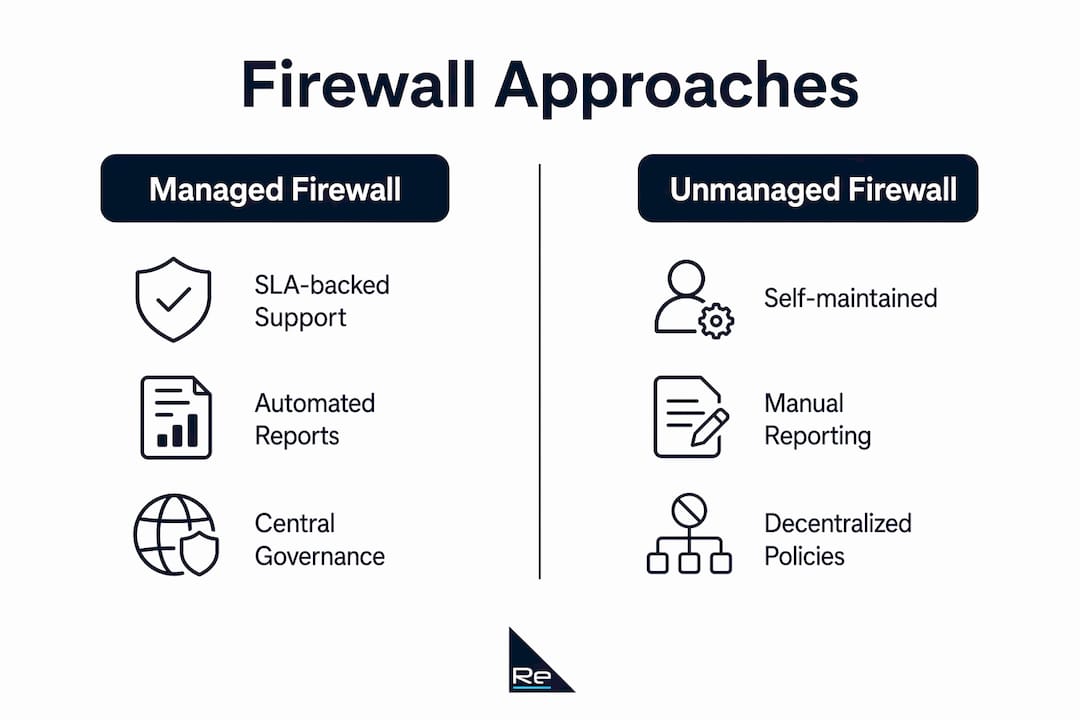
Managed vs unmanaged firewalls: which approach suits your organisation?
The decision between managed and unmanaged firewall approaches is not purely technical. It involves operational risk, compliance documentation, and the realistic capacity of internal teams to maintain security at the required standard.
Support SLAs represent one of the clearest differentiators. With a managed service, incidents are escalated to dedicated vendor Technical Assistance Centre engineers with contractual response times. The difference between community help and dedicated TAC support becomes critical during a live security incident, where hours of delay can translate directly into data exposure or service disruption.
Compliance documentation is the second major differentiator. Auditors prefer documented vendor relationships and managed change practices as evidence of compliance, even when a DIY firewall is technically sound. A technically well-configured open-source firewall with no vendor relationship and no formal change management process will frequently fail an audit on documentation grounds alone. That is a significant operational risk for organisations in regulated sectors.
Additional considerations when comparing the two approaches:
- Threat intelligence updates: Managed services receive automatic, vendor-curated threat intelligence feeds. Unmanaged solutions require internal teams to source, evaluate, and apply updates manually.
- Internal expertise dependency: Unmanaged firewalls place full responsibility on internal staff, creating risk when key personnel leave or are unavailable.
- Cost structure: Managed services carry a predictable subscription cost. Unmanaged solutions carry hidden costs in staff time, training, and incident recovery.
- Scalability: Managed firewall services scale with organisational growth without requiring proportional increases in internal headcount.
- Incident response: Managed providers offer defined response procedures. Unmanaged environments rely on internal capacity, which is often constrained during incidents.
For organisations in education, manufacturing, or logistics where IT teams are lean and compliance obligations are real, the operational case for managed firewall services is strong. The network infrastructure compliance checklist published by Re-Solution provides a practical framework for assessing where firewall management gaps exist before making a procurement decision.
What to consider when adopting managed firewall services
Selecting a managed firewall provider requires more than comparing feature lists. The implementation decisions made at the outset will determine whether the service delivers long-term security value or simply replaces one set of management problems with another.
-
Evaluate SLA specifics, not just headline response times. Understand what constitutes a P1 incident under the provider’s classification, what the escalation path looks like, and whether 24/7 support is genuinely staffed or relies on on-call arrangements.
-
Assess integration with existing infrastructure. A managed firewall service that cannot integrate with your existing SIEM, identity provider, or cloud management platform will create visibility gaps. Confirm API availability and pre-built integrations before committing.
-
Establish a policy review cadence from day one. Default firewall rules are a known security risk. Managed services that do not include scheduled policy optimisation reviews will accumulate redundant or overly permissive rules over time. Agree on a quarterly review cycle as a minimum.
-
Confirm scalability for hybrid and growing environments. If your organisation is expanding sites, adopting cloud workloads, or increasing remote working, the managed firewall service must scale without requiring contract renegotiation for every change.
-
Require change tracking from the outset. Neglecting change tracking is one of the most common implementation pitfalls. Every policy modification should be logged, attributed, and retrievable. This is non-negotiable for audit readiness.
-
Understand the provider’s threat intelligence sources. Advanced managed firewall services for mission-critical environments now incorporate AI-driven policy recommendations and unified IT/OT security operations. Confirm whether the provider’s threat intelligence is vendor-curated, third-party sourced, or community-based, as the quality difference is significant.
The integrated security solutions approach, where managed firewalls sit within a broader security architecture rather than operating in isolation, consistently produces better compliance and security outcomes than point solutions deployed independently.
Key takeaways
Managed firewalls deliver their greatest value through centralised governance, automated compliance documentation, and expert-backed support that internal teams cannot reliably replicate at scale.
| Point | Details |
|---|---|
| Compliance automation | Managed firewalls generate audit-ready reports aligned to NIST, ISO, and CMMC without manual effort. |
| Centralised policy control | Single-console platforms like Palo Alto Networks Panorama eliminate configuration drift across multi-site estates. |
| Audit documentation matters | Auditors value documented vendor relationships and traceable change logs as much as technical configuration. |
| SLA-backed support | Dedicated TAC support provides faster, more reliable incident response than unmanaged alternatives. |
| Implementation discipline | Change tracking, policy review cadence, and integration planning determine long-term managed firewall value. |
Why the compliance argument is the one IT managers should lead with
From my experience working with IT teams across education, manufacturing, and logistics, the conversation about managed firewalls almost always starts with security and ends with compliance. That order should be reversed.
The technical security case for managed firewalls is well understood. What gets overlooked is that compliance documentation is often the deciding factor in an audit, not the technical configuration. I have seen technically sound firewall deployments fail audit reviews because there was no vendor relationship, no formal change log, and no scheduled review process. The auditor’s question is not “is this firewall configured correctly?” It is “can you prove it has been managed correctly over time?”
The shift from per-device management to centralised governance is also more significant than it appears on paper. When you remove the need for individual device access to make policy changes, you remove a category of human error that is responsible for a disproportionate share of security incidents. That is not a minor operational improvement. It is a structural change in how risk is managed.
Hybrid working has accelerated managed firewall adoption in ways that were not anticipated even three years ago. When remote users, branch offices, and cloud workloads all need consistent policy enforcement, the argument for centralised managed governance becomes difficult to counter. The organisations I have seen resist this shift are typically those with a single experienced network engineer who manages everything personally. That is a single point of failure, not a security strategy.
— Jacob
How Re-Solution supports your firewall and security strategy

Re-Solution has delivered Cisco IT infrastructure and security solutions for over 35 years, working with organisations in education, manufacturing, logistics, and hospitality to build networks that are secure, compliant, and operationally reliable. The importance of firewall management sits at the centre of that work, and Re-Solution’s managed IT services cover the full scope of firewall governance, from policy management and compliance reporting to incident response and infrastructure audits.
If you are assessing whether your current firewall approach meets your compliance obligations or supports your hybrid environment effectively, Re-Solution’s team can provide a structured review. Explore the IT infrastructure fundamentals resource to understand where managed firewall services fit within your broader network architecture, or contact Re-Solution directly to discuss your specific requirements.
FAQ
What is a managed firewall service?
A managed firewall service is a third-party or specialist-delivered solution that takes operational responsibility for an organisation’s firewall infrastructure, including policy management, threat monitoring, compliance reporting, and incident response.
How do managed firewalls support compliance audits?
Managed firewalls automate compliance report generation aligned to frameworks such as NIST, ISO 27001, and CMMC, and maintain detailed change logs that provide auditors with documented, traceable evidence of ongoing security governance.
What is the difference between managed and unmanaged firewalls?
Managed firewalls provide SLA-backed support, automated compliance documentation, and centralised policy governance. Unmanaged firewalls place full operational and compliance responsibility on internal teams, which increases risk when expertise or capacity is limited.
Why do auditors prefer managed firewall solutions?
Auditors value documented vendor relationships and formal change management practices as evidence of compliance. A technically sound but undocumented DIY firewall frequently fails audit reviews on governance grounds, regardless of its technical configuration.
Can managed firewalls support hybrid and multi-site environments?
Managed firewall services using platforms such as Palo Alto Networks Panorama provide single-console policy control across physical, virtual, and cloud-hosted environments, making them well suited to hybrid and multi-site network architectures.
Recommended
- Understanding firewall security: a 2026 guide
- Infrastructure Insights for Business Growth | Re-Solution
- NGFW: Everything You Need to Know | Re-Solution
- Effective network access management for schools in 2026