TL;DR:
- A Network Operations Centre monitors, manages, and maintains network infrastructure to maximize availability and minimize downtime. It handles real-time alerting, incident triage, patch management, and logs operational metrics, supporting continuous network health. Outsourcing or hybrid models are often faster and more cost-effective for mid-sized UK organizations compared to building an in-house NOC.
A Network Operations Centre (NOC) is a centralised facility where IT engineers monitor, manage, and maintain an organisation’s network infrastructure around the clock, with the primary goal of maximising availability and minimising unplanned downtime. It is the operational backbone behind reliable connectivity, handling everything from switch failures and bandwidth saturation to patch scheduling and backup verification.
At a glance:
- 24/7 real-time monitoring of network devices, servers, and applications
- Incident triage, remote remediation, and structured escalation
- Scheduled maintenance, patch management, and backup verification
- SLA tracking and operational reporting
If your organisation depends on continuous network availability, the rest of this guide explains exactly how a NOC delivers that, and how to decide whether to build one, buy one, or use a hybrid model.
Table of Contents
- What does a NOC actually cover day to day?
- What are the core functions inside a NOC?
- People, process, and platform: the three pillars of a NOC
- How does a NOC handle an incident from alert to resolution?
- Why do organisations run a NOC?
- NOC vs SOC vs help desk: who handles what?
- Should you build an in-house NOC or buy managed services?
- How are automation and AIOps changing NOC operations?
- Practical next steps for UK organisations
- Key takeaways
- Why the NOC conversation matters more than most IT teams realise
- How Re-solution supports NOC networking and managed monitoring
- Useful sources
What does a NOC actually cover day to day?
A NOC’s remit is back-end infrastructure health, not end-user support. Where a help desk handles password resets and application queries, the NOC owns the underlying infrastructure: routers, switches, firewalls, wireless access points, servers, WAN links, and backup systems.
In practice, that means a NOC engineer is watching for a core switch that stops forwarding traffic, a WAN circuit that drops below its committed data rate, or a nightly backup job that fails silently. These are the events that, left unattended, turn into outages that affect every user on the network.

The NOC does not typically handle individual user incidents unless those incidents point to an infrastructure fault. A single user who cannot connect to Wi-Fi is a help desk ticket. Forty users who cannot connect because a wireless controller has crashed is a NOC incident.
What are the core functions inside a NOC?
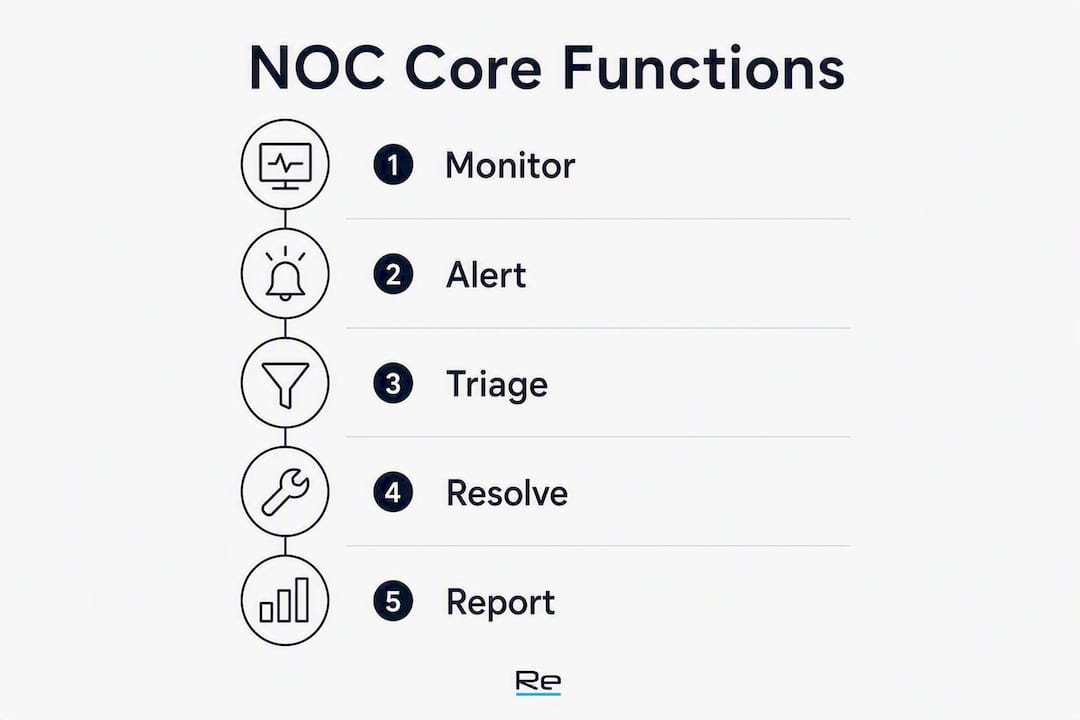
NOC primary functions cover four operational pillars: real-time monitoring and alerting, incident triage and remediation, patch and update management, and the ongoing management of routers, switches, firewalls, and wireless systems. Each pillar feeds into a structured incident lifecycle.
The incident lifecycle
- Detect — a monitoring platform raises an alert based on a threshold breach or anomaly.
- Validate — a NOC engineer confirms the alert is genuine and assesses scope.
- Remediate — the engineer applies a fix remotely, following a documented runbook.
- Escalate — if the issue exceeds Tier 1 or Tier 2 capability, it moves to a specialist or the SOC.
- Document — the incident is logged, root cause recorded, and the ticket closed.
Operational metrics that matter
Mature NOCs track a defined set of KPIs to demonstrate service quality and identify process gaps:
- Alert-to-resolution time — how quickly an alert becomes a closed ticket
- Mean time to repair (MTTR) — average duration from incident detection to full restoration
- First-call resolution rate — percentage of incidents resolved without escalation
- Alert noise ratio — proportion of actionable alerts versus total alert volume
- SLA compliance — whether agreed response and resolution targets are being met
These metrics are not just internal scorecards. For UK organisations subject to regulatory frameworks or contractual uptime commitments, they form part of the evidence trail that demonstrates operational due diligence.
People, process, and platform: the three pillars of a NOC
People and shift models
A NOC runs on a tiered staffing model. Tier 1 technicians handle first-line triage and routine alerts. Tier 2 engineers take on more complex diagnostics and configuration changes. Tier 3 specialists, often senior network or systems engineers, handle escalations that require deep expertise or vendor engagement.
Continuous 24/7 coverage requires shift rotation, typically three shifts across a 24-hour period, with handover documentation to maintain continuity. Out-of-hours coverage is one of the most significant cost drivers in an in-house NOC, which is why many UK organisations consider outsourced or hybrid models.
Processes and runbooks
Process discipline separates a functional NOC from an ad hoc support team. Standard operating procedures (SOPs) and runbooks define exactly how each alert type is handled, who owns each step, and what constitutes a successful resolution. Change windows and maintenance coordination prevent unplanned changes from causing incidents during peak hours.
SLA workflows specify response time targets by severity: a Priority 1 outage affecting the whole site demands a different response cadence than a non-critical monitoring alert on a secondary link.
Platform and tooling
The technology layer typically combines three categories:
- Monitoring and observability platforms — tools such as Nagios, SolarWinds, and Datadog provide real-time visibility across network devices, servers, and applications. Cisco Meraki’s cloud-managed dashboard offers centralised visibility for organisations running Cisco infrastructure.
- Remote monitoring and management (RMM) — RMM platforms provide monitoring visibility, alert management, remote access, and automation for patching across multiple environments.
- Ticketing and ITSM — platforms such as ServiceNow integrate alerting with ticket creation, assignment, and SLA tracking, creating an auditable record of every incident.
Integration between these layers matters. A monitoring alert that automatically creates a prioritised ticket and notifies the on-call engineer removes manual steps and reduces mean time to detect.
How does a NOC handle an incident from alert to resolution?
Monitoring inputs arrive from multiple sources: SNMP traps from network devices, syslog streams, synthetic transaction checks, and application performance metrics. Splunk, for example, aggregates log and event data across the environment, giving NOC engineers a unified view rather than siloed device-by-device checks.
When an alert fires, the engineer’s first task is validation. Not every alert represents a genuine fault — threshold misconfiguration and transient spikes generate noise. Once validated, the engineer follows the relevant runbook. If the issue is within scope and documented, resolution happens at Tier 1 or Tier 2 without escalation. If the fault has a security dimension, such as unusual traffic patterns suggesting a compromise, the NOC hands off to the SOC with a structured notification.
Routine maintenance runs on a separate track. Scheduled patch windows and backup verification are planned activities that reduce the risk of incidental outages and confirm recovery capability before it is needed in anger.
Pro Tip: Alert tuning is not a one-time task. Review your alert thresholds and suppression rules quarterly. Poorly tuned monitoring generates excessive alert volume that distracts engineers and masks genuine incidents. Mature NOCs implement event correlation and deduplication so that engineers see only actionable alerts, not noise.
Why do organisations run a NOC?
The business case for a NOC rests on three outcomes: higher availability, faster recovery, and predictable service quality.
Core benefits:
- Improved uptime — continuous monitoring catches faults before they become outages, or reduces the window between fault and recovery.
- Faster MTTR — structured triage and documented runbooks remove guesswork from incident response, cutting recovery time.
- Predictable SLAs — defined response targets and tracked metrics give organisations and their customers confidence in service delivery.
- Change discipline — coordinated patch windows and change management reduce the risk of self-inflicted outages.
- Compliance support — for UK organisations pursuing or maintaining ISO 27001 certification, NOC activity logs, incident records, and SLA reports provide audit-ready evidence of operational controls.
- Business continuity — backup verification and recovery testing are standard NOC responsibilities that directly support BCDR plans.
For sectors such as manufacturing, logistics, and education, where network downtime translates directly into lost productivity or disrupted services, these capabilities are operationally significant rather than aspirational.
NOC vs SOC vs help desk: who handles what?
The three functions are complementary but distinct. Conflating them creates gaps in coverage and unclear escalation paths.
The NOC focuses on performance, availability, and uptime. The SOC focuses on detecting and mitigating security threats. The help desk handles end-user requests and service requests that do not involve infrastructure faults.
A ransomware incident illustrates the boundary clearly. The NOC detects unusual network behaviour — high outbound traffic, unexpected device connections — and raises an alert. The SOC takes ownership of the threat investigation and containment. The NOC then supports recovery by restoring network segments, verifying backups, and confirming connectivity once the SOC declares the environment clean. Neither team can do the other’s job effectively, but both need defined handoff points and shared communication templates to avoid delays during a live incident.
Help desk teams escalate to the NOC when a user-reported issue points to an infrastructure fault. The NOC resolves the underlying problem and notifies the help desk to close the user ticket. Shared alerting and joint runbooks for cross-boundary incidents reduce friction significantly.
Should you build an in-house NOC or buy managed services?
This is a strategic decision driven by scale, cost, and risk tolerance. Large enterprises with complex, high-value environments sometimes build in-house NOCs for control and institutional knowledge. Mid-market and growing organisations more often find that outsourced or white-label managed NOC services deliver faster time-to-value and lower fixed costs.
| Factor | In-house NOC | Managed/outsourced NOC | Hybrid model |
|---|---|---|---|
| 24/7 staffing cost | High fixed cost | Included in service fee | Reduced (partner covers out-of-hours) |
| Time to operational | Months to years | Weeks | Moderate |
| Control and customisation | Full | Varies by provider | Shared |
| Compliance evidence | Internally owned | Provider-generated reports | Shared responsibility |
| Runbook maturity required | Must build internally | Provider brings templates | Requires internal baseline |
| Best fit | Large enterprise | SME to mid-market | Organisations with existing internal teams |
A hybrid model, where an internal team handles business-hours operations and a managed partner covers overnight and weekend monitoring, is increasingly common among UK organisations that want to retain engineering capability without the full cost of round-the-clock staffing.
Decision checklist for UK organisations:
- What coverage hours do you actually need (business hours, 24/5, 24/7)?
- What are your contractual or regulatory SLA targets?
- How mature is your runbook and documentation library?
- Which monitoring and ticketing tools are already in place?
- What is your compliance posture (ISO 27001, Cyber Essentials, sector-specific requirements)?
- What is the realistic budget for year-one tooling, staffing, and training?
For managed network services, the provider typically brings tooling, staffing, and process frameworks, which significantly reduces the internal effort required to reach operational maturity.
How are automation and AIOps changing NOC operations?
Traditional NOC operations are reactive: an alert fires, an engineer responds. AIOps and predictive analytics shift that model toward proactive operations, identifying patterns that precede incidents and triggering automated responses before users are affected.
Observability extends beyond traditional monitoring by combining metrics, logs, and distributed traces into a unified picture of service health. Where a conventional monitoring tool tells you a server’s CPU is at 95%, an observability platform tells you which application request is causing it, which downstream services are affected, and how long the condition has persisted. For organisations running distributed or cloud-native services, that context is the difference between a five-minute fix and a two-hour investigation.
Network automation fundamentals underpin much of this shift. Automated runbooks handle routine remediation tasks, such as restarting a service or clearing a log file, without engineer intervention. This reduces toil, accelerates resolution, and allows engineers to focus on higher-value diagnostic and improvement work.
Best practice guidance:
- Tune alert thresholds based on historical baselines, not vendor defaults.
- Implement event correlation and deduplication to suppress redundant alerts.
- Use service-aware dashboards that show business impact, not just device status.
- Build capacity planning reviews into the NOC calendar, using trend data to anticipate growth before it causes performance degradation.
Practical next steps for UK organisations
Whether you are building a NOC function from scratch or evaluating a managed provider, a structured approach reduces risk and accelerates time to value.
- Define scope — list every device, circuit, application, and service the NOC will monitor. Be specific: vague scope leads to monitoring gaps.
- Audit current tooling — identify what monitoring, ticketing, and RMM tools are already in place and whether they can be integrated or need replacement.
- Set SLA targets — agree response and resolution time targets by severity level before selecting a model or provider.
- Inventory runbooks — document existing incident response procedures. Gaps here are a key risk factor for both in-house and outsourced models.
- Simulate an outage — run a tabletop exercise or controlled fault injection to test current detection and response capability before committing to a design.
- Evaluate providers — ask managed NOC providers: What are your escalation SLAs by severity? How do you integrate with our existing ticketing system? What compliance reporting do you provide? Can you demonstrate ISO 27001 certification or equivalent?
- Plan the first phase — a realistic first-phase rollout for a mid-sized UK organisation typically covers core network monitoring, alerting integration, and basic runbook documentation. Expand scope in subsequent phases once the baseline is stable.
A network audit before NOC design is a practical first step: it surfaces monitoring gaps, undocumented devices, and configuration inconsistencies that would otherwise create blind spots from day one.
Key takeaways
A NOC delivers reliable network availability through 24/7 monitoring, structured incident triage, and documented remediation, with the people, process, and platform integration determining whether it operates at a reactive or proactive level.
| Point | Details |
|---|---|
| NOC scope is infrastructure, not users | A NOC owns back-end network health; the help desk handles end-user requests. |
| Three pillars determine NOC quality | People (tiered staffing), process (runbooks and SLAs), and platform (monitoring, RMM, ticketing) must all be in place. |
| Build vs buy depends on scale and cost | Mid-market UK organisations typically reach operational maturity faster with a managed or hybrid model than by building in-house. |
| Automation reduces reactive toil | AIOps and event correlation allow engineers to focus on complex faults rather than routine alert handling. |
| Re-solution as your NOC partner | Re-solution provides managed network services, NaaS, and Cisco-based infrastructure support for UK organisations evaluating outsourced or hybrid NOC models. |
Why the NOC conversation matters more than most IT teams realise
Most IT teams understand what a NOC does in theory. The gap is in how they think about the build-vs-buy decision. The instinct is often to build, because it feels like more control. The reality is that control without documentation maturity, trained staff, and integrated tooling is not control at all — it is organised improvisation.
The organisations that get the most value from a NOC function are not necessarily the ones with the largest internal teams. They are the ones that have invested in runbook discipline, alert tuning, and clear escalation paths, regardless of whether the engineers sitting behind those processes are internal or from a managed partner. The model matters less than the process rigour behind it.
For UK IT directors specifically, the compliance angle deserves more attention than it typically gets. ISO 27001 and Cyber Essentials both require demonstrable operational controls. A well-run NOC generates that evidence automatically, through incident logs, SLA reports, and change records. A poorly run one, or the absence of one, leaves a gap that auditors will find.
The fastest route to value for most mid-sized UK organisations is a managed or hybrid model with a Cisco-experienced partner, combined with an internal commitment to runbook development. That combination delivers 24/7 coverage without the full overhead of in-house staffing, while retaining the institutional knowledge that makes escalation effective.
How Re-solution supports NOC networking and managed monitoring
Re-solution works with UK organisations across education, manufacturing, logistics, and hospitality to design and operate network infrastructure that performs reliably under real-world conditions. As a Cisco partner with over 35 years of experience, Re-solution brings the tooling, process frameworks, and engineering depth that a NOC function requires, without the overhead of building it from scratch internally.

Re-solution’s managed services cover continuous monitoring, incident response, patch management, and SLA reporting, aligned to the operational model that fits your organisation, whether that is fully outsourced, hybrid, or a structured transition to in-house capability. The NaaS offering provides a subscription-based alternative to capital-intensive infrastructure ownership, with monitoring and management included. For organisations at the start of this process, a network audit is the practical first step: it maps your current environment, identifies monitoring gaps, and gives you the evidence base to make a confident build-vs-buy decision. Contact Re-solution to arrange a discovery conversation.
Useful sources
- What Is a NOC? Network Operations Centers, Explained — Splunk
- Network operations center — Wikipedia
- Top network monitoring techniques — Re-solution
- Network audits and assessments — Re-solution
Recommended
- Cloud networking in hospitality: a guide for IT leaders
- Cloud networking definition: a 2026 guide for IT teams
- Understanding Cloud Networking: Expert Guide | Re-Solution
- Understanding Cloud Networking: Expert Guide | Re-Solution