TL;DR:
- HPE Aruba’s cloud-managed wireless portfolio offers proactive, AI-driven network management suitable for enterprise and distributed sites. Proper PoE capacity, switch support, and a clear deployment plan are essential for successful implementation. Cisco remains a strong alternative, especially for organizations with existing Cisco infrastructure or on-premises control needs.
HPE Aruba’s enterprise wireless portfolio, managed through the Aruba Central cloud platform, is the vendor’s answer to AI-native, cloud-managed Wi-Fi at campus and distributed-site scale. For UK IT decision-makers, the immediate verdict is this: Aruba is a credible, cloud-first option worth serious evaluation, provided your wired network, PoE budgets and switch capacity are assessed before deployment, not after. Cisco remains the dominant alternative, with its Meraki and Catalyst wireless lines offering their own management philosophies. Re-solution, as a Cisco partner with over 35 years of UK infrastructure experience, works with organisations across both paths.
Table of Contents
- What does Aruba Wireless actually consist of?
- How does Aruba Central’s AI-native management change operations?
- What deployment models does Aruba support in enterprise sites?
- How does Aruba wireless compare to Cisco wireless approaches?
- What should UK organisations check before committing to Aruba?
- How do you evaluate vendors and plan a migration?
- Key takeaways
- What actually matters when choosing between Aruba and Cisco
- How Re-solution can support your wireless project
- Useful sources and vendor references
What does Aruba Wireless actually consist of?
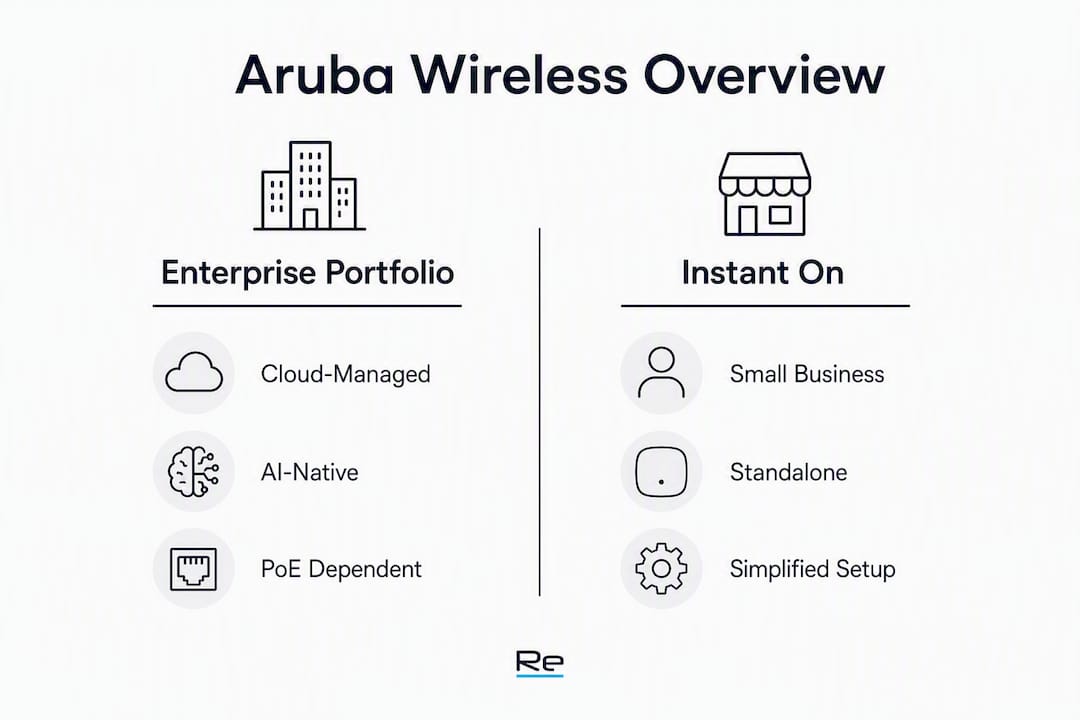
HPE Aruba is the vendor; Aruba Central is the cloud-management plane that ties the portfolio together. The core components are:
- Access point portfolio — enterprise APs spanning entry-level, mid-range and high-density models, including Wi-Fi 6 and Wi-Fi 6E capable series (such as the 550 and 650 Series), with multi-gig Ethernet ports and integrated BLE for location services.
- Mobility controllers — physical appliances or virtual instances providing centralised RF management, high-availability clustering and roaming support for large enterprise WLANs.
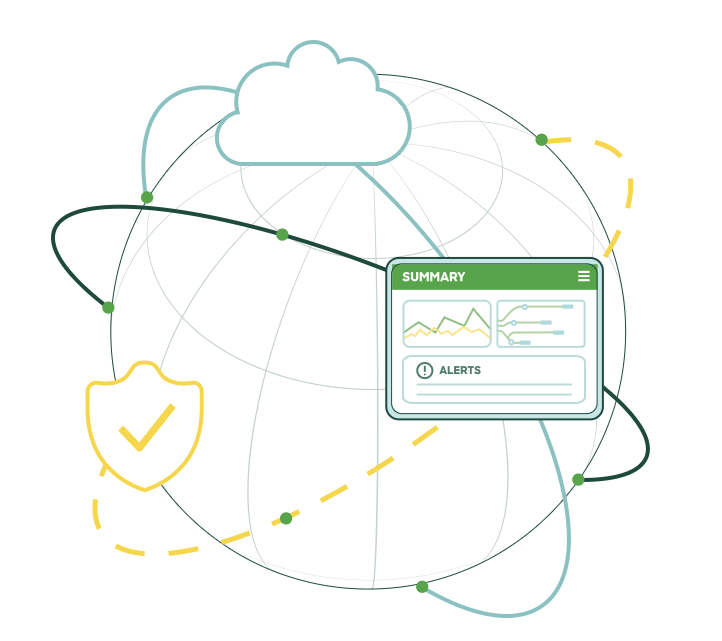
- Aruba Central — the cloud-native management platform delivering AI-driven insights, zero-touch provisioning and consolidated monitoring across APs, switches and gateways.
- ClearPass — the network access control (NAC) layer, handling role-based access, device profiling and guest workflows across wired and wireless domains.
- Aruba gateways / SD-Branch — branch and campus gateways providing IPSec tunnel termination, per-user firewalling and dynamic segmentation for distributed-site architectures.
- Aruba Instant On — a separate, small-business product family (1–99 employees) for retailers, boutique hotels and startups. There is no direct upgrade path from Instant On to the enterprise line, so selecting the wrong family early forces a costly migration later.
The enterprise portfolio and Instant On share the Aruba name but nothing else of operational significance. Procurement teams should confirm which family they are evaluating before any commercial discussion begins.
How does Aruba Central’s AI-native management change operations?
The operational case for Aruba Central is straightforward: it moves IT teams from reactive, manual configuration to proactive, automated optimisation. AirMatch and ClientMatch are the two features that deliver this most visibly. AirMatch handles RF channel and power optimisation across the entire WLAN automatically, reducing the manual tuning cycles that consume engineering time in high-density environments. ClientMatch steers clients to the best available AP and band, cutting roaming incidents before users notice them.

Zero-touch provisioning means a replacement AP can be shipped directly to a remote site, plug in, and join the managed estate without an engineer on-site. The analytics dashboards in Aruba Central give operations teams visibility into client health, application performance and security events from a single pane. ClearPass integration extends that visibility into policy enforcement, enabling role-based access and device profiling across both wired and wireless.
The caveat is practical: none of these benefits materialise if the underlying wired network cannot support them. PoE budgets and switch capacity must be planned for Wi-Fi 6/6E APs before deployment, not treated as an afterthought.
Pro Tip: Before finalising your AP count, audit every IDF and MDF for available PoE wattage. Wi-Fi 6E APs frequently draw more power than the legacy APs they replace, and a switch that cannot deliver the required wattage will throttle the AP to a lower power mode, degrading coverage regardless of how well Aruba Central is configured.
What deployment models does Aruba support in enterprise sites?
Aruba reaches enterprise sites through three primary delivery patterns:
- Cloud-managed (Aruba Central) — APs and gateways are provisioned and monitored entirely through the cloud platform. This is the recommended path for new deployments and suits organisations comfortable with subscription-based licensing.
- Controller-based (on-premises) — physical or virtual mobility controllers sit on-site, providing centralised RF management and HA clustering. This suits environments with strict data-residency requirements or where cloud connectivity is unreliable.
- Hybrid — controllers handle local traffic and failover while Aruba Central provides management-plane visibility. Common in phased migrations from legacy controller estates.
AP series and hardware considerations
Aruba’s AP portfolio spans compact indoor models for standard office densities, mid-range models for mixed-use spaces, and high-capacity models for lecture theatres, warehouses and open-plan manufacturing floors. The 550 Series and 650 Series are the flagship Wi-Fi 6 and Wi-Fi 6E lines respectively, both featuring multi-gig Ethernet ports and BLE radios for location services. Product listings confirm that PoE power draws and port configurations vary significantly across models, making switch-capacity planning a prerequisite, not an optional step.
Aruba gateways and SD-Branch appliances integrate wireless and wired security at the branch, providing VPN termination, dynamic segmentation and per-user firewalling. For organisations with distributed sites, this is where Aruba’s wireless and wired security posture converges into a single policy framework.
How does Aruba wireless compare to Cisco wireless approaches?
Aruba emphasises a cloud-first, AI-native management model via Aruba Central. Cisco offers two distinct approaches: Meraki, which is also cloud-managed, and Catalyst (formerly Aironet), which is controller-based. The management philosophy differs more than the hardware spec sheets suggest.
| Dimension | Aruba (Central / enterprise) | Cisco cloud-managed | Cisco controller-based |
|---|---|---|---|
| Management model | Cloud-native via Aruba Central | Cloud-native via Meraki dashboard | On-premises controller or hybrid |
| AI / automation | AirMatch, ClientMatch, AI Insights | ML-driven RF optimisation, auto-RF | Limited; manual RF tuning more common |
| Security & NAC | ClearPass, WPA3, role-based access, dynamic segmentation | Meraki MX integration, WPA3, group policies | ISE integration, WPA3, policy-based access |
| Scalability & performance | High-density Wi-Fi 6/6E, multi-gig ports, HA clustering | High-density Wi-Fi 6/6E, centralised cloud scale | Large enterprise scale, HA controller clusters |
| Licensing & lifecycle cost | Subscription (Aruba Central), GreenLake OPEX option | Per-device subscription, bundled licensing | Perpetual + SmartNet, higher upfront CAPEX |
| Partner support | HPE partner ecosystem, UK resellers | Cisco partner ecosystem, UK Meraki partners | Cisco partner ecosystem, specialist integrators |
When does each approach tend to fit?
- Aruba suits organisations that want a single cloud pane across wireless, wired and WAN, and are prepared to invest in ClearPass for NAC and in wired-network upgrades to support Wi-Fi 6/6E.
- A Cisco cloud-managed approach (via Meraki wireless) suits organisations already invested in the Cisco ecosystem, or those that want tightly integrated switching and security under one vendor relationship.
- A Cisco controller-based approach suits large, complex environments where on-premises control, deep ISE integration and existing Cisco licensing agreements make a cloud-first model less attractive.
For organisations already working with a Cisco managed-service partner, switching vendors purely for the cloud-management interface rarely delivers the expected savings once migration, retraining and support costs are factored in.
What should UK organisations check before committing to Aruba?
Licensing and support checklist
- Confirm whether Aruba Central licensing is per-device or per-site, and clarify the subscription renewal cadence.
- Verify SLA terms for cloud-platform availability and support response times, particularly for P1 incidents.
- Check warranty entitlements for APs and gateways, including advance hardware replacement terms for UK sites.
- Clarify whether ClearPass licensing is included or a separate line item.
- Confirm HPE GreenLake as-a-service packs are available for your procurement model if you prefer OPEX over CAPEX.
Cost factors to plan for
- PoE and switch upgrades — the single most commonly underestimated cost. Wi-Fi 6/6E APs draw more power; older access-layer switches may need replacing or supplementing with PoE injectors.
- AP replacement cycles — Wi-Fi 6E APs represent a generation shift; budget for a phased refresh rather than a single capital event.
- Professional services for migration — controller-to-cloud migrations require configuration translation, pilot validation and staged rollout. Underestimating this inflates project timelines.
- ClearPass deployment — NAC is not plug-and-play. Policy design, directory integration and device profiling require dedicated engineering time.
UK-specific notes
UK organisations should verify that their chosen partner holds current HPE Aruba or Cisco partner credentials, not just reseller status. For network infrastructure upgrades, confirm that cabling, containment and power provisioning meet current standards before AP placement begins. VAT and import handling for hardware should be confirmed at the point of order, particularly for multi-site projects where delivery addresses span different regions.
How do you evaluate vendors and plan a migration?
Decision framework
Start with requirements, not product brochures. Map your current WLAN estate, identify coverage gaps and density requirements, then define the management model your operations team can realistically support.
- Discovery — inventory existing APs, switches, PoE capacity and controller licences. Identify sites with the highest migration risk (2–4 weeks).
- Proof-of-concept — deploy a small AP cluster in a representative environment; validate Aruba Central provisioning, ClearPass policy and roaming behaviour (2–3 weeks).
- Pilot — extend to a full floor or building; stress-test client density, RF performance and failover (3–4 weeks).
- Staged rollout — migrate site by site, with rollback procedures in place for each phase (timeline varies by estate size).
- Operations handover — confirm monitoring dashboards, alerting thresholds and escalation paths with your managed-service partner.
| Phase | Activity | Typical duration |
|---|---|---|
| Discovery | Asset inventory, PoE audit, requirements mapping | 2–4 weeks |
| Proof-of-concept | Lab or limited-site AP deployment and validation | 2–3 weeks |
| Pilot | Full floor/building deployment and stress testing | 3–4 weeks |
| Staged rollout | Site-by-site migration with rollback procedures | Varies by estate |
| Operations handover | Monitoring, alerting and escalation path confirmation | 1–2 weeks |
Questions to ask vendors and partners
- What is the API surface for integration with existing ITSM and SIEM platforms?
- How does ClearPass handle multi-vendor roaming and wired NAC enforcement?
- What are the PoE requirements per AP model, and which switch SKUs are validated?
- How is remote management handled for sites without on-site IT staff?
- What compliance reporting is available from Aruba Central, and in what formats?
Red flags that should pause a procurement
- A partner unable to demonstrate a live Aruba Central or Cisco dashboard during a pre-sales call.
- Licensing quotes that exclude ClearPass or professional services without explanation.
- No reference to PoE capacity planning in the site survey proposal.
- Vague SLA terms with no defined P1 response time.
For a broader view of common infrastructure challenges that affect wireless projects, it is worth reviewing these before finalising scope.
Key takeaways
Aruba wireless delivers genuine AI-native, cloud-managed benefits, but only when wired infrastructure, PoE capacity and the right managed-service partner are in place before deployment.
| Point | Details |
|---|---|
| Aruba Central is cloud-native | It provides AI-driven provisioning, RF optimisation and analytics across the full Aruba estate. |
| PoE and switch capacity are prerequisites | Wi-Fi 6/6E APs draw more power; audit switch capacity before finalising AP counts. |
| Instant On is a different product family | There is no upgrade path from Aruba Instant On to the enterprise line; confirm the correct family early. |
| Cisco remains a strong alternative | Meraki and Catalyst wireless lines suit organisations already in the Cisco ecosystem or with complex on-premises requirements. |
| Re-solution as next step | Re-solution’s managed Cisco wireless and network audit services provide a structured, low-risk path to enterprise wireless delivery in the UK. |
What actually matters when choosing between Aruba and Cisco
The debate between Aruba and Cisco wireless is often framed as a feature comparison, but in practice the decision turns on three things: what your operations team can manage day-to-day, what your wired network can support, and what your managed-service partner is credentialled to deliver. Aruba Central’s AI-native approach is genuinely compelling, particularly for organisations that want proactive RF management without a dedicated wireless engineer on staff. But the organisations that get the most from it are those that treated the wired-network audit as the first project, not an afterthought.
From Re-solution’s experience working with campus and distributed-site projects across education, logistics and hospitality, the pattern is consistent: the wireless deployment that runs smoothly is almost always the one where switch capacity, PoE budgets and NAC policy were defined before the first AP was ordered. In education, for example, high-density lecture environments demand both the right AP class and a switching layer that can sustain full PoE output under load. In logistics and warehousing, the priority shifts to coverage continuity and roaming performance across large floor plates, where ClientMatch and gateway-level segmentation make a measurable difference. In both cases, the managed-service relationship, not the vendor brand, is what determines whether the platform performs as specified.
How Re-solution can support your wireless project
Re-solution brings over 35 years of Cisco infrastructure experience to wireless projects across the UK, working with organisations in education, manufacturing, logistics and hospitality. The starting point for most engagements is a network audit, which maps existing PoE capacity, switch estate and coverage gaps before any hardware is specified. From there, Re-solution can deliver managed Cisco wireless, pilot and migration services, and subscription-based Network as a Service for organisations that prefer a fully managed OPEX model.
For organisations evaluating Aruba or a Cisco-managed alternative, Re-solution’s managed IT services provide a structured path from audit through to live operations, with UK-based support and Cisco partner credentials. Contact Re-solution to arrange a network audit or discuss a pilot scope for your site.
Useful sources and vendor references
- Aruba Central and AP portfolio overview — covers Aruba Central’s management features, AirMatch, ClientMatch, ClearPass integration and controller architecture. Check here for licensing model detail and feature scope.
- Aruba products and solutions brochure — sets out the AP series, GreenLake as-a-service packs and SD-Branch gateway capabilities. Use this to confirm which AP family and consumption model fits your procurement requirements.
- HP Aruba AP specifications — product listings with PoE draw, port configurations and mounting options. Essential for switch-capacity planning before site surveys begin.
- Re-solution network audit service — the recommended first step before any wireless pilot or migration; covers PoE, switching and coverage gap assessment.
- Re-solution NaaS offering — subscription-managed networking for organisations that want wireless and wired infrastructure delivered as a service with defined SLAs.
- Network access control guide — in-depth guidance on NAC implementation, ClearPass policy design and role-based access control for wired and wireless environments.
Recommended
- Meraki Wireless
- Network Access Controller Guide | Secure Network | Re-Solution
- Optimise Wi-Fi bandwidth: A practical management guide
- How to manage workspace bandwidth: IT manager’s guide