Build-to-rent (BTR) Wi-Fi is a managed network that the operator designs, installs and supports across apartments and shared spaces, so residents connect on day one instead of arranging their own broadband. For developers and asset managers it is part of the building’s infrastructure, not a tenant extra. It needs deciding early, specifying properly and running as a service for the life of the asset.
This guide explains what BTR Wi-Fi involves, how it differs from individual broadband, which design and security decisions matter, and what to put in a brief for a network partner.
TL;DR
- Managed building-wide Wi-Fi gives residents instant connectivity and gives the operator remote monitoring and control. Individual broadband leaves both to chance.
- In England, new dwellings must be built with gigabit-ready infrastructure under the Building Regulations, so connectivity planning starts at design stage, not at handover.
- Late changes to digital infrastructure lead to costly compromises. Define the vision in the early RIBA stages.
- Treat Wi-Fi as a security and operations service: segregated traffic, central logging, rogue access point detection and a named support route.
- Commission a wireless survey and a clear service model before cabling is fixed, and decide who owns the network after practical completion.
Table of Contents
- What build-to-rent Wi-Fi actually is
- What the regulations require
- Managed Wi-Fi versus residents arranging their own broadband
- How residents connect to a building-wide service
- Design decisions that decide whether it works
- Building systems, IoT and the network underneath
- Security, privacy and resilience
- Costs and responsibilities
- A practical brief for a network partner
- Perspective: treat resident Wi-Fi as a service, not an installation
- How Re-Solution can help
- FAQ
- Sources
What build-to-rent Wi-Fi actually is
In a conventional rented home, each resident chooses a provider, books an installation and waits. In a BTR scheme the operator can instead provide a managed service: a purpose-designed network of access points, switching, cabling, internet circuits and a management platform, delivered across apartments, corridors, amenity space, co-working areas and external courtyards.
The Association for Rental Living describes reliable digital connectivity as the bedrock of a resident’s lived experience and fundamental to the operational performance of a BTR asset. That second part matters to owners. The same network often carries door entry, access control, metering, CCTV, building management and parcel systems. If it fails, residents notice and so does the operations team.
There are three broad delivery models:
| Model | How it works | Where it fits |
|---|---|---|
| Managed building-wide Wi-Fi | Operator-controlled network, residents join through a managed service | Large schemes, amenity-rich buildings, operators who want consistent experience and data |
| Individual broadband | Each resident contracts with a provider, operator supplies only the infrastructure | Small schemes, areas with strong provider competition |
| Hybrid | Managed Wi-Fi in shared spaces and building systems, resident-chosen broadband in apartments | Schemes that want control of common areas without mandating a resident service |
None of these is right everywhere. The decision turns on scheme size, resident profile, the operator’s service ambitions and how the building’s smart systems are connected.
What the regulations require
In England, the Building Regulations 2010 (as amended in 2022) require developers of new dwellings to install gigabit-ready physical infrastructure and a gigabit-capable connection, subject to a cost cap of £2,000 per dwelling, according to the GOV.UK guidance for developers. The same guidance says developers must set out the infrastructure and connectivity they will provide in a connectivity plan, submitted early with the building approval application.
Two practical points follow:
- The regulation concerns the connection and physical infrastructure into each home. It does not design the Wi-Fi that serves residents, shared spaces and building systems. That is a separate design task.
- Because the connectivity plan comes early, the network strategy cannot wait for fit-out. Risers, containment, comms rooms and cable routes are fixed long before anyone chooses access points.
The rules described above apply to England. Scotland, Wales and Northern Ireland have their own regimes, so check the requirements for your site. Investors comparing new-build stock may also want to read about new build buy-to-let considerations, which cover the wider purchase context for new homes.
Our own guide to connectivity planning for new builds walks through the planning side in more detail.
Managed Wi-Fi versus residents arranging their own broadband
The case for managed Wi-Fi rests on experience and operations.
For residents, a managed service offers plug-and-play connectivity. Someone moving in can connect without waiting for an engineer or negotiating a contract. The Association for Rental Living lists instant connectivity, reliability, speed, coverage throughout apartments and shared spaces, provider choice and support for resident smart technology as the six pillars of a strong digital resident experience. Note that provider choice is on that list: a managed network does not have to mean a single option for every resident.

For operators, US industry bodies point to similar benefits. The National Apartment Association says managed Wi-Fi can attract residents, support retention, generate net revenue and enable smart-home technology. The National Multifamily Housing Council adds that managed Wi-Fi lets providers monitor on-site networks in real time and fix disruptions remotely. Both are American sources and the commercial arrangements differ in the UK, but the operating logic carries across: a network you can see is a network you can fix.
The limitations are real too. A managed service puts responsibility on the operator. If residents expect a service level and the network underperforms, the complaint comes to the property team. Resident choice, pricing transparency and data handling need clear answers before launch. Individual broadband avoids that responsibility but leaves the operator blind to the network, with mixed router placement, interference between neighbouring apartments and no consistent way to support smart building systems.
How residents connect to a building-wide service
Exact onboarding depends on the platform, and it is worth asking any supplier to demonstrate it. In general, good design aims for these outcomes:
- The resident receives credentials as part of move-in, not as a separate project.
- Each household’s devices sit in their own protected segment, so one apartment cannot see another’s printers, televisions or speakers.
- Devices that cannot handle a login page, such as games consoles and smart speakers, can be registered without friction.
- Roaming between apartment, lift lobby, gym and roof terrace does not force a reconnect.
- When a resident moves out, access is removed cleanly.
These are requirements to write into the brief rather than features to assume. Ask suppliers to show how each is handled on a live site.
Design decisions that decide whether it works
The Association for Rental Living warns that overlooking digital infrastructure can mean requirements are not met and cause costly late-stage compromises through value engineering. Wi-Fi is easy to cut from a budget because it is invisible until it fails. The following decisions are the ones to protect.
Coverage designed for the building, not the floor plan
Reinforced concrete, fire-rated doors, foil-backed plasterboard and lift cores absorb or reflect radio signals. A router in a hallway cupboard rarely covers a full apartment. A wireless survey, ideally predictive at design stage and validated on site once partitions are up, tells you where access points go and how many you need. Our article on predictive Wi-Fi surveys explains the margins of error to expect, and why invest in a wireless site survey sets out the business case.
Cabling and containment first
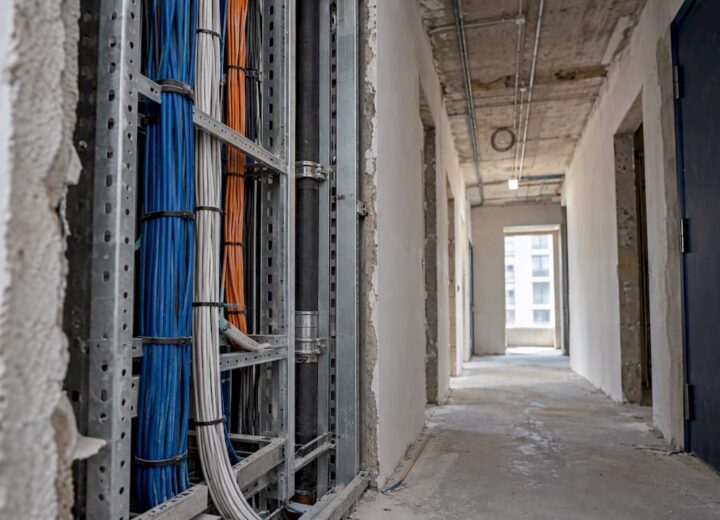
Wi-Fi performance is limited by the cabling behind it. Specify cable category, riser capacity, comms room space, power and cooling at the same time as the architectural layout. Retrofitting cable into occupied apartments is slow, disruptive and expensive compared with doing it before plastering.

Capacity for the next standard
Newer Wi-Fi standards often change access point counts and placement. Our guidance on Wi-Fi 7 readiness explains why planning for extra access points avoids coverage gaps. Designing the cable and power infrastructure with headroom costs little at construction and a great deal later.
Shared spaces behave differently
Amenity lounges, co-working rooms and gyms have density and usage patterns unlike apartments: many devices, video calls, peaks at the same hours. Design them as high-density zones. Our piece on Meraki Wi-Fi design decisions covers channel planning, power levels and roaming choices that apply here.
Internet circuits and resilience
A large scheme should not depend on a single line. Consider diverse routes or a secondary circuit, and decide what must keep working during an outage, such as access control and building management. For checking what broadband is available at a site, the government’s new-build broadband guidance names the Go Superfast postcode checker as the best first tool and the local authority as the best source of availability information. The document dates from 2016, so treat it as a starting point and confirm current provider options directly.
Building systems, IoT and the network underneath
Modern BTR schemes rarely run Wi-Fi alone. Smart locks, energy meters, leak sensors, lighting controls and lift telemetry all need connectivity, and each one is a potential weak point. Keeping these on separate, controlled network segments from resident traffic is a design decision, not an afterthought. Our articles on the role of networking in smart buildings and PropTech connectivity explain how the network and the smart property layer fit together.
Security, privacy and resilience
A resident network is a shared environment with strangers on it. Security needs to be designed in.
The UK government’s Wireless Network Security Standard (SS-019), written by the Department for Work and Pensions for its own estate, is a useful benchmark for control categories. It calls for wireless authentication and encryption, segregation of guest traffic, resilient authentication services, central logging of authentication and association events, and detection of rogue access points. It is a public sector standard and BTR operators are not bound by it, but the controls translate well to a multi-tenant residential network.
In practice that means:
- Segregation. Residents, staff, building systems and visitors each sit on their own network segment.
- Authentication. Per-household credentials rather than one shared password for the whole building.
- Logging and monitoring. Central records of who connected, when and where, kept with a clear retention policy. Because this records personal data, the operator needs a lawful basis, a privacy notice and a defined retention period, and should take advice from its data protection lead or legal adviser.
- Rogue device detection. Alerts for unauthorised access points, which in apartments might be a resident’s own router causing interference.
- Patching and firmware. Someone named and accountable for keeping network equipment up to date.
For wider control frameworks, see our guides on how to know your network is secure and network access control.
Costs and responsibilities
Costs split into three layers: the physical infrastructure (cabling, containment, comms rooms), the active equipment (access points, switches, controllers, firewalls) and the service (internet circuits, licences, monitoring, support, replacement cycles). Build budgets often capture the first layer and underplay the other two.
Responsibility needs naming as clearly as cost. Settle these questions before contracts are signed:
- Who owns the equipment at practical completion, and who is responsible for it afterwards?
- Who answers a resident’s call at 9pm on a Sunday, and what are the response targets?
- Who pays for lifecycle replacement of access points and switches?
- How are service levels measured and reported to the asset manager?
- What happens to the network if the operator changes managing agent or support supplier?
The Association for Rental Living advises owners and developers to define their digital-infrastructure vision from the early RIBA stages, because late-stage changes can lead to costly compromises. In practice, that means a connectivity brief at concept stage, a survey and design before cable containment is fixed, and a support model agreed before handover. Our checklist for procurement of outsourced network management is a useful way to compare support proposals.
A practical brief for a network partner
When you approach suppliers, ask for a response on these points:
- Survey method: predictive, on-site or both, and what is delivered.
- Design: access point counts per apartment type and amenity zone, with assumptions stated.
- Infrastructure requirements: risers, comms rooms, power and cooling.
- Segmentation and security model for residents, staff, visitors and building systems.
- Monitoring and support: hours, escalation, reporting and response targets.
- Commercial model: capital purchase, managed service or subscription, and the term.
- Exit and handover: documentation, ownership and what happens at contract end.
- Experience on comparable multi-site or multi-building estates.
The quality of the answers on points 4, 5 and 7 usually separates a supplier who has run a residential network from one who has only installed one.
Perspective: treat resident Wi-Fi as a service, not an installation
We have spent more than 35 years working with Cisco networks across education, hospitality, logistics and property, and the pattern is consistent. Projects go wrong when Wi-Fi is treated as a one-off installation priced against a line in the build budget. The network then gets value-engineered at the stage when it is hardest to correct.
Our view is that a BTR network should be specified from the outcome backwards: what residents and operators need to experience, what the building systems need to run, and what monitoring and support will keep it that way for years. A cloud-managed approach suits this well, because the operator can see the estate, update it remotely and add sites without rebuilding the model. We would rather survey properly and design with headroom than sell more equipment later to fix gaps.
We would also advise owners to keep a clear line between resident traffic and building systems from the first drawing. It is far cheaper to segment on day one than to untangle a flat network once smart locks and meters depend on it.
— Jacob
How Re-Solution can help
Re-Solution designs and supports Cisco-based networks for property developers, housing associations and other multi-site organisations. For a BTR scheme, the relevant starting points are a wireless survey before design is fixed, managed services for ongoing monitoring and support, and Network as a Service where a subscription model suits the operator better than capital purchase. Our page on IT solutions for property developers outlines how we approach secure, compliant connectivity. To discuss a scheme, start from our services overview.
FAQ
Is Wi-Fi in a build-to-rent building different from ordinary home broadband?
Yes. Home broadband is a single connection and router serving one household. BTR Wi-Fi is a designed network across the whole building, with multiple access points, central management, segmented traffic and a support route run by or for the operator. It also usually supports building systems, not just residents’ devices.
Do developers have to provide broadband in new build homes?
In England, the Building Regulations require new dwellings to be built with gigabit-ready infrastructure and a gigabit-capable connection, subject to a cost cap of £2,000 per dwelling, as set out in GOV.UK guidance. That covers the connection, not a managed Wi-Fi service. Other UK nations have separate rules.
When should Wi-Fi be planned in a build-to-rent project?
At concept and early design stage. The Association for Rental Living recommends defining the digital-infrastructure vision from the early RIBA stages, since the connectivity plan, risers and containment are fixed well before fit-out. A survey and design before cabling is finalised avoids the most expensive corrections.
Should residents be forced to use the managed Wi-Fi?
Not necessarily. A hybrid model can provide managed Wi-Fi in shared areas and for building systems while letting residents choose their own broadband in apartments. Resident choice is one of the pillars the Association for Rental Living associates with a strong digital experience, so decide this deliberately and state it in the tenancy information.
Sources
- New build connectivity: information for developers, GOV.UK
- Connectivity is the key to retention, Association for Rental Living
- 5 Ways Managed Wi-Fi Drives Value for Multifamily Properties, National Apartment Association
- Bulk Internet in Rental Housing FAQs, NMHC
- Security Standard: Wireless Network (SS-019), UK Government
- New build homes: superfast broadband connectivity options, UK Government
Recommended
- Connectivity planning for new builds: a developer’s guide
- Optimise Wi-Fi bandwidth: A practical management guide
- How to upgrade building network infrastructure