
TL;DR:
- Investing in IT infrastructure as a strategic asset enhances growth, reduces costs, and mitigates operational risks. Neglecting this investment leads to costly downtimes, compliance issues, and increased technical debt. Proactive, modular, and security-focused investments improve resilience, agility, and long-term competitiveness.
Most business leaders understand that technology matters. Far fewer treat IT infrastructure as a strategic asset rather than an overhead line on a budget sheet. That misconception is costly. Understanding why invest in IT infrastructure goes well beyond keeping the lights on. It means recognising that the networks, servers, security controls, and connectivity underpinning your operations directly determine your capacity to grow, compete, and recover from disruption. This article covers the financial risks of underinvestment, the measurable returns from modernisation, and the practical frameworks your organisation needs to make infrastructure decisions that deliver lasting value.
Table of Contents
- Key takeaways
- Why invest in IT infrastructure: the risks of not doing so
- How IT investment drives efficiency and transformation
- Principles for scalable and secure infrastructure
- Common pitfalls in infrastructure investment
- Planning and implementing IT infrastructure investments
- My perspective on infrastructure as a strategic driver
- How Re-solution can help you move forward
- FAQ
Key takeaways
| Point | Details |
|---|---|
| Downtime carries real financial cost | IT failures cost organisations thousands per minute, making proactive investment far cheaper than reactive recovery. |
| Digital transformation delivers strong ROI | Modernising infrastructure can cut operational costs significantly and generate returns well above initial spend. |
| Modular design prevents costly overbuilding | Scalable, modular architecture lets systems grow with your business without expensive overprovisioning. |
| Shared cloud responsibility is often misunderstood | Moving to cloud does not transfer all security obligations; data governance and identity management remain your responsibility. |
| Continuous investment avoids technical debt | Treating infrastructure as a dynamic asset rather than a fixed cost protects agility and long-term competitiveness. |
Why invest in IT infrastructure: the risks of not doing so
The question of whether to invest in IT infrastructure is often framed as a cost discussion. The more accurate framing is a risk discussion. When infrastructure is neglected, the consequences are measurable and severe.
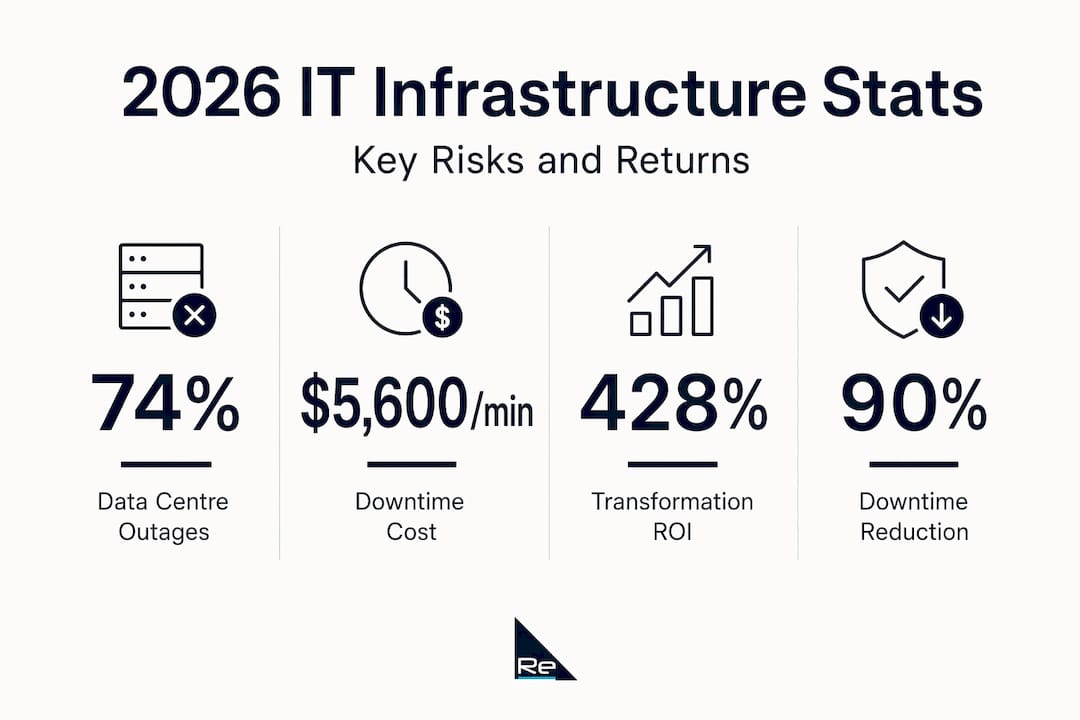
IT downtime costs organisations approximately $5,600 per minute on average, and data breaches carry an average cost exceeding $4 million. Those figures represent direct financial loss. They do not capture the downstream effects: customer attrition, reputational damage, and regulatory penalties that compound over time.
The specific risks of inadequate infrastructure include:
- Revenue loss from outages. When systems fail during peak trading periods, the financial impact is immediate and often unrecoverable within that window.
- Regulatory and compliance exposure. Infrastructure failures cause compliance violations that attract fines and audit scrutiny, particularly in regulated sectors such as education, healthcare, and financial services.
- Reputational damage. Customers and partners lose confidence quickly after visible failures. Rebuilding that trust takes considerably longer than preventing the incident.
- Legacy system fragility. Older systems are harder to patch, slower to integrate with modern platforms, and increasingly incompatible with security tooling.
Consider the scale of disruption from poor scaling decisions: 74% of companies have experienced a data centre outage, and 80% report significant operational disruptions as a result. These are not isolated incidents. They are predictable outcomes of treating infrastructure as a static, low-priority spend category.
Proactive investment in monitoring, redundancy, and disaster recovery is not a premium option. It is the baseline for operational continuity.
How IT investment drives efficiency and transformation
One of the clearest arguments for understanding the benefits of IT infrastructure is the return it generates when investment is approached strategically. The data here is difficult to ignore.

Strategic digital transformation delivers ROI ranging from 187% to 428%, with operational cost reductions of between 38% and 65%. These figures come from documented case studies, not projections. Organisations that modernised their infrastructure did not simply spend less on IT. They fundamentally changed how efficiently their operations ran.
The mechanism behind this is straightforward. Modern infrastructure enables automation, reduces manual error, and removes the friction that slows decisions and processes. Here is how that translates in practice:
- Scalability on demand. Cloud-native architecture and modular systems allow capacity to expand during peak periods without procuring and provisioning physical hardware months in advance.
- Faster deployment of new services. When the underlying infrastructure is well-designed, new applications and tools can be rolled out in days rather than quarters.
- AI and advanced analytics readiness. IT infrastructure forms the foundation for the current AI supercycle. Without the physical and network assets to support it, AI adoption remains aspirational rather than operational.
- Technical debt reduction. Organisations that invest continuously in infrastructure reduce the accumulation of outdated systems that slow agility and increase maintenance costs.
- Earnings growth correlation. Sustaining IT investment above baseline by just 5% annually correlates with 24% EPS growth over five years. That is a compelling business case for any board conversation.
Pro Tip: When presenting infrastructure investment to senior stakeholders, anchor the discussion to business outcomes rather than technical specifications. Frame the case around revenue protection, cost reduction, and competitive positioning.
The importance of IT investments becomes visible not just in cost savings but in strategic flexibility. Organisations with modern, well-maintained infrastructure can respond to market changes faster, onboard new partners more easily, and absorb acquisitions with less integration risk.
Principles for scalable and secure infrastructure
Knowing the advantages of investing in technology is one thing. Designing systems that actually deliver those advantages is another. The following principles help decision-makers avoid the two most common failure modes: overbuilding expensive capacity that goes unused, and underbuilding systems that buckle under growth.
Modular architecture over monolithic design
Scalability is architectural by nature. Modular design allows individual services to scale independently, which prevents bottlenecks and removes the need for costly overprovisioning. A manufacturing company, for example, can scale its production monitoring systems independently from its enterprise resource planning (ERP) environment, rather than upgrading the entire infrastructure stack to accommodate one workload.
| Approach | Strengths | Risks |
|---|---|---|
| Modular architecture | Scales components independently; reduces overprovisioning | Requires clear integration planning |
| Monolithic architecture | Simpler initial setup; fewer moving parts | Difficult to scale; creates bottlenecks at growth stages |
| Hybrid (modular + core monolith) | Balances flexibility with stability | Demands stronger governance and documentation |
Security by design, not by addition
Security added as an afterthought is consistently less effective and more expensive than security built into the architecture from the outset. This means implementing Zero Trust principles, network access controls (NAC), and identity governance before systems go live, not after an incident forces the conversation.
In cloud environments, the shared responsibility model creates a specific risk that many organisations underestimate. Moving workloads to cloud does not transfer accountability for data governance, identity management, or configuration controls. Those remain the customer’s responsibility. Misunderstanding this boundary is one of the most common sources of cloud security incidents.
Redundancy and automated monitoring
High availability is not achieved by hoping systems stay up. It requires redundant components, tested failover processes, and automated monitoring that detects degradation before it becomes an outage. Automation reduces manual errors and enables faster response at the moments when speed matters most.
Pro Tip: Move beyond basic monitoring towards observability. Observability uses AI-driven tooling to understand why a system is behaving in a particular way, not just that something has gone wrong. This shift is where proactive infrastructure management becomes genuinely predictive rather than reactive.
Common pitfalls in infrastructure investment
Understanding why upgrade IT systems matters requires equally understanding why organisations delay or underfund the decision. Several recurring patterns lead to poor outcomes:
- Treating infrastructure as a static cost centre. Technology spend linked to clear business outcomes consistently outperforms spend managed as a fixed overhead. Organisations that view IT as a fixed cost miss the value it can unlock.
- Cutting monitoring and backup budgets. These are the first items removed when finance teams look for savings. They are also the controls that prevent a routine failure from becoming a catastrophic one.
- Ignoring scalability during procurement. Selecting infrastructure based on today’s workload without modelling growth scenarios results in systems that require replacement far sooner than planned.
- Underestimating hidden costs. Cost-driven infrastructure decisions mask the real expense. The operational risk, the inability to adopt new technologies, and the engineering time consumed by maintaining fragile systems all carry costs that do not appear on the initial procurement comparison.
- Deferring investment until failure. IT infrastructure is a dynamic, depreciating asset that requires continuous attention. Deferred maintenance accumulates technical debt that becomes exponentially more expensive to address.
The key reasons for IT infrastructure investment are not found in vendor marketing. They are found in the operational and financial consequences of the organisations that chose not to invest.
Planning and implementing IT infrastructure investments
Knowing the rationale for investment is necessary. Acting on it effectively requires a structured approach. These steps give business leaders a practical path from assessment to execution:
- Audit your current state. Before planning future investment, understand what you have. Map your existing infrastructure challenges including hardware age, software dependencies, network capacity, and security gaps. You cannot prioritise what you have not measured.
- Set goals tied to business outcomes. Infrastructure investment goals should connect directly to measurable business results: uptime targets, deployment timescales, compliance requirements, or cost reduction percentages. Avoid setting purely technical targets that the board cannot evaluate.
- Model growth scenarios. Design systems to accommodate projected growth, not just current demand. This is where modular architecture decisions pay off, because capacity can be added incrementally rather than through disruptive replacement cycles.
- Engage managed services expertise. Managed IT services reduce downtime by 70 to 90% through continuous monitoring, patching, and 24/7 response. For many organisations, this model delivers capabilities that would be cost-prohibitive to build in-house.
- Plan for ongoing optimisation. Infrastructure investment is not a project with a completion date. Build governance processes that include regular reviews, capacity planning, and security assessments as standard practice rather than exceptional events.
Modernising infrastructure in 2026 requires aligning technical decisions with strategic priorities. The organisations that do this consistently outperform those treating IT as a back-office function.
My perspective on infrastructure as a strategic driver
I have observed a persistent and damaging pattern across organisations of every size: infrastructure investment decisions made by elimination rather than strategy. When budgets tighten, IT gets cut. When projects overrun, infrastructure upgrades get deferred. The logic appears sound in the short term. The consequences appear two or three years later, when the cost of remediation dwarfs the original saving.
What I have seen in the organisations that get this right is a fundamentally different framing. They treat infrastructure not as a cost to manage down, but as a capability to invest in. They connect every infrastructure decision to a business question: What does this enable? What risk does it remove? What will this cost us if we defer it?
The businesses I have seen gain genuine competitive advantage from IT investment are not always the ones with the largest budgets. They are the ones with the clearest governance, the most consistent investment discipline, and the willingness to engage expert partners rather than trying to manage complexity entirely in-house.
Conventional wisdom says you invest in IT when something breaks. In my experience, the organisations that wait for that moment are always playing catch-up. The ones that invest ahead of need are the ones that can actually exploit new technologies when the opportunity arrives, rather than scrambling to get the basics in place first.
— Jacob
How Re-solution can help you move forward

Re-solution has over 35 years of experience helping organisations across education, manufacturing, hospitality, and logistics design, implement, and manage IT infrastructure that performs under real operational demands. Whether your priority is network modernisation, security and compliance, or building the connectivity foundation for digital transformation, Re-solution brings the technical depth and sector knowledge to make the investment count.
Explore Re-solution’s managed IT services to understand how continuous monitoring and proactive management protect uptime and reduce operational risk. If you are at the planning stage, the IT infrastructure explained resource provides a clear foundation for making informed investment decisions. The team is available to assess your current infrastructure, identify gaps, and build a roadmap aligned to your business objectives.
FAQ
What is the average cost of IT downtime for businesses?
IT downtime costs organisations approximately $5,600 per minute on average. Data breaches carry an average cost exceeding $4 million, making proactive infrastructure investment considerably more cost-effective than incident recovery.
How much ROI can strategic IT infrastructure investment deliver?
Documented case studies show digital transformation ROI ranging from 187% to 428%, with operational cost reductions of between 38% and 65%. The returns depend on the scope of modernisation and how clearly investment goals are tied to business outcomes.
What does the cloud shared responsibility model mean for my organisation?
Moving workloads to cloud does not transfer all security obligations to the provider. Customers remain responsible for data governance, identity management, and security configurations under the shared responsibility model, regardless of which cloud platform is used.
How do managed IT services reduce infrastructure risk?
Managed IT services reduce downtime by 70 to 90% through continuous monitoring, automated patching, and 24/7 incident response. For organisations without large internal IT teams, this model provides enterprise-grade capabilities at a predictable cost.
Why do organisations keep deferring IT infrastructure investment?
The most common reason is that infrastructure is treated as a fixed cost rather than a strategic asset. Short-term budget pressure leads to deferred maintenance that accumulates technical debt, ultimately costing more to resolve than the original investment would have.
Recommended
- Challenges in IT Infrastructure & How to Overcome | Re-Solution
- How to Future-Proof IT Infrastructure for 2025 | Re-Solution