TL;DR:
- Firewalls have evolved from simple packet filters to AI-driven platforms that inspect application behavior in real time.
- Effective security depends on continuous rule updates, layered defenses, and integrating logs with broader security systems.
Firewalls have never been simple tools, yet too many organisations treat them that way. Understanding firewall security is not just about knowing what a firewall does. It is about recognising how far these systems have evolved, from basic packet filters that matched source and destination addresses to AI-enhanced platforms that inspect application behaviour in real time. Firewalls scrutinise traffic to block threats like malware and data exfiltration while preserving the integrity and availability of your digital assets. This guide covers firewall security basics, firewall protection types, advanced integration strategies, and the best practices that separate effective security from false confidence.
Table of Contents
- Key takeaways
- Understanding firewall security fundamentals
- Firewall protection types in modern architectures
- Advanced firewall features and integration
- Firewall security best practices
- Emerging trends shaping firewall security
- My perspective on firewall security
- How Re-Solution supports your firewall strategy
- FAQ
Key takeaways
| Point | Details |
|---|---|
| Firewalls are not static | Firewall rules must evolve continuously to address emerging threats and changing network conditions. |
| Firewall protection types vary widely | Understanding differences between packet-filtering, stateful, NGFW, and cloud firewalls enables better architecture decisions. |
| Default-deny is the correct baseline | Explicit allow rules combined with a default-deny policy significantly reduce your attack surface. |
| Logs are a critical intelligence source | Monitoring and correlating firewall logs with SIEM systems reveals policy failures and active threats. |
| Integration is non-negotiable | Firewalls alone are insufficient. Combining them with endpoint security and Zero Trust models provides layered defence. |
Understanding firewall security fundamentals
A firewall enforces a security policy at the boundary between networks. Every packet that crosses that boundary is evaluated against a set of rules, and the outcome is either to permit, reject, or drop the traffic. Firewall security acts as the primary gatekeeper against malware and data theft, making foundational knowledge of how these systems operate indispensable for any IT professional.
How packet inspection and rule matching work
When a packet arrives at a firewall interface, the device examines its headers. At the most basic level, this means checking source IP, destination IP, protocol, and port number against an ordered rule list. The first matching rule wins. This is packet filtering, and while it is fast, it is also stateless. Each packet is assessed in isolation, with no awareness of whether it belongs to an established connection.
Stateful inspection addresses that limitation. Rather than treating every packet independently, stateful firewalls track active sessions using a connection table keyed by protocol, source and destination IP, and port information. Packets belonging to established, legitimate sessions are permitted without re-evaluating every rule. New connection attempts are scrutinised fully. This significantly improves both security and efficiency.
Firewall zones and deployment models
Most enterprise deployments segment traffic into at least three zones:
- Trust zone: Internal networks with higher implicit confidence, such as your corporate LAN.
- DMZ (Demilitarised Zone): A semi-public segment hosting services like web servers or mail gateways that must be reachable from the internet while remaining isolated from internal systems.
- Untrust zone: The internet or any external network treated as hostile by default.
The default-deny approach treats all traffic as untrusted until explicitly permitted. This contrasts with default-allow, where everything passes unless blocked. Default-deny is the correct security posture for virtually every environment. It forces administrators to make deliberate, documented decisions about what is allowed, rather than hoping that blocklists catch everything threatening.
| Firewall type | Inspection depth | Session awareness | Typical use case |
|---|---|---|---|
| Packet filter | Headers only | No | Basic perimeter control |
| Stateful inspection | Headers and session state | Yes | Enterprise perimeter and branch offices |
| Proxy firewall | Full application content | Yes | Controlled internet access, content filtering |
| Next-generation firewall | Deep packet, application and user identity | Yes | Modern enterprise and cloud-connected environments |
Firewall protection types in modern architectures
The category of firewall you deploy shapes what threats you can realistically detect and contain. Each type carries specific strengths, and understanding those differences is central to building a sound architecture.
Hardware firewalls are dedicated physical appliances positioned at network boundaries. They handle high traffic volumes with minimal latency and are well suited to data centre perimeters. Their limitation is that they do not follow workloads when those workloads move to cloud environments.

Software firewalls run on general-purpose operating systems and are commonly deployed on endpoints or virtual machines. They offer flexibility but depend heavily on the underlying host for performance and availability.
Cloud-native and virtual firewalls address distributed infrastructure by operating within cloud platforms, inspecting traffic between virtual machines, containers, and cloud services. As more workloads move to AWS, Azure, or Google Cloud, these firewalls become essential rather than optional.
Next-generation firewalls (NGFWs) combine stateful inspection with deep packet inspection, application awareness, user identity integration, and intrusion prevention. Re-Solution’s resource on legacy vs next-generation firewalls outlines the specific capability gaps between traditional perimeter devices and modern NGFW platforms. NGFWs can distinguish between legitimate LinkedIn traffic and a tunnelling tool using port 443, which a simple stateful firewall cannot.
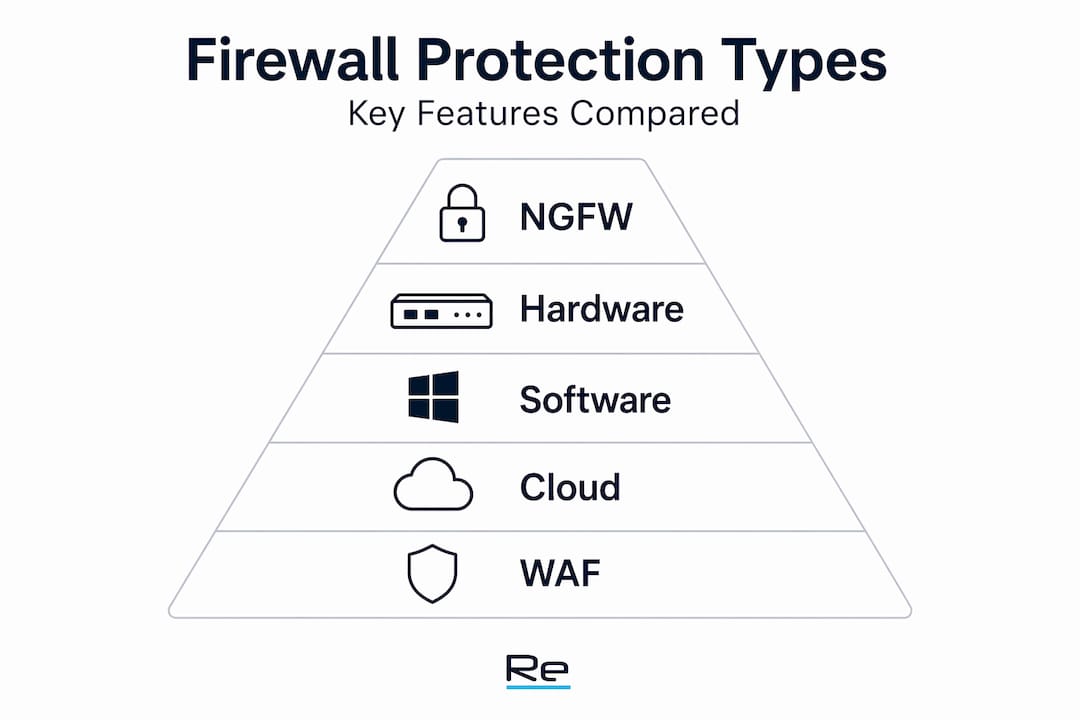
Web application firewalls (WAFs) focus specifically on HTTP and HTTPS traffic, protecting web applications from SQL injection, cross-site scripting, and application-layer denial-of-service attacks. They operate at Layer 7 and understand web application context in ways that perimeter firewalls do not.
Network segmentation by function and trust level is a principle that applies across all firewall types. Separating guest Wi-Fi from production systems, and production systems from management interfaces, ensures that a compromise in one segment does not automatically cascade across the entire network.
Advanced firewall features and integration
Modern NGFWs are no longer purely boundary enforcement tools. AI and machine learning are now integrated into threat detection, enabling firewalls to identify anomalous behaviour patterns that signature-based systems would miss entirely. A firewall that has learned the typical traffic profile for your network can flag an unusual spike in outbound DNS queries before any signature exists for the underlying malware.
Intrusion Prevention Systems embedded within NGFWs inspect traffic in real time and automatically block malicious activity based on threat intelligence feeds, behavioural analysis, and vulnerability signatures. This moves the firewall from a passive policy enforcer to an active participant in threat response.
Deep Packet Inspection (DPI) deserves specific attention. DPI looks beyond headers into the actual payload of packets, allowing firewalls to identify applications, inspect for embedded threats, and enforce policies based on content rather than just port and protocol. This is what allows an NGFW to block file transfers over an otherwise-permitted application or to detect malware embedded within a PDF.
The following integration points are where firewall effectiveness multiplies:
- Endpoint security platforms: Sharing threat intelligence between endpoint detection tools and the firewall allows the firewall to block lateral movement when an endpoint is compromised.
- Zero Trust architectures: Firewalls enforce micro-segmentation and identity-aware policies, ensuring that users and devices only access what they are explicitly authorised for, regardless of their network location.
- Security Information and Event Management (SIEM): Forwarding firewall logs to a SIEM enables correlation across your entire environment, not just at the boundary.
- Threat intelligence feeds: Automatically updated lists of known malicious IP addresses, domains, and certificates keep firewall policies current without manual intervention.
Pro Tip: When integrating firewall logs with a SIEM, verify that timezone configurations are consistent across both systems. Timezone mismatches during incident investigations can cause analysts to sequence events incorrectly, leading to flawed conclusions about the attack chain.
Firewall security best practices
Effective firewall management is ongoing work, not a deployment exercise. The following practices define the difference between a firewall that genuinely reduces risk and one that provides only the appearance of security.
-
Implement default-deny as your baseline policy. Every rule you add should represent a deliberate, documented decision. Unexplained allow rules accumulate over time and create exposure that no one fully understands.
-
Review and prune firewall rules on a scheduled basis. Firewall rules must adapt to emerging threats and changing infrastructure. Rules written for systems that no longer exist are a common source of unnecessary exposure.
-
Monitor firewall logs actively. Traffic permitted to suspicious destinations is one of the clearest indicators of a compromised internal host or a failing security policy. Allowed traffic to suspicious IPs in firewall logs frequently signals policy failure rather than normal network behaviour.
-
Apply least privilege to firewall rule scope. Rules should be as specific as possible. Permitting all traffic from a trusted source IP to any destination on any port negates the value of having a firewall. Source, destination, protocol, and port should all be specified.
-
Handle ICMP selectively rather than blocking it entirely. Blanket ICMP blocks can break essential network functions such as Path MTU Discovery. Permit only the ICMP types your environment actually requires and block the remainder.
-
Choose between ‘drop’ and ‘reject’ deliberately. Drop discards packets silently to avoid revealing network topology information, while reject sends an error response that can prevent connection timeouts for legitimate services. The right choice depends on the specific rule context and what information disclosure risk you are managing.
Pro Tip: Review your rule base from the perspective of an attacker who already has access to your network. Ask what lateral movement is possible given your current allow rules. The answers are often uncomfortable and almost always worth acting on.
Re-Solution’s network security best practices guide provides additional guidance on defence-in-depth approaches that complement sound firewall configuration.
Emerging trends shaping firewall security
The boundaries of what a firewall does and where it operates are shifting significantly. IT professionals who understand these trends will be better positioned to make architecture decisions that remain sound over the next several years.
- AI-driven threat detection and automated response: Firewalls increasingly use machine learning models trained on global threat telemetry to identify novel attack patterns without relying on existing signatures. Automated response capabilities can isolate a compromised segment within seconds of a detected anomaly.
- Cloud-native firewalls: As infrastructure shifts to multi-cloud and hybrid models, firewalls must operate natively within those environments. Cloud-native firewalls scale dynamically with workloads rather than requiring manual capacity planning.
- Zero Trust and identity-aware policies: The traditional perimeter model assumes that internal traffic is trustworthy. Zero Trust rejects that assumption entirely. Modern firewalls enforce policies based on verified user identity, device posture, and application context. Re-Solution’s resource on advanced networking technologies covers how identity-aware access fits within broader network security architectures.
- Integration with unified security platforms and SOCs: Firewalls are increasingly a data source and enforcement point within a larger security operations architecture rather than a standalone tool. The value comes from what the rest of the platform does with the firewall’s telemetry.
- Beyond the perimeter: Workloads in containerised environments, serverless functions, and edge computing require firewall-like controls that operate at entirely new layers of the stack. Understanding network security now means thinking beyond the traditional appliance model.
My perspective on firewall security
I’ve seen firewall projects go wrong in a very specific way. The deployment is well planned, the initial rule base is sensible, and the team celebrates getting the system live. Then, eighteen months later, no one can explain why half the rules exist or what would break if they were removed. The firewall has become a black box that everyone is afraid to touch.
The organisations that get this right treat firewall management as a continuous process with regular ownership. Every rule has an owner. Every allow rule has a documented business justification. Log review happens on a schedule, not just when an incident forces it.
What I find most underappreciated is the correlation between firewall logs and endpoint telemetry. The firewall log tells you that traffic was permitted. The endpoint tells you what process generated it. Together, they tell you whether you have a problem. Separately, each one leaves critical gaps. Combining firewalls with endpoint tools is not optional in any environment handling sensitive data.
The uncomfortable truth is that most organisations have more firewall rules than they can confidently audit. Fixing that is less about technology and more about process discipline and clear ownership.
— Jacob
How Re-Solution supports your firewall strategy

Re-Solution works with organisations across education, manufacturing, and logistics to design, deploy, and manage IT infrastructure that meets real security requirements. With over 35 years of experience as a Cisco partner, the team brings direct expertise in NGFW deployment, network segmentation, Zero Trust architecture, and ongoing firewall rule management.
Rather than delivering a configuration and stepping away, Re-Solution provides managed services that treat firewall security as the continuous discipline it actually is. That means scheduled rule reviews, log monitoring, and integration with broader security platforms. For organisations looking to understand their current exposure before making changes, infrastructure audits provide a clear starting point.
Explore Re-Solution’s IT infrastructure services to see how managed network security and firewall expertise translate into practical, auditable protection for your environment. To discuss your specific requirements, visit the Network as a Service page or get in touch directly.
FAQ
What is understanding firewall security in simple terms?
Firewall security is the practice of using rule-based systems to control which network traffic is permitted or blocked between networks or network segments. It preserves the integrity, confidentiality, and availability of digital assets by filtering traffic according to defined security policies.
How do firewalls work at a technical level?
Firewalls inspect packet headers and, in more advanced systems, packet payloads and session state against an ordered rule list. Stateful firewalls maintain a connection tracking table to distinguish new and established sessions, improving both accuracy and performance.
What are the main firewall protection types?
The main types are packet-filtering firewalls, stateful inspection firewalls, proxy firewalls, next-generation firewalls (NGFWs), and web application firewalls (WAFs). Each operates at a different layer of the network stack and suits different security requirements.
What are the core benefits of firewall security?
Firewalls block unauthorised access, contain lateral movement within networks, prevent data exfiltration, and provide a traffic log that supports incident investigation and compliance reporting. NGFWs add application-layer visibility and automated threat response.
What are the most important firewall security best practices?
Implement default-deny policies, review and audit rules regularly, monitor logs actively, apply least privilege to rule scope, handle ICMP selectively, and integrate firewall telemetry with endpoint security tools and SIEM platforms for complete visibility.
Recommended
- Step-by-step network security guide for robust protection
- Modern network security: A complete guide for IT leaders
- Network Security Best Practices Guide | Re-Solution
- Network Security Best Practices Guide | Re-Solution