TL;DR:
- Implementing structured, framework-driven network security reduces risks across education, manufacturing, and hospitality sectors by enhancing planning, controls, and validation. Gathering comprehensive requirements and adopting layered frameworks like NIST CSF, Zero Trust, and CIS Controls provide a practical approach to effective cybersecurity. Continuous testing, validation, and adaptation are essential for maintaining a resilient, compliant, and secure network environment.
Network breaches in education, manufacturing, and hospitality are not theoretical. Ransomware shut down multiple UK universities in recent years, while manufacturing facilities have suffered costly operational halts due to compromised industrial control systems. Hospitality networks, with their mix of guest Wi-Fi, point-of-sale terminals, and back-office systems, present a similarly complex attack surface. A structured, framework-driven approach to network security reduces risk systematically, replacing reactive firefighting with disciplined, repeatable protection. This guide takes you from requirements gathering through technical implementation to ongoing validation.
Table of Contents
- Identify your network security requirements
- Choose the right frameworks and controls
- Implement core network security steps
- Test, validate, and continuously improve your security
- Why a framework-first approach is necessary but never enough
- Take the next step towards robust network security
- Frequently asked questions
Key Takeaways
| Point | Details |
|---|---|
| Map your environment | Start with a clear inventory of assets, risks, and regulations before any network changes. |
| Choose proven frameworks | Select and layer NIST CSF, Zero Trust, and CIS Controls to guide actions and strategies. |
| Follow a sequenced process | Implement controls step-by-step for logical coverage and measurable outcomes. |
| Test and adapt continuously | Regular validation and improvement are vital as threats and environments evolve. |
| Tailor for your sector | Modify frameworks and controls to address unique needs of education, manufacturing, or hospitality. |
Identify your network security requirements
Mapping your requirements before touching any configuration is the single most important step in any security programme. Without it, organisations tend to apply generic controls that either miss critical gaps or create unnecessary friction for legitimate users.
Start by documenting what you are protecting. Requirements typically fall into three categories:
- Regulatory compliance: GDPR data protection obligations, sector-specific mandates such as PCI DSS for hospitality payment systems, and Cyber Essentials for UK public sector contracts.
- Data confidentiality: Student records, intellectual property in manufacturing, and guest personal data in hotels all carry distinct sensitivity levels and legal obligations.
- Availability of critical systems: A manufacturing production line cannot tolerate the same downtime as an office email server. Mission-critical systems need explicit uptime and recovery targets.
Assessing your environment honestly is equally important. Legacy systems are common across all three sectors. Manufacturing sites often run operational technology (OT) such as programmable logic controllers (PLCs) that were never designed with network security in mind. Hospitality venues frequently operate a mix of on-premises and cloud-based property management systems. Educational institutions juggle student-owned devices, staff workstations, and research infrastructure simultaneously.
A practical, step-by-step approach for network security implementation can be structured around NIST Cybersecurity Framework (CSF) functions and profiles, then operationalised via concrete implementations. The NIST CSF organises security activities into five core functions: Identify, Protect, Detect, Respond, and Recover. Using these as a template, you can build a current-state profile and a target-state profile, then prioritise the gap between them.
Critically, requirements gathering must involve more than the IT team. Heads of operations, finance directors, and risk officers each bring context that shapes priorities. A finance director may flag a specific regulatory deadline. An operations manager may identify a production system that cannot be taken offline for patching.
| Sector | Common legacy constraints | Key regulatory drivers |
|---|---|---|
| Education | Student-owned BYOD devices, aged campus switches | GDPR, Cyber Essentials |
| Manufacturing | OT/PLC systems, air-gapped networks | NIS2 Directive, ISO 27001 |
| Hospitality | POS terminals, guest Wi-Fi segmentation | PCI DSS, GDPR |
When building a secure network, this structured requirements phase prevents costly rework later. Similarly, tackling network infrastructure challenges effectively starts with a clear understanding of your current environment before any remediation begins.
Pro Tip: Create a simple asset register at this stage, even a spreadsheet, that maps every system to its owner, its sensitivity level, and its connectivity. This single document will anchor every subsequent security decision.
Choose the right frameworks and controls
Once requirements are documented, select the frameworks that will govern your implementation. No single framework covers every situation, and the most effective programmes layer them deliberately.
NIST CSF remains the best starting point for most organisations. It is risk-based, adaptable, and widely recognised by auditors, insurers, and executive stakeholders. It gives IT managers a language for communicating security investment in business terms.
Zero Trust Architecture (ZTA) addresses the reality that network perimeters no longer exist in a meaningful sense. Remote workers, cloud services, and guest networks all blur the boundary. ZTA operates on the principle of “never trust, always verify,” enforcing identity and device checks before granting any resource access. NIST’s ZTA practice guide describes how organisations can implement zero trust and includes detailed technical information on multiple reference implementations, covering both software-defined perimeters and micro-segmentation approaches.
CIS Controls offer something different: a prioritised, implementation-ready checklist. CIS Controls v8.1 provides a prioritised control set that explicitly includes network-focused controls, such as secure configuration management, continuous monitoring, and controlled access based on the need to know. For organisations with limited resources, CIS Controls help identify the highest-impact actions first.
CISA Cybersecurity Performance Goals (CPGs) are particularly relevant for manufacturing environments with OT infrastructure. They address the intersection of IT and OT security, providing measurable goals designed for critical infrastructure operators.
A useful sequence for selecting and layering frameworks:
- Use NIST CSF to define your current and target security profiles.
- Apply CIS Controls to identify specific, actionable technical steps within each CSF function.
- Introduce Zero Trust principles where access diversity is highest, particularly for hybrid and cloud-connected environments.
- Reference CISA CPGs for OT-specific requirements or where critical infrastructure obligations apply.
- Validate your framework selection against sector-specific guidance from bodies such as the NCSC.
The network security best practices that emerge from this layered approach are far more robust than those derived from a single standard alone. For an overview of how industry-specific security solutions align with these frameworks, the industry security solutions overview provides useful context on applied implementations.
| Framework | Best used for | Key strength |
|---|---|---|
| NIST CSF | Strategic planning and risk profiling | Flexible, risk-based, executive-friendly |
| Zero Trust (ZTA) | Access control in hybrid environments | Eliminates implicit trust |
| CIS Controls v8.1 | Technical implementation prioritisation | Actionable, step-by-step |
| CISA CPGs | OT/critical infrastructure environments | Measurable, cost/impact aware |
Pro Tip: Do not attempt to implement all frameworks simultaneously. Start with NIST CSF for planning and CIS Controls for your first technical sprint. Add Zero Trust capabilities incrementally as your team’s familiarity grows.
Implement core network security steps
Frameworks provide the strategy. What follows is the sequenced technical process that transforms that strategy into operational protection.
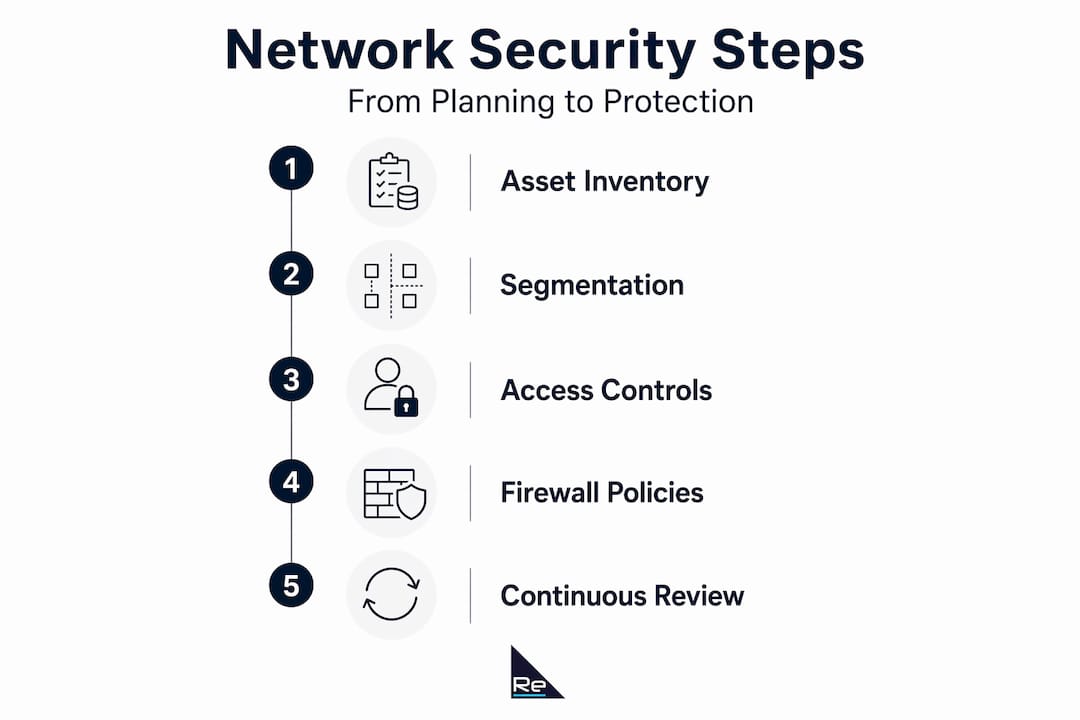
Step 1: Complete an asset inventory
You cannot protect what you cannot see. Document every endpoint, server, network device, and OT system. Assign each asset a classification: critical, sensitive, or standard. This classification drives every subsequent decision about segmentation and access controls.

Step 2: Apply network segmentation
Segmentation limits the blast radius of any breach. Separate guest networks from internal systems. Isolate OT networks from IT networks in manufacturing environments. Create distinct VLANs (virtual local area networks) for different user groups in education and hospitality. NIST’s ZTA practice guide provides concrete reference implementations for segmentation that align with a Zero Trust model.
Step 3: Enforce access controls
Implement least-privilege access, meaning every user and system receives only the permissions required for their role. In educational environments, this means different access profiles for students, academic staff, and administrators. In hospitality, front-desk terminals should have no access to back-office financial systems. Multi-factor authentication (MFA) should be enforced for all privileged accounts.
Step 4: Configure and enforce firewall policies
Firewall rules should be explicit rather than permissive. Start with a deny-all default policy and permit only necessary traffic. Document the business justification for every rule. Review rules regularly to remove those that are outdated. CIS Controls v8.1 includes network-focused controls covering secure firewall configuration and ongoing rule management.
Step 5: Deploy continuous monitoring
Passive monitoring is insufficient. Deploy a security information and event management (SIEM) system or at minimum a network detection tool capable of alerting on anomalous behaviour. Log all authentication events, firewall denials, and lateral movement attempts. Establish baseline behaviour so that deviations trigger investigation rather than being lost in noise.
Step 6: Develop and rehearse an incident response plan
A documented plan that no one has practised is of limited value. Run tabletop exercises at least twice a year. Define escalation paths, communication protocols, and containment procedures for your most likely threat scenarios.
“The biggest gap in most organisations’ security posture is not a missing tool. It is the absence of a tested, role-specific response plan that staff can execute under pressure.”
The network security best practices that govern this sequenced approach should be documented with version control so that changes are traceable. A network build step-by-step guide can serve as a useful companion reference for teams working through technical implementation for the first time.
Pro Tip: After completing each implementation step, document the current state in your NIST CSF profile. This creates an audit trail and makes progress visible to senior stakeholders who may not be close to day-to-day implementation activities.
Test, validate, and continuously improve your security
After deployment, commit to structured validation. Security that has not been tested is security that cannot be trusted.
Penetration testing should be performed at least annually and after any significant infrastructure change. External testers bring an adversarial perspective that internal teams often cannot replicate. Focus testing on segmentation boundaries, authentication bypass attempts, and OT interfaces.
User access reviews should be conducted quarterly. Stale accounts and over-privileged roles accumulate rapidly in environments with high staff turnover, which is a consistent challenge in both hospitality and education. Automated identity governance tools can flag accounts that have not been accessed within a defined period.
Continuous monitoring benchmarks allow you to measure improvement over time. CISA’s CPGs provide prioritised IT and OT cybersecurity practices for measurable risk reduction in critical infrastructure environments, giving IT managers a benchmarking framework that translates directly into board-level reporting.
Firewall policy reviews must be scheduled formally, not conducted ad hoc. NIST’s firewall guideline is the primary federal technical reference for perimeter and firewall policy mechanics, offering structured criteria for evaluating rule sets and configuration standards.
Common issues identified during validation include:
- Overly permissive firewall rules that were added during an emergency and never reviewed.
- Segmentation gaps where a new device was connected to the wrong VLAN without documentation.
- Monitoring blind spots caused by encrypted traffic that bypasses inspection.
- Unmanaged devices, particularly in OT environments, where firmware updates have not been applied in years.
| Validation activity | Recommended frequency | Primary risk addressed |
|---|---|---|
| Penetration testing | Annually and post-major change | Undetected vulnerabilities |
| User access review | Quarterly | Privilege creep and stale accounts |
| Firewall rule review | Annually and post-incident | Unnecessary exposure |
| SIEM alert tuning | Monthly | Missed detections and alert fatigue |
| Incident response drill | Bi-annually | Slow or ineffective response |
The firewall policy deployment process should include a formal sign-off step after each review cycle, ensuring accountability. For practical guidance on addressing gaps discovered during validation, the resource on troubleshooting network security covers common configuration errors and remediation approaches in accessible detail.
Why a framework-first approach is necessary but never enough
Frameworks such as NIST CSF and CIS Controls are indispensable. They provide a common language for internal communication, a baseline for benchmarking, and a defensible audit trail for regulators and insurers. Without them, security programmes tend to be reactive, underfunded, and difficult to justify to leadership.
But frameworks are not a substitute for judgement. After working across education, manufacturing, and hospitality environments for over three decades, the clearest pattern is this: organisations that treat framework compliance as the goal rather than a tool consistently underperform on actual security outcomes.
Consider legacy OT environments in manufacturing. CISA’s CPGs acknowledge cost, impact, and feasibility constraints that make direct application of IT security controls impractical for embedded industrial systems. A PLC running firmware from 2009 cannot simply have an endpoint agent installed. Segmentation and network monitoring become the primary controls, but their effectiveness depends on physical network diagrams that are often incomplete or outdated. The framework tells you what to achieve. It does not tell you how to work around a 15-year-old network switch that has no VLAN capability.
In education, overlapping access requirements create a different kind of complexity. Students, staff, researchers, and visitors all require network access with different trust levels. Zero Trust in principle is straightforward. In practice, implementing it across a campus with hundreds of access points, dozens of legacy systems, and a user population that changes every academic year requires constant adaptation rather than a one-time configuration.
The frameworks and practical advice available from recognised bodies are best treated as a scaffold, not a blueprint. Real security maturity comes from applying frameworks repeatedly, learning where they fit imperfectly, and building the institutional knowledge to adapt them. Organisations that document what they have adapted and why are far better positioned to respond to new threats than those who simply claim framework compliance on paper.
Take the next step towards robust network security
Understanding the steps is valuable. Acting on them with the right support makes the difference between a theoretical plan and a genuinely secure network.

Re-Solution has over 35 years of experience supporting educational institutions, manufacturers, and hospitality businesses in designing, implementing, and validating network security that aligns with NIST, CIS, and Zero Trust standards. Whether your starting point is a basic understanding of IT infrastructure or a gap-ridden legacy environment, our team can help you move forward with clarity. Our professional network audits provide a structured assessment of your current state, mapping findings directly to remediation priorities. For teams working through compliance requirements, our network compliance checklist provides a practical reference that complements the framework-driven approach described in this guide.
Frequently asked questions
How do I choose between NIST CSF, Zero Trust, and CIS Controls?
Start with NIST CSF for strategic alignment, layer in Zero Trust for access control in hybrid environments, and use CIS Controls for stepwise, prioritised technical implementation. The three frameworks complement rather than compete with each other.
What is the main benefit of Zero Trust Architecture for educational or hospitality networks?
Zero Trust limits lateral movement across the network and enforces granular access decisions, which is particularly valuable in environments with mixed user populations and unmanaged devices. NIST’s ZTA practice guide provides concrete reference implementations suited to these scenarios.
How often should firewall policies be reviewed and updated?
Firewall policies should be reviewed at least annually and immediately after any major system change or significant new threat advisory. NIST’s firewall guideline provides structured criteria for evaluating rule sets during each review cycle.
How do I address network security gaps in legacy OT environments?
Combine controls from CIS and CISA CPGs, then adapt for OT by prioritising network segmentation, monitoring of embedded systems, and compensating controls where direct patching is not feasible. Document all adaptations with clear justification for audit purposes.
Recommended
- How to Build a Secure Network: Step-by-Step | Re-Solution
- How to Build a Secure Network: Step-by-Step | Re-Solution
- Network Security Best Practices Guide | Re-Solution
- Network Security Best Practices Guide | Re-Solution