TL;DR:
- Sustainable IT requires operational governance, resource management, and measurable outcomes beyond dashboards and claims.
- Effective practices include reducing digital waste, tracking hardware lifecycle, and integrating sustainability into core organizational processes.
Sustainable IT is frequently reduced to a set of dashboards, carbon offset claims, and procurement pledges. That framing is not only insufficient; it actively prevents organisations from achieving measurable results. For IT managers in schools, colleges, and manufacturing facilities, the reality is far more operational: sustainability is about how infrastructure is governed, how hardware is procured and retired, and how digital waste accumulates silently across networks. This article cuts through the noise to deliver practical, evidence-based strategies that genuinely reduce environmental impact while improving IT efficiency.
Table of Contents
- What sustainable IT means in practice
- Integrating sustainable IT practices: Frameworks that work
- Circular economy in IT: Closing the loop
- Optimising manufacturing with sustainable IT: A practical methodology
- The uncomfortable truth about sustainable IT
- Connect with expert sustainable IT support
- Frequently asked questions
Key Takeaways
| Point | Details |
|---|---|
| Beyond dashboards | True sustainable IT depends on continual governance and digital waste reduction, not just reporting and marketing. |
| Frameworks drive impact | Proven models like ITIL 4 plus green IT practices deliver measurable improvements in efficiency and eco-governance. |
| Circular economy benefits | Hardware reuse, repair, and recycling cut waste and improve environmental outcomes for IT at scale. |
| Manufacturing optimisation | Combining process mining, dynamic LCA, and optimisation enables factories to balance efficiency and environmental goals. |
| Integrated systems matter | Effective sustainable IT requires cross-functional integration in both education and manufacturing organisations. |
What sustainable IT means in practice
The phrase “sustainable IT” has been stretched so thin that it risks losing all operational meaning. Procurement teams print it on tender documents; vendors embed it in sales decks. But on the ground, in server rooms and factory floors, the phrase means very little unless it is tied to concrete metrics and governance structures.
A critical distinction is the difference between operational emissions and embodied emissions. Operational emissions come from the energy consumed by running devices, networks, and data centres day to day. Embodied emissions are generated during the manufacture, transport, and eventual disposal of hardware. As balancing carbon in computing research confirms, reducing operational carbon can actually increase embodied carbon, because chasing efficiency sometimes means replacing older hardware with newer, more energy-efficient equipment. Sustainability planning must account for both sides of this equation.
“Sustainable IT is not a story, a brand initiative, or a marketing narrative. It is scopes, categories, and killing digital waste.”
This matters because, as digital waste and governance expert analysis highlights, organisations routinely fail when sustainability is treated as a reporting exercise rather than a governed operating method. Idle compute resources, over-provisioned storage, and unbounded AI workloads quietly consume energy and budget with no accountability attached.
Key factors for effective sustainable IT include:
- Governance: Policies, ownership, and accountability for IT energy use
- Procurement alignment: Contracting incentives that reward efficiency, not just low upfront cost
- Monitoring: Real-time visibility into resource consumption across the network
- Digital waste reduction: Active management of idle compute, storage bloat, and redundant processes
Understanding IT infrastructure challenges is the first step. Many institutions are running ageing hardware alongside underutilised cloud subscriptions, which creates waste in both directions. The path forward is not simply to buy greener hardware; it is to use what is already deployed more intelligently, and to build governance structures that keep waste in check over time.
Pro Tip: Conduct a quarterly digital waste audit. Identify idle virtual machines, unused storage volumes, and stale cloud subscriptions. In most organisations, 20 to 30 per cent of IT resources are underutilised at any given time.
The shift toward modernising IT infrastructure is not just a technology upgrade; it is a governance transformation. Institutions that treat sustainability as an operational discipline, rather than a communications exercise, consistently achieve better outcomes.
Integrating sustainable IT practices: Frameworks that work
With the core principles established, practical frameworks provide the structure needed to translate intent into results. The combination of ITIL 4 service management with green IT practices offers one of the most effective models currently available for educational and manufacturing environments.
ITIL 4 combined with green IT integrates service management disciplines with specific sustainability actions: cloud adoption, e-waste management, paperless administration, and energy monitoring. The result is a governance model that improves operational efficiency while reducing environmental impact. For schools and colleges, this means IT teams are not managing sustainability as a separate initiative; it is embedded in how services are delivered and measured.
Practical actions for educational institutions include:
- Migrate on-premises servers to cloud infrastructure, reducing physical hardware footprint
- Implement e-waste management programmes aligned with local authority recycling obligations
- Introduce paperless administrative workflows across student records, timetabling, and communications
- Deploy energy monitoring tools that provide granular visibility into device-level consumption
- Establish service-level agreements (SLAs) that include sustainability performance indicators
For manufacturing environments, the priorities shift slightly. Energy monitoring becomes more critical given the scale of operational technology (OT) networks, and digital workflow automation reduces both paper use and process inefficiency. A sustainability intelligence platform can help organisations measure and report on these outcomes at an enterprise level.
The table below compares key sustainable IT practices against their primary outcomes:
| Practice | Primary outcome | Sector relevance |
|---|---|---|
| Cloud migration | Reduced hardware footprint | Education, manufacturing |
| E-waste management | Lower landfill contribution | Both |
| Paperless workflows | Reduced resource consumption | Education |
| Energy monitoring | Real-time efficiency data | Manufacturing |
| ITIL 4 governance | Structured accountability | Both |
| Procurement alignment | Lifecycle cost efficiency | Both |
Understanding how educational IT infrastructure is structured helps determine which of these practices will deliver the greatest return. Schools with ageing local area networks (LANs) often see significant gains from cloud migration alone, while those with modern infrastructure benefit most from governance and monitoring improvements. For manufacturing, manufacturing IT solutions that integrate OT and IT networks create the data visibility required to measure and improve sustainability outcomes.
Circular economy in IT: Closing the loop
Circular economy principles are not new to manufacturing, but their application to IT infrastructure is less mature. The core idea is straightforward: instead of a linear procure, use, dispose model, circular IT design extends hardware life through reuse, repair, remanufacturing, and recycling, and tracks material flows with rigorous reporting.
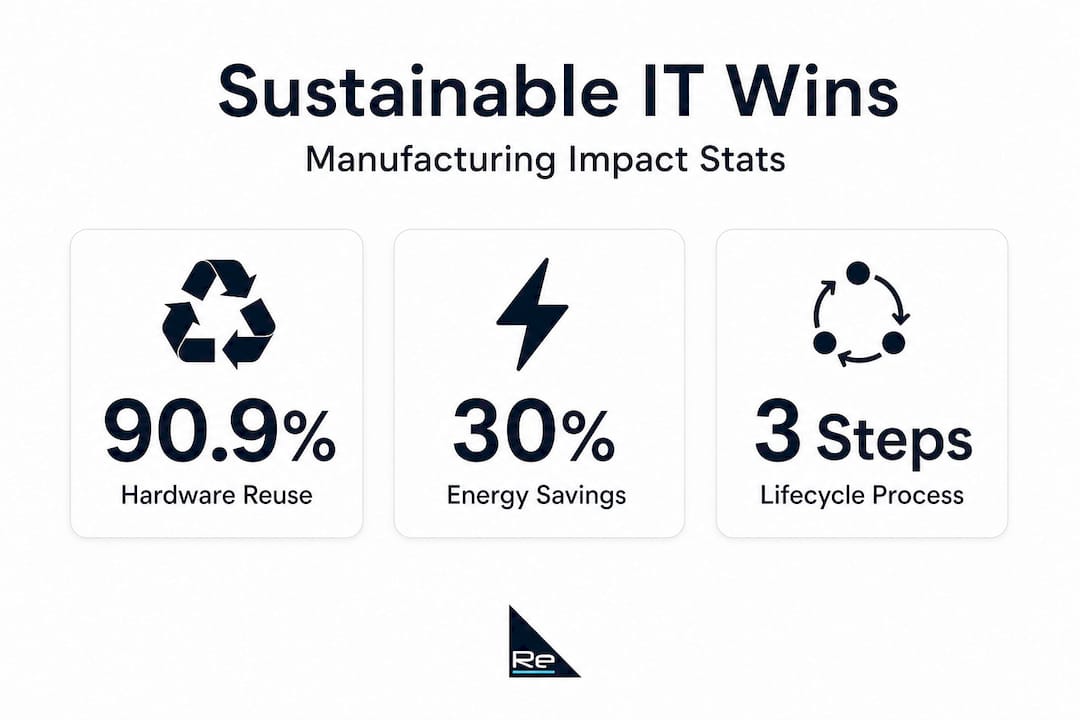
The scale of what is achievable is demonstrated clearly by industry data. Microsoft’s circular data centre design achieved a hardware reuse and recycling rate of 90.9 per cent across its cloud infrastructure. That figure is not simply impressive; it demonstrates that near-elimination of hardware waste is operationally achievable at scale.
Microsoft: 90.9% cloud hardware reuse and recycling rate
Similarly, Hitachi Vantara’s FY2025 sustainability report highlights the role of recycled-content materials and energy-efficient architectures in enterprise infrastructure. The report frames material circularity and governance reporting as foundational, not optional, elements of sustainable AI and data platforms.
For IT managers in schools and factories, the principles translate into practical actions:
- Repair before replace: Establish internal repair processes for common hardware failures before requesting replacement budgets
- Repurpose end-of-life devices: Older workstations can be redeployed as thin clients or donated to community programmes
- Report on material flows: Track what hardware is retired, where it goes, and what proportion is recycled versus sent to landfill
- Optimise procurement cycles: Extend refresh cycles where hardware remains fit for purpose, reducing embodied carbon from premature replacement
The IT for manufacturing sector has a particular opportunity here. Manufacturing facilities often run large inventories of networked devices, from sensors and PLCs to workstations and switches. A structured circular programme applied to this estate can produce measurable reductions in e-waste and procurement cost simultaneously. The connection between AI and data sustainability is equally relevant: as AI workloads grow, the hardware demands associated with them must be managed with the same circular discipline to avoid a new wave of rapid obsolescence.
Optimising manufacturing with sustainable IT: A practical methodology
Manufacturing environments present a specific challenge: the need to balance production efficiency, cost control, and environmental performance simultaneously. These goals are not inherently in conflict, but without the right data architecture, it is very difficult to optimise across all three at once.
A structured methodology, grounded in current research, provides a clear path forward. Cloud-based sustainable manufacturing research outlines an approach that begins with data collection and progresses through quantification to optimisation. The steps are as follows:
- Deploy sensor networks: Install IoT sensors across production lines to capture real-time data on energy consumption, material use, and process throughput
- Apply process mining: Use process mining tools to analyse operational data, identify inefficiencies, and map where energy and material waste occur in the workflow
- Implement dynamic life cycle assessment (LCA): Connect the sensor data to LCA models that calculate environmental impact in real time, rather than relying on static, periodic assessments
- Run multi-objective optimisation: Use the combined data to model trade-offs between efficiency, cost, and environmental impact, then select operational parameters that best balance all three
- Iterate continuously: Treat the methodology as an ongoing cycle, not a one-time project. Conditions change; the data layer must remain live and the optimisation must be repeated as processes evolve
This approach has measurable results. Factories that have implemented sensor-driven process mining alongside dynamic LCA report reductions in energy consumption and material waste, while maintaining or improving production throughput. The key is that the data layer makes invisible inefficiencies visible, and the optimisation tools make trade-off decisions systematic rather than intuitive.
Pro Tip: Start the sensor deployment with the highest-energy processes first. A targeted assessment of two or three production lines will generate enough data to validate the methodology before scaling across the full facility.
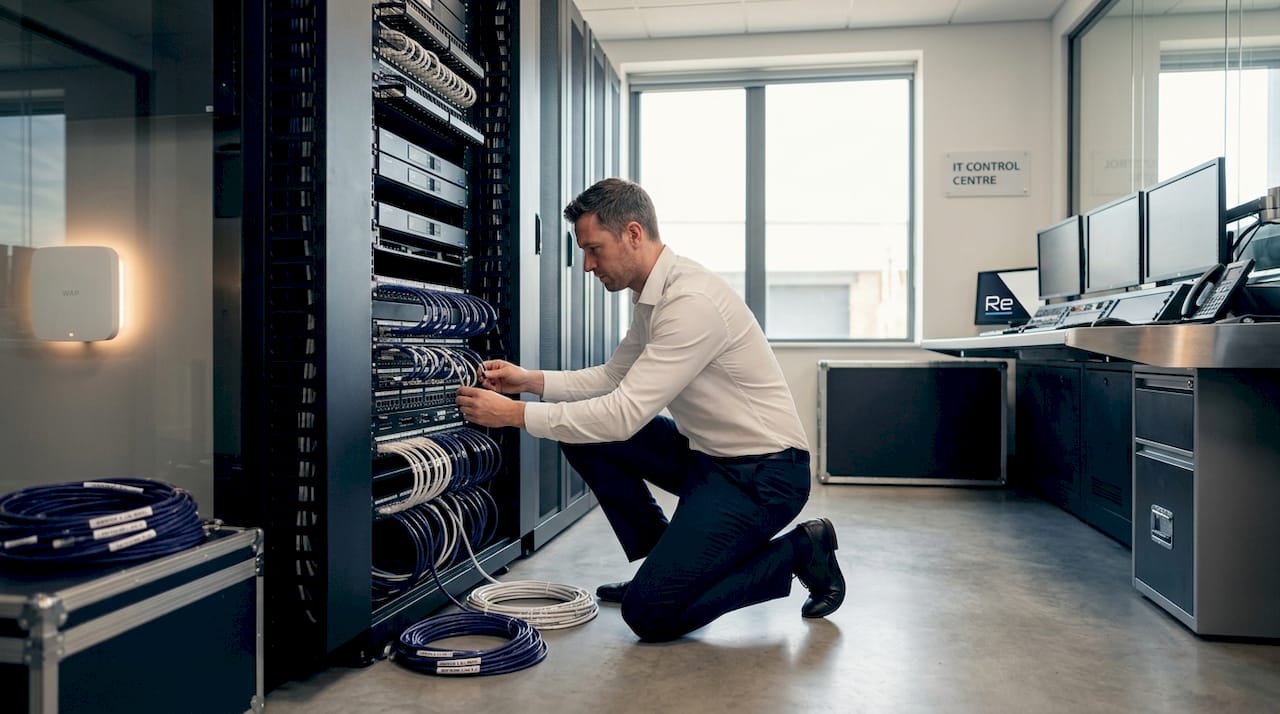
Modern manufacturing IT infrastructure must be designed to support this data architecture. That means robust wireless networks capable of handling high-density IoT device connectivity, edge computing capacity for local data processing, and secure cloud integration for aggregation and analysis. Organisations looking at broader logistics sustainability challenges will find that many of the same principles apply to supply chain and warehousing operations.
The uncomfortable truth about sustainable IT
Most sustainable IT initiatives fail. Not because the technology is unavailable or the intentions are wrong, but because organisations treat sustainability as a communications project rather than an operational discipline. The dashboard gets built, the report gets published, and the underlying infrastructure continues to consume more than it should.
This is the pattern that expert analysis describes as “dashboard syndrome,” and it is disturbingly common in both education and manufacturing. Leadership signs off on a carbon reduction target, IT produces a report showing progress, and the cycle continues without anyone actively governing the digital waste that accumulates in the background. Idle virtual machines, unused storage allocations, and poorly configured network segments all generate emissions and cost, invisibly, quarter after quarter.
The harder truth is that digital transformation in education and manufacturing requires an integration problem to be solved, not just a technology problem. As research on sustainable digital transformation demonstrates, achieving genuine sustainability outcomes across production and educational institutions requires digital tools, experiential learning approaches, and consistent measurement to be integrated across organisational boundaries.
That integration is where most organisations fall short. IT teams operate in silos from procurement, facilities, and academic or operational leadership. Sustainability data sits in separate systems. Governance accountability is unclear. The result is that even well-intentioned initiatives produce limited measurable impact.
The organisations that get this right share a common characteristic: they treat digital waste reduction as a continuous operational practice, not a periodic exercise. They build procurement processes that reward lifecycle efficiency. They give IT teams clear accountability for sustainability metrics alongside performance metrics. And they invest in governance structures that make waste visible and expensive, rather than invisible and free.
Connect with expert sustainable IT support
For those ready to put these strategies into practice, the right support makes the difference.
Translating sustainable IT principles into governed, measurable infrastructure improvements requires both technical expertise and sector-specific experience. Re-Solution has supported educational institutions and manufacturing organisations for over 35 years, delivering Cisco-powered infrastructure that meets operational efficiency and sustainability goals.

Whether you are beginning with a review of IT infrastructure fundamentals, working through IT infrastructure challenges, or evaluating a flexible network as a service model to reduce capital expenditure and improve scalability, the Re-Solution team can help you build an infrastructure strategy that delivers on both performance and sustainability. Get in touch to discuss your specific requirements.
Frequently asked questions
What makes an IT solution truly sustainable?
An IT solution is sustainable if it reduces both operational and embodied emissions, controls digital waste, and is governed with measurable outcomes. As carbon accounting research confirms, effective sustainability planning must account for the full hardware life cycle, not just energy consumption at the point of use.
How can educational institutions reduce IT-related environmental impact?
Educational institutions can implement paperless processes, cloud infrastructure, energy monitoring, and e-waste management to cut environmental impact. The ITIL 4 and green IT model provides a structured governance framework for embedding these practices into everyday IT service management.
What is circular economy in IT, and why is it important?
A circular economy in IT means continually reusing, repairing, and recycling hardware to minimise waste, which significantly boosts sustainability. Microsoft’s circular infrastructure approach demonstrates that reuse and recycling rates above 90 per cent are achievable at scale.
How can manufacturing companies optimise IT for sustainability?
Manufacturers use sensor-based process mining, life cycle assessment, and multi-objective optimisation to balance efficiency, cost, and environmental impact. The cloud-based manufacturing framework outlines how this data-driven methodology delivers measurable reductions in energy use and material waste.
Why do many sustainable IT initiatives fail?
Many fail because they focus on dashboards and reporting, not on ongoing governance, digital waste reduction, and systems integration. As expert analysis on digital waste makes clear, sustainable IT requires aligned procurement incentives and active control of idle and over-provisioned resources to generate genuine impact.
Recommended
- Modernise IT infrastructure in 2026 for connectivity
- IT Infrastructure for Education in 2025 | Re-Solution
- Drive hospitality success with innovative IT solutions