TL;DR:
- Modern IT systems like IIoT, MES, and ERP significantly boost manufacturing efficiency and OEE.
- Effective data flow and integration across factory systems enable faster decision-making and improved operations.
- Successful digital transformation relies on combining technology with organizational change and workforce engagement.
Manufacturing operations that still rely on fragmented, legacy IT setups are leaving measurable value on the table. OEE gains of 12–30% are now documented across real facilities using unified data platforms and real-time manufacturing execution systems. The difference between a plant running at 70% efficiency and one running at 90% often comes down to the IT architecture underpinning it. This article breaks down the core IT solutions transforming manufacturing today, explains how data flows across modern factory environments, addresses the IT and OT convergence challenge, and examines the outcomes you can realistically expect when these systems are deployed well.
Table of Contents
- The cornerstone IT solutions in manufacturing today
- Connecting the factory: How data flows in a modern setup
- Bridging IT–OT gaps: Strategies for secure convergence
- Unlocking value: Real-world outcomes and adoption barriers
- Our take: Why IT transformation is about people, not just platforms
- How Re-Solution supports secure and connected manufacturing
- Frequently asked questions
Key Takeaways
| Point | Details |
|---|---|
| Integrated IT platforms | Combining IIoT, MES, ERP, and edge computing maximises efficiency and visibility. |
| Secure data flows | Network architecture and security must be designed for seamless, safe information exchange. |
| Organisational alignment | Bridging IT and OT requires more than technology—it needs collaborative culture change. |
| Proven value | Empirical case studies show double-digit gains in OEE, throughput, and cost savings for adopters. |
The cornerstone IT solutions in manufacturing today
Modern manufacturing depends on a tightly integrated set of IT systems, each serving a distinct purpose. Understanding what each one does, and how they relate to one another, is the starting point for any meaningful digital transformation.
The key IT solutions for manufacturing include the following core platforms:
- IIoT platforms (Industrial Internet of Things): Connect physical machines, sensors, and devices to digital systems, enabling real-time data collection across the shop floor.
- MES (Manufacturing Execution Systems): Manage and monitor production processes in real time, from scheduling and quality control to work order management.
- ERP (Enterprise Resource Planning): Integrates business functions such as finance, procurement, and inventory into a single system, giving leadership a unified operational view.
- Edge computing: Processes data locally, at or near the machine, reducing latency and bandwidth demands before data is sent to the cloud.
- OT security solutions: Protect operational technology environments, including PLCs (programmable logic controllers), SCADA systems, and industrial control networks, from cyber threats.
These systems do not operate in isolation. Their value multiplies when they are integrated, sharing data across the production lifecycle. A well-architected modern IT infrastructure allows MES to pull live machine data from IIoT sensors, while ERP uses that same data to update procurement and scheduling automatically.
| System | Primary role | Key benefit |
|---|---|---|
| IIoT platform | Device connectivity and data capture | Real-time visibility across assets |
| MES | Production monitoring and control | Reduced downtime, improved quality |
| ERP | Business process integration | Unified planning and reporting |
| Edge computing | Local data processing | Low latency, reduced bandwidth use |
| OT security | Cyber protection for industrial systems | Operational resilience and compliance |
Pro Tip: When evaluating platforms, prioritise those with open APIs and proven connectors for legacy equipment. Forcing a full rip-and-replace of existing machinery is rarely necessary and significantly increases project risk and cost.
The goal is an ecosystem where data moves freely, decisions are made faster, and production teams have the information they need when they need it.
Connecting the factory: How data flows in a modern setup
Understanding which systems to deploy is one thing. Understanding how they connect and communicate is where the real operational gains are unlocked.
Modern factories use a tiered, edge-to-cloud architecture to manage data flow efficiently. At the lowest tier, machines and sensors generate raw data continuously. At the middle tier, edge devices process and filter that data locally. At the top tier, cloud platforms store, analyse, and present aggregated insights.
Here is how a typical IIoT data journey unfolds on the shop floor:
- Sensor data generation: A machine sensor captures temperature, vibration, or cycle time data several times per second.
- Edge processing: A local edge gateway filters out noise, applies initial analytics, and flags anomalies without sending everything to the cloud.
- Protocol transmission: Filtered data is transmitted using lightweight protocols such as MQTT (Message Queuing Telemetry Transport), which is designed for unreliable or constrained networks.
- Factory-level aggregation: A local server or on-premises MES receives the processed data and updates production dashboards in near real time.
- Cloud synchronisation: Summarised data is pushed to the cloud for long-term storage, trend analysis, and cross-site benchmarking.
Latency requirements vary significantly depending on the process. Not every decision needs cloud-level compute. Some require sub-second responses that only edge processing can deliver.
| Process type | Latency target | Processing location |
|---|---|---|
| Safety shutoff trigger | <100 milliseconds | On-device or edge |
| Quality inspection alert | <1 second | Edge gateway |
| Production scheduling update | 5–15 seconds | Local MES or server |
| Cross-site analytics | Several minutes | Cloud platform |
Pro Tip: Use MQTT as your default protocol for machine-to-edge communication in environments with intermittent connectivity or high device counts. It is lightweight, reliable, and widely supported across industrial hardware.
Building robust network designs that account for these latency tiers is essential. A network that treats all factory traffic equally will create bottlenecks that undermine the very systems designed to improve performance.
Bridging IT–OT gaps: Strategies for secure convergence
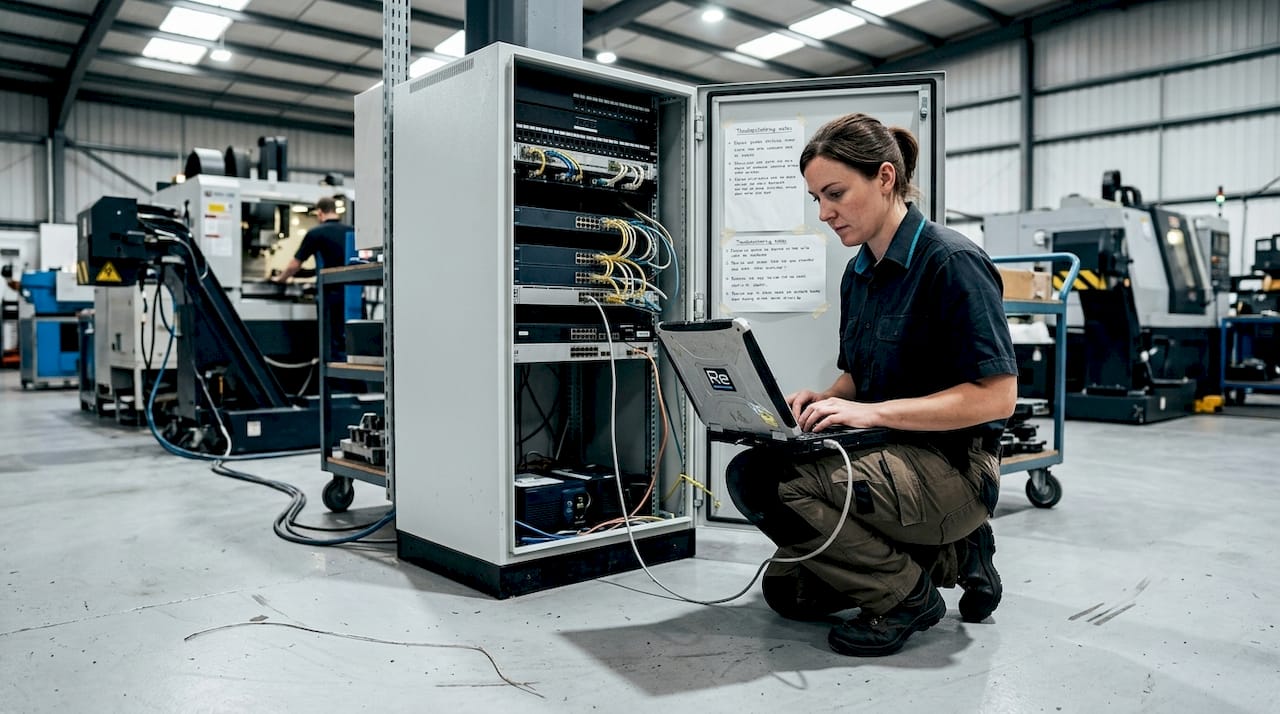
IT and OT have historically operated as separate worlds, and for good reason. IT teams prioritise innovation, flexibility, and rapid iteration. OT teams prioritise uptime, stability, and safety. These priorities are not always compatible, and forcing convergence without addressing that tension creates significant risk.
Common pain points in IT/OT convergence include:
- Legacy OT equipment that was never designed to connect to IP networks, making integration technically complex.
- Different patching cycles: IT systems are updated frequently; OT systems may run unpatched for years to avoid production disruption.
- Siloed teams with different vocabularies, KPIs, and reporting lines, limiting effective collaboration.
- Security gaps created when OT systems are connected to corporate networks without adequate segmentation or monitoring.
- Lack of shared ownership over cross-functional outcomes, leading to blame rather than resolution when issues arise.
The technical fixes, such as network segmentation, firewalls, and OT-aware monitoring tools, are well understood. The harder challenge is organisational. Silos cause a 50% collaboration roadblock, and no amount of new hardware resolves that without deliberate process and cultural change.
“True IT/OT convergence requires an operating model shift, not just a technology integration. Organisations that treat it as a purely technical exercise consistently underperform those that invest equally in people and process alignment.”
Practical steps to reduce silos and accelerate convergence:
- Form cross-functional teams that include both IT and OT staff from the outset of any project.
- Establish joint KPIs that reflect shared goals, such as uptime combined with security incident rates.
- Invest in manufacturing facility security frameworks that account for OT-specific risks.
- Build a shared language through joint training sessions and regular cross-team briefings.
- Review manufacturing cybersecurity essentials to ensure both teams understand the threat landscape.
Convergence done well produces a factory that is both agile and resilient. Done poorly, it creates new attack surfaces and operational friction that can cost more than the original problem.
Unlocking value: Real-world outcomes and adoption barriers
The business case for manufacturing IT investment is well supported by evidence. OEE gains of 12–30%, throughput increases of 53%, and WIP reductions of 37% have been recorded in real UK and global facilities. These are not projections. They are outcomes from manufacturers that committed to structured IT transformation programmes.
Measurable outcomes reported across successful implementations include:
- Labour savings: Lincoln Manufacturing recorded over $100,000 in annual labour cost reductions through automated data collection and reporting.
- Throughput improvements: Weir Group achieved a 53% throughput increase at its Todmorden facility following MES and IIoT integration.
- WIP reduction: The same Weir implementation reduced work-in-progress inventory by 37%, freeing capital and reducing floor congestion.
- OEE uplift: Versatech achieved a 30% OEE improvement by deploying a real-time MES connected to live production data.
- Faster decision-making: Real-time dashboards reduced the time from anomaly detection to corrective action from hours to minutes.
Despite these outcomes, not every manufacturer succeeds. The barriers are real. Edge AI deployment is significantly harder due to compute constraints, intermittent connectivity, and the strict change controls that govern OT environments. A hybrid edge-cloud model is increasingly preferred because it balances local processing with cloud-scale analytics.
Approximately 27% of manufacturers cite edge complexity as a primary adoption barrier. Edge devices can filter up to 90% of raw sensor data before it reaches the cloud, which is a major efficiency gain, but only if the edge infrastructure is correctly specified and maintained.
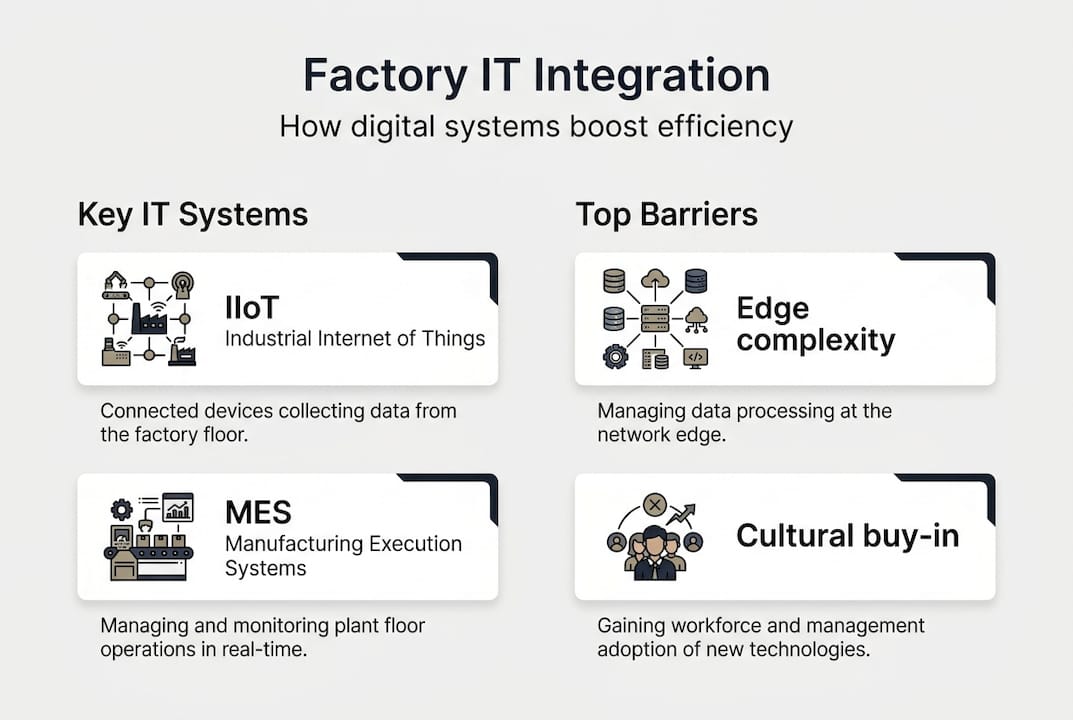
Cultural buy-in is equally critical. Facilities where frontline operators understand and trust the new systems consistently outperform those where technology is imposed from above without adequate training or communication. Reviewing AI threat guidance alongside your IT roadmap also helps teams understand emerging risks before they become operational problems.
Pro Tip: Start with a focused pilot project on one production line or process. Measure the outcomes rigorously, share the results with both leadership and frontline staff, and use that evidence to build the internal case for broader rollout.
Our take: Why IT transformation is about people, not just platforms
After reviewing the evidence from dozens of manufacturing IT implementations, one pattern stands out consistently. The facilities that achieve the strongest results are not always those with the most sophisticated technology. They are the ones where leadership committed to change management as seriously as they committed to the technology itself.
The platforms matter. IIoT, MES, and edge computing are genuinely powerful. But a well-configured system operated by a disengaged workforce will underperform a simpler system operated by a team that understands why it exists and how to use it.
Frontline buy-in is not a soft consideration. It is a hard operational variable. When machine operators trust the data their systems produce, they act on it faster and more accurately. When they do not, they revert to manual workarounds that quietly erode the gains the technology was supposed to deliver.
The smartest strategy combines the right technology with empowered staff, clear communication, and a culture that treats data as a shared asset rather than a management surveillance tool. Explore future-focused strategies to understand how forward-thinking manufacturers are structuring this balance.
How Re-Solution supports secure and connected manufacturing
For manufacturers ready to act on the insights above, the path forward requires more than selecting the right software. It requires a network and security foundation that can support IIoT, MES, and edge computing reliably and securely.
Re-Solution brings over 35 years of Cisco infrastructure expertise to manufacturing environments, designing and managing the connectivity and security layers that underpin digital transformation. Whether you need to assess your current IT infrastructure for manufacturing, explore a flexible network as a service model that scales with your production needs, or simply want to understand where your vulnerabilities lie, we can help. Connect with our team to discuss your specific requirements and take the first step towards a more connected, secure, and efficient operation.
Frequently asked questions
What are the most important IT solutions for manufacturing?
Modern manufacturers rely on IIoT platforms, MES, ERP, edge computing, and OT security to optimise operations, improve connectivity, and maintain production resilience.
How do IT systems boost manufacturing efficiency?
IT solutions improve real-time data collection, automate repetitive processes, and drive measurable productivity gains. OEE uplifts of up to 30% have been recorded in facilities using real-time MES connected to live production data.
What challenges do manufacturers face in adopting IT solutions?
Manufacturers commonly struggle with edge complexity, compute constraints, and integration difficulties, alongside the need for significant organisational change that goes well beyond technology upgrades alone.
What does IT/OT convergence mean for manufacturing?
IT/OT convergence means integrating IT systems with operational technology to eliminate silos, improve efficiency, and strengthen security. Silos create a 50% collaboration roadblock, making the organisational dimension of convergence as important as the technical one.
Recommended
- Warehousing & Logistics | Cisco Cloud, Security & Datacenter Experts
- Modernise IT infrastructure in 2026 for connectivity
- Manufacturing | Cisco Cloud, Security & Datacenter Experts
- Drive hospitality success with innovative IT solutions