TL;DR:
- Smart buildings incorporate sensors, IoT devices, and analytics to optimize operations and enhance occupant comfort.
- Implementing these systems requires careful planning of infrastructure, security, and organizational culture to realize maximum benefits.
Facility managers in education and hospitality often assume smart building technology is primarily about installing the latest gadgets or automating a handful of tasks. The reality is considerably more significant. A smart building integrates sensors, IoT devices, building management systems, and analytics software to collect data, control operations, and adapt dynamically to conditions in real time. For schools managing large estates and hotels serving thousands of guests annually, this translates directly into reduced energy bills, lower maintenance costs, improved occupant comfort, and stronger compliance outcomes.
Table of Contents
- What makes a building smart?
- How smart buildings operate: methodologies and automation
- Smart building benefits: data-driven results
- Challenges and risks: cybersecurity and integration
- Implementing smart building technology: best practices for schools and hotels
- What most guides miss: real-world nuances in smart building adoption
- How Re-Solution empowers your smart building vision
- Frequently asked questions
Key Takeaways
| Point | Details |
|---|---|
| Smart buildings are data-driven | They combine IoT systems and analytics to automate, predict, and optimise operations. |
| Substantial cost and energy savings | Facilities commonly reduce energy use and maintenance costs by up to 40%. |
| Cybersecurity and integration matter | Legacy systems, protocols, and proprietary technologies create real risks requiring resilient strategies. |
| Start with high-impact systems | Target HVAC and lighting for initial upgrades in educational and hospitality environments. |
| Operational change is critical | Technology alone is not enough—team adoption and strategic planning define success. |
What makes a building smart?
The term “smart building” is frequently used interchangeably with “connected building” or “intelligent building,” yet these are meaningfully different concepts. Understanding the distinction matters when you are making procurement decisions or scoping an upgrade programme.
According to industry definitions, a smart building uses integrated systems including sensors, IoT devices, building management systems (BMS), building automation systems (BAS), connectivity infrastructure, and analytics software to automatically collect data, optimise performance, and improve occupant experience. The keyword here is optimise. A connected building may simply relay data. An intelligent building may respond to preprogrammed rules. A smart building actively learns, predicts, and adjusts.
| Feature | Connected building | Intelligent building | Smart building |
|---|---|---|---|
| Data collection | Yes | Yes | Yes |
| Rule-based automation | No | Yes | Yes |
| AI/ML optimisation | No | No | Yes |
| Predictive capability | No | Limited | Yes |
| Self-adjustment | No | No | Yes |
The core technologies that underpin smart buildings include:
- Sensors and IoT devices: Occupancy sensors, temperature monitors, air quality meters, and energy sub-meters feeding continuous data streams.
- BMS and BAS platforms: Centralised software controlling HVAC, lighting, access control, and fire systems. Platforms such as Siemens Desigo use open protocols to integrate across systems.
- Connectivity infrastructure: Wired and wireless networks carrying data between devices, edge systems, and cloud platforms.
- Analytics and AI software: Processing sensor data to identify patterns, flag anomalies, and trigger automated responses.
Industry standards such as ASHRAE 135 (BACnet), IEC 62443, and ETSI EN 303 645 govern how these systems communicate and remain secure. When evaluating vendors, open protocol compatibility is a strong indicator of a future-proof solution. Proprietary systems may perform well initially but can create costly silos as your estate grows.
For facility managers exploring how to enhance building efficiency across complex sites, or those at the early stages of designing smart buildings, establishing a clear technology framework is the logical first step. Getting this right from the outset also supports integrated security solutions that protect both physical and digital assets. Practical IoT integration examples across sectors show just how varied and scalable these deployments can be.
“Smart buildings use AI and analytics to continuously optimise operations, not just respond to fixed rules. This distinction is what separates genuinely transformative infrastructure from expensive automation.”
How smart buildings operate: methodologies and automation
Once the technology components are in place, the real value comes from how they work together. Smart building operation relies on a set of well-established methodologies that drive both day-to-day efficiency and longer-term resilience.

Predictive maintenance, occupancy-based automation, energy optimisation using historical data patterns, and closed-loop control are the four pillars of smart building operation. Each one addresses a specific operational challenge that facility managers in education and hospitality face regularly.
How a smart building automation cycle works:
- Data collection: Sensors across the building gather real-time data on occupancy, temperature, energy use, air quality, and equipment performance.
- Data transmission: This data moves across the network to a BMS or cloud analytics platform, often via edge computing nodes to reduce latency.
- Analysis: AI and ML algorithms identify patterns, compare current conditions against historical baselines, and flag deviations.
- Decision making: The system determines the optimal response, whether that is adjusting HVAC output, dimming lighting in an empty corridor, or scheduling a maintenance check.
- Automated action: Commands are sent back to building systems automatically, without manual intervention.
- Feedback and learning: Outcomes are logged, compared against targets, and used to refine future decisions, creating a continuous improvement loop.
This closed-loop model is particularly valuable in environments with variable occupancy, such as university lecture halls that are busy in the morning and empty by evening, or hotel conference rooms that shift between packed and vacant throughout the week.
Effective energy optimisation techniques are closely tied to the quality of your network infrastructure. Without reliable, low-latency connectivity, sensor data arrives too slowly to be actionable. IT optimisation strategies that align network performance with building system requirements are therefore a prerequisite, not an afterthought. It is also worth considering how AI threats and safeguards interact with the AI-driven analytics powering these automation cycles.
Pro Tip: For the strongest return on investment, begin automation with HVAC and lighting in your highest-occupancy spaces. These systems account for the largest share of energy spend in most educational and hospitality buildings, and the data feedback loop matures fastest where occupancy patterns are most predictable.
Smart building benefits: data-driven results
The business case for smart buildings is well-supported by real-world evidence. For decision-makers who need to present a financial justification, the benchmarks are consistent and compelling.
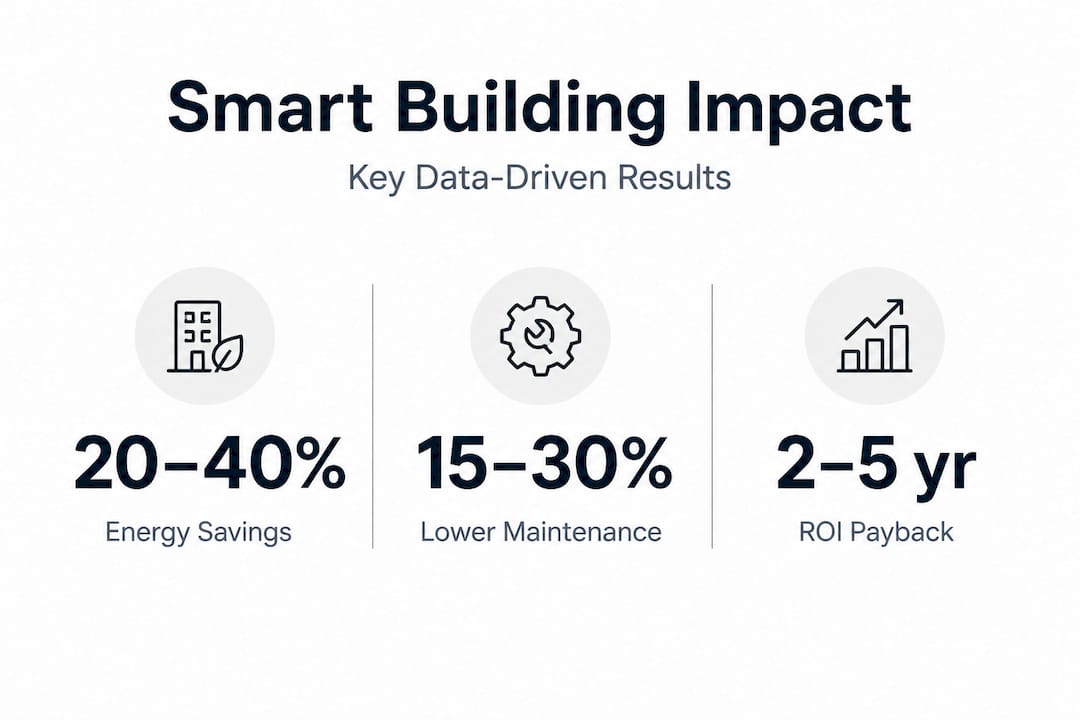
Smart buildings deliver 20 to 40% energy savings, 15 to 30% reductions in maintenance costs, and payback periods of two to four years in most commercial deployments. Hotels in particular benefit significantly. A chain operating 12 properties reported annual savings of $230,000 after implementing smart HVAC and lighting controls. Across a 45-property portfolio, comparable implementations delivered $4.2 million in annual savings. Office towers with smart HVAC systems have recorded 28% reductions in cooling and heating costs, equivalent to $392,000 per year in large facilities.
| Sector | Energy saving | Maintenance saving | Payback period |
|---|---|---|---|
| Hotels (12 properties) | 25 to 35% | 15 to 25% | 2 to 3 years |
| Hotels (45 properties) | 25 to 35% | Up to 30% | 3 to 4 years |
| Office towers | 28% HVAC savings | 20% | 2 to 4 years |
| Education campuses | 20 to 40% | 15 to 30% | 2 to 4 years |
Beyond energy and cost, smart buildings deliver a wider set of operational benefits that are equally important for schools and hotels:
- Improved occupant comfort: Automated temperature and lighting adjustments based on real occupancy improve the experience for students, guests, and staff without manual oversight.
- Stronger regulatory compliance: Automated logging of energy consumption, air quality, and safety system performance supports compliance with building regulations and environmental reporting obligations.
- Enhanced safety: Smart access control and integrated security systems respond faster to incidents than manual processes.
- Sustainability credentials: Verified energy reductions support Net Zero commitments and improve ESG (Environmental, Social and Governance) ratings, which are increasingly important to funding bodies and investors.
- Reduced reactive maintenance: Predictive alerts allow maintenance teams to address issues before they escalate into costly failures or service disruptions.
- Operational reputation: For hotels, consistent comfort and safety directly affect guest reviews and repeat bookings. For schools, a well-managed environment supports staff retention and student wellbeing.
Understanding smart security benefits as part of the broader smart building picture helps facility managers prioritise correctly. Security is not a separate workstream. It is embedded in the same infrastructure that manages energy, access, and environment. The ROI benchmarks available across sectors consistently point to measurable, repeatable gains when implementations are properly scoped.
Challenges and risks: cybersecurity and integration
The efficiency gains from smart buildings are real, but so are the risks. Facility managers who overlook these challenges during the planning phase are likely to encounter costly problems post-deployment.
Legacy building systems expose facilities to cyber attacks through protocols such as BACnet, which were designed for open communication rather than security. Interoperability issues arise when proprietary systems from different vendors cannot share data, creating isolated silos that undermine the integrated efficiency the smart building was intended to deliver. Centralised BAS architectures introduce single points of failure: if the central controller is compromised or goes offline, multiple building systems can be affected simultaneously. A striking data point is that 37.8% of smart buildings have experienced a cyber-attack, a figure that underscores the seriousness of the threat.
Key risks facility managers must plan for include:
- Outdated protocols: BACnet and similar OT protocols were not built with modern cyber threats in mind. Connecting them to IP networks without additional security layers is a significant vulnerability.
- Vendor lock-in: Proprietary integration frameworks restrict your ability to switch suppliers or add new technologies without expensive re-engineering.
- IT versus OT security conflict: IT security teams often prioritise prevention through measures such as Zero Trust network access. Operational technology (OT) teams prioritise deterministic control and fail-safe reliability. These goals can conflict, and managing the boundary requires a deliberate governance approach.
- Insufficient segmentation: Without proper network segmentation, a compromised IoT sensor can become a gateway into core IT systems or operational controls.
- Rushed deployments: Pressure to demonstrate quick wins from pilots can lead to incomplete security configurations that remain in place long after go-live.
“Smart buildings enable significant efficiency and sustainability gains, but they also introduce cyber-physical risks that must be managed through deliberate architecture, not bolted-on security after deployment.”
The IT vs OT security tension is particularly important to resolve early. Standards such as IEC 62443 provide a framework for securing operational technology environments, but applying them requires both technical expertise and organisational alignment between IT and facilities teams. A real-world compliance case study illustrates how network access control can bridge this gap effectively.
Pro Tip: During procurement, require vendors to demonstrate compliance with IEC 62443 and ETSI EN 303 645. Favour open protocol architectures and ask directly how each component handles firmware updates and vulnerability patching. This single step prevents the majority of post-deployment security headaches.
Implementing smart building technology: best practices for schools and hotels
Knowing the risks and benefits is only useful if you can translate that knowledge into a structured implementation approach. The following guidance is drawn from deployments across education campuses and hotel portfolios.
ROI is strongest in buildings with variable occupancy, such as university campuses and hotels, because automation systems have the most to gain from dynamic adjustment. Starting with HVAC and lighting gives you the fastest measurable impact and establishes the data foundation for subsequent phases.
Implementation steps for schools and hotels:
- Conduct a baseline audit: Survey existing systems, connectivity infrastructure, and energy consumption data. Identify which legacy systems can be integrated and which need replacing.
- Define measurable objectives: Set specific targets, such as a 25% reduction in HVAC energy use within 18 months, referenced against ENERGY STAR benchmarks for your building type.
- Select a pilot zone: Choose a high-occupancy area with clear data signals, such as a student union building or a hotel’s largest conference floor.
- Deploy sensors and connectivity: Install occupancy sensors, energy sub-meters, and the network infrastructure to support them. Ensure segmentation between OT and IT networks from day one.
- Integrate with BMS: Connect sensors to your BMS or analytics platform, configure automated rules, and establish reporting dashboards.
- Measure and validate: Run the pilot for a defined period, typically three to six months, and compare results against your baseline metrics.
- Scale with confidence: Use pilot data to build the business case for phased rollout across the full estate.
For larger estates, digital twins provide a compelling capability. A digital twin is a virtual replica of your physical building that lets you model changes, test automation rules, and predict outcomes before deploying them in the real environment. This reduces risk significantly on complex sites. Edge computing also becomes important at scale, processing data locally to reduce latency and network load rather than relying entirely on cloud platforms.
The designing building strategy you adopt at the outset will determine how much flexibility you retain as technology evolves. Open standards and modular architectures are not just technical preferences. They are commercial decisions that protect your long-term investment.
What most guides miss: real-world nuances in smart building adoption
Most articles on smart building technology focus heavily on the technology itself, the sensors, the platforms, the energy savings figures. What they rarely address is the organisational reality of making these systems work over time.
The notion that smart building upgrades are “plug and play” does not survive contact with a real estate. Legacy systems behave unpredictably when connected to modern platforms. Data formats differ. Communication protocols conflict. Firmware versions create compatibility gaps. Experienced delivery teams expect this and plan for it. Teams without that experience often discover it mid-project, at significant cost.
Organisational culture is arguably as important as the technology stack. Facilities teams, IT departments, and senior management often have different priorities and risk tolerances. A smart building project that does not actively manage these dynamics will encounter friction, particularly when IT and OT security responsibilities overlap. Training is frequently underestimated. Staff who do not understand how to interpret and act on building analytics data will default to manual processes, negating much of the automation benefit.
Most published ROI studies focus on energy savings during the deployment phase. They rarely account for ongoing software licensing costs, network maintenance, security monitoring, or the internal resource required to manage the system over a five to ten year lifecycle. Facility managers should build these figures into their business cases from the outset rather than discovering them post-approval.
Rushed pilot deployments are a common failure pattern. The pressure to demonstrate value quickly leads to incomplete configurations, insufficient testing, and security shortcuts. A pilot that runs for six months with proper measurement disciplines will generate far more credible data for scaling decisions than one compressed into six weeks.
The mindset that matters most in smart building adoption is resilience. Any individual device or system will fail at some point. The question is whether your architecture, your team, and your processes can absorb that failure without significant operational disruption. Insights from practical design learnings consistently reinforce this point: the most successful deployments are those that plan for failure as rigorously as they plan for success.
How Re-Solution empowers your smart building vision
For facility managers in education and hospitality, moving from awareness to action requires the right technology partner. Re-Solution has over 35 years of experience delivering Cisco-based infrastructure and security solutions across complex, multi-site environments, and that experience applies directly to smart building deployments.

Re-Solution’s managed IT services cover every phase of a smart building programme, from initial infrastructure audit and network survey through to ongoing monitoring, security management, and performance reporting. Our approach ensures that connectivity, OT security, and building system integration are aligned from day one rather than retrofitted later. Our smart security solutions are designed specifically for environments where physical and digital security must operate as a unified system. If you are ready to move from planning to implementation, we are ready to help you build the business case, scope the right architecture, and deliver measurable results.
Frequently asked questions
What is the difference between a smart building and an intelligent building?
A smart building uses AI and analytics to optimise operations dynamically, whereas an intelligent building simply responds to preprogrammed inputs without real-time learning or adjustment.
How much energy can smart buildings really save?
Smart buildings consistently achieve 20 to 40% energy savings, with hotels typically seeing 25 to 35% reductions and payback periods of two to four years.
What cybersecurity risks should building operators know about?
37.8% of smart buildings have experienced cyber attacks, often through legacy protocols and centralised systems that lack modern security architecture.
Where should schools or hotels start with smart building upgrades?
Begin with HVAC and lighting in high-occupancy areas, measure results against ENERGY STAR benchmarks, then use that validated data to scale across the wider estate.
Recommended
- Smart Building Technologies Enhance Security | Re-Solution
- Designing Smart Buildings with Security | Re-Solution
- Future Operation | Cisco Cloud, Security & Datacenter Experts
- Mobile apps boost operational efficiency in UK sectors
- Pocket App | Building Apps for the Internet of Things (IoT)