
TL;DR:
- Cloud networking matches or surpasses traditional on-premises security, scalability, and cost efficiency, making it a practical choice for education and manufacturing sectors. It offers centralized management, automation, rapid deployment, and enhanced business continuity, addressing key operational challenges. Success depends on organizational readiness and change management, not just technology; thorough planning and staff involvement are essential.
The assumption that on-premises networks represent the gold standard for security and cost control has persisted in education and manufacturing for years. It is understandable. These sectors handle sensitive data, operate complex physical environments, and carry significant compliance obligations. Yet that assumption is increasingly difficult to justify. Cloud networking has matured to the point where it not only matches traditional architectures on reliability and security, but frequently surpasses them on scalability, operational efficiency, and total cost of ownership. This article cuts through the noise to give IT decision-makers a clear, practical view of what cloud networking offers, where it fits, and how to approach adoption responsibly.
Table of Contents
- What is cloud networking and how does it differ from traditional networks?
- Major benefits of cloud networking for education and manufacturing
- Key security considerations and misconceptions
- Is cloud networking the right fit for your organisation?
- What most IT leaders overlook when choosing cloud networking
- Explore cloud networking solutions with expert guidance
- Frequently asked questions
Key Takeaways
| Point | Details |
|---|---|
| Scalable solutions | Cloud networking lets organisations expand or adapt instantly without major new investment. |
| Enhanced security | When well designed, cloud networks can match or exceed on-premises security standards. |
| Operational efficiency | Automated, centrally managed cloud networks reduce admin load and speed up deployments. |
| Tailored for each sector | Education and manufacturing gain unique advantages, from remote access to real-time analytics. |
What is cloud networking and how does it differ from traditional networks?
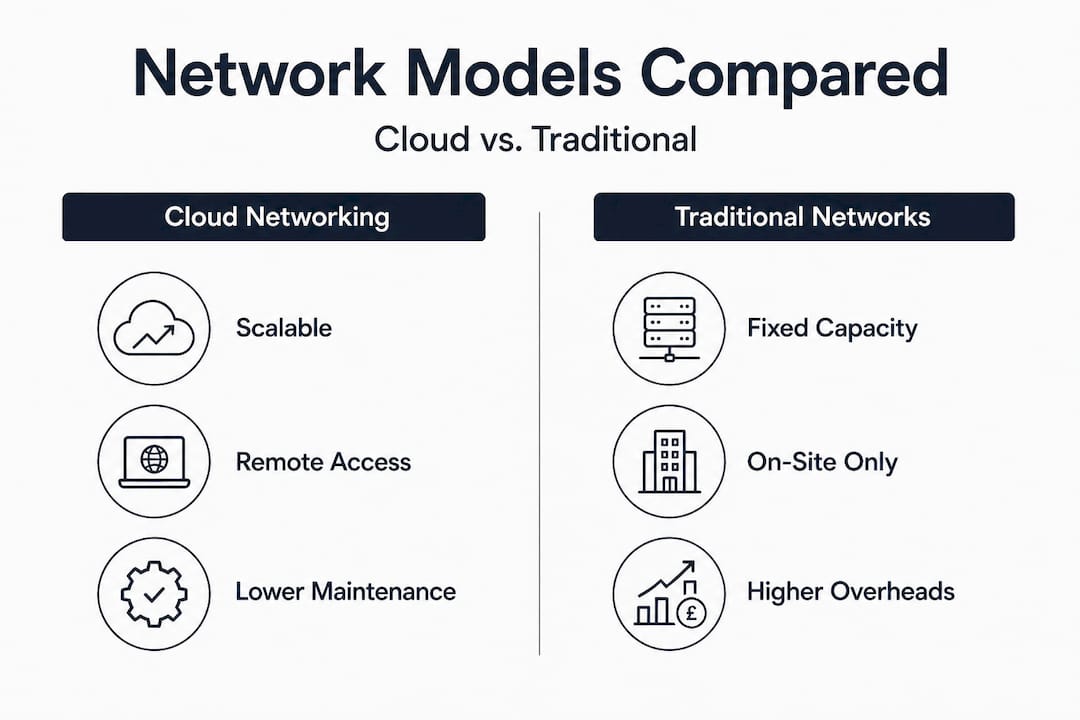
Cloud networking refers to the use of cloud-based resources to deliver network functions, management, and connectivity, rather than relying solely on physical hardware located on-site. In a traditional on-premises network, your routers, switches, firewalls, and management systems all sit within your building, maintained by your internal team or a contracted service provider. In a cloud networking model, much of this management layer shifts to the cloud, enabling centralised control, remote configuration, and policy management across multiple sites from a single dashboard.
This is more than a hosting change. Understanding cloud networking as an architectural shift helps clarify why so many organisations are reconsidering their infrastructure roadmaps. The physical hardware at each site does not disappear, but the intelligence and management layer moves upward, making it far easier to scale, update, and secure the entire estate consistently.
A secure peer-to-peer architecture is one of the emerging models making cloud networking especially compelling for distributed organisations, enabling direct, encrypted communication between nodes without routing all traffic through a central data centre.
Core differences between cloud and traditional networks
| Feature | Traditional (on-premises) | Cloud networking |
|---|---|---|
| Hardware management | Maintained on-site by IT staff | Vendor-managed or cloud-administered |
| Scalability | Limited by physical capacity | Scale on demand, often within minutes |
| Cost model | High upfront capital expenditure | Subscription or consumption-based pricing |
| Management | Per-site configuration | Centralised, single-pane-of-glass |
| Security updates | Manual patching, variable timing | Automated, consistent policy enforcement |
| Business continuity | Dependent on local resilience | Built-in redundancy and failover capability |
Key drivers pushing education and manufacturing organisations toward cloud networking include:
- Rising costs of maintaining ageing on-premises hardware across multiple sites
- Growing need to support remote learners, hybrid staff, and distributed factory floors
- Increasing complexity of device management as IoT endpoints proliferate
- Pressure to meet GDPR, Cyber Essentials, and sector-specific compliance standards
- Demand for faster deployment of new sites, classrooms, or production lines
“Organisations that have moved to cloud-managed networking report faster incident response times, reduced IT overhead, and improved visibility across their entire estate.” This shift is not theoretical. It is being realised in schools, colleges, and production facilities across the UK right now.
The cloud network advantages for 2025 and beyond are increasingly well-documented, making this an opportune moment for decision-makers to revisit their infrastructure strategies.
Major benefits of cloud networking for education and manufacturing
With a solid understanding of how cloud networking works, let us explore why it has become so attractive to education and manufacturing leaders specifically.
Cloud networking enhances connectivity, streamlines operations, and reduces upfront infrastructure costs. These are not abstract marketing claims. They translate into measurable operational improvements when the right solution is properly deployed.
Key benefits applicable across both sectors include:
- Scalability on demand: Add new sites, classrooms, or production zones without procuring and shipping hardware in advance
- Remote management: IT teams can configure, monitor, and troubleshoot from any location, critical for multi-site institutions and manufacturers
- Cost optimisation: Shift from large capital expenditure cycles to predictable operational expenditure
- Automation: Policy enforcement, firmware updates, and security patches are applied automatically across the entire network estate
- Speed of deployment: New connectivity can be provisioned in hours rather than weeks
- Business continuity: Built-in redundancy and cloud failover reduce the risk of costly downtime
For educational institutions
The benefits of cloud Wi-Fi are particularly visible in education. Schools and universities managing hundreds or thousands of devices across sprawling campuses benefit enormously from centralised policy management. Student devices can be onboarded automatically. Content filtering and access controls can be applied consistently across every building, every floor, and every access point without manual per-site configuration.
Remote access has also become a permanent feature of educational delivery rather than a temporary workaround. Cloud networking ensures that whether a student is on campus or connecting from home, the same security policies and access controls apply. IT administrators spend less time troubleshooting connectivity issues and more time supporting learning outcomes.
For manufacturing companies
Manufacturing environments present unique networking challenges. Factory floors combine operational technology (OT) with traditional IT, connecting CNC machines, automated assembly systems, quality control cameras, and logistics platforms across the same network fabric. IoT endpoint management at scale is simply not practical with traditional on-premises tools.

The cloud logistics advantages for enterprise supply chains are well established. Cloud networking gives manufacturers real-time visibility across production lines, warehouses, and logistics operations. When a network issue arises on the shop floor, it can be identified and resolved remotely, often before it impacts production targets.
According to recent sector analysis, organisations adopting cloud networking report reductions in network management overhead of up to 40%, alongside significantly faster deployment of new capacity at existing and greenfield sites.
Pro Tip: When prioritising cloud networking benefits for your organisation, map each advantage directly to a current operational pain point. If staff spend hours each month on manual firmware updates, automation should rank highly. If expanding to new sites is a near-term goal, speed of deployment takes priority. Aligning cloud benefits to existing business pressures builds a much stronger internal business case.
Key security considerations and misconceptions
Having identified the clear advantages, it is crucial to address one of the biggest concerns: security. Let us separate myth from reality, because security objections are the single most common reason organisations delay cloud networking decisions unnecessarily.
The most persistent misconception is that on-premises networks are inherently more secure because your data and hardware remain within your physical boundaries. In practice, on-premises networks are frequently under-patched, inconsistently monitored, and dependent on individual staff members who may lack specialist security expertise. “Cloud networking can offer equal or superior security compared to on-premises networks when well implemented” is not wishful thinking. It reflects the reality of modern cloud-native security architectures.
Common risks and their mitigations include:
- Misconfiguration risk: Mitigated through vendor-supplied configuration templates, role-based access controls, and change management policies
- Data in transit exposure: Addressed through end-to-end encryption and TLS 1.3 protocols across all traffic
- Unauthorised access: Controlled via multi-factor authentication (MFA), Zero Trust Network Access (ZTNA), and network access control (NAC) policies
- Vendor dependency risk: Managed by selecting vendors with strong SLAs, ISO 27001 certification, and transparent incident reporting
- Compliance gaps: Closed through regular audits, automated compliance reporting, and documented access logs
For educational institutions, GDPR compliance is non-negotiable. Cloud networking platforms that offer granular access controls, full audit trails, and data residency options within the UK or EEA directly support GDPR obligations. Student data protection is not an afterthought in a well-implemented cloud network. It is built into the architecture.
For manufacturers, the protection of intellectual property (IP) and supply chain data is paramount. Segmenting OT and IT traffic, enforcing Zero Trust policies, and monitoring east-west traffic within the network (not just perimeter traffic) are all more achievable with cloud-native tools than with traditional on-premises firewalls alone.
Robust cloud security strategies should be established before any migration begins, not bolted on afterwards. A secure cloud network architecture that incorporates Zero Trust principles from the outset is far more effective than retrofitting security controls to an existing design.
Pro Tip: Before selecting a cloud networking vendor, ask the following questions directly: What is your incident response SLA? Where is our data stored and processed? How is multi-tenancy isolation enforced? What certifications do you hold, including ISO 27001 and Cyber Essentials Plus? The answers will quickly reveal whether the vendor takes security as seriously as you need them to.
Is cloud networking the right fit for your organisation?
Understanding the security realities and practical benefits is essential, but how do you decide if cloud networking aligns with your unique organisational needs? The answer depends on your current infrastructure state, your growth trajectory, and your internal capability to manage change.
“Cloud networking enables flexible, scalable IT infrastructure, supporting both rapid expansion and cost efficiency.” That is relevant whether you are a multi-academy trust adding new schools, or a manufacturer expanding into a new facility. The question is not whether cloud networking could work for your organisation. The question is which model, and at what pace.
Comparing deployment models
| Criteria | On-premises | Hybrid | Full cloud networking |
|---|---|---|---|
| Upfront cost | High | Medium | Low |
| Agility | Low | Medium | High |
| Manageability | Complex, per-site | Moderate | Centralised |
| Compliance control | Direct but manual | Shared | Vendor-assisted |
| Long-term ROI | Variable | Good | Strong |
| Legacy system support | Full | Good | Requires planning |
Hybrid models are frequently the right starting point for organisations with significant existing infrastructure investment. Rather than replacing everything at once, a hybrid approach allows you to extend cloud management capabilities to existing hardware progressively, proving value before committing fully.
Multi-cloud deployment options are also worth evaluating for larger organisations with complex application estates spread across AWS, Google Cloud, and Azure.
Steps to take before transitioning
- Conduct a needs analysis: Audit your current network infrastructure, identify pain points, and document your connectivity requirements across all sites and user groups.
- Evaluate vendors carefully: Assess potential cloud networking partners on security certifications, support SLAs, UK data residency, and proven experience in your sector.
- Run a pilot project: Deploy cloud networking in a single site or department first. Measure performance, gather user feedback, and identify integration challenges before full rollout.
- Plan the full rollout: Build a phased migration plan that accounts for legacy system dependencies, staff training, and business continuity requirements at every stage.
Network as a Service (NaaS) is an increasingly popular model that packages cloud networking into a fully managed, subscription-based service, removing the burden of procurement, configuration, and ongoing management from internal IT teams. For organisations without large in-house networking teams, NaaS is often the most practical route to cloud networking adoption.
For broader context on how network infrastructure choices affect long-term IT strategy, network solutions explained provides a useful grounding in the options available to UK organisations.
What most IT leaders overlook when choosing cloud networking
You have examined the facts, comparisons, and security realities. Now consider what actually determines cloud networking success in the real world, because it is rarely the technology itself.
From our experience working with educational institutions and manufacturers across the UK, the most common reason cloud networking projects underperform is not a product limitation or a vendor failure. It is the gap between the technology that is deployed and the organisation’s readiness to use it effectively. Change management is consistently underinvested. Staff who have managed on-premises infrastructure for years are asked to adopt cloud management tools without adequate training, context, or involvement in the decision-making process. The result is resistance, workarounds, and configurations that undermine the very benefits the transition was meant to deliver.
Legacy integration is the other frequently underestimated challenge. Older network hardware, proprietary management systems, and OT equipment in manufacturing environments do not always play cleanly with cloud management platforms. Discovering these integration points late in a project can extend timelines significantly and erode stakeholder confidence. The organisations that navigate this most successfully are those that conduct thorough discovery work before vendor selection, not after.
The advanced advantages of cloud networking only materialise when the organisation is genuinely ready to operate in a cloud-managed model. That readiness is as much about culture and workflow as it is about connectivity.
Our strongest recommendation to IT leaders is this: treat cloud networking adoption as an organisational change project with a technology component, not the other way around. Engage end users early. Involve department heads in the pilot phase. Build internal champions who understand and advocate for the new approach. The technology, when properly chosen, will perform. The variable that determines success is the people and processes around it.
Explore cloud networking solutions with expert guidance
Ready to take the next step or explore tailored cloud networking options for your organisation?
Re-Solution has over 35 years of experience delivering Cisco-based network infrastructure, managed services, and cloud-based network solutions to education providers, manufacturers, and logistics businesses across the UK. We understand the compliance pressures, legacy infrastructure realities, and operational demands that make network decisions genuinely complex in your sectors.

Whether you are at the early research stage or ready to scope a cloud networking project, our team can help you evaluate your options with clarity and confidence. Explore our IT infrastructure overview to understand the full range of solutions available, or speak to an expert directly to discuss your specific requirements. We are here to help you make a well-informed, strategically sound decision.
Frequently asked questions
Are cloud networks really more cost-effective than on-premises solutions?
Cloud networking reduces upfront infrastructure investment and enables pay-as-you-grow consumption models, which typically deliver better long-term value than capital-intensive on-premises refresh cycles.
What are common pitfalls when moving to cloud networking?
Poor pre-migration planning, insufficient user training, and underestimating the complexity of legacy system integration are the most frequent causes of cloud networking project difficulties.
How does cloud networking support compliance in education?
Cloud networks configured with encryption, role-based access controls, and full audit logging can directly support GDPR and compliance obligations, including student data privacy requirements.
Can manufacturing benefit from real-time monitoring with cloud networking?
Yes. Cloud networking supports IoT integration and real-time operational visibility across multiple manufacturing and logistics sites, enabling faster incident response and reduced downtime.
Recommended
- Cloud Network Advantages 2025 | Re-Solution
- Understanding Cloud Networking: Expert Guide | Re-Solution
- Understanding Cloud Networking: Expert Guide | Re-Solution
- Top private cloud advantages for IT decision-makers