TL;DR:
- Regulatory pressures and rising energy costs make sustainable IT infrastructure a business imperative for organizations. Building a credible carbon baseline, retiring underutilized equipment, and optimizing cloud and hardware choices significantly reduce environmental impact. Continuous measurement, cross-departmental collaboration, and strategic leadership are essential for effective, long-term sustainable IT practices.
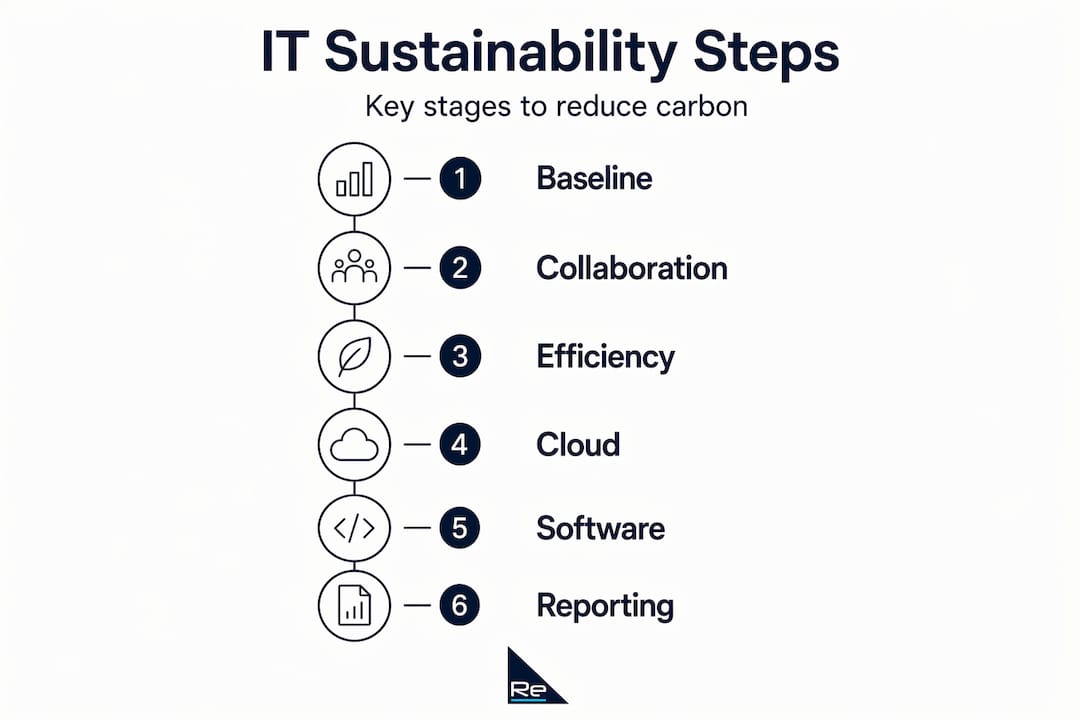
Pressure on IT departments to reduce their environmental footprint is no longer theoretical. Regulatory frameworks such as the EU Corporate Sustainability Reporting Directive (CSRD) are making sustainability metrics a legal obligation for tens of thousands of organisations, and energy costs continue to climb. For IT decision-makers and sustainability officers, a practical guide to sustainable IT infrastructure is now a business necessity, not a nice-to-have. This article provides structured, actionable guidance on how to build, manage, and continuously improve green IT infrastructure, from baselining emissions through to cloud strategy and circular economy procurement.
Table of Contents
- Key takeaways
- Prerequisites for sustainable IT infrastructure
- Energy-efficient hardware and data centre practices
- Sustainable cloud strategies and software efficiency
- Managing hardware lifecycle and circular economy
- Measuring, reporting, and continuous improvement
- My perspective on sustainable IT adoption
- How Re-solution supports your sustainable IT goals
- FAQ
Key takeaways
| Point | Details |
|---|---|
| Baseline before you build | Measure Scope 1, 2, and 3 emissions using GHG Protocol before committing to any green IT investment. |
| Retire unused infrastructure first | Decommissioning zombie servers is the single highest-impact, lowest-cost action any organisation can take. |
| Cloud region selection matters | Carbon intensity varies significantly by region; choosing the right cloud zone reduces emissions without changing workloads. |
| Hardware lifecycle reduces embodied carbon | Manufacturing accounts for up to 80% of a laptop’s lifetime carbon, making procurement and refurbishment decisions critical. |
| Reporting requires a data supply chain | Accurate sustainability reporting depends on combining market-based and location-based carbon datasets with strong governance. |
Prerequisites for sustainable IT infrastructure
Before your organisation invests in new hardware, cloud migrations, or eco-friendly technology solutions, you need an accurate picture of where you stand today. Without a credible baseline, sustainability programmes risk misallocating budget and producing reports that cannot withstand scrutiny.
Establish your carbon baseline
The GHG Protocol is the most widely accepted framework for measuring organisational carbon emissions. Applying it to IT means capturing three categories:
- Scope 1: Direct emissions from on-site diesel generators and cooling systems.
- Scope 2: Purchased electricity consumed by data centres and office IT equipment.
- Scope 3: Upstream emissions from hardware manufacturing and downstream emissions from employee devices.
Scope 3 is where most IT organisations underestimate their footprint, and it is precisely where regulators are now focusing. The EU CSRD mandates roughly 50,000 companies to report detailed sustainability metrics, including IT emissions, with mandatory reporting periods starting between 2025 and 2027.
Build cross-functional collaboration
Sustainable IT practices cannot be owned exclusively by the IT department. Procurement teams control supplier selection. Facilities teams manage cooling and power. Finance teams control capital expenditure cycles. Getting all three aligned with sustainability officers is the difference between a fragmented initiative and a coherent programme.
Pro Tip: Before launching any green IT programme, conduct a cross-departmental workshop to map all IT energy touchpoints. You will frequently find that facilities teams hold utility data that IT teams have never seen, and that data changes prioritisation entirely.
Identify quick wins before long-term investment
The most impactful first action is often the least glamorous. Retiring zombie servers, those running at under 10% utilisation, cuts energy waste substantially and requires no capital expenditure. Power management policies on endpoint devices, consolidating meeting room technology, and switching off non-production workloads outside business hours are all changes that deliver measurable results within weeks.
| Tool or resource | Purpose | Example |
|---|---|---|
| GHG Protocol framework | Carbon accounting standard | Baseline Scope 1, 2, 3 emissions |
| DCIM software | Real-time data centre monitoring | Monitor PUE and cooling efficiency |
| Cloud cost/carbon tools | Cloud usage visibility | AWS Customer Carbon Footprint Tool |
| EPEAT / ENERGY STAR | Hardware procurement guidance | Compare device energy ratings |
| Sustainability management platforms | Consolidated reporting | Integrate data across IT and facilities |
Energy-efficient hardware and data centre practices
Once your baseline exists, hardware and data centre efficiency become the core levers for reducing operational emissions. This is where sustainable IT practices produce the most measurable reductions.

Selecting the right hardware
Procuring equipment with recognised eco-labels such as ENERGY STAR and EPEAT gives organisations a credible, third-party basis for comparing devices. Beyond labels, pay attention to total cost of ownership calculations that factor in energy consumption over a three to five year lifecycle, not just purchase price.
Server virtualisation deserves particular attention. Running multiple workloads on a single physical server reduces the total number of machines required and cuts both energy consumption and cooling load. Right-sizing servers, matching hardware specifications to actual workload demands rather than peak theoretical capacity, eliminates the hidden energy waste of overprovisioned infrastructure.
Data centre efficiency and cooling
Typical enterprise data centres operate at a Power Usage Effectiveness (PUE) rating of between 1.8 and 2.5. Improving PUE to 1.5 produces significant energy savings, with cooling accounting for 30 to 40% of total data centre energy consumption.
| Cooling method | Typical PUE improvement | Best suited to |
|---|---|---|
| Traditional air cooling | Baseline (1.8 to 2.5) | Legacy facilities |
| Adiabatic cooling | 1.4 to 1.6 | Moderate climates |
| Free cooling (air-side economisation) | 1.2 to 1.4 | Cooler climates |
| Direct liquid cooling | 1.02 to 1.2 | High-density compute |
Liquid cooling, once considered niche, is now becoming the standard for AI and GPU-intensive workloads. Free cooling, which uses ambient outside air during cooler periods, is particularly effective for UK-based facilities given the climate.
Cloud migration as an efficiency lever
Moving workloads from on-premise infrastructure to public cloud is one of the most impactful changes an organisation can make. Cloud migration can reduce IT carbon footprint by up to 84%, largely because hyperscale providers achieve 65 to 75% server utilisation compared to the typical enterprise figure of 15 to 20%.
Pro Tip: Do not migrate everything indiscriminately. Lift-and-shift of poorly architected workloads to cloud can actually increase costs and emissions. Rationalise before you migrate.
Sustainable cloud strategies and software efficiency
Moving to cloud is not a sustainability destination. It is a starting point. Where you run workloads, how you size them, and when you schedule them all determine the actual carbon outcome.
Region selection and carbon-aware scheduling
Carbon intensity varies significantly by cloud region, with EU-West regions typically showing substantially lower intensity than US East. Selecting the right region for non-latency-sensitive workloads is one of the simplest configuration decisions with direct carbon impact.
Carbon-aware scheduling goes further. By timing heavy data transfers and batch processing to coincide with periods of renewable energy surplus, organisations can reduce associated emissions substantially. Solar-scheduled egress and carbon-aware routing can reduce the operational carbon footprint of network data transfers to near zero. Combining temporal flexibility, running workloads when carbon intensity is low, with spatial flexibility, running them where carbon intensity is low, achieves the greatest overall reduction.
Right-sizing and serverless architectures
Over-provisioned cloud instances are the cloud equivalent of zombie servers. Auto-scaling policies that match compute capacity to actual demand prevent paying for and emitting carbon on resources sitting idle. Serverless architectures go further by removing the concept of an always-on server entirely, with compute provisioned only during active function execution.
A practical approach to cloud rightsizing:
- Run a cloud cost and utilisation report across all accounts for the previous 90 days.
- Identify instances running below 40% average CPU utilisation.
- Downsize or consolidate those instances in a staging environment before production changes.
- Set auto-scaling policies with minimum instance counts aligned to actual baseline demand.
- Schedule non-critical batch jobs to run during low-carbon intensity windows using your cloud provider’s carbon intensity APIs.
Software sustainability principles
Software Carbon Intensity metrics allow development teams to measure and reduce code-related emissions directly. The Green Software Foundation defines green software across three dimensions: carbon efficiency, energy efficiency, and hardware efficiency. In practice, this means writing algorithms that complete tasks with fewer compute cycles, minimising unnecessary data storage and transfer, and designing architectures that can run on lower-specification hardware.
Pro Tip: Require your development teams to include carbon impact as a review criterion in architecture decision records. It does not need to be the primary criterion, but making it visible changes behaviour over time.
Managing hardware lifecycle and circular economy
The environmental impact of IT hardware does not begin when a device is switched on. Manufacturing accounts for 70 to 80% of a laptop’s lifetime carbon footprint and around 50% for servers. This means procurement and end-of-life decisions carry more weight than most organisations realise.
Circular economy principles applied to IT investment include:
- Green procurement policies: Require suppliers to hold recognised environmental certifications such as ISO 14001. Specify EPEAT-registered or ENERGY STAR-compliant products as minimum standards in tender documents.
- Extending device lifespan: A laptop refreshed after five years rather than three avoids significant embodied carbon. Structured maintenance, firmware updates, and targeted component upgrades, such as RAM or SSD replacements, extend useful life without full device replacement.
- Certified e-waste recycling: Partner with certified WEEE-compliant recyclers. Avoid general waste streams for any IT equipment. Batteries, displays, and circuit boards contain materials that require specialist handling.
- Refurbishment programmes: Consider certified refurbished equipment for non-critical roles such as reception terminals, display systems, and back-office workstations. The carbon cost of a refurbished device is a fraction of new manufacture.
- Asset tracking: Maintain a full asset register with purchase date, warranty status, and projected end-of-life. This prevents devices being replaced prematurely due to poor visibility of what is already deployed.
Aligning hardware lifecycle planning with your wider IT infrastructure investment strategy prevents ad-hoc procurement decisions that undermine sustainability goals.
Measuring, reporting, and continuous improvement
Building sustainable IT infrastructure is not a project with a completion date. It is an operational discipline that requires measurement, governance, and ongoing adjustment.
Setting up your reporting framework
- Select your primary carbon reporting standard. GHG Protocol Corporate Standard is the most widely recognised baseline, with the Science Based Targets initiative (SBTi) framework appropriate for organisations committing to net-zero targets.
- Identify data sources for each emission category. Cloud providers offer native carbon reporting tools, but cloud carbon data lacks consistency across providers, which means independent datasets and dual-accounting models are needed for accuracy.
- Combine market-based and location-based datasets to avoid greenwashing. Market-based accounting reflects the energy contracts you hold, including renewable energy certificates. Location-based accounting reflects the actual grid mix where your systems run.
- Implement a governance protocol that assigns ownership for data quality at each source. Carbon data without governance produces reports that cannot survive external assurance.
- Set KPIs for energy intensity per workload, PUE for owned facilities, percentage of cloud spend in low-carbon regions, and hardware refresh cycle length.
Continuous optimisation practices
- Conduct quarterly energy and carbon audits rather than annual reviews. The IT environment changes too quickly for annual cycles to catch regressions.
- Engage stakeholders from procurement, finance, and operations in quarterly sustainability reviews. Siloed reporting produces data that does not translate into decisions.
- Track progress against baseline year-on-year, not just against targets. Real reduction must be demonstrated, not just efficiency relative to output growth.
Pro Tip: Do not wait for your cloud provider to improve their carbon reporting tools. Build your own carbon data supply chain now using third-party datasets such as Electricity Maps alongside provider data. Organisations that build this capability early will have a significant compliance advantage as CSRD reporting requirements tighten.
My perspective on sustainable IT adoption
I’ve worked with IT teams across manufacturing, education, and logistics, and the same pattern appears consistently. Organisations treat sustainability as a reporting obligation rather than an operational discipline, and then wonder why their programmes stall after the first year.
What I’ve found is that the organisations making genuine progress share one characteristic. They treat energy efficiency as a strategic KPI, not a footnote in the annual CSR report. Energy cost, emissions per workload, and hardware utilisation sit alongside uptime and cost-per-user in their operational dashboards.
The most common pitfall I see is over-reliance on cloud provider carbon data. Providers use different methodologies, different boundaries, and different update frequencies. Accepting that data uncritically produces sustainability reports that cannot be compared year-on-year or across providers. Building your own data supply chain is not optional if you need credible compliance reporting.
Systems thinking is the other underrated discipline here. Optimising cloud carbon without considering the security implications of region selection, or extending device lifespans without a robust patch management programme, creates new risks while solving one problem. Sustainable IT infrastructure has to be evaluated across its full operational context.
The organisations that get this right do not treat it as a technology problem. They treat it as a leadership problem, and they solve it accordingly.
— Jacob
How Re-solution supports your sustainable IT goals

Re-solution has over 35 years of experience helping organisations across education, manufacturing, hospitality, and logistics build IT infrastructure that is fit for current and future demands. As a trusted Cisco partner, Re-solution understands that sustainable IT infrastructure is not achievable through a single product purchase. It requires an architecture-led approach that covers network design, hardware lifecycle, managed services, and compliance visibility.
Whether you are looking to modernise ageing infrastructure, reduce energy costs, or prepare for CSRD reporting obligations, Re-solution’s team can assess your current environment and identify the highest-impact changes available to you. Explore Re-solution’s managed IT services to see how ongoing management supports efficiency goals, or visit the infrastructure modernisation guide to understand what a sustainable upgrade path looks like for your organisation. Contact the team directly to arrange a consultation tailored to your sector and compliance requirements.
FAQ
What is sustainable IT infrastructure?
Sustainable IT infrastructure refers to the design, operation, and management of technology systems in ways that minimise energy consumption, reduce carbon emissions, and apply circular economy principles to hardware. It encompasses data centres, cloud services, end-user devices, and software architecture.
How do I start building a green IT infrastructure?
Start by establishing a carbon baseline using the GHG Protocol, covering Scope 1, 2, and 3 emissions across your IT estate. The first practical action is identifying and decommissioning underutilised servers, which delivers immediate energy savings at minimal cost.
Does cloud migration always reduce carbon emissions?
Not automatically. Migrating to public cloud can reduce IT carbon footprint by up to 84%, but only when workloads are properly architected and placed in low-carbon regions. Poorly optimised lift-and-shift migrations can increase both cost and emissions.
What regulations require IT sustainability reporting?
The EU CSRD requires approximately 50,000 companies to report sustainability metrics, including IT-related emissions, with mandatory periods beginning between 2025 and 2027. Organisations subject to CSRD must ensure their IT carbon data is auditable and consistent with GHG Protocol standards.
How do I measure and improve cloud carbon efficiency?
Use your cloud provider’s native carbon reporting tools as a starting point, then supplement with third-party carbon intensity datasets to account for inconsistencies. Combining temporal and spatial workload flexibility achieves the greatest reduction in cloud operational emissions.
Recommended
- Why invest in IT infrastructure: a 2026 guide
- Sustainable IT strategies for efficient, eco-friendly systems
- How to Future-Proof IT Infrastructure for 2025 | Re-Solution