TL;DR:
- Access control systems regulate access to physical and digital resources through credential verification and policy enforcement. They involve hardware, software, and various architecture types, with credentials like smart cards and biometrics providing different levels of security. Proper deployment and ongoing management are essential to prevent gaps between physical and logical security, ensuring compliance and protection.
An access control system is a security solution that regulates who can enter specific physical areas or access logical resources by authenticating identities and authorising rights. This overview of access control systems covers the four functional steps defined by NIST SP 800-53 Rev. 5: credential presentation, identity verification, authorisation decision, and physical actuation. Security managers and IT professionals across education, manufacturing, and hospitality sectors all rely on these principles to protect assets and meet compliance obligations. Understanding the components, credential technologies, policy models, and deployment practices is the foundation for any effective security programme.
What is an overview of access control systems?
Access control systems are built from four interconnected subsystems that work in sequence. A credential reader captures the presented token or biometric. A control panel processes the identity claim against a stored policy. A locking mechanism receives the authorisation signal. Management software ties the entire system together, providing configuration, reporting, and audit trails.

Physical access control governs entry to buildings, rooms, and secure zones. Logical access control governs access to networks, applications, and data. The two categories share the same underlying principles but operate through different hardware and software layers. Synchronising physical and logical access is critical because a gap between them creates a situation where physical entry grants network privileges that IT policy never authorised.
ASIS International and NIST both publish frameworks that define minimum requirements for access control design. ASIS PSP standards address physical security planning, while NIST SP 800-53 Rev. 5 covers information system controls. Security managers who align deployments to both frameworks satisfy the majority of sector-specific compliance requirements in finance, healthcare, and critical infrastructure.
What are the key components and architecture types?
Hardware and software building blocks
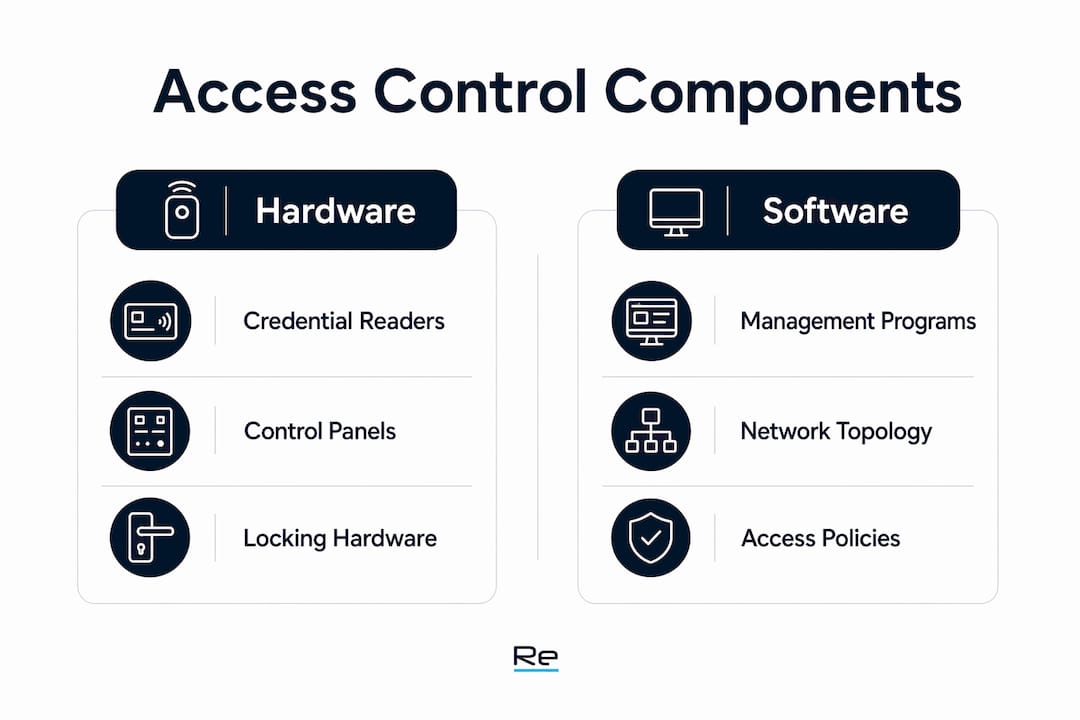
Every access control deployment combines credential readers, control panels, locking hardware, and management software. Readers range from basic keypad units to multi-technology devices that accept cards, fobs, and mobile credentials simultaneously. Control panels, sometimes called door controllers, hold the local policy database and send unlock signals. Management software provides the administrative interface for enrolment, reporting, and integration with HR or identity governance platforms.
Network topology design, including Power over Ethernet (PoE) switch placement and backhaul capacity, directly impacts door performance. Poor network design causes door response lag, which frustrates users and undermines confidence in the system. Specifying adequate PoE budgets and redundant uplinks at the design stage prevents this problem.
Architectural categories compared
| Architecture | Key advantage | Key limitation | Typical use case |
|---|---|---|---|
| Standalone | No network dependency | No central management | Small single-door installations |
| Networked on-premises | Full central control | Requires on-site server maintenance | Mid-size facilities with IT teams |
| Cloud-managed | Remote administration and scalability | Depends on internet connectivity | Multi-site organisations |
| Hybrid | Local resilience with central oversight | Higher design complexity | Campuses with mixed connectivity |
Cloud-managed access control systems centralise administration and support remote management, but they depend on internet connectivity and typically carry subscription costs. Distributed architectures cache credential databases locally to maintain door operation during WAN outages, though revocation propagation introduces a delay that security teams must account for in their incident response procedures.
Pro Tip: On large multi-building deployments, specify local caching controllers at each building and a dedicated management VLAN. This eliminates WAN latency as a variable in door response time and keeps revocations from becoming a single point of failure.
What credential types and authentication methods are available?
Credential technologies fall into three categories based on the authentication factor they use.
- Knowledge-based: PINs and passwords. Low cost, easy to deploy, but vulnerable to observation and sharing.
- Possession-based: Proximity cards, smart cards, and key fobs. Widely deployed in commercial buildings; smart cards offer cryptographic assurance that proximity cards lack.
- Biometric: Fingerprint, iris, and facial recognition. High assurance but subject to significant legal constraints.
- Mobile credentials: Smartphone-based tokens delivered via Bluetooth Low Energy or NFC. Convenient and non-duplicable, with strong cryptographic backing.
- Multi-factor authentication (MFA): Combines two or more of the above categories. Required by many regulatory frameworks for high-security zones.
80% of security breaches involve stolen or compromised credentials, which makes the choice of credential technology a direct security decision, not merely a convenience one. Legacy proximity cards are easily cloned with off-the-shelf hardware, so organisations still relying on them carry a measurable and avoidable risk. Replacing them with secure, non-duplicable credentials such as smart cards or mobile tokens is the single highest-impact upgrade most facilities can make.
Biometric systems offer high-assurance authentication but create significant legal exposure. Regional biometric privacy laws impose strict requirements on data storage, consent, and retention. Security managers must conduct a legal assessment before deploying biometrics, particularly in multi-jurisdiction organisations. The compliance burden is real and should be factored into the total cost of ownership.
How do access control policy models govern permissions?
Policy models define the rules that determine whether a verified identity receives access. Four principal models are in common use.
- Discretionary Access Control (DAC): Resource owners set permissions individually. Flexible but difficult to govern at scale.
- Mandatory Access Control (MAC): A central authority assigns security labels to subjects and objects. Used in government and defence environments where classification levels are fixed.
- Role-Based Access Control (RBAC): Permissions attach to roles rather than individuals. A user inherits access by being assigned a role such as “warehouse operative” or “finance manager.”
- Attribute-Based Access Control (ABAC): Permissions are evaluated dynamically against multiple attributes, including time of day, location, device state, and user department.
Most commercial deployments start with RBAC and eventually layer ABAC on top for more complex authorisation scenarios. This combination allows organisations to handle straightforward role assignments efficiently while applying fine-grained controls where the risk profile demands it. A manufacturing site might use RBAC to grant shift workers access to the production floor and ABAC to restrict that access to scheduled shift hours only.
Organisations frequently combine DAC, RBAC, and ABAC to create layered security. Physical environments often use RBAC for door groups, while logical environments apply ABAC for application access. Aligning both layers to a single identity governance platform reduces administrative overhead and improves audit quality. For a practical guide to network access policy workflows, the principles of RBAC and ABAC translate directly into network policy enforcement.
Pro Tip: Privilege creep, where users accumulate access rights beyond their current role, is the most common policy failure in mature deployments. Automate quarterly access reviews using your identity governance platform and trigger automatic revocation when a user changes role or department. Manual reviews alone will not keep pace with organisational change.
What are the best practices for deploying access control systems?
Deploying an access control system effectively requires a structured approach across six phases.
- Site assessment. Survey all entry points, identify security zones, and document existing infrastructure. Map power availability, network drops, and cable routes before specifying hardware.
- System design. Select the architecture type, define door controller placement, and specify network topology including PoE switch capacity. Align the design with network infrastructure compliance requirements.
- Hardware specification. Choose credential readers, control panels, and locking hardware. Decide on fail-safe versus fail-secure configurations per door type.
- Commissioning. Install and test all hardware. Verify that each door responds within acceptable latency thresholds and that the management software receives accurate event data.
- Policy configuration. Define roles, access groups, and schedules. Import user data from HR systems and configure automated provisioning workflows.
- Operations and review. Establish a periodic review cycle for access rights. Integrate audit logs with your SIEM or identity governance platform.
Fail-safe locks unlock on power loss for egress safety, while fail-secure locks remain locked. NFPA 101 Life Safety Code and local building regulations mandate specific configurations for fire exits, stairwells, and secure areas. Applying a uniform configuration across all doors is a common and serious error. Each door type requires its own assessment against the applicable code.
Automated credential lifecycle management is the most effective control against privilege creep. Manual processes cannot reliably track joiners, movers, and leavers at the pace of a modern organisation. Automated workflows that trigger on HR system events provision access on day one and revoke it on the last day, closing the window of risk that manual processes leave open. Access control also functions as a compliance and audit engine, generating immutable event records that satisfy audit requirements in regulated sectors including finance, healthcare, and critical infrastructure.
Key takeaways
Effective access control requires aligning credential technology, policy models, and network infrastructure to a single governance framework from the design stage.
| Point | Details |
|---|---|
| Credential choice is a security decision | Replace legacy proximity cards with smart cards or mobile credentials to eliminate cloning risk. |
| Architecture must match connectivity | Choose cloud-managed or hybrid architectures based on WAN reliability and multi-site requirements. |
| Policy models layer for depth | Combine RBAC for role assignments with ABAC for time, location, and device-based conditions. |
| Fail-safe configuration is code-driven | Assess each door type individually against NFPA 101 before specifying locking hardware. |
| Automate credential lifecycle management | Automated provisioning and revocation workflows are the primary defence against privilege creep. |
What security managers often get wrong about access control
The most persistent mistake I see is treating access control as a one-time installation project rather than an ongoing security programme. Teams invest heavily in hardware commissioning and then leave the policy layer to drift. Within eighteen months, role assignments no longer reflect the organisation, and the audit trail that compliance teams depend on becomes unreliable.
The second issue is the disconnect between physical and logical access. A user whose employment ends on a Friday may have their Active Directory account disabled by Monday morning, but their physical access card still works. That gap is not theoretical. It represents a real window of risk that unified identity governance closes.
Biometrics deserve particular caution. The technology is mature, but the legal framework around it is not uniform. Deploying facial recognition across a multi-site estate without a jurisdiction-by-jurisdiction legal review is a compliance liability that no security manager should accept. The assurance gain rarely justifies the legal exposure without careful preparation.
Network infrastructure is the silent variable that determines whether a well-designed access control system actually performs. I have seen deployments where door response lag exceeded two seconds because nobody specified adequate PoE capacity at the design stage. That is a network infrastructure problem, not an access control problem, and it is entirely preventable with proper planning. The IT infrastructure fundamentals that underpin access control performance deserve the same attention as the security hardware itself.
— Jacob
How Re-solution supports access control deployments
Re-solution has over 35 years of experience designing and delivering Cisco IT infrastructure that underpins physical and logical access control systems across education, manufacturing, and hospitality sectors.

Re-solution’s network design, audit, and managed services address the infrastructure layer that determines whether access control systems perform reliably. From PoE switch specification and VLAN segmentation to network access controller configuration and compliance reporting, Re-solution delivers the technical foundation that security managers need. If your organisation is planning a new deployment or reviewing an existing system, contact Re-solution to discuss how the right network infrastructure supports every door, every credential, and every audit requirement.
FAQ
What is an access control system?
An access control system is a security solution that regulates entry to physical areas or logical resources by verifying credentials and authorising access based on defined policies. NIST SP 800-53 Rev. 5 defines the process as four sequential steps: credential presentation, identity verification, authorisation decision, and actuation.
What are the main types of access control systems?
The main types are standalone, networked on-premises, cloud-managed, and hybrid architectures. Each type differs in how it stores credential data, manages policies, and maintains operation during network outages.
What credential types offer the strongest security?
Mobile credentials and smart cards offer the strongest security because they use cryptographic authentication that cannot be cloned. Legacy proximity cards are easily duplicated and account for a significant proportion of credential-related breaches.
What is the difference between fail-safe and fail-secure locking?
Fail-safe locks release on power loss, allowing egress in an emergency. Fail-secure locks remain locked on power loss, protecting secure areas. NFPA 101 Life Safety Code governs which configuration applies to each door type.
How does RBAC differ from ABAC in access control policy?
Role-Based Access Control assigns permissions based on a user’s role within the organisation. Attribute-Based Access Control evaluates multiple real-time attributes, such as time of day, location, and device state, to make dynamic authorisation decisions. Most enterprises deploy both models together.
Recommended
- What is access control? A clear guide for 2026
- Effective network access management for schools in 2026
- Top smart security solutions: safety and compliance 2026