TL;DR:
- Cloud-managed networking centralizes device control through a cloud platform, enabling remote configuration and monitoring. It enhances visibility, security, and operational efficiency across multiple sites, but requires careful planning of segmentation, security policies, and incremental change management to avoid propagation issues.
Cloud-managed networking is defined as the centralised management of network devices through a cloud-hosted software platform, where configuration, monitoring, and lifecycle operations are handled remotely via management APIs and dashboards. This model replaces traditional command-line interface management on individual devices with a unified control plane accessible from anywhere. For IT professionals and decision-makers, this shift means faster deployments, consistent policy enforcement, and real-time visibility across every site. This cloud-managed networking guide covers the architecture, benefits, security practices, and operational workflows you need to implement and maintain a well-run cloud network in 2026.
What is cloud-managed networking and how does it work?
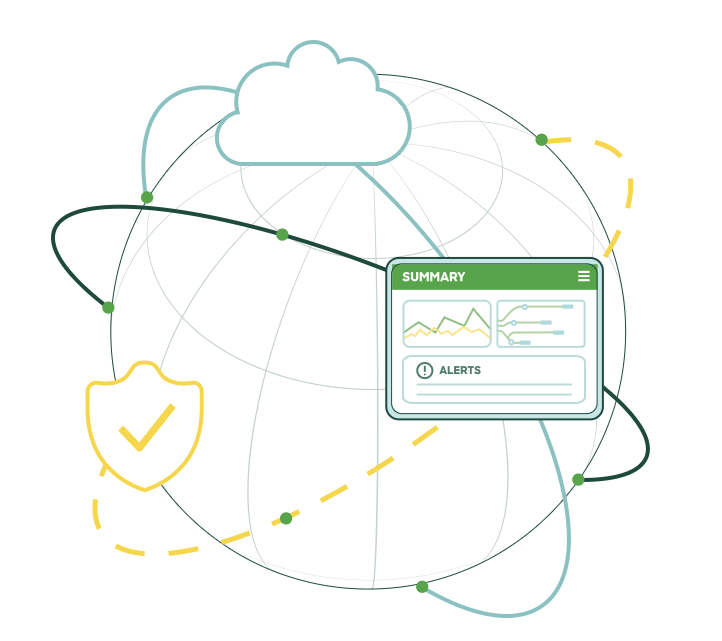
Cloud-managed networking centralises control with a cloud-hosted management plane that coordinates device configuration, monitoring, and lifecycle operations remotely. On-premises devices, such as switches, access points, and routers, connect via secure, encrypted channels to the cloud platform. The platform then pushes configuration changes, collects telemetry, and manages firmware updates without requiring a technician on site.
The architecture separates the management plane from the data plane. The management plane lives in the cloud and handles policy, configuration, and visibility. The data plane remains on the physical device and continues forwarding traffic locally, which preserves performance even when cloud connectivity is briefly interrupted. This distinction matters: a cloud-managed switch still routes packets at wire speed regardless of whether the dashboard is reachable.
Cloud networking virtualises networks, subnets, and route tables to isolate and route traffic efficiently, preventing address overlap and simplifying connectivity across sites. Virtual networks behave like private data centres, and subnet design is foundational for predictable traffic flow. Getting this right at the design stage avoids costly re-addressing later.
Device onboarding and trust verification
Onboarding in cloud-managed systems requires device trust validation, licensing verification, and site assignment before any configuration is pushed. A device that fails licence checks or certificate validation will not receive its configuration profile. This workflow protects the network from unauthorised hardware joining the managed estate.
- Register the device serial number or claim code in the cloud dashboard.
- Verify the licence entitlement and assign the device to the correct site and network profile.
- Connect the device to the internet; it contacts the cloud platform and downloads its configuration automatically.
- Confirm the device appears as “online” in the dashboard before proceeding with further policy changes.
Pro Tip: Label devices with their physical location and rack position before onboarding. The dashboard will reflect these labels, making remote troubleshooting significantly faster when you need to identify a specific port or access point.
What are the key benefits of cloud networking for organisations?
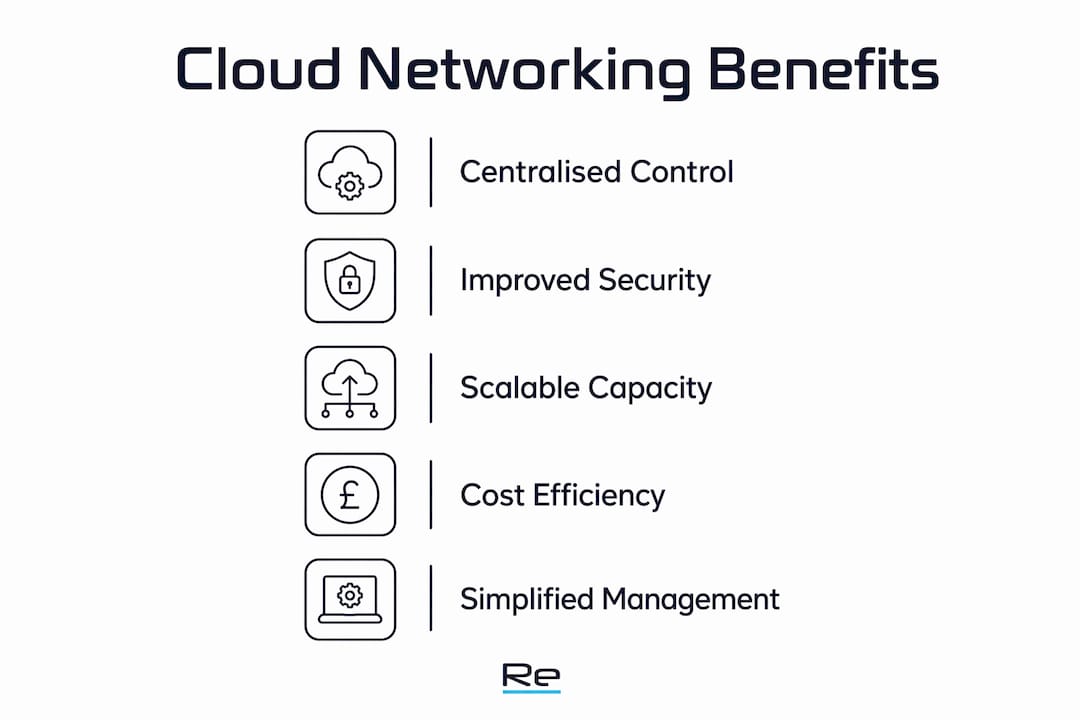
Cloud-managed networking enables real-time monitoring, centralised configuration, and automatic firmware updates, reducing manual overhead across the entire network estate. That reduction in manual effort translates directly into fewer after-hours callouts and faster mean time to resolution. For multi-site organisations, the value compounds: one IT team can manage dozens of locations from a single pane of glass.
The operational advantages extend beyond convenience:
- Global visibility. A single dashboard shows device health, traffic patterns, and alert status across every site simultaneously.
- Automated security updates. Firmware and security patches deploy on a schedule without requiring manual intervention at each device.
- Predictable cost model. Subscription-based licensing replaces large capital expenditure on hardware refresh cycles, shifting spend to a controllable operational budget.
- Faster troubleshooting. Packet capture, event logs, and topology maps are accessible remotely, cutting diagnostic time from hours to minutes.
- Multi-site and remote work support. New sites come online by shipping pre-registered hardware and connecting it to the internet, with no specialist on-site configuration required.
Cloud-managed models are cloud-native and internet-dependent, unlike controller-based campus solutions that can operate internally without constant cloud connectivity. That dependency is worth planning for: a resilient internet uplink at each site is not optional, it is a design requirement. Organisations that treat internet connectivity as a secondary concern often discover this the hard way during an outage.
For a broader view of how cloud networking fits within your overall infrastructure, the Re-solution guide on cloud networking models covers the full taxonomy of deployment options.
How should IT teams plan capacity and monitor performance?
Capacity planning for cloud-managed networks starts with load and stress testing to establish baseline bandwidth consumption, connection counts, and latency under realistic traffic conditions. Without a baseline, alert thresholds are guesswork. With one, you can set meaningful limits that trigger before users notice a problem.

Industry guidance recommends setting alert thresholds when bandwidth utilisation exceeds 60%, latency grows beyond baseline by 50%, or connection counts approach 80% of capacity. These thresholds give IT teams enough lead time to act before a performance issue becomes a service outage.
| Metric | Alert threshold | Action |
|---|---|---|
| Bandwidth utilisation | Above 60% | Review traffic mix; consider QoS policy or uplink upgrade |
| Latency increase | Above 50% of baseline | Investigate routing path; check for congestion or misconfiguration |
| Connection count | Above 80% of capacity | Prepare to scale; review NAT table limits and session timeouts |
Automated dashboards in cloud-managed platforms surface these metrics continuously. The real advantage is not the data itself but the ability to set automated alerts that page the right person before a threshold is breached. Pair dashboard alerts with bandwidth management practices to prioritise critical application traffic during peak periods.
Pro Tip: Run a quarterly capacity review using 90-day trend data from your dashboard. A gradual 5% monthly increase in bandwidth utilisation will breach the 60% threshold within a predictable window, giving you time to plan an upgrade rather than react to an outage.
What security best practices apply to cloud-managed networks?
Cloud network security is software-defined and API-driven, replacing physical perimeters with programmatic policies and virtual constructs. There is no firewall appliance at the edge of a cloud network in the traditional sense. Security controls are applied via API, which means a misconfigured policy can expose resources just as effectively as a misconfigured physical firewall.
The most effective approach to cloud network security combines segmentation, layered controls, and continuous visibility:
- Segment by account, subscription, or project. Segmenting cloud environments by account or project limits the blast radius of a breach. An attacker who compromises one segment cannot move laterally into another without crossing a policy boundary.
- Apply layered controls. Use security groups for instance-level rules, network access control lists (ACLs) for subnet-level rules, and micro-segmentation for workload-level policy. Each layer catches what the previous one misses.
- Review open inbound rules quarterly. Any rule permitting traffic from 0.0.0.0/0 (the open internet) deserves scrutiny every quarter. Rules added for testing or temporary access frequently become permanent by default.
- Enable flow logs. Flow logs routed to a central store provide the metadata needed to identify scanning activity, lateral movement, and data exfiltration. Without them, forensic investigation after an incident is severely limited.
- Use anomaly detection. Network detection tools that baseline normal traffic patterns can flag unusual behaviour before it escalates to a confirmed breach.
Modern cloud network security relies on layered, identity-based micro-segmentation applied at the workload level rather than perimeter-only approaches. Perimeter controls remain necessary but are no longer sufficient. Every workload should carry its own security policy, enforced regardless of where it runs or which network it connects to.
For detailed guidance on layered security controls, Re-solution’s resource on cloud security strategies covers segmentation and micro-segmentation in depth.
What are the common challenges in managing cloud networks?
Change management is the most underestimated challenge in cloud network management. Cloud platforms use eventual consistency, meaning a configuration change applied to one component may take seconds or minutes to propagate across all dependent components. Applying multiple dependent changes simultaneously creates a window where the network is in an inconsistent state.
Avoid batching dependent control plane changes. Apply one change, verify it has propagated correctly, then proceed to the next. This approach takes longer in the short term but eliminates the category of outage caused by race conditions between configuration updates.
Practical pitfalls to watch for:
- Trust relationship errors during onboarding. A device that cannot reach the cloud platform’s authentication endpoint will fail to claim its configuration. Check DNS resolution and firewall rules for the platform’s management URLs before shipping hardware to a remote site.
- Licence mismatches. Assigning a device to a feature tier it is not licenced for silently disables those features. Audit licence assignments after every hardware addition.
- Forwarding plane versus management plane confusion. When a device appears offline in the dashboard but users report normal connectivity, the forwarding plane is healthy and the management plane connection has dropped. These require different diagnostic approaches.
Pro Tip: Keep a change log with timestamps for every configuration update, even minor ones. When troubleshooting an issue that appeared gradually, the log often reveals a change made days earlier that had a delayed effect due to propagation timing.
Industry best practice is to prioritise small, incremental network control updates rather than batching changes, ensuring predictable behaviour in eventually consistent cloud management platforms. Automation tools that enforce this discipline by design are worth the investment.
My view on where cloud-managed networking is heading
After working with organisations across education, manufacturing, and hospitality on network deployments, the pattern I see most often is this: teams adopt cloud-managed networking for the convenience, then discover its deeper value is in observability. The ability to see exactly what is happening across every site, in real time, without dispatching an engineer, changes how IT teams operate fundamentally.
What I think most guides understate is the importance of routing and segmentation design at the outset. Teams that treat these as details to sort out later spend significant time re-architecting networks that were built without clear traffic boundaries. Getting the virtual network topology right before onboarding the first device saves weeks of remediation work.
The security model is also shifting faster than most organisations realise. Identity-based micro-segmentation, where policy follows the workload rather than the network address, is becoming the expected baseline rather than an advanced capability. Teams still relying solely on perimeter controls will find themselves exposed as workloads become more distributed.
The future of cloud network management points toward greater automation and AI-assisted anomaly detection. The platforms that will matter most are those that can surface a meaningful alert from millions of telemetry events, not just collect the data. My advice: adopt small, reversible changes with strong monitoring from day one, and build the discipline of verification into every change process. The teams that do this consistently are the ones that avoid the outages that make headlines.
— Jacob
How Re-solution supports your cloud network deployment
Re-solution has over 35 years of experience delivering Cisco IT infrastructure, managed network solutions, and security services to organisations across education, manufacturing, logistics, and hospitality. The team works with clients from initial network design through to ongoing management, covering capacity planning, segmentation architecture, and security policy configuration.
Whether you are planning a first cloud-managed deployment or consolidating a multi-site estate, Re-solution’s Network as a Service offering provides a fully managed path that covers device onboarding, monitoring, firmware management, and incident response. Contact Re-solution to discuss a bespoke cloud network strategy built around your organisation’s specific connectivity and compliance requirements.
FAQ
What is cloud-managed networking?
Cloud-managed networking is the centralised management of network devices through a cloud-hosted platform that handles configuration, monitoring, and firmware updates remotely. It replaces per-device CLI management with a unified dashboard accessible from any location.
How does cloud-managed networking differ from traditional networking?
Traditional networking requires direct CLI access to each device for configuration and troubleshooting. Cloud-managed networking centralises these operations in a cloud platform, enabling remote management, automated updates, and real-time visibility across all sites simultaneously.
What security controls are essential for cloud networks?
The essential controls are network segmentation by account or project, layered security groups and ACLs, quarterly review of open inbound rules, and continuous flow log collection routed to a central store for detection and forensic analysis.
What alert thresholds should IT teams set for cloud network performance?
Alert thresholds should trigger when bandwidth utilisation exceeds 60%, latency increases beyond 50% of baseline, or connection counts approach 80% of capacity. These thresholds provide enough lead time to act before a performance issue affects users.
What is the biggest operational risk when making cloud network changes?
The biggest risk is applying multiple dependent configuration changes simultaneously. Cloud platforms use eventual consistency, so batched changes can create propagation conflicts. Apply one change at a time and verify propagation before proceeding to the next.
Key takeaways
Cloud-managed networking requires a cloud-hosted management plane, clear segmentation design, layered security controls, and disciplined incremental change management to deliver reliable, visible, and secure network operations.
| Point | Details |
|---|---|
| Separate management from data plane | The cloud handles policy and config; on-premises hardware handles local traffic forwarding for performance. |
| Set performance alert thresholds | Trigger alerts at 60% bandwidth, 50% latency increase, and 80% connection capacity to act before outages occur. |
| Segment by account or project | Isolating environments limits breach impact and prevents lateral movement across the network estate. |
| Apply changes incrementally | Cloud platforms use eventual consistency; batch changes cause propagation conflicts and unpredictable behaviour. |
| Enable flow logs from day one | Flow logs provide the metadata needed to detect scanning, lateral movement, and exfiltration in cloud networks. |
Recommended
- Cloud networking definition: a 2026 guide for IT teams
- Cloud connectivity explained: a 2026 guide for IT teams
- Cloud Network Advantages 2025 | Re-Solution