TL;DR:
- Firewalls are essential for protecting business networks by filtering traffic and reducing attack surfaces. Their effectiveness depends on correct configuration, regular review, and integration with other security measures, especially in manufacturing and OT environments. Ongoing discipline in firewall management is crucial for maintaining strong network security.
A firewall is defined as a network security control that filters incoming and outgoing traffic based on predefined security rules to protect business networks from unauthorised access and threats. The role of firewalls in business extends beyond simple packet blocking. Firewalls reduce the attack surface by limiting connections to only approved communications, blocking malicious attempts such as port scans and exploit probes. NIST SP 800-41 establishes firewalls as a foundational network security control, and their position within cybersecurity frameworks like the NIST Cybersecurity Framework and ISO 27001 confirms their status as a non-negotiable baseline defence. For IT decision-makers, understanding what firewalls do and where they fit is the starting point for any credible security architecture.
What are the main types of firewalls used in business?
Firewall technologies span four primary categories, each offering a different depth of traffic inspection and control. Packet-filtering firewalls examine individual packets against static rules based on IP address, port, and protocol. Stateful inspection firewalls track the state of active connections, making decisions based on context rather than individual packets alone. Proxy firewalls act as intermediaries, inspecting traffic at the application layer before forwarding it. Next-generation firewalls (NGFW) combine stateful inspection with deep packet inspection, application awareness, intrusion prevention, and identity-based policies.

Hardware, software, and cloud-managed firewalls serve different business needs based on scale, user count, and management preferences. Hardware firewalls sit at the network perimeter and protect all devices behind them. Software firewalls run on individual hosts and are suited to endpoint protection or virtual environments. Cloud-managed firewalls, increasingly common in 2026, centralise policy management across distributed sites and remote workforces.
The table below summarises the key differences across firewall types and their typical deployment contexts.
| Firewall type | Key feature | Deployment context |
|---|---|---|
| Packet-filtering | Fast, low overhead | Small networks, basic perimeter control |
| Stateful inspection | Connection-aware decisions | Mid-size business perimeter |
| Proxy (application-layer) | Deep content inspection | High-security or regulated environments |
| NGFW | Application and identity awareness | Enterprise, cloud, and hybrid networks |
| Cloud-managed | Centralised policy control | Multi-site and remote-first organisations |
Zero Trust principles align naturally with NGFW and cloud-managed firewall deployments. Rather than trusting traffic by network location, Zero Trust requires verification at every access point. Firewalls enforcing micro-segmentation and identity-based rules are a direct technical expression of that principle. For organisations adopting Zero Trust Network Access (ZTNA), the firewall layer becomes the enforcement point for granular access policies across users, devices, and workloads.
Pro Tip: When selecting a firewall type, map your choice to your network topology first. An NGFW deployed at the perimeter without internal segmentation still leaves lateral movement unchecked inside the network.
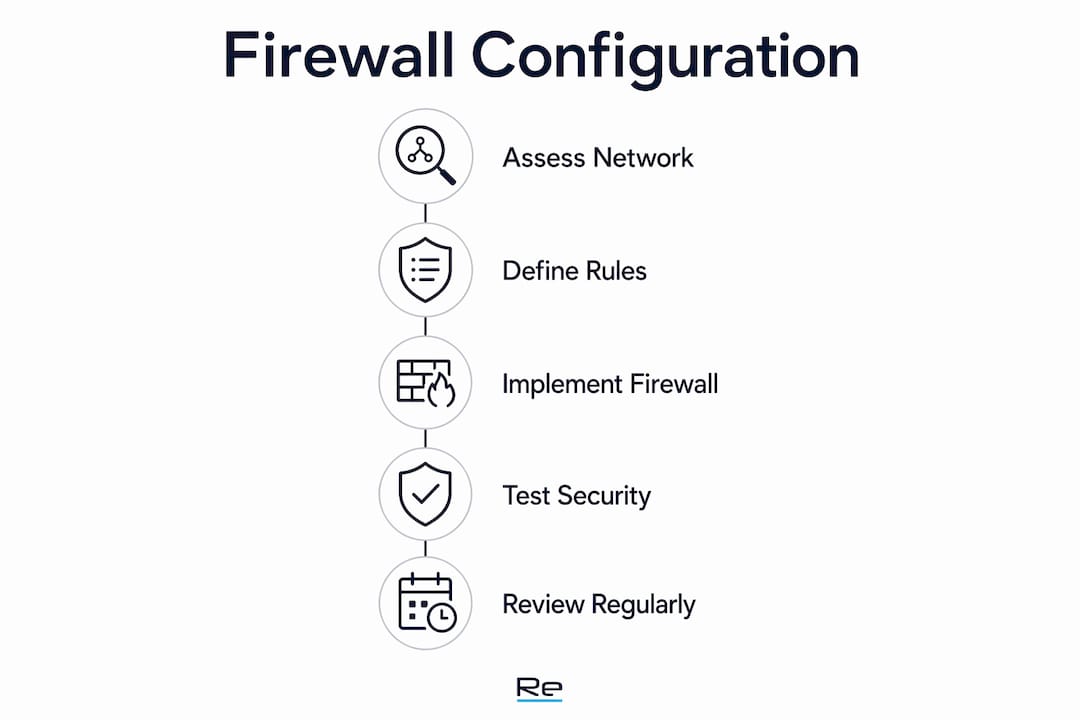
How should firewalls be configured to reduce cyber risk?
Effective firewall configuration is about reducing the attack surface by closing unnecessary ports, removing exposed services, and denying non-essential connections by default. This is not simply about blocking all traffic. It is about permitting only what the business explicitly requires and denying everything else. The principle of least privilege applied to firewall rules means each rule grants the minimum access needed for a specific function.
The following configuration practices form the foundation of a well-managed firewall policy:
- Apply a default-deny policy. All traffic is blocked unless a specific rule permits it. This inverts the common but dangerous default-allow approach.
- Segment the network using VLANs and subnets. Segmentation through VLANs and subnets limits lateral movement in the event of a breach, containing damage to a single zone rather than the whole network.
- Define zone-based rules. Separate zones for internal users, servers, guest access, and DMZ resources each carry their own rule sets aligned to their risk profile.
- Harden remote access. VPNs combined with multi-factor authentication (MFA) prevent unauthorised access from external endpoints. MFA alone reduces credential-based attack success rates significantly.
- Enable comprehensive logging and monitoring. Firewall logs are the primary source of evidence during incident response. Logs must be retained, reviewed, and fed into a SIEM or monitoring platform.
- Conduct regular rule reviews. Outdated or overly permissive rules accumulate over time. A quarterly review cycle identifies redundant rules and tightens access where business requirements have changed.
Misconfigured firewalls with excessively broad or outdated rules expose business networks to risk and may disrupt operations. Temporary rules created during maintenance windows or incident response are a particular hazard. They frequently remain in place long after their purpose has passed, widening the attack surface without any deliberate decision to do so.
Pro Tip: Every firewall rule should carry a documented owner, a creation date, and a review date. Rules without documentation are rules without accountability, and they are the ones most likely to cause a breach.
For a broader view of network security best practices, including how firewall configuration fits within a full security programme, the principles above apply across all network sizes and sectors.
What is the role of firewalls in manufacturing and OT environments?
Manufacturing networks present a distinct set of requirements that standard enterprise firewall strategies do not address without modification. Manufacturing IT networks require specially designed firewall policies that prioritise uptime, real-time communication, and safety. A firewall misconfiguration that causes a brief outage in an office environment is an inconvenience. The same event on a production line can halt output, damage equipment, or create a safety incident.
Operational technology (OT) networks run industrial protocols including Modbus, Profinet, and EtherNet/IP. Standard enterprise firewalls often lack the protocol parsers needed to inspect these communications correctly. Industrial firewalls prevent threats crossing IT to OT boundaries and handle proprietary protocols, ensuring real-time control system integrity. Deploying a generic enterprise firewall in front of a programmable logic controller (PLC) without OT-aware inspection creates blind spots that attackers can exploit.
The key considerations for firewall deployment in manufacturing environments include:
- IT/OT segmentation aligned with IEC 62443. The IEC 62443 standard defines security zones and conduits for industrial control systems. Firewall rules should enforce zone boundaries and restrict conduit traffic to approved protocols and endpoints only.
- DMZ placement between IT and OT. A demilitarised zone between the corporate IT network and the OT network prevents direct communication between the two, requiring all data exchange to pass through controlled inspection points.
- Support for legacy and proprietary systems. Many OT environments run equipment that cannot be patched or updated. Firewalls must compensate by enforcing strict access controls around these assets.
- Availability as the primary constraint. Unlike IT environments where a brief service interruption is acceptable, OT networks often require 24/7 availability. Firewall changes must be tested in a staging environment before production deployment.
- Collaboration between IT and OT teams. Firewall policy decisions in manufacturing require input from both IT security professionals and OT engineers who understand process requirements.
Pro Tip: Never apply an IT firewall change management process directly to an OT environment without consulting the OT team. What constitutes a low-risk change in IT can be a production-stopping event in OT.
The role of firewalls in manufacturing goes beyond perimeter defence. They are the primary technical control for enforcing the boundary between business systems and the physical processes those systems control. Getting that boundary wrong has consequences that extend well beyond the network.
How do firewalls fit into a broader cybersecurity strategy?
Firewalls are a foundational control but cannot replace complementary security measures such as antivirus, MFA, endpoint protection, and user awareness training. Their role is essential within a layered defence-in-depth architecture. No single control stops every threat, and firewalls are no exception.
Well-configured firewalls support policy enforcement, restrict access based on roles and services, and log traffic to aid monitoring and incident response throughout enterprise and cloud environments. They reduce lateral movement inside networks by enforcing segmentation and controlling communications between departments or zones. That capability makes them a critical component of any Zero Trust architecture, where implicit trust is removed and every connection is verified.
The controls that work alongside firewalls in a mature security architecture include:
- Intrusion detection and prevention systems (IDS/IPS). These analyse traffic for known attack signatures and anomalous behaviour, complementing the access control function of firewalls.
- Endpoint detection and response (EDR). Firewalls protect the network perimeter and internal segments. EDR protects individual devices from threats that bypass network controls.
- Multi-factor authentication (MFA). MFA prevents compromised credentials from granting network access, reducing the risk that an attacker who obtains a password can reach protected resources.
- Patch management. Unpatched systems remain vulnerable regardless of firewall rules. Patch management closes vulnerabilities that firewalls cannot address.
- Security awareness training. Phishing and social engineering attacks bypass technical controls by targeting users directly. Training reduces the likelihood of a user action that circumvents firewall protections.
For organisations managing data security in 2026, the firewall layer sits within a wider set of controls that together define the organisation’s security posture. Treating firewalls as the sole line of defence is the most common and most costly mistake in network security planning.
The role of managed firewalls in network security is increasingly relevant for organisations that lack the internal resource to maintain firewall policies, review logs, and respond to alerts continuously. Managed firewall services provide the operational discipline that many in-house teams struggle to sustain alongside other priorities.
Key takeaways
Firewalls are a critical network security control, but their effectiveness depends entirely on correct configuration, regular maintenance, and integration with complementary security measures across IT and OT environments.
| Point | Details |
|---|---|
| Firewalls filter by rule | A default-deny policy blocks all traffic unless explicitly permitted, reducing the attack surface. |
| Firewall type must match context | NGFWs suit enterprise and cloud environments; industrial firewalls are required for OT and manufacturing networks. |
| Misconfiguration is the primary risk | Temporary or overly broad rules frequently persist, widening exposure without any deliberate decision. |
| Segmentation limits breach impact | VLANs and zone-based rules contain lateral movement, restricting damage to a single network segment. |
| Firewalls require complementary controls | MFA, EDR, IDS/IPS, and patch management are all necessary alongside firewalls in a defence-in-depth architecture. |
Why firewall strategy still gets underestimated in 2026
After working across IT infrastructure projects for many years, the pattern I see most often is not a lack of firewalls. It is a lack of firewall discipline. Organisations deploy capable hardware, configure it during the initial project, and then treat it as a set-and-forget control. Rules accumulate. Temporary exceptions become permanent. Nobody owns the review cycle.
The second most common mistake is treating the firewall as the security strategy rather than one component within it. A well-configured perimeter firewall with no internal segmentation still allows an attacker who gains a foothold inside the network to move laterally without restriction. That is not a firewall failure. It is a strategy failure.
What I have found works is treating firewall policy as a living document. Every rule needs an owner and a review date. Every change needs a record. OT environments need their own firewall governance, separate from IT, with OT engineers involved in every policy decision. And the firewall layer needs to be tested regularly, not just monitored. Penetration testing and configuration audits reveal what log review alone cannot.
The organisations that get this right are not necessarily the ones with the most advanced technology. They are the ones with the clearest processes and the most consistent discipline in applying them.
— Jacob
Re-solution’s approach to firewall and network security
Re-solution has over 35 years of experience designing and managing Cisco IT infrastructure for organisations across manufacturing, education, hospitality, and logistics. Firewall strategy sits at the centre of that work, from initial architecture through to ongoing managed services.

Whether you are reviewing your current firewall posture, planning a network segmentation project, or moving towards a managed security model, Re-solution provides the technical depth and sector knowledge to get it right. Explore Re-solution’s managed network services or review the IT infrastructure fundamentals that underpin effective firewall deployment. For organisations ready to assess their current environment, Re-solution’s network audit service provides a clear baseline from which to build.
FAQ
What is the primary role of firewalls in business?
A firewall controls which network traffic is permitted or denied based on predefined security rules, protecting business networks from unauthorised access and reducing the attack surface against external threats.
What is the difference between a stateful firewall and an NGFW?
A stateful firewall tracks the state of active connections to make context-aware decisions. An NGFW adds deep packet inspection, application awareness, and identity-based policies, providing significantly greater visibility and control.
Why do manufacturing environments need specialist firewall configurations?
Manufacturing OT networks run industrial protocols such as Modbus and Profinet that standard enterprise firewalls cannot inspect correctly. Industrial firewalls aligned with IEC 62443 are required to protect control systems without disrupting production.
Can a firewall alone protect a business network?
A firewall is a foundational control but cannot replace MFA, endpoint protection, intrusion prevention systems, or security awareness training. Effective network security requires a layered, defence-in-depth approach.
How often should firewall rules be reviewed?
Firewall rules should be reviewed at least quarterly. Temporary or overly permissive rules frequently persist beyond their intended purpose, increasing the attack surface over time.
Recommended
- Why invest in IT infrastructure: a 2026 guide
- Understanding firewall security: a 2026 guide
- The role of managed firewalls in network security
- Infrastructure Insights for Business Growth | Re-Solution