TL;DR:
- Proper bandwidth management boosts organizational productivity by preventing congestion and prioritizing critical applications. It involves measuring, monitoring, and controlling network traffic using policies like QoS and traffic shaping. Continuous review and sector-specific policies are essential for optimal network performance.
Organisations that implement proper bandwidth management report productivity gains of 25% or more, yet many IT teams still treat it as an afterthought. Poor bandwidth control does not just slow down internet browsing. It disrupts VoIP calls, delays cloud application access, and undermines the reliability of critical systems across every department. For IT managers in education, manufacturing, and hospitality, the stakes are particularly high. This guide covers what bandwidth management actually involves, the measurable benefits it delivers, the tools and techniques available, and how to apply best practice within your specific sector.
Table of Contents
- What is bandwidth management?
- Why bandwidth management matters: Key benefits
- Core techniques and tools for bandwidth management
- Sector focus: Bandwidth management for education, manufacturing, and hospitality
- A fresh look: What most guides miss about bandwidth management
- Transform your network with expert support
- Frequently asked questions
Key Takeaways
| Point | Details |
|---|---|
| Prevents network congestion | Bandwidth management keeps key applications running smoothly, especially at peak times. |
| Boosts productivity | Optimising bandwidth allocation can lead to major gains in staff efficiency and customer experience. |
| Supports real-time apps | Proper management minimises jitter and lag in VoIP and video services. |
| Sector-specific strategies win | Tailored practices for education, manufacturing, and hospitality deliver the best results. |
What is bandwidth management?
Bandwidth management is not simply about buying more capacity. It is about using what you have intelligently. At its core, bandwidth management is the systematic process of measuring, monitoring, and controlling network traffic to prevent congestion, optimise performance, and prioritise critical applications.
Think of your network connection as a road with a fixed number of lanes. Without traffic management, every vehicle competes equally, causing gridlock during peak hours. Bandwidth management introduces traffic signals, priority lanes, and routing rules so that the most important vehicles, your critical business applications, always get through.
For IT leaders, this translates into three core operational tasks:
- Measurement: Establishing accurate baselines for how much bandwidth different applications and users consume.
- Monitoring: Continuously tracking traffic patterns to identify anomalies, bottlenecks, and emerging congestion.
- Control: Applying policies such as Quality of Service (QoS), traffic shaping, and rate limiting to manage flows in real time.
The aim is to prevent any single application or user from monopolising shared resources, while ensuring that optimising network performance remains an ongoing operational priority rather than a one-time project.
Key fact: Bandwidth management is the systematic process of measuring, monitoring, and controlling network traffic to prevent congestion, optimise performance, and prioritise critical applications.
For education, manufacturing, and hospitality organisations, the practical value is clear. A university campus needs to ensure that e-learning platforms are not crowded out by streaming services. A factory floor needs real-time data from IoT sensors to flow without interruption. A hotel needs to separate guest Wi-Fi from back-office systems. Bandwidth management makes all of this achievable through structured policy and the right tooling.
Top four functions for IT leaders:
- Prioritise mission-critical applications over non-essential traffic.
- Enforce fair usage policies across user groups and departments.
- Detect and respond to bandwidth abuse or unexpected traffic spikes.
- Provide visibility into network utilisation for capacity planning and reporting.
Why bandwidth management matters: Key benefits
Having clarified what bandwidth management entails, let us explore why it is so vital for organisational success. The benefits extend well beyond faster page loads. They touch cost efficiency, staff productivity, service quality, and strategic resilience.
Organisations that deploy effective bandwidth management alongside network performance strategies consistently report measurable improvements across key metrics. Productivity gains of 25% and VoIP jitter reductions of up to 70% with QoS are among the most cited outcomes.
| Metric | Before bandwidth management | After bandwidth management |
|---|---|---|
| Staff productivity | Frequent delays and dropped calls | 25%+ improvement reported |
| VoIP call quality | High jitter and packet loss | Up to 70% jitter reduction |
| Application latency | Unpredictable, peak-hour spikes | Consistent, policy-controlled |
| Network visibility | Limited or reactive | Real-time dashboards and alerts |
| Capacity planning | Guesswork-based | Data-driven and accurate |
Key business and technical advantages:
- Reduced operational disruption from network congestion during peak periods.
- Improved user experience for staff and guests relying on cloud-based tools.
- Lower risk of costly downtime caused by bandwidth-hungry applications.
- Better compliance posture through traffic visibility and audit trails.
- Stronger foundation for SD-WAN, cloud migration, and hybrid working initiatives.
The financial case is equally compelling. When bandwidth is unmanaged, organisations often respond by purchasing additional capacity, which is expensive and rarely solves the underlying problem. Proper management frequently reveals that existing capacity is sufficient once traffic is correctly prioritised and shaped.
For manufacturing environments, where IoT sensors and process control systems require consistent, low-latency connectivity, even brief congestion events can halt production. In hospitality, poor Wi-Fi directly affects guest satisfaction scores and online reviews. In education, unreliable connectivity during online assessments creates serious operational and reputational risks.
Core techniques and tools for bandwidth management
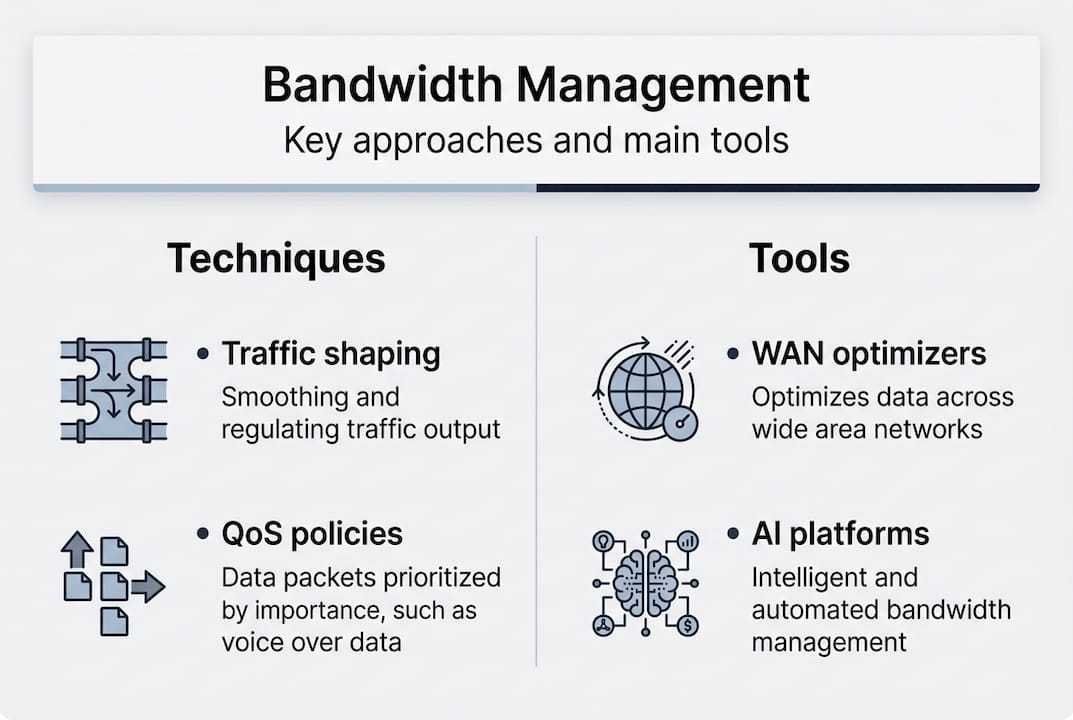
Now that we have seen the benefits, understanding the main approaches and platforms is the next step. Bandwidth management tools broadly fall into three categories: hardware appliances, software-based solutions, and protocol-level monitoring.

Hardware vs software solutions each carry distinct advantages. Hardware appliances, such as dedicated WAN optimisers or traffic shapers, are straightforward to deploy and manage. They suit organisations that need reliability without deep technical configuration. Software-based tools, such as Linux tc/HTB, offer far greater flexibility and customisation but require more skilled administration. Sampled sFlow scales better than full NetFlow on high-speed links, making it the preferred monitoring protocol for larger or faster network environments.
| Approach | Strengths | Best suited for |
|---|---|---|
| Hardware appliances | Simple setup, reliable, vendor-supported | Smaller teams, branch offices |
| Software (Linux tc/HTB) | Highly flexible, cost-effective | Skilled IT teams, complex environments |
| NetFlow monitoring | Detailed per-flow visibility | Compliance-focused organisations |
| sFlow monitoring | Scalable, low overhead | High-speed or large-scale networks |
| SNMP monitoring | Broad device compatibility | General infrastructure monitoring |
For organisations exploring network infrastructure strategies, the choice of monitoring protocol matters significantly. SNMP provides broad compatibility but limited granularity. NetFlow delivers detailed flow data but can become resource-intensive at scale. sFlow uses packet sampling to reduce overhead while maintaining useful visibility.
Bandwidth management workflow:
- Audit current traffic patterns and establish usage baselines.
- Identify critical applications and assign QoS priority classes.
- Select appropriate monitoring protocols (SNMP, NetFlow, or sFlow).
- Deploy traffic shaping and rate-limiting policies.
- Monitor continuously and adjust policies as usage patterns evolve.
- Review capacity requirements quarterly against actual utilisation data.
Emerging AI-driven solutions are beginning to automate parts of this workflow, dynamically adjusting routing and prioritisation based on real-time conditions. These are worth evaluating as part of a longer-term network strategy.
Pro Tip: If your organisation runs a high-speed core network above 1 Gbps, sFlow is typically the better monitoring choice over NetFlow. Its sampling approach reduces the processing burden on network devices while still providing actionable traffic intelligence.
Sector focus: Bandwidth management for education, manufacturing, and hospitality
While every organisation shares basic objectives, sector-specific nuances shape best practice considerably. A single policy framework rarely fits all three environments without meaningful adaptation.
Education
In educational settings, Per Connection Queuing (PCQ) allocates bandwidth fairly per connection, preventing any individual student or device from consuming a disproportionate share. This is particularly important in large lecture halls or shared computer labs where dozens of devices connect simultaneously. Protecting the integrity of LAN and WLAN infrastructure is equally critical during online assessments, where any disruption carries academic and reputational consequences.
- Implement PCQ policies to ensure equitable distribution across student devices.
- Prioritise e-learning platforms and video conferencing tools above general browsing.
- Segment staff and administrative networks from student-facing infrastructure.
Manufacturing
On the factory floor, IoT sensors, SCADA systems, and process control applications demand consistent, low-latency connectivity. Any congestion that delays a control signal can disrupt production or trigger safety events. Bandwidth management here focuses on strict prioritisation of operational technology (OT) traffic over general IT traffic.
- Apply strict QoS policies that protect OT and real-time process data flows.
- Monitor for unexpected traffic from connected devices that may indicate a fault or security issue.
- Segment production networks from corporate IT to reduce interference.
Hospitality
Hospitality environments must balance guest satisfaction with operational reliability. Guest Wi-Fi segmentation and prioritisation ensure that back-office systems, point-of-sale terminals, and staff communications are never compromised by guest usage spikes. Regulatory considerations around data handling and network access also apply.
- Segment guest Wi-Fi completely from internal operational networks.
- Apply per-user rate limits on guest access to prevent bandwidth monopolisation.
- Prioritise VoIP and booking system traffic at all times.
Pro Tip: Machine learning aided dynamic allocation is increasingly viable for SME environments in all three sectors. ML models can learn usage patterns over time and automatically adjust bandwidth policies, reducing the manual overhead for IT teams managing complex, fluctuating demand.
A fresh look: What most guides miss about bandwidth management
Most guidance on bandwidth management focuses on initial setup and tool selection. That is useful, but it misses a more important truth: the organisations that get the most from bandwidth management are those that treat it as a continuous discipline, not a one-time configuration exercise.
Internet usage patterns shift month by month. A new cloud application, a remote working policy change, or a surge in video conferencing can render last year’s QoS policies ineffective almost overnight. Reactive strategies, where IT teams respond only when users complain, are no longer adequate.
Custom policies consistently outperform generic best-practice templates. The specific mix of applications, user behaviour, and infrastructure in a secondary school is fundamentally different from that in a hotel or a factory. Applying a standard configuration without contextual adjustment is a common and costly mistake.
Automatic tools also have limits. Even sophisticated traffic management platforms can miss context-specific bottlenecks that only become visible through regular human review and dialogue with end users. Ongoing monitoring, quarterly policy reviews, and active engagement with department heads will always outperform a set-and-forget approach. The organisations that invest in this ongoing discipline consistently outperform those that treat bandwidth management as a solved problem.
Transform your network with expert support
Effective bandwidth management requires more than the right tools. It requires experienced guidance, sector-specific knowledge, and a partner who understands how your network needs to evolve over time.

Re-Solution has over 35 years of experience delivering tailored Cisco network solutions across education, manufacturing, and hospitality. Whether you need a full Network as a Service deployment, expert consulting on traffic management policies, or a structured review of your current infrastructure, we can help. Explore our network solutions explained resource to understand the options available, or browse our IT infrastructure guides for practical frameworks you can apply immediately. Get in touch with our team to discuss your specific bandwidth management requirements.
Frequently asked questions
What are the main functions of bandwidth management?
Bandwidth management measures, monitors, and controls network traffic to prevent congestion and prioritise essential applications. It gives IT teams the visibility and control needed to maintain consistent network performance across all users and systems.
How does bandwidth management improve VoIP and video calls?
By applying QoS policies, bandwidth management ensures real-time applications receive sufficient network resources ahead of lower-priority traffic. Organisations report up to 70% jitter reduction in VoIP quality following proper implementation.
What is the difference between hardware and software-based bandwidth management?
Hardware appliances offer straightforward deployment and reliable performance with minimal configuration complexity. Software solutions such as Linux tc/HTB provide greater flexibility and customisation for organisations with skilled IT teams and more complex requirements.
Why is bandwidth management especially important in education and hospitality?
In education, PCQ ensures fair allocation across student connections so no single device dominates shared resources. In hospitality, guest Wi-Fi segmentation protects operational systems from being affected by high consumer demand on shared infrastructure.
Recommended
- How to Optimize Networks for Peak Performance 2025 | Re-Solution
- Clear Strategies to Tackle Network Infrastructure | Re-Solution
- Network infrastructure checklist: optimise compliance
- Optimize cloud scalability and security with connectivity
- Improving Home WiFi Signal for Reliable Streaming and Work – Projector Display