TL;DR:
- Physical security integration unifies multiple security systems into a single, interoperable framework to improve response and reduce costs. It enhances crime deterrence, shortens incident response times, and lowers operational overhead by sharing data across systems. Most facilities neglect infrastructure audits and open protocols, risking costly upgrades and vendor lock-in.
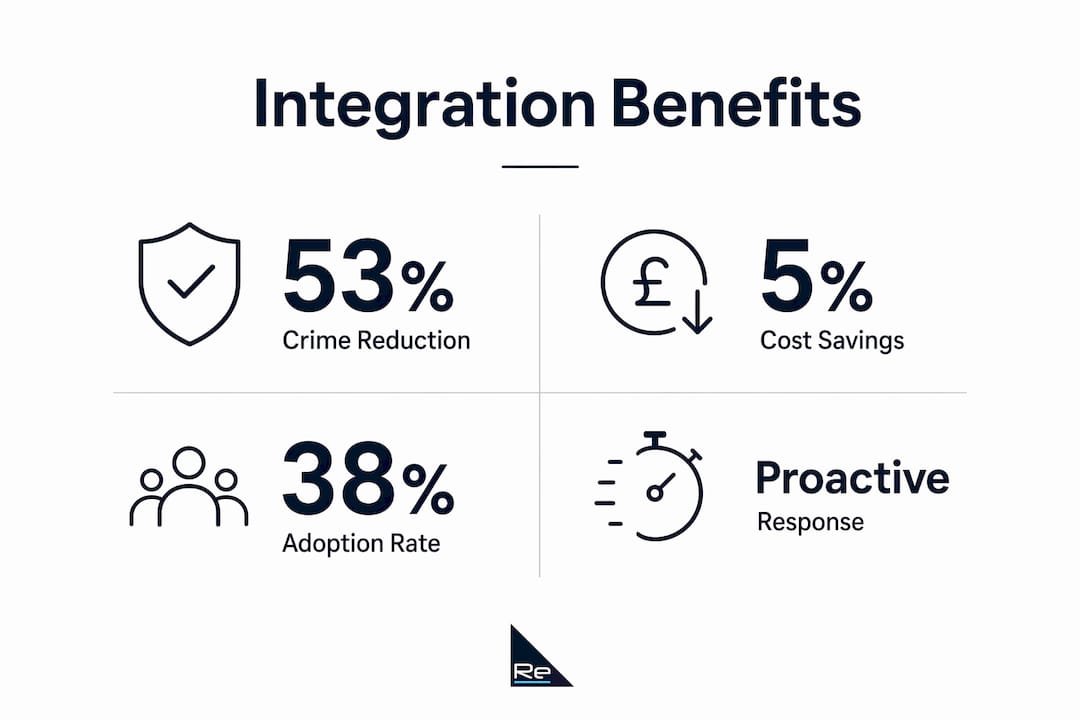
Physical security integration is defined as the unification of multiple security systems, such as access control, CCTV, and alarm platforms, into a single interoperable framework that shares data and responds to threats as one. Why physical security integration has become a priority for facility managers is straightforward: siloed systems create blind spots, inflate costs, and slow incident response. Visible security cameras reduce criminal activity by up to 50%, and when combined with integrated alarm systems, that figure rises to 53%. Security complexity already costs organisations more than 5% of annual revenue, a figure that grows every time a new standalone system is added without a unifying architecture.
What are the primary benefits of physical security integration?
Integrated physical security delivers measurable improvements across three areas: crime deterrence, operational cost, and incident response. Each benefit compounds when systems share data rather than operate in isolation.
Crime deterrence and visible protection
Visible deterrents within integrated systems reduce criminal activity by up to 53% when cameras and alarms work together. That figure matters because it reflects correlation between visibility and behaviour change, not just equipment presence. A camera that cannot trigger an alarm, or an alarm that cannot direct a camera, is a weaker deterrent than one that does both automatically.
Operational cost reduction
Security complexity costs organisations more than 5% of annual revenue. That overhead comes from managing separate vendor contracts, training staff on multiple interfaces, and paying for bespoke integrations that break with every software update. A unified platform consolidates those costs into a single management layer, reducing both headcount requirements and professional services spend.
Improved incident response
Integrated systems correlate events across access control, video, and alarm data simultaneously. A door forced open at 2:00 AM triggers a camera to record, an alert to the control room, and a log entry in the access control system, all without manual intervention. That speed of response is not achievable when each system operates independently.
Facility managers and security professionals gain the following specific advantages from integration:
- Centralised monitoring: One interface for all security events reduces operator error and training time.
- Automated workflows: Pre-set rules trigger responses without human delay.
- Audit trails: Unified logs simplify compliance reporting and post-incident investigation.
- Reduced false alarms: Cross-system verification filters out spurious alerts before they reach operators.
- Faster escalation: Correlated data gives responders context, not just a raw alert.
How does a unified integration layer differ from siloed systems?
The industry term for the architecture that connects disparate security platforms is a “unified integration layer.” This is distinct from simple API connectors or middleware, and the difference has significant cost and reliability implications.
Siloed systems versus unified integration
Middleware-based integrations require expensive maintenance and requalification after every software update. Each new version of an access control or video management platform can break the connector to adjacent systems, triggering a cycle of professional services costs. That accumulation of technical debt is called middleware debt, and it grows linearly with the number of integrated systems.
A unified integration layer normalises data formats, centralises credential management, and applies consistent severity policies across all connected platforms. The result is a single hub that scales without proportional increases in maintenance cost.
| Feature | Siloed systems | Unified integration layer |
|---|---|---|
| Data sharing | Manual or absent | Automated and normalised |
| Maintenance cost | Increases with each update | Scales efficiently |
| Incident correlation | Requires manual cross-referencing | Automated and real-time |
| Vendor flexibility | Limited by proprietary connectors | Open to best-in-class choices |
| Operator experience | Multiple interfaces | Single management view |
Interoperability versus monolithic platforms
A common misconception is that integration requires a single vendor to supply every component. Modern integration embraces rich ecosystems where best-in-class specialist systems exchange data through open APIs, rather than forcing all functions into one monolithic platform. That approach preserves freedom of choice and allows organisations to select the strongest product in each category.
Pro Tip: When evaluating integration platforms, ask vendors to demonstrate interoperability with your existing access control and video management systems using open protocols such as ONVIF or OSDP. Proprietary connectors are a warning sign of future middleware debt.
What are practical strategies for integrating security systems in existing facilities?
Only 38% of organisations currently have physical access control fully integrated with other platforms. That low adoption rate reflects a common barrier: facility managers assume integration requires a full system replacement. It does not.

Phased improvement strategies focusing on business-critical assets allow organisations to improve integration sustainably, without replacing working infrastructure. The approach prioritises where failure would cause the greatest operational or financial harm, then builds outward from there.
A practical integration project follows this sequence:
- Audit existing systems. Catalogue every security device, its age, its protocol, and its current integration status. A network infrastructure audit identifies gaps before they become liabilities.
- Rank assets by business consequence. A server room breach carries more risk than a car park incident. Prioritise integration where the impact of failure is highest.
- Select an open-protocol integration platform. Standards-based interoperability avoids vendor lock-in and preserves technology choice for future upgrades.
- Integrate in phases. Connect the highest-priority systems first. Validate performance before expanding to secondary assets.
- Train operators on the unified interface. Technology integration fails when operators revert to old workflows. Structured training is not optional.
- Review and iterate. Security requirements change. Schedule quarterly reviews to assess whether the integrated system still matches operational risk.
Pro Tip: Do not wait for legacy systems to fail before planning integration. Identify which devices support open protocols now, and factor replacement cycles into your phased plan. Upgrading one system at a time is far less disruptive than a full overhaul.
Upgrading the underlying network infrastructure is often a prerequisite for integration. Older cabling, switches, and wireless access points may lack the bandwidth or reliability to support real-time data sharing between security platforms.
How does physical security integration support business continuity?
Physical security integration is a business continuity asset, not just a theft prevention measure. Organisations that treat it as the latter underestimate its operational value and underinvest accordingly.
Converging physical and digital security enhances protection by enabling better incident correlation and reducing blind spots across both domains. A physical breach that goes undetected can enable a cyber intrusion, and vice versa. Integration closes that gap by treating physical and digital events as part of the same risk picture.
The business continuity benefits of integration extend across three dimensions:
- Operational continuity: Automated responses to physical threats reduce downtime. A fire alarm integrated with access control can lock or unlock specific zones automatically, keeping evacuation routes clear without manual intervention.
- Financial continuity: Faster incident response reduces the duration and cost of security events. Theft, vandalism, and unauthorised access all carry financial consequences that integration measurably shortens.
- Customer and reputational continuity: Organisations that demonstrate proactive security governance retain client trust more effectively than those that respond reactively after incidents occur.
Effective security strategies focus on organisational readiness and operational continuity, not just threat prevention. Integration enables this shift by giving security teams the data and automation they need to act before situations escalate, rather than after damage is done.
The shift from reactive to proactive security posture is the defining advantage of integration. Reactive security responds to events. Proactive security anticipates and contains them. That distinction matters most during high-consequence incidents, where minutes determine outcomes. Facility managers who invest in integrated security solutions position their organisations to manage risk rather than absorb it.
Key takeaways
Physical security integration reduces organisational risk, lowers operational cost, and enables proactive incident management by unifying access control, video, and alarm systems into a single interoperable framework.
| Point | Details |
|---|---|
| Crime deterrence increases with integration | Visible cameras and alarms working together reduce criminal activity by up to 53%. |
| Siloed systems carry hidden costs | Security complexity costs organisations more than 5% of annual revenue in management overhead. |
| Phased implementation is viable | Organisations can integrate high-priority assets first without replacing entire systems. |
| Open protocols prevent vendor lock-in | Standards-based interoperability preserves technology choice and long-term flexibility. |
| Integration supports business continuity | Converged physical and digital security reduces blind spots and accelerates incident response. |
Why I think most facilities are integrating security in the wrong order
After working with facility managers across education, manufacturing, and logistics, I have noticed a consistent pattern. Organisations invest in new security hardware before they have assessed whether their existing infrastructure can support integration. They buy the camera system, then discover the network cannot carry the video load. They deploy access control, then find it cannot communicate with the video management platform because both use proprietary protocols.
The uncomfortable truth is that integration is an infrastructure problem before it is a security problem. The organisations that get it right start with a network audit, not a security product catalogue. They map what they have, identify where the gaps are, and then select technology that fits the architecture they can actually support.
I also think the industry overcomplicates the vendor question. The goal is not to find one vendor who does everything. The goal is to build an ecosystem where best-in-class systems talk to each other through open standards. That approach takes more planning upfront, but it avoids the expensive renegotiations and forced upgrades that come with monolithic single-vendor contracts.
The facility managers I respect most do not lead with fear. They lead with readiness. They ask “what would happen to our operations if this system failed?” and then they build integration plans around that answer. That framing produces better outcomes than any threat-led security review I have seen.
— Jacob
How Re-solution supports physical security integration projects
Re-solution has over 35 years of experience designing and delivering Cisco IT infrastructure for organisations across education, manufacturing, hospitality, and logistics. Physical security integration depends on a network that can carry real-time data reliably, and that is precisely where Re-solution’s expertise applies.

Re-solution’s services include network audits, infrastructure design, and Network as a Service (NaaS) deployments that give facility managers the connectivity foundation their security systems require. Whether you are planning a phased integration project or assessing the readiness of your current infrastructure, Re-solution provides the technical guidance and Cisco-backed solutions to move forward with confidence. Speak to the Re-solution team to assess your IT infrastructure challenges and identify the right path for your organisation.
FAQ
What is physical security integration?
Physical security integration is the process of connecting separate security systems, such as access control, CCTV, and intruder alarms, into a unified platform that shares data and automates responses. The goal is to eliminate blind spots and reduce the manual effort required to manage multiple systems.
Why does physical security integration reduce costs?
Security complexity costs organisations more than 5% of annual revenue when systems are managed separately. A unified integration layer reduces vendor management, training, and maintenance overhead by consolidating those functions into a single architecture.
How do I start integrating security systems without replacing everything?
Start with a full audit of existing systems to identify which devices support open protocols. Then prioritise integration for your highest-consequence assets and connect systems in phases, validating performance at each stage before expanding further.
What is the difference between middleware and a unified integration layer?
Middleware connects systems through bespoke connectors that require requalification after every software update, creating ongoing maintenance costs. A unified integration layer normalises data formats centrally, scaling more efficiently and reducing the risk of integration failures.
How does integration support business continuity?
Integrated physical and digital security systems correlate events across both domains, reducing blind spots and enabling faster incident response. That speed directly reduces the operational, financial, and reputational impact of security incidents.
Recommended
- Top smart security solutions: safety and compliance 2026
- Cybersecurity for Manufacturing: Why It Matters | Re-Solution
- Integrated security solutions: Boost connectivity and compliance
- Security in Manufacturing: Protect Facilities | Re-Solution