
Many IT managers and decision-makers assume their existing network is performing adequately, simply because it has not failed outright. That assumption is increasingly costly. Legacy infrastructure is quietly undermining productivity, blocking innovation, and leaving organisations exposed to threats that modern security frameworks are designed to prevent. With hybrid working now standard, IoT device counts rising sharply, and cyber threats growing in sophistication, the question is no longer whether to upgrade, but how to do so effectively. This article provides a clear, evidence-backed guide to help you make that decision with confidence.
Table of Contents
- Understanding network infrastructure: The backbone of organisational operations
- Key drivers for upgrading network infrastructure
- Sector insights: How network upgrades drive value in education, manufacturing, and hospitality
- Security at the core: Zero trust and modern protection strategies
- Common pitfalls and best practices for a successful network upgrade
- Building your business case: Quantifying ROI and long-term gains
- Next steps: Expert support for seamless network upgrades
- Frequently asked questions
Key Takeaways
| Point | Details |
|---|---|
| Upgrade drives business value | Modernising network infrastructure supports productivity, security, and innovation across all sectors. |
| Zero trust is essential | Implementing zero trust strategies drastically reduces the risks posed by emerging cyber threats. |
| Prepare for future growth | Upgrading now ensures organisations can adopt AI, IoT, and future technologies without disruption. |
| Plan to avoid pitfalls | Proper assessment and phased upgrades keep costs down and avoid downtime. |
| Expert support pays off | Professional guidance guarantees the upgrade delivers the right results for your organisation’s needs. |
Understanding network infrastructure: The backbone of organisational operations
Network infrastructure is not simply the cables running through your walls or the wireless access points mounted on ceilings. It is the entire interconnected system that enables your organisation to function, communicate, and operate securely. Understanding its components is the first step in recognising where gaps exist.
Core components of network infrastructure include:
- Switching and routing equipment: Controls how data moves between devices and systems across your site or sites.
- Structured cabling: The physical foundation that determines maximum data throughput and reliability.
- Wireless access points: Deliver connectivity to mobile devices, laptops, IoT sensors, and guest users.
- Firewalls and security appliances: Enforce access policies and protect against external and internal threats.
- Network management platforms: Provide visibility, monitoring, and control across the entire environment.
For education, manufacturing, and hospitality organisations, these components carry distinct operational weight. A school network must support hundreds of simultaneous device connections during lessons. A factory floor requires reliable, low-latency connectivity for automation systems. A hotel must deliver seamless guest Wi-Fi while keeping payment systems isolated and secure.
As outlined in our network infrastructure guide, planning these components correctly from the outset prevents costly remediation later. Critically, modern infrastructure enables segmentation of operational technology, IT, IoT, and AI traffic, which is essential for both performance and security in complex environments.
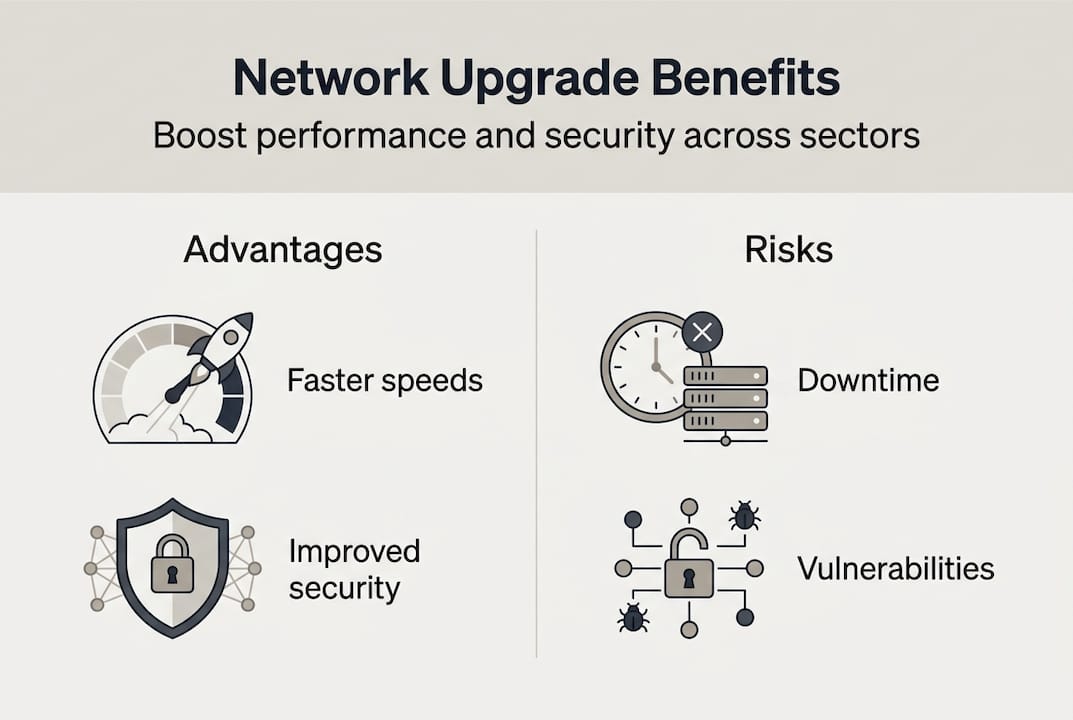
Key drivers for upgrading network infrastructure
Having defined the infrastructure, the next question is: why upgrade now? The answer lies in several converging pressures that organisations across all three sectors are facing simultaneously.
The top drivers for network modernisation are:
- Performance bottlenecks: Ageing switches and access points cannot handle the volume of simultaneous connections that modern workplaces demand. Slow data transfers and dropped connections directly reduce staff productivity.
- IoT and AI readiness: Factories, schools, and hotels are deploying more connected devices than ever. Without adequate network segmentation and capacity, these devices create both performance and security risks.
- Cybersecurity threats: Ransomware, phishing, and insider threats are escalating. Legacy networks were not designed to defend against them.
- Regulatory compliance: GDPR, PCI DSS for payment systems, and sector-specific data protection requirements demand robust, auditable network controls.
- Cloud adoption: As more services move to cloud platforms, network performance directly affects application reliability and user experience. Understanding cloud network advantages is increasingly relevant for planning upgrades.
“Zero trust is no longer optional for organisations modernising their networks. It must be embedded from the outset, not bolted on afterwards.” Why now is the right time to modernise
Pro Tip: Before committing to any upgrade, measure your current network performance baselines. Latency, packet loss, throughput, and device connection counts give you objective data to compare against post-upgrade results, and they strengthen your business case with stakeholders. Reviewing guidance on future-proof infrastructure can help frame your planning approach.
Sector insights: How network upgrades drive value in education, manufacturing, and hospitality
With the main drivers identified, it is important to see how these priorities translate into tangible outcomes across different sectors.
| Sector | Primary upgrade driver | Key benefit | Main risk of inaction |
|---|---|---|---|
| Education | Hybrid learning, device density | Reliable connectivity for all users | Disrupted lessons, data breaches |
| Manufacturing | Automation, IoT, AI readiness | Reduced downtime, improved defect rates | Production losses, safety risks |
| Hospitality | Guest Wi-Fi, payment security | Enhanced guest experience, compliance | Reputational damage, fines |
For education, the shift to hybrid and blended learning models has placed enormous strain on networks designed for far fewer devices. Securing sensitive student data under GDPR is equally pressing, requiring network segmentation and access controls that many legacy systems simply cannot provide.

For manufacturing, the stakes are particularly high. Properly segmented networks that separate operational technology from IT and IoT traffic deliver measurable gains in productivity and defect reduction. Preparation for private 5G and Time-Sensitive Networking (TSN) is also becoming a priority for forward-looking facilities. Our manufacturing network solutions page outlines how these requirements can be addressed practically, and our guidance on modern IT upgrades in manufacturing provides further context.
For hospitality, guest expectations for fast, reliable Wi-Fi are non-negotiable. Simultaneously, payment card data must be protected under PCI DSS, requiring strict network segmentation between guest-facing and back-office systems.
Security at the core: Zero trust and modern protection strategies
One common thread runs through every sector and every upgrade conversation: security. Specifically, the shift towards a zero trust security model.
Zero trust operates on a simple but powerful principle: no user or device is trusted by default, regardless of whether they are inside or outside the network perimeter. Every access request is verified continuously, based on identity, device health, and context. This is a fundamental departure from traditional perimeter-based security, where anything inside the firewall was broadly trusted.
Legacy networks carry significant security gaps. Flat network architectures allow threats to move laterally once inside. Outdated firmware on switches and access points creates exploitable vulnerabilities. Insufficient logging and monitoring means breaches can go undetected for weeks or months.
As zero trust becomes essential to modern network security, organisations that delay upgrades are accepting growing exposure. The financial and reputational cost of a breach far exceeds the investment required to modernise.
Pro Tip: Integrate zero trust initiatives directly into your upgrade project rather than treating them as a separate workstream. Configuring network segmentation, identity-based access controls, and endpoint verification from the start is far more cost-effective than retrofitting them later. Our Cisco zero trust overview explains the framework in practical terms, and the zero trust importance page outlines why it matters for your sector. For access control specifically, Cisco Access Manager provides a robust starting point.
Common pitfalls and best practices for a successful network upgrade
Securing the network is vital, but realising tangible benefits from an upgrade also requires careful planning and avoiding frequent, costly mistakes.
Common pitfalls to avoid:
- Failing to baseline current performance: Without pre-upgrade measurements, you cannot demonstrate improvement or identify where problems originate.
- Overlooking future growth: Specifying equipment for current device counts rather than projected growth leads to premature capacity issues.
- Ignoring zero trust from the outset: Treating security as an afterthought creates expensive remediation work.
- Underestimating cabling requirements: Wireless performance is only as good as the cabling infrastructure supporting it.
- Skipping a site survey: Physical environment factors such as building materials and interference sources significantly affect wireless coverage.
Best-practice steps for a successful upgrade:
| Step | Action | Expected outcome |
|---|---|---|
| 1. Survey | Audit current infrastructure and performance baselines | Clear picture of gaps and priorities |
| 2. Design | Plan segmentation, capacity, and security architecture | Scalable, secure network design |
| 3. Pilot | Deploy in a controlled area first | Validate design before full rollout |
| 4. Deploy | Phased rollout with minimal disruption | Reduced operational risk |
| 5. Validate | Measure post-upgrade performance against baselines | Quantifiable evidence of improvement |
Pro Tip: Where budget is a constraint, reuse existing cabling with long-reach PoE switches where the cabling is compatible. This can significantly reduce infrastructure costs without compromising performance. Our network planning steps guide walks through each phase in detail.
Building your business case: Quantifying ROI and long-term gains
Planning the upgrade is only half the challenge. Justifying the investment to stakeholders requires clear, quantifiable evidence of return.
The most compelling business cases for network upgrades focus on four areas of measurable value:
- Productivity gains: Reduced downtime and faster data access translate directly into staff hours recovered. Even a 10% reduction in network-related delays across a 200-person organisation represents significant annual savings.
- Compliance cost avoidance: GDPR fines, PCI DSS penalties, and audit failures carry substantial financial risk. A compliant, auditable network reduces that exposure materially.
- Downtime reduction: Unplanned outages cost organisations across all sectors in lost revenue, staff idle time, and recovery expenses. Modern, resilient infrastructure reduces both frequency and duration of outages.
- Customer and student experience: In hospitality, poor Wi-Fi directly affects guest satisfaction scores and repeat bookings. In education, unreliable connectivity disrupts learning outcomes.
For manufacturing specifically, properly segmented, AI and OT-ready networks deliver measurable gains in productivity and defect reduction, providing concrete figures for ROI calculations. Reviewing network ROI examples can help frame the financial argument for your stakeholders.
Key metrics to include in your business case:
- Current and projected downtime costs per hour
- Staff productivity impact from network performance issues
- Compliance risk exposure and potential fine values
- Cost of a security breach versus cost of prevention
- Total cost of ownership comparison: legacy versus modern infrastructure
Next steps: Expert support for seamless network upgrades
With a compelling business case established, the final step is ensuring flawless execution. That is where expert guidance makes a measurable difference.
Re-Solution has over 35 years of experience delivering Cisco network infrastructure solutions across education, manufacturing, and hospitality. We assess your current environment thoroughly, identify gaps, and design upgrades that are secure, scalable, and aligned with your operational requirements.

Our services span the full upgrade lifecycle, from initial IT infrastructure overview and site surveys through to deployment and ongoing support. For organisations seeking flexibility, our Network as a Service model removes the burden of capital expenditure, while our managed IT services ensure your upgraded network continues to perform and remain secure long after go-live. Whether you are planning a phased refresh or a full infrastructure overhaul, we provide the expertise to deliver it without disruption.
Frequently asked questions
What are the main signs that our network needs upgrading?
Frequent downtime, slow data speeds, difficulty integrating new devices, and recurring performance bottlenecks from outdated systems are the clearest indicators that your infrastructure requires modernisation.
Is it possible to minimise disruption during a network upgrade?
Yes. Phased deployments, thorough pre-project planning, and measuring baselines pre-upgrade allow transitions to be managed with minimal impact on day-to-day operations.
How does zero trust differ from traditional security models?
Traditional models trust everything inside the network perimeter by default. Zero trust is essential because it requires continuous verification of every user and device, regardless of location.
Are there cost-effective options for network upgrades?
Yes. Where existing cabling is compatible, reusing cabling with long-reach PoE switches can substantially reduce infrastructure costs without sacrificing performance or security.
Recommended
- Clear Strategies to Tackle Network Infrastructure | Re-Solution
- How to Optimize Networks for Peak Performance 2025 | Re-Solution
- How to Know Your Network Is Secure | Re-Solution
- How to enhance network security for SMBs: 5 steps