
TL;DR:
- Network reliability is the network’s ability to deliver consistent, uninterrupted service by withstanding failures. IT managers must focus on measurable metrics like MTBF, MTTR, and high availability to improve uptime. Proper design, testing, and disciplined operations are essential for creating dependable networks.
Network reliability is defined as a network’s ability to deliver consistent, uninterrupted service by withstanding failures and maintaining performance over time. For IT managers, mastering the essentials of network reliability is not optional. Medium-sized organisations lose £10,000 to £20,000 per minute of network downtime, making the financial case for investment clear. A single unplanned outage can cost more than a year’s worth of preventive infrastructure work. The principles covered here give IT decision-makers a structured framework to reduce that risk.
What are the core concepts of network reliability?
Network reliability, known formally in engineering disciplines as dependability, rests on a set of measurable metrics that define how well a network performs under real conditions. Understanding these metrics is the first step toward improving network uptime in any organisation.

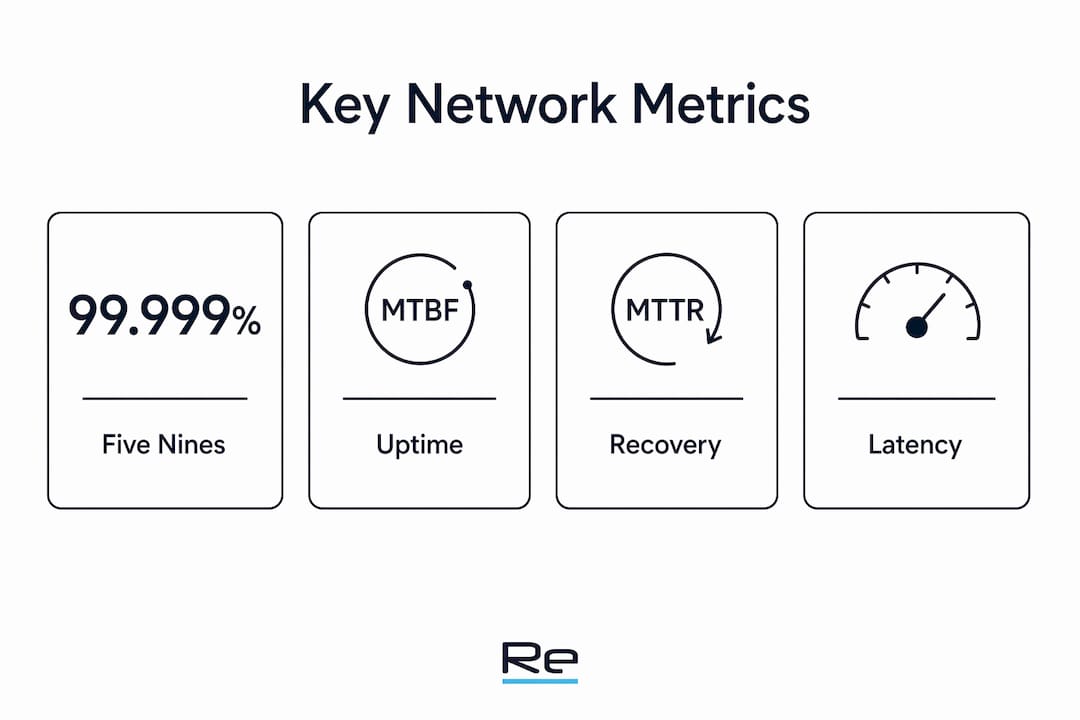
Mean Time Between Failures (MTBF) measures how long a system typically runs before a failure occurs. A higher MTBF means fewer interruptions. Mean Time to Repair (MTTR) measures how quickly the team restores service after a failure. Reducing MTTR has an immediate effect on user experience, even when failures cannot be eliminated entirely.
The industry benchmark most IT managers recognise is the “Five Nines” standard. Five Nines availability (99.999%) allows less than six minutes of downtime per year, while 99.9% availability permits roughly 8.76 hours annually. That difference of nearly nine hours per year is significant for any business-critical system. Choosing the right availability target depends on the service type and the cost of downtime for that specific workload.
Latency and convergence time targets vary by traffic type. Critical systems require failover convergence of 50–200ms and one-way latency below 40ms, while web applications need 95th-percentile latency under 300ms with availability above 99.9%. These figures are not arbitrary. They reflect the point at which users perceive degradation in voice calls, video, or application response.
Pro Tip: Balance your efforts between raising MTBF through better hardware and design, and lowering MTTR through faster detection and automated recovery. Focusing only on one produces diminishing returns.
| Metric | Definition | Target threshold |
|---|---|---|
| MTBF | Average time between failures | As high as possible; baseline varies by component |
| MTTR | Average time to restore service | Under 15 minutes for critical systems |
| Availability | Percentage of uptime over a period | 99.9% minimum; 99.999% for critical services |
| Latency (voice/real-time) | One-way delay for time-sensitive traffic | Below 40ms |
| Convergence time | Time to reroute after a failure | 50–200ms for critical paths |
| Web app latency (p95) | 95th-percentile response time | Under 300ms |
Fault tolerance and high availability are related but distinct concepts. Fault tolerance means the network continues operating with no perceptible impact during a failure. High availability minimises downtime but may allow a brief interruption. Both require isolated failure domains and tested automated rerouting to function as designed.
How does resilient network design prevent failures?
Resilient network design is the architectural foundation of network resiliency strategies. No amount of monitoring or automation compensates for a poorly structured network. The design must account for failure at every layer before a single cable is installed.
Redundancy at every layer
Redundancy means providing alternative paths, devices, and power sources so that no single component failure causes a service outage. This applies to physical links, core and distribution switches, WAN connections, and power supplies. Each layer of redundancy reduces the probability that one failure cascades into a full outage.
Redundant backup paths frequently fail when untested under load. An untested failover path is not a backup. It is a false assumption. IT teams must simulate failure conditions regularly to confirm that secondary paths carry traffic as expected. Environmental factors matter too. A 10°C rise in temperature can halve hardware lifespan, making cooling infrastructure a direct reliability concern.
Failure domains and modularity
A failure domain is the portion of the network affected when a single component fails. Smaller failure domains mean fewer users and services are disrupted by any one event. Failure domains should be mapped visually to design small blast radii, so outages impact minimal critical services and recovery is targeted.
Modular and hierarchical network design simplifies both troubleshooting and planned upgrades. Scaling flat, redundant networks without hierarchy becomes unsustainable as the number of redundant components multiplies and maintenance complexity grows. A three-tier architecture of core, distribution, and access layers contains failures and makes changes predictable.
Pro Tip: Avoid building flat networks where every device connects to every other device for redundancy. The short-term simplicity creates long-term maintenance problems that grow faster than the network itself.
| Design principle | Advantage | Associated risk if ignored |
|---|---|---|
| Hierarchical topology | Simplifies troubleshooting and change management | Flat networks become unmanageable at scale |
| Redundant links and devices | Eliminates single points of failure | Untested paths fail silently under load |
| Small failure domains | Limits blast radius of any outage | Large domains cause widespread service loss |
| Environmental controls | Extends hardware lifespan | Temperature stress halves component life |
| Modular design | Allows isolated updates without full outages | Monolithic design makes changes high-risk |
What operational strategies improve network uptime?
Good design creates the conditions for reliability. Operations determine whether those conditions are maintained day to day. The shift from reactive to proactive maintenance is the single most impactful change an IT team can make when improving network uptime.
AI-enabled tools reduce MTTR by automating recurring diagnostics and incident responses. This shifts diagnostic workload away from engineers during high-pressure incidents. The result is faster recovery and fewer human errors under stress. Proactive, intent-based operations represent a shift from firefighting to predictive reliability management, enabled by AI analytics and documented runbooks.
Automation improves reliability only after architecture standardisation. Applying automation to an inconsistent or undocumented network multiplies errors rather than reducing them. Standardise device configurations, naming conventions, and change processes first. Then automate firmware updates, configuration backups, and compliance checks.
Software-defined networking (SDN) and network function virtualisation (NFV) enable dynamic failover without manual intervention. These technologies allow traffic to be rerouted in software within milliseconds, reducing the human dependency during failure events. Clear service level agreements (SLAs), escalation protocols, and runbooks give teams a defined response path when automated systems reach their limits.
Common causes of outages and the measures that prevent them:
- Configuration errors: Automated configuration management and pre-deployment validation reduce human mistakes.
- Hardware failure: Redundant components and proactive replacement based on MTBF data prevent unexpected failures.
- Software bugs: Staged firmware rollouts and rollback procedures limit the blast radius of bad updates.
- Capacity exhaustion: Real-time telemetry and threshold alerts flag congestion before it causes packet loss.
- Environmental failure: Temperature monitoring and dual power feeds protect against physical infrastructure faults.
- Security incidents: Network segmentation and anomaly detection contain threats before they disrupt services.
How to measure and monitor network reliability effectively?
Measurement is the mechanism that connects design intent to operational reality. Without accurate monitoring, IT managers cannot confirm whether their network infrastructure planning is delivering the reliability targets they set.
Observability must focus on user impact metrics, specifically latency, jitter, and packet loss, rather than interface counters alone. Interface counters show whether a link is up or down. They do not show whether voice calls are breaking up or whether application transactions are timing out. User experience metrics reveal the truth.
Establishing performance baselines is the prerequisite for meaningful alerting. A threshold alert without a baseline is noise. With a baseline, the same alert becomes a signal that something has changed. Baselines should be set per traffic type, per time of day, and per site, because normal behaviour varies significantly across these dimensions.
Key monitoring practices for IT teams:
- Track latency, jitter, and packet loss per application class, not just per interface.
- Set alert thresholds at 80% of the maximum acceptable value to allow response time before impact.
- Map fault domains in your monitoring platform so alerts show the likely scope of impact immediately.
- Integrate monitoring with your incident management system so alerts create tickets automatically.
- Review availability reports monthly against your SLA targets to identify trends before they become outages.
Pro Tip: Choose monitoring tools that integrate directly with your incident management platform. An alert that requires manual ticket creation adds minutes to MTTR during every incident.
The case for treating reliability as an engineering discipline
Reliability engineering is a discipline, not a checklist. After working with IT infrastructure across sectors including education, manufacturing, and logistics, the pattern I see most often is the same: organisations invest in redundant hardware, then discover it does not work when they need it most.
The reason is almost always the same. Redundancy was designed but never tested under realistic conditions. A failover path that has never carried production traffic is an assumption, not a guarantee. The organisations that achieve genuine dependability treat testing as a recurring operational activity, not a one-time commissioning task.
The second pitfall is automating before standardising. I have seen teams deploy configuration automation across networks where no two devices share the same naming convention. The automation runs, and the inconsistencies propagate at machine speed. Standardise the architecture first. Document it. Then automate against that documented standard.
The third observation is about monitoring depth. Most teams monitor whether devices are reachable. Fewer teams monitor whether the network is actually delivering the latency and packet loss targets that their applications require. Moving from device-up monitoring to advanced networking technologies that track user experience metrics is the difference between knowing your network is running and knowing it is performing.
Reliability is not achieved by buying better hardware. It is achieved by designing, operating, and measuring with discipline.
— Jacob
How Re-solution helps organisations build dependable networks
Re-solution has supported organisations across education, manufacturing, hospitality, and logistics for over 35 years as a trusted Cisco partner. The team designs and delivers IT infrastructure built around the network reliability principles covered in this guide, from redundant architecture and failure domain planning to proactive managed services and network audits.

Whether your organisation needs a structured network audit to identify reliability gaps, or a fully managed service that handles monitoring, maintenance, and incident response, Re-solution provides the expertise to match the solution to your specific environment. The Network as a Service offering gives IT managers a predictable, high-availability network without the overhead of managing it in-house. Contact Re-solution to discuss how your network can be designed and operated to meet the uptime standards your business depends on.
Key takeaways
Network reliability requires consistent design, disciplined operations, and user-focused monitoring to deliver the uptime that business-critical services demand.
| Point | Details |
|---|---|
| Define your availability target | Choose between 99.9% and 99.999% based on the cost of downtime for each workload. |
| Design small failure domains | Map blast radii visually so any outage affects the fewest possible services. |
| Test redundancy under load | Untested backup paths are unreliable; simulate failures regularly to confirm failover works. |
| Standardise before automating | Automation applied to inconsistent architecture multiplies errors rather than reducing them. |
| Monitor user experience metrics | Track latency, jitter, and packet loss per application class, not just interface status. |
FAQ
What is the difference between network reliability and availability?
Network reliability measures how consistently a network performs over time without failure, while availability measures the percentage of time the network is operational. A network can be available but unreliable if it frequently degrades before recovering.
What does “Five Nines” mean in network terms?
Five Nines refers to 99.999% availability, which permits less than six minutes of downtime per year. It is the standard target for business-critical and carrier-grade network services.
Why do redundant networks still fail during outages?
Redundant paths fail when they are never tested under real load conditions. An untested failover route may have misconfigured routing, insufficient capacity, or hardware faults that only surface during an actual failure event.
How does fault tolerance differ from high availability?
Fault tolerance means the network continues operating with no user-perceptible impact during a failure. High availability minimises downtime but may allow a brief interruption before recovery completes.
What metrics should IT managers prioritise for network monitoring?
IT managers should prioritise latency, jitter, and packet loss per application class, alongside MTBF and MTTR. Interface counters alone do not reflect whether the network is meeting user experience requirements.
Recommended
- Benefits of managed networks for IT teams in 2026
- Clear Strategies to Tackle Network Infrastructure | Re-Solution
- Best Practices for Network Design Explained | Re-Solution