
TL;DR:
- Many organizations mistakenly believe that patching alone secures IoT devices, overlooking the broader security landscape.
- IoT security involves managing device identities, implementing network segmentation, and continuously monitoring physical and cyber vulnerabilities.
IoT security explained is a topic that far too many organisations approach with a dangerously narrow assumption: that securing connected devices is simply a matter of applying patches and updating firmware. In practice, IoT security concepts span a far wider domain. The devices in question range from industrial sensors on a factory floor to access control systems in a university campus, and their vulnerabilities carry consequences that extend well beyond data loss into physical safety and operational continuity. This article clarifies what IoT security actually involves, where the real risks live, and how IT decision-makers can structure a credible response.
Table of Contents
- Key takeaways
- IoT security explained: scope and core definitions
- Security across the IoT device lifecycle
- Understanding complex IoT vulnerabilities
- Zero Trust and network segmentation for IoT
- Practical strategies for IT decision-makers
- My perspective on where IoT security actually fails
- How Re-Solution can support your IoT security posture
- FAQ
Key takeaways
| Point | Details |
|---|---|
| IoT security goes beyond patching | Many devices lack built-in security capabilities, making manufacturer design choices a primary risk factor. |
| Credential lifecycle is a critical failure point | Poorly managed device credentials are among the most common starting points for fleet-wide compromises. |
| Zero Trust applies directly to IoT | Explicit verification, least privilege, and continuous monitoring reduce lateral movement across device networks. |
| Vulnerability management needs a new model | IoT threats involve cyber-physical interactions that single-patch workflows cannot adequately address. |
| Risk-based, gradual implementation works | Prioritising critical assets first and using structured assessment tools makes IoT security manageable in practice. |
IoT security explained: scope and core definitions
Understanding IoT security begins with defining what falls under the IoT umbrella. The Internet of Things refers to any network of physical devices equipped with sensors, software, and connectivity that allows them to exchange data. In an enterprise context, this includes building management systems, CCTV cameras, HVAC controllers, medical monitoring equipment, warehouse scanners, and industrial control systems. What distinguishes these devices from conventional IT assets is their operational context: many run proprietary firmware, lack a user interface, and cannot be managed through standard IT tools.
IoT security, therefore, covers the policies, technologies, and processes used to protect these devices and the networks they connect to. It differs from traditional IT security in several important ways:
- Attack surface breadth: IoT deployments often involve hundreds or thousands of devices, each representing a potential entry point.
- Cyber-physical risk: A compromised building access system or industrial controller can cause physical harm, not just data exposure. IoT vulnerabilities carry cyber-physical risks that conventional IT threat models do not account for.
- Patching limitations: Many IoT devices cannot be updated remotely or at all, making patch-based security strategies insufficient.
- Authentication gaps: Default credentials and shared certificates are endemic across IoT fleets, creating persistent access risks.
- Network visibility: IoT devices frequently connect without full IT oversight, creating shadow infrastructure that bypasses security controls.
Recognising these differences is the starting point for any credible IoT security strategy. Treating IoT devices as simple endpoints within a standard IT security framework is a structural error that leaves organisations exposed.
Security across the IoT device lifecycle
One of the most frequently overlooked IoT security concepts is that security must begin before a device is ever deployed. NIST recommends manufacturers embed security functions before sale and supply customers with the cybersecurity information they need to manage devices responsibly. The practical implication is that the security posture of your IoT deployment is partly determined at the point of procurement, not just configuration.
The IoT device lifecycle can be broken into four security-relevant phases:
- Procurement and design: Selecting products from manufacturers who document their security capabilities and provide configuration guidance. Many IoT products lack usable security capabilities by default, so verifying this at the selection stage is non-negotiable.
- Provisioning: Assigning unique device identities and credentials at the point of deployment. Each device should receive a distinct certificate or key rather than sharing credentials across a fleet.
- Operational management: Rotating and monitoring credentials throughout the device’s operational life. Credential lifecycle management including provisioning, rotation, and revocation is critical because compromised credentials are among the most common starting points for wide-scale IoT incidents.
- Decommissioning: Revoking credentials and wiping configuration data before a device is retired or repurposed. This step is routinely skipped and routinely exploited.
The shift in responsibility between manufacturers and customers is also worth understanding clearly. Manufacturers are responsible for building in the security capabilities. Customers are responsible for activating and managing them. When either party fails to perform their role, the gap becomes an exploitable vulnerability.
Pro Tip: When evaluating IoT products for procurement, request the manufacturer’s cybersecurity documentation as part of your procurement checklist. If a vendor cannot supply this, treat it as a disqualifying factor.

Understanding complex IoT vulnerabilities
IoT vulnerability management is structurally different from conventional IT vulnerability management, and IoT defenders must move beyond traditional cyber vulnerability paradigms to address these differences effectively.
The core distinction lies in two categories of vulnerability:
| Vulnerability type | Characteristics |
|---|---|
| In-band | Exploited through the device’s primary communication channel (e.g. network protocols, APIs). Similar to traditional IT vulnerabilities but may lack patching routes. |
| Out-of-band | Exploited through physical access, side-channel attacks, or secondary interfaces (e.g. debug ports, Bluetooth). Often invisible to network-based scanning tools. |
Why does this matter in practice? Because multi-vulnerability, cyber-physical exploitation requires holistic mitigation planning. A single patch workflow addresses neither out-of-band vectors nor the combination of vulnerabilities that an attacker might chain together to escalate access from a network-connected sensor to a critical operational system.
A more structured approach uses attack surface modelling. Attack surface graphs and attack-countermeasure trees allow security teams to link specific asset characteristics with known vulnerabilities and their available countermeasures. This visual, graph-based approach provides something that a simple CVE list does not: an understanding of which mitigations have the greatest impact on reducing exploitable attack paths. Structured vulnerability assessment tools enable informed prioritisation rather than reactive patching.
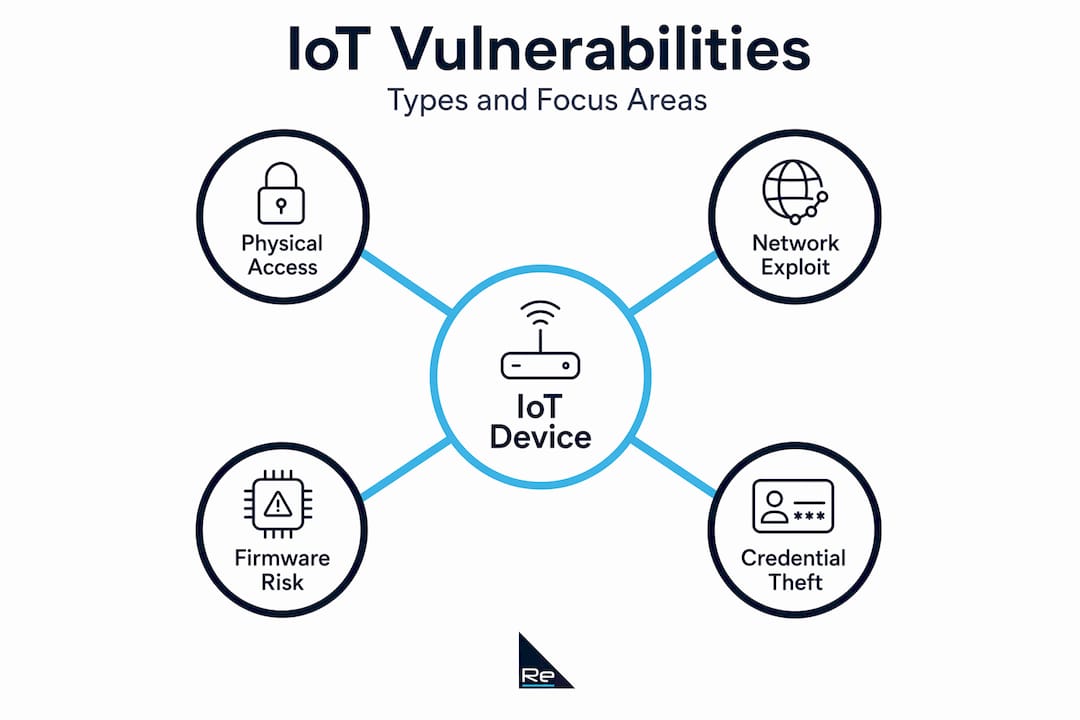
This is particularly relevant for industries like manufacturing and logistics where IoT devices interact directly with physical processes. For further context on the current threat environment, Re-Solution’s overview of cybersecurity threats and trends outlines how the vulnerability landscape has evolved and what that means for operational technology environments.
Pro Tip: Do not rely solely on network scanning to identify IoT vulnerabilities. Physical security audits and firmware analysis should form part of your assessment process, particularly for devices with debug or maintenance interfaces.
Zero Trust and network segmentation for IoT
Zero Trust is not a product. It is an architectural philosophy, and Zero Trust principles apply directly to IoT environments through three core assumptions: never trust any device or user by default, enforce least privilege at every access decision, and assume that a breach may already be occurring.
Applying these principles to IoT environments requires the following capabilities:
- Device identity management: Every device must have a unique, verifiable identity. X.509 certificates and tightly scoped permissions are the standard mechanism for achieving this in production IoT deployments. Shared credentials or symmetric keys across a device fleet undermine the entire model.
- Microsegmentation: Isolating IoT devices into network segments limits lateral movement. A compromised HVAC controller should not have a communication path to financial systems or identity infrastructure. Network segmentation enforced at the policy level, not just the VLAN level, is the goal.
- Continuous monitoring and telemetry: Static access policies are insufficient. Real-time behavioural monitoring of device communication patterns enables detection of anomalous activity that would otherwise go unnoticed for weeks.
- Policy evaluation at every connection: Access decisions should be made dynamically based on device identity, health status, and context, not on the assumption that a device within the perimeter is safe.
Re-Solution’s guidance on secure network design provides practical examples of how segmentation and policy enforcement are applied in complex multi-device environments. For manufacturing and industrial settings, the considerations around layered security in manufacturing apply directly to IoT-connected operational technology networks.
Practical strategies for IT decision-makers
The best practices for IoT security are clearest when they are tied to concrete decisions. The following steps give IT leaders a structured path from current state to a more defensible IoT posture:
-
Audit your IoT inventory. You cannot secure what you cannot see. Begin with a full discovery exercise across all sites and network segments, including shadow IoT devices that were connected without formal IT approval.
-
Evaluate procurement criteria. Add manufacturer cybersecurity documentation as a mandatory requirement in any IoT purchasing process. Products without documented security capabilities and customer guidance should not pass procurement review.
-
Establish a credential management playbook. Define processes for device provisioning, credential rotation schedules, and decommissioning procedures. Automate where possible, particularly for large device fleets where manual rotation creates operational risk.
-
Apply structured vulnerability assessment. Use attack-countermeasure tree modelling for high-risk device categories. This approach, validated in recent IoT security research, gives security teams a prioritised view of which countermeasures will have the most impact on reducing exploitable paths.
-
Segment and enforce policy progressively. Do not attempt to apply Zero Trust principles across your entire IoT estate simultaneously. Start with the highest-risk segments, such as those connecting to operational technology or sensitive data systems, and expand from there.
-
Deploy continuous monitoring. Establish telemetry collection and baseline behavioural profiling for IoT device categories. Deviations from baseline communication patterns are frequently the earliest detectable signal of a compromise.
These steps do not require a complete infrastructure overhaul from day one. A risk-based, phased approach that prioritises critical assets is both practical and effective. Re-Solution’s resource on network security best practices offers additional detail on building a structured security programme across complex network environments.
My perspective on where IoT security actually fails
In my experience working with organisations across manufacturing, education, and logistics, the consistent failure point in IoT security is not the absence of technology. It is the absence of process.
I’ve seen environments where sophisticated firewalls and network monitoring tools were in place, yet hundreds of IoT devices were operating on default credentials months after deployment. The tools existed. The operational playbook did not. That gap is where attackers operate.
What I’ve learned is that the “patching-only” mindset is more deeply embedded than most organisations realise. Teams that would never accept a server running without credential rotation routinely accept IoT devices that have never had their factory credentials changed. The cyber-physical dimension makes this particularly concerning. When a compromised device can affect a physical process, the calculus changes entirely.
My view on Zero Trust for IoT is that it is not aspirational technology for large enterprises. It is a practical discipline applicable at any scale. The key is starting with device identity. If every device has a unique, verified identity and tightly scoped permissions, you have eliminated the most common attack vector before you have written a single segmentation policy.
The organisations I have seen execute IoT security well share one characteristic: they treat their IoT fleet with the same operational rigour they apply to their server estate. Not more complexity. The same discipline, applied consistently.
— Jacob
How Re-Solution can support your IoT security posture
Re-Solution has over 35 years of experience delivering Cisco IT infrastructure, network security, and managed services to organisations across education, manufacturing, logistics, and hospitality. If you are working through what IoT security means for your environment, Re-Solution’s team can help you assess your current posture, design appropriate segmentation and access control architecture, and implement the credential management and monitoring processes that underpin a defensible IoT deployment.

Whether you are starting with an infrastructure audit or looking to modernise your security architecture, Re-Solution’s managed IT services provide the operational continuity and expert support that complex IoT environments require. For organisations looking at wider infrastructure decisions, the guide to modernising IT infrastructure in 2026 covers how connectivity, security, and IoT readiness intersect in practical terms. Get in touch with Re-Solution to discuss your specific requirements.
FAQ
What is IoT security and why does it matter?
IoT security covers the policies, technologies, and processes used to protect connected devices and the networks they operate on. It matters because IoT vulnerabilities carry cyber-physical risks that can affect physical operations, not just data systems.
How does IoT security differ from traditional IT security?
IoT devices often cannot be patched conventionally, run proprietary firmware, and introduce cyber-physical attack vectors. Traditional IT security models were not designed to account for these constraints or for the scale of device fleets involved.
What is the biggest IoT security risk for organisations?
Compromised device credentials are among the most frequently exploited starting points for IoT incidents. Without a structured credential lifecycle covering provisioning, rotation, and revocation, even well-segmented networks remain vulnerable.
How do Zero Trust principles apply to IoT?
Zero Trust applied to IoT means every device must have a unique, verified identity, operate under least-privilege access policies, and be subject to continuous behavioural monitoring. No device is trusted by default, regardless of network location.
What is the best first step for improving IoT security?
Conduct a full IoT device inventory across all network segments, including shadow devices connected without formal IT approval. You cannot apply security controls to devices you do not know exist.
Recommended
- Secure network design: proven examples for robust protection
- Integrated security solutions: Boost connectivity and compliance
- Modern network security: A complete guide for IT leaders
- Network security investment: reduce risk and protect your enterprise