
TL;DR:
- Modern network optimization uses automation, real-time telemetry, and intent-based frameworks.
- Sector-specific techniques improve performance, efficiency, and user satisfaction across diverse industries.
- Successful projects require organizational buy-in, continuous review, and balancing quick wins with strategic goals.
Network inefficiency costs more than most IT leaders realise. Research points to up to 40% reduction in network spend when organisations adopt modern optimisation practices, yet many still treat the problem as a simple bandwidth issue. The reality is far more nuanced. Network optimisation today draws on automation, real-time telemetry, and intent-based frameworks to manage traffic intelligently, not just expand capacity. This guide cuts through the complexity, explaining core concepts, proven methodologies, and sector-specific applications so you can make informed decisions about your infrastructure strategy.
Table of Contents
- What is network optimisation, really?
- Key methods and technologies shaping modern network optimisation
- Sector insights: Optimisation in education, manufacturing, logistics, and hospitality
- Common pitfalls and advanced considerations in network optimisation
- Our perspective: Why modern network optimisation demands more than technical upgrades
- Next steps: Transforming your network with expert guidance
- Frequently asked questions
Key Takeaways
| Point | Details |
|---|---|
| Intent-based automation | Modern optimisation uses smart automation to continually improve network performance and reliability. |
| Sector-specific impact | Education, manufacturing, logistics, and hospitality each gain tangible benefits from tailored optimisation techniques. |
| Avoid common traps | Oversights like misconfiguration and neglecting compliance can undermine optimisation efforts. |
| Proven ROI | Quick wins and iterative improvements often fund themselves and drive lasting value. |
What is network optimisation, really?
At its core, network optimisation is the process of improving how data moves across your infrastructure, reducing congestion, latency, and packet loss while maximising efficiency and reliability. The traditional approach relied on manual configuration: engineers would adjust routing tables, tweak bandwidth allocations, and respond to incidents reactively. That model is no longer sufficient for the demands placed on modern networks.
Today, intent-based network optimisation involves path computation, closed-loop automation, and real-time telemetry to manage tunnels and label-switched paths (LSPs) dynamically. Rather than waiting for an engineer to notice a problem, the network detects degraded utilisation, delay, or packet loss and adjusts automatically. This is the difference between reactive management and proactive intelligence.
The key technologies driving this shift include:
- Intent-based networking (IBN): Translates high-level business intent into automated network policies, removing the need for device-by-device manual configuration.
- Telemetry and streaming analytics: Provides continuous, real-time visibility into network health, far beyond what traditional SNMP polling offers.
- Closed-loop automation: Enables the network to self-correct based on defined thresholds, without human intervention at every step.
- Traffic engineering (TE): Controls how traffic flows across paths to avoid bottlenecks and optimise resource use.
Common bottlenecks that optimisation addresses include link congestion during peak periods, high latency on critical application paths, and packet loss caused by misconfigured quality of service (QoS) policies. Each of these has a direct impact on user experience, application performance, and ultimately, business outcomes.
Organisations that learn to optimise networks for peak performance consistently report lower operational costs and higher user satisfaction, not because they bought more hardware, but because they used what they had more intelligently.
Pro Tip: If your first instinct when facing performance issues is to increase bandwidth, pause. Many congestion problems are caused by poor traffic prioritisation or suboptimal routing, both of which automation can resolve without additional spend. Understanding network solutions explained in full context helps avoid costly over-provisioning.
Key methods and technologies shaping modern network optimisation
With the foundations clear, it helps to understand the specific methodologies that deliver measurable results. Modern network optimisation is not a single action but a layered set of strategies applied in sequence.
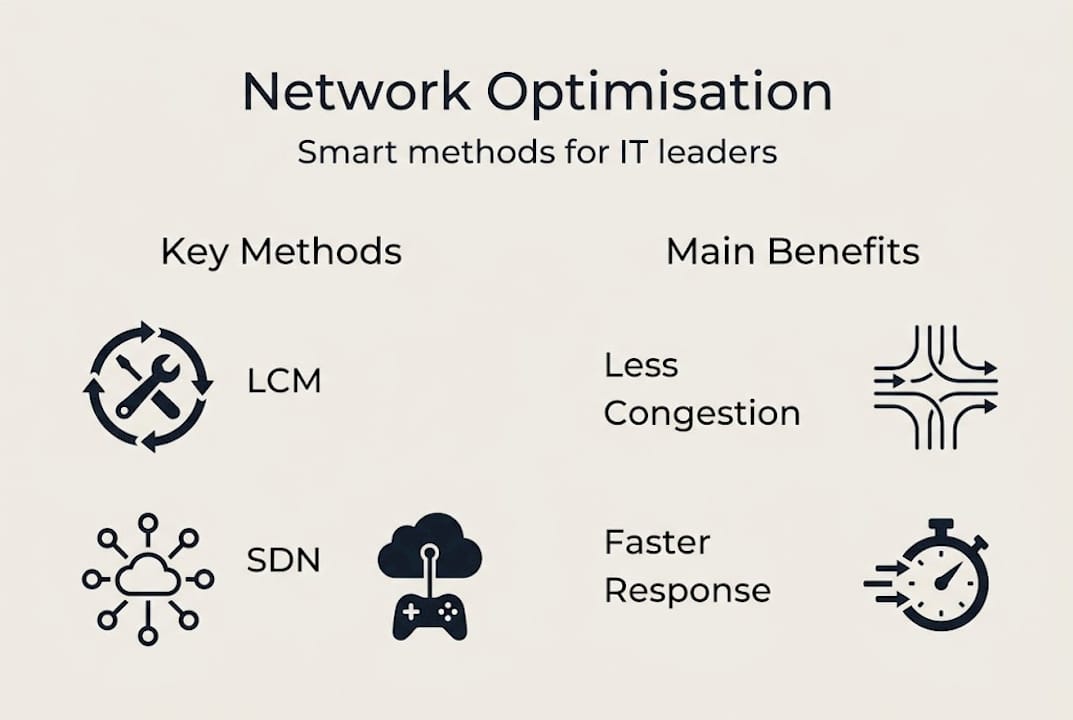
- Local Congestion Mitigation (LCM): Operates at the interface level, rerouting traffic when utilisation thresholds are exceeded. LCM is particularly effective as a quick win because it requires minimal configuration changes and delivers immediate relief on congested links.
- Circuit-Style Segment Routing Traffic Engineering (SR-TE): Reserves bandwidth along specific paths, ensuring critical applications receive guaranteed capacity. This is valuable in environments where latency-sensitive workloads, such as video conferencing or industrial control systems, cannot tolerate variable performance.
- Intent profiles: Intent profiles for tunnel optimisation allow engineers to define desired outcomes for bandwidth, endpoints, and tunnel behaviour, letting the controller handle the complexity of achieving those outcomes automatically.
- Software-Defined Networking (SDN): Separates the control plane from the data plane, enabling centralised policy management across distributed infrastructure. SDN reduces the risk of configuration drift and makes large-scale changes far less error-prone.
- AI-driven telemetry and analytics: Uses machine learning to identify traffic patterns, predict congestion, and recommend or implement adjustments before performance degrades.
| Method | What it does | Primary benefit |
|---|---|---|
| LCM | Reroutes traffic at interface level | Fast congestion relief |
| SR-TE | Reserves bandwidth on defined paths | Guaranteed latency for critical apps |
| Intent profiles | Automates tunnel and endpoint policies | Reduced manual configuration |
| SDN | Centralises network control | Consistent policy enforcement |
| AI telemetry | Predicts and prevents degradation | Proactive performance management |
These methods address the pain points that tackling network infrastructure challenges requires in practice. Manual configuration is error-prone and slow. Policy-driven automation, by contrast, applies changes consistently and at scale, reducing human error and freeing engineers for higher-value work. For network infrastructure planning, selecting the right combination of these methods depends on your environment, traffic profile, and business priorities.

Sector insights: Optimisation in education, manufacturing, logistics, and hospitality
The tools and methods above apply across sectors, but the priorities and techniques differ significantly depending on the environment.
| Sector | Key techniques | Standout outcome |
|---|---|---|
| Education | VLANs, SDN, QoS, edge computing | 52% better bandwidth utilisation |
| Manufacturing | IIoT switches, IT/OT convergence, zero-trust | Reduced downtime, Industry 4.0 readiness |
| Logistics | Edge intelligence, AMR connectivity, dynamic routing | 71% reduction in picking times |
| Hospitality | High-density Wi-Fi, guest segmentation, QoS | Improved guest satisfaction, lower support costs |
Sector-specific techniques worth highlighting:
- Education: Campus networks benefit from VLAN segmentation to separate student, staff, and IoT traffic. SDN enables QoS prioritisation so that e-learning platforms receive consistent bandwidth even during peak exam periods. Distributed edge computing reduces latency for real-time applications.
- Manufacturing: Industrial IoT optimisation relies on rugged switches, routers, and wireless access points designed for harsh environments. IT/OT convergence, bringing operational technology onto the IP network, demands zero-trust segmentation to prevent lateral movement between production and business systems.
- Logistics: Autonomous Mobile Robots (AMRs) and warehouse management systems require ultra-reliable, low-latency connectivity. Edge intelligence allows data to be processed locally, reducing round-trip times and supporting dynamic routing decisions in real time.
- Hospitality: High-density venues present a unique challenge. Hundreds of concurrent devices in a small area demand careful channel planning, load balancing, and guest network isolation to maintain performance and security.
A university deploying SDN-based QoS saw a 52% improvement in bandwidth utilisation without adding physical capacity. A logistics provider achieved significant annual savings by re-optimising its linehaul network through dynamic routing and edge analytics. For those focused on manufacturing efficiency with IT, the convergence of IT and OT networks is increasingly the decisive factor in operational performance. Reviewing campus network design principles also reveals how structured planning translates directly into measurable results.
Common pitfalls and advanced considerations in network optimisation
Understanding what can go wrong is just as important as knowing what to do. Optimisation projects fail more often due to avoidable errors than technical limitations.
Warning signs that your optimisation may be heading off course:
- Profiles are configured without clear separation between tunnel optimisation, endpoint management, and bandwidth reservation, leading to conflicts and TTE churn in dynamic networks.
- Cost reduction is prioritised over resiliency, leaving the network vulnerable to single points of failure.
- Automation is deployed without adequate monitoring, so errors propagate silently before anyone notices.
- Compliance and data sovereignty requirements are treated as an afterthought rather than a design constraint.
- Scalability is not tested under realistic peak-load conditions before rollout.
Advanced considerations for IT leaders include ensuring that your chosen optimisation framework supports the scale of your environment. High-density campuses, harsh manufacturing floors, and logistics warehouses with variable peak demand all present edge cases that generic configurations handle poorly. Separating intent profiles by function, avoiding overlap between tunnel and endpoint policies, is a frequently overlooked but critical detail.
For compliance-heavy sectors such as education and healthcare-adjacent logistics, network segmentation must align with regulatory requirements. Zero-trust architecture, where every device and user is verified before access is granted, is increasingly the baseline expectation rather than an optional enhancement.
Pro Tip: Even the most sophisticated closed-loop automation requires human oversight. Automation reduces the frequency of manual intervention, but it does not eliminate the need for engineers to review telemetry data, validate policy changes, and audit outcomes. Reviewing your peak network performance guide regularly ensures your automation remains aligned with evolving business needs.
Balancing quick wins with broader transformation is also a strategic consideration. LCM and SDN-based QoS can deliver results within weeks. Full intent-based networking with AI-driven telemetry may take months to implement correctly. A phased approach, starting with high-impact, low-risk changes, builds confidence and demonstrates ROI before committing to larger investments.
Our perspective: Why modern network optimisation demands more than technical upgrades
In our experience working across education, manufacturing, logistics, and hospitality, the most common reason optimisation projects underdeliver is not a technology gap. It is a people and process gap.
IT leaders who achieve lasting results do not simply deploy the latest tools. They build cross-departmental buy-in, align network strategy with business objectives, and treat optimisation as an ongoing discipline rather than a one-time project. The organisations that struggle are often those that chase feature-rich platforms without first establishing clear ownership, measurement frameworks, and change management processes.
The ROI of network optimisation extends well beyond labour savings. Resiliency, sustainability, and user trust are all measurable outcomes that rarely appear in a traditional cost-benefit analysis but matter enormously to the business. Quick wins like LCM can self-fund wider transformation, making the case for investment far easier to make internally.
Iterative improvement, driven by real data and reviewed regularly, consistently outperforms large-scale overhauls that attempt to solve every problem at once. A clear network strategy grounded in your specific environment and business goals is the most reliable path to sustainable performance.
Next steps: Transforming your network with expert guidance
The strategies covered in this guide represent proven, measurable approaches to network optimisation across some of the most demanding environments in the UK. Acting now, rather than waiting for performance issues to escalate, is consistently the more cost-effective choice.
Re-Solution has over 35 years of experience delivering Cisco-powered network solutions to educational institutions, manufacturers, logistics providers, and hospitality businesses. Whether you are exploring network as a service as a flexible alternative to capital investment, need a clearer picture of your current estate through network audits, or want to understand the full scope of IT infrastructure explained, our team is ready to help you take the next step with confidence.
Frequently asked questions
What is the main goal of network optimisation?
The main goal is to improve network performance, reliability, and cost-efficiency by using automation and real-time analytics. Intent-based networking and automation achieve this more effectively than hardware upgrades alone.
How does intent-based optimisation differ from traditional methods?
Intent-based optimisation abstracts manual configuration, enabling closed-loop self-optimisation that reduces errors and allows policies to be reused across the network without device-by-device changes.
Which industries benefit most from network optimisation?
Education, manufacturing, logistics, and hospitality gain the most, with measurable sector benefits including bandwidth improvements, cost savings, and stronger user experience across all four environments.
What are the main risks in network optimisation projects?
The primary risks include misconfigured profiles, over-prioritising cost at the expense of resiliency, and ignoring compliance requirements. Dynamic network edge cases such as congestion and configuration conflicts are particularly common in high-density or variable-demand environments.
How quickly can network optimisation show ROI?
Quick wins are achievable within weeks using approaches like LCM. Fast wins fund transformation by generating early savings that can be reinvested into broader, longer-term optimisation programmes.
Recommended
- How to Optimize Networks for Peak Performance 2025 | Re-Solution
- Clear Strategies to Tackle Network Infrastructure | Re-Solution
- Network Solutions Explained: What You Should Know | Re-Solution