
TL;DR:
- Network optimization focuses on improving performance, efficiency, and reliability rather than just increasing speed.
- It requires continuous, sector-specific strategies, leveraging modern tools like SDN, telemetry, and AI, for lasting impact.
- Effective network management relies on organizational discipline, ongoing review, and understanding sector-specific demands.
Many organisations invest heavily in network infrastructure yet still experience sluggish performance, unexpected downtime, and frustrated users. The assumption that adding more bandwidth or hardware will resolve these issues is a costly one. Up to 40% of network investment can be recovered through pragmatic optimisation techniques, according to Gartner. This guide explains what network optimisation actually means, which methods deliver the strongest results, and how education, manufacturing, and hospitality organisations can apply targeted strategies to achieve measurable improvements in efficiency, reliability, and cost control.
Table of Contents
- Defining network optimisation: more than just speed
- Key methods and technologies driving optimisation
- Challenges and limitations: getting beyond tech jargon
- Tailoring optimisation strategies to your sector
- Why real-world optimisation means more than just technology
- Take the next step with expert support
- Frequently asked questions
Key Takeaways
| Point | Details |
|---|---|
| Performance and reliability | Proper network optimisation ensures fast, reliable access to critical services in any industry. |
| Cost savings potential | Smart strategies can cut network spend by up to 40% without over-provisioning. |
| Modern and proactive methods | Techniques like SDN, AI-driven telemetry, and automation deliver ongoing optimisation, not just reactive fixes. |
| Sector-specific adaptation | Education, hospitality, and manufacturing benefit from tailored solutions to their unique challenges. |
Defining network optimisation: more than just speed
Network optimisation is maximising performance, efficiency, and reliability of a network infrastructure. It is not simply about increasing connection speeds or purchasing additional hardware. True optimisation ensures data flows smoothly across the entire network, eliminating bottlenecks, reducing latency, and preventing unnecessary data loss.
For sectors that depend on digital systems to function, the stakes are high. A school relying on cloud-based learning platforms cannot afford classroom interruptions caused by congestion. A hotel with unreliable guest Wi-Fi risks damaging its reputation. A manufacturing facility where production systems stall due to network delays faces real financial consequences. These are not edge cases. They are everyday realities for IT teams managing complex, high-demand environments.
Optimising network performance delivers three core outcomes:
- Efficiency: Data reaches its destination faster and with fewer retransmissions, reducing wasted capacity.
- Reliability: Redundant paths and proactive monitoring prevent single points of failure from becoming outages.
- Cost reduction: Right-sizing infrastructure and eliminating over-provisioning can significantly reduce operational spend.
One of the most common mistakes organisations make is treating optimisation as a one-off project. Network environments are not static. Demand patterns shift, new devices are added, applications change, and security requirements evolve. Optimisation must be approached as a continuous discipline.
“Network optimisation is not a destination. It is an ongoing process of measurement, adjustment, and improvement that must keep pace with how your organisation actually operates.”
Using smart optimisation strategies helps organisations move from reactive fire-fighting to proactive performance management. The difference in operational stability and cost efficiency is substantial.
Key methods and technologies driving optimisation
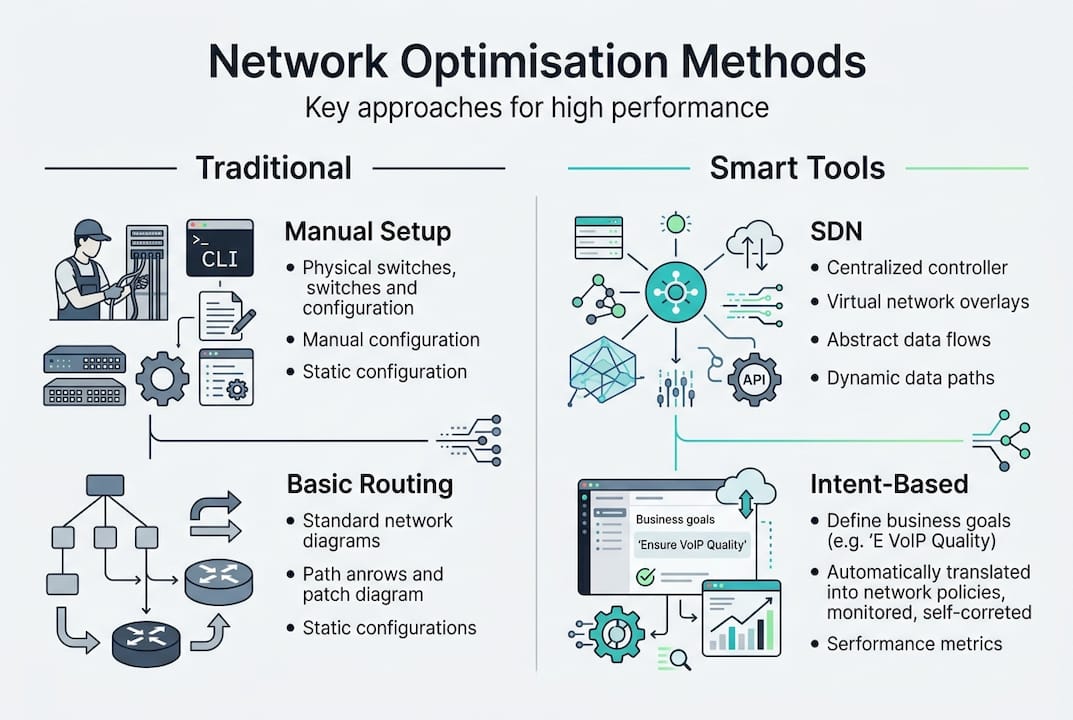
Modern network optimisation draws on a broad set of methodologies and tools. Key methods include intent-based networking (IBN), Software-Defined Networking, telemetry, traffic engineering, and AI-driven analytics, each serving a distinct purpose in the optimisation stack.
Understanding how these approaches differ in practice helps IT leaders make informed investment decisions. The table below compares manual, semi-automated, and fully automated optimisation approaches:
| Approach | Control level | Complexity | Typical ROI |
|---|---|---|---|
| Manual configuration | High | High (error-prone) | Low |
| Semi-automated (SDN) | Medium | Medium | Medium |
| Fully automated (AI/ML) | Lower | Lower (self-adjusting) | High |
Software-Defined Networking (SDN) separates the control plane from the data plane, allowing administrators to manage traffic centrally rather than device by device. This is particularly valuable in large campus environments such as universities or multi-site manufacturers.

Segment Routing with Traffic Engineering (SR-TE) provides granular control over how traffic traverses the network, ensuring critical applications always use the most efficient path. Telemetry tools stream real-time performance data, enabling closed-loop automation that adjusts configurations without manual intervention.
To modernise from a legacy setup to a proactive, intent-driven network, follow these steps:
- Audit your current infrastructure to identify bottlenecks and configuration drift.
- Introduce Quality of Service (QoS) policies to prioritise business-critical traffic.
- Deploy SDN or moving towards automation tools to centralise control.
- Implement real-time telemetry and monitoring dashboards.
- Introduce AI/ML analytics to identify patterns and automate adjustments.
- Review and refine policies quarterly to reflect changing demand.
Not every organisation needs to adopt every type of optimisation method at once. Starting with quick wins builds momentum.
Pro Tip: Local congestion mitigation (LCM) is one of the fastest, lowest-cost improvements available. Addressing congestion at the edge can free up significant capacity and fund broader infrastructure transformation without a large upfront investment.
Challenges and limitations: getting beyond tech jargon
Optimisation is not a straightforward technology upgrade. Real-world environments introduce complications that even well-resourced IT teams struggle to manage. Edge cases include high-density environments, legacy buildings, single points of failure, compliance requirements, configuration drift, and cost-resilience trade-offs, all of which require careful consideration.
Each sector carries its own set of barriers:
| Sector | Key challenge | Recommended approach |
|---|---|---|
| Education | Legacy cabling in historic buildings | Phased wireless upgrades with VLAN segmentation |
| Hospitality | High guest churn and device density | Dynamic access policies and robust guest network isolation |
| Manufacturing | Compliance and OT/IT convergence | Segmented networks with strict access controls and monitoring |
Beyond sector-specific issues, several operational pitfalls affect organisations across all industries:
- Over-provisioning: Purchasing excess capacity to compensate for poor configuration wastes budget without solving the root cause.
- Configuration drift: Networks that are manually adjusted over time accumulate inconsistencies that degrade performance and introduce security risks.
- Underestimating peak demand: Failing to model traffic spikes, such as exam periods in schools or check-in surges in hotels, leads to avoidable congestion.
- Ignoring the human factor: Automation tools require skilled oversight. Closed-loop systems are not truly set-and-forget.
Addressing common infrastructure challenges requires a structured approach to network planning best practice. Without a clear baseline and documented policies, even the most advanced tools will underperform.
“The most expensive network problems are the ones that were entirely predictable but never planned for.”
Following network design best practices from the outset reduces the likelihood of costly remediation later.
Pro Tip: Avoid over-provisioning by using traffic analysis tools to model actual demand before purchasing additional capacity. Data-driven capacity planning consistently outperforms gut-feel estimates.
Tailoring optimisation strategies to your sector
Universal best practices provide a foundation, but effective optimisation requires sector-specific adaptation. The priorities, constraints, and user expectations in a secondary school differ enormously from those in a hotel or a factory floor.
Education
Schools and universities face unique density challenges. Hundreds of devices connecting simultaneously during lessons or lectures strain even well-configured networks. SDN delivers a 52% improvement in bandwidth for education sector environments, making it one of the most impactful investments available.
Key starting points for education:
- Deploy density-aware Wi-Fi access points with band steering and load balancing.
- Use VLANs to separate staff, student, and administrative traffic.
- Implement content filtering and QoS to prioritise learning platforms over general browsing.
- Conduct regular surveys to identify coverage gaps and interference sources.
Hospitality
Guest expectations for Wi-Fi quality are high and rising. Poor connectivity is one of the most frequently cited complaints in hotel reviews. Optimisation here focuses on seamless roaming, high device density, and secure guest isolation.
Key starting points for hospitality:
- Segment guest, staff, and back-of-house systems onto separate networks.
- Use captive portals with bandwidth management to ensure fair usage.
- Deploy controllers that handle high device churn without manual intervention.
Manufacturing
Manufacturing environments increasingly rely on IoT sensors, automated systems, and real-time analytics. Network failures translate directly into production downtime. Using secure network controllers ensures that operational technology (OT) and information technology (IT) systems are properly segmented and monitored.
Key starting points for manufacturing:
- Deploy edge computing nodes to process IoT data locally and reduce core network load.
- Implement strict access controls between OT and IT segments.
- Use real-time telemetry to detect anomalies before they cause production disruptions.
Why real-world optimisation means more than just technology
There is a persistent assumption in IT circles that network problems are solved by acquiring the right tools. Buy a better controller, deploy a newer access point, or subscribe to an AI analytics platform and performance will follow. This view is incomplete, and acting on it alone leads to wasted investment.
The organisations that achieve lasting optimisation are those that treat it as a cultural and procedural commitment, not a procurement exercise. They establish clear performance baselines, assign ownership of ongoing monitoring, and build review cycles into their operational calendar. They also make deliberate trade-off decisions, accepting that perfect resilience costs more than most budgets allow and that the goal is informed balance, not maximum specification.
Senior IT leaders should resist the pressure to over-engineer. The most effective networks are often the ones that are well-understood, consistently maintained, and incrementally improved. Continuous, informed adjustment is the real competitive advantage. Technology enables it, but process and priorities sustain it.
Take the next step with expert support
If this guide has clarified what network optimisation involves and where your organisation might focus first, the logical next step is a structured assessment of your current environment.

Re-Solution brings over 35 years of Cisco infrastructure expertise to organisations in education, manufacturing, and hospitality. Whether you need to understand IT infrastructure explained from the ground up, explore network solutions explained in practical terms, or evaluate a fully managed Network as a Service offering, our team can help you identify the right path forward. Speak to us about an infrastructure audit or network survey tailored to your sector.
Frequently asked questions
What are the main benefits of network optimisation?
Network optimisation increases efficiency, reduces operational costs, and boosts reliability for critical systems across all sectors.
How often should networks be optimised?
Optimisation is an ongoing iterative process, not a one-time project. Periodic reviews are recommended, as well as reassessment whenever business demands or technologies change significantly.
Which network optimisation method suits my sector?
Education benefits most from advanced Wi-Fi and SDN, hospitality should prioritise high-density segmentation, and manufacturing gains the most from edge computing and real-time analytics.
How much can be saved through network optimisation?
Organisations can reduce network spend by 40% using pragmatic optimisation methods, according to Gartner research.
Recommended
- Network optimisation explained: Smart strategies for IT leaders
- How to Optimize Networks for Peak Performance 2025 | Re-Solution
- Clear Strategies to Tackle Network Infrastructure | Re-Solution