TL;DR:
- Choosing the correct network architecture ensures optimal performance and security for specific sector needs.
- A robust network offers improved communication, security, scalability, and operational efficiency.
- Strategy-focused planning and continuous management are key to successful, resilient network solutions.
Not all network solutions are built the same, and assuming otherwise is one of the most common and costly mistakes organisations make. The wrong infrastructure choice can leave schools vulnerable to data breaches, slow manufacturing operations to a crawl, or frustrate hotel guests with unreliable connectivity. Organisations in education, manufacturing, and hospitality each face distinct network demands shaped by their users, compliance obligations, and operational rhythms. This guide breaks down the core components, key benefits, architectural options, and practical strategies you need to make informed decisions about your network infrastructure.
Table of Contents
- What makes up modern network solutions?
- Key benefits of robust network solutions
- Comparing approaches: cloud, hybrid, and on-premises networks
- Practical strategies for selecting and managing network solutions
- Our perspective: why strategy outshines technology in network solutions
- Get tailored advice for your network solution
- Frequently asked questions
Key Takeaways
| Point | Details |
|---|---|
| Understand network foundations | A solid network combines hardware, software, and a suitable architecture for your sector. |
| Prioritise security | Segmentation, firewalls, and diligent management are crucial to prevent breaches and downtime. |
| Choose flexible solutions | Cloud and hybrid networks can future-proof operations by supporting scalability and adaptability. |
| Align with business goals | Network design works best when it’s integrated as part of your long-term strategy, not as an afterthought. |
What makes up modern network solutions?
Building from that introduction, it is crucial to understand the actual building blocks of any robust network. Network infrastructure components fall into three broad categories: hardware, software, and architecture. Get any one of these wrong and the entire solution underperforms.
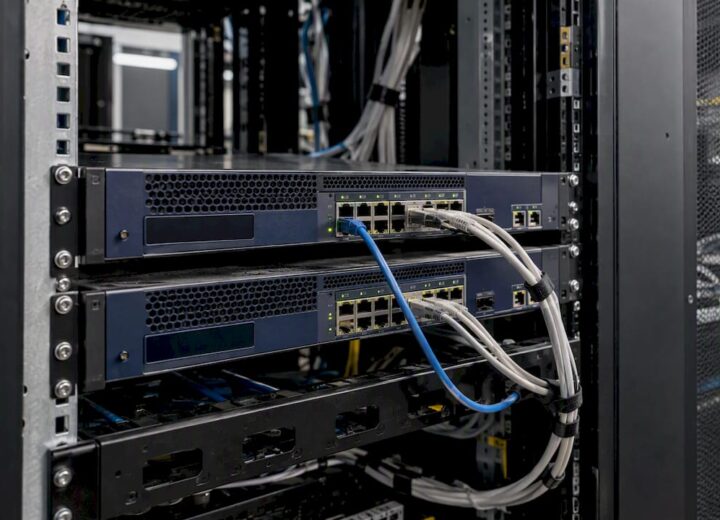
Hardware forms the physical foundation. Routers direct traffic between networks, switches connect devices within a network, and cabling determines the maximum data throughput available. Wireless access points extend connectivity without physical constraints, which is especially relevant in large campuses or factory floors.
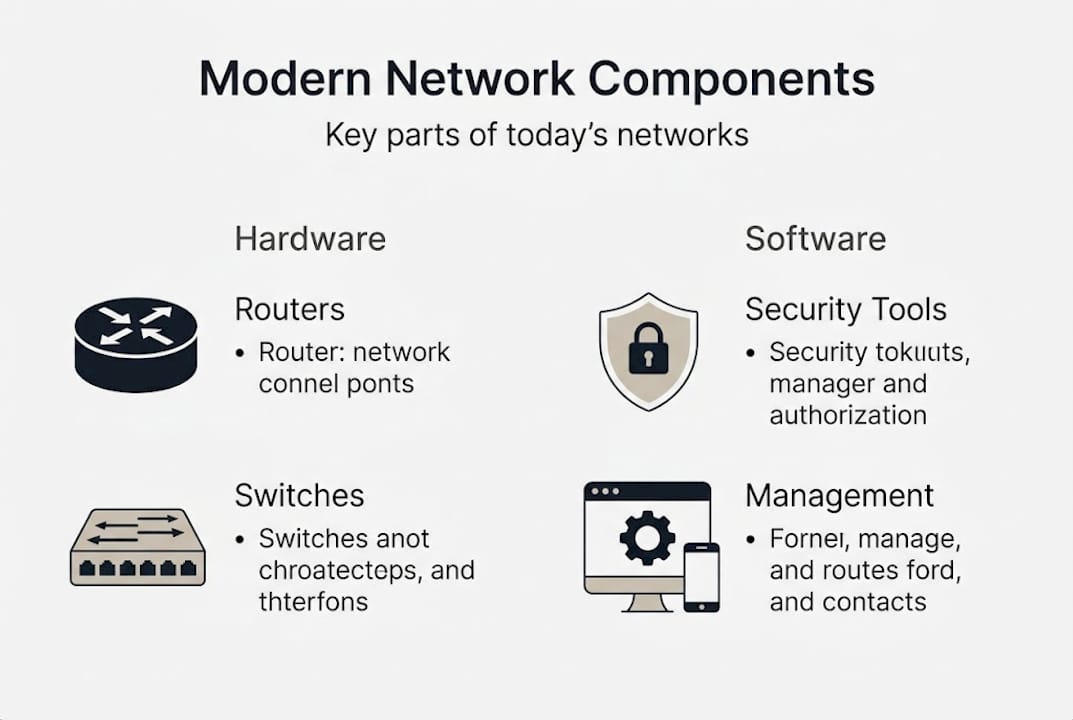
Software is where management and security come together. Network management tools provide visibility into traffic, performance, and faults. Security applications such as firewalls, intrusion detection systems, and endpoint protection guard against threats in real time. As network infrastructure specialists note, a complete solution combines hardware, software, and the right architectural type to serve the organisation’s needs.
Architecture defines how everything connects at scale:
- LAN (Local Area Network): Connects devices within a single site. Ideal for schools, hotel properties, or factory floors where everything is co-located.
- WAN (Wide Area Network): Links multiple sites over distance. Essential for manufacturers with regional facilities or hotel chains managing properties nationally.
- Cloud networking: Infrastructure hosted and managed off-site. Offers rapid deployment and remote access without on-site hardware investment.
- Hybrid networking: Combines on-premises hardware with cloud services. Delivers flexibility while retaining control over sensitive data.
The table below shows how each architecture aligns with sector requirements:
| Architecture | Education | Manufacturing | Hospitality |
|---|---|---|---|
| LAN | Campus connectivity | Production floor | In-room guest Wi-Fi |
| WAN | Multi-campus links | Multi-site operations | Chain-wide management |
| Cloud | E-learning platforms | Remote monitoring | Centralised booking systems |
| Hybrid | BYOD and admin systems | Data sovereignty + cloud tools | Guest and back-office split |
When planning network infrastructure, it is worth mapping your current estate before committing to any architecture. Many organisations discover redundant hardware or misconfigured segments during this process.
Pro Tip: Document every network component and schedule quarterly reviews. Gaps in documentation often reveal hidden vulnerabilities or outdated hardware that is quietly degrading performance.
Key benefits of robust network solutions
With the main parts of network solutions outlined, it is important to explore the tangible benefits these offer to different industries.
A well-designed network does more than keep devices connected. It actively supports business outcomes. Here are the four core benefits that matter most to IT decision-makers:
- Enhanced communication: Fast, reliable connectivity accelerates collaboration between departments, sites, and remote workers. In education, this means seamless video conferencing and shared digital resources. In manufacturing, it enables real-time data exchange between production systems.
- Stronger security: Network segmentation isolates sensitive systems so that a breach in one area cannot spread across the entire estate. Combined with firewalls and encryption, this approach significantly reduces exposure. According to network infrastructure research, segmentation, firewalls, and encryption are among the most effective defences available.
- Scalability: Whether a school is adding a new building, a manufacturer is expanding its production line, or a hotel group is opening new properties, the network must grow with the organisation. Cloud and hybrid architectures make this far simpler than traditional on-premises expansion.
- Operational efficiency: Automated monitoring and centralised management reduce the manual workload on IT teams. Fewer errors, faster fault resolution, and lower operational costs are the direct result.
Using a compliance checklist during the planning phase ensures that security and regulatory requirements are built in from the start rather than retrofitted later. This is particularly important in education, where data protection obligations are strict, and in manufacturing, where operational technology (OT) networks must meet specific industry standards.
The table below summarises benefit impact by sector:
| Benefit | Education | Manufacturing | Hospitality |
|---|---|---|---|
| Communication | Collaborative learning | Real-time production data | Guest services coordination |
| Security | Student data protection | OT/IT network separation | Payment card compliance |
| Scalability | Campus expansion | New production lines | New property onboarding |
| Efficiency | Reduced IT overhead | Automated monitoring | Centralised management |
Understanding upgrading infrastructure benefits is often the catalyst that moves organisations from reactive maintenance to proactive investment.
Comparing approaches: cloud, hybrid, and on-premises networks
Selecting the right architecture is crucial, so let us break down how cloud, hybrid, and on-premises networks compare.
Each approach carries distinct strengths and trade-offs. The right choice depends on your sector, compliance obligations, and operational priorities. As cloud networking has matured, the lines between these options have blurred, but the core distinctions remain important.
Cloud networks offer rapid deployment, elastic scaling, and straightforward remote access. For educational institutions rolling out e-learning platforms, cloud is often the fastest route to capability. The key concern is data residency: where is your data stored, and does that comply with UK regulations such as the UK GDPR?

Hybrid networks blend the flexibility of cloud with the stability and control of on-premises infrastructure. Hospitality businesses frequently adopt this model, using cloud-based property management systems alongside on-premises networks for guest Wi-Fi and payment processing. This separation protects sensitive financial data while keeping guest-facing services agile.
On-premises networks provide maximum control and are often preferred where data sovereignty is non-negotiable. Many manufacturers handling proprietary production data or operating in regulated industries choose on-premises for their core OT networks, supplementing with cloud tools for analytics and remote access.
Key considerations when comparing:
- Data residency and compliance: Cloud providers must meet UK data protection requirements.
- Latency requirements: Time-sensitive manufacturing processes may require on-premises infrastructure to avoid cloud latency.
- Cost model: Cloud shifts capital expenditure to operational expenditure, which suits organisations with variable budgets.
- Resilience: Hybrid models can maintain operations during internet outages by keeping critical systems on-premises.
| Approach | Strengths | Weaknesses | Best fit |
|---|---|---|---|
| Cloud | Fast deployment, scalable | Data residency concerns | Education, remote teams |
| Hybrid | Flexible, resilient | Complex to manage | Hospitality, mixed environments |
| On-premises | Full control, compliant | High maintenance cost | Manufacturing, regulated sectors |
Exploring cloud network advantages in detail can help clarify whether a full or partial cloud approach is right for your organisation.
Pro Tip: Do not treat architecture as a binary choice. Mixing approaches where it improves continuity and resilience is often the most pragmatic path forward.
Practical strategies for selecting and managing network solutions
Now that the options are clear, the final step is putting network solutions into action with solid strategy.
Choosing the right solution is only half the work. Implementation and ongoing management determine whether the investment delivers its intended value. Bandwidth management strategies are a good example: even a well-architected network will underperform if bandwidth is not allocated and monitored effectively.
Here is a practical framework for selection and management:
- Audit your current infrastructure: Identify what hardware and software is in place, what is end-of-life, and where performance bottlenecks exist.
- Define your requirements: Consider user numbers, application demands, compliance obligations, and growth projections for the next three to five years.
- Align with sector demands: A school network must support hundreds of simultaneous BYOD connections. A manufacturing network must prioritise OT system reliability. A hotel network must separate guest traffic from back-office systems.
- Plan a staged rollout: Avoid big-bang deployments. Phased implementation reduces risk and allows teams to adapt incrementally.
- Implement robust monitoring: Real-time visibility into network performance enables faster fault resolution and proactive capacity planning.
- Train end users: Technical excellence is undermined when staff do not understand basic security practices or how to use network tools correctly.
Best network management practices consistently highlight regular reviews, segmentation, and layered security as the foundation of a resilient network.
“A robust network strategy is never static. It adapts to user behaviour and technology shifts.”
Pro Tip: Schedule network drills alongside your regular documentation reviews. Testing failover procedures and incident response plans under controlled conditions reveals gaps that routine monitoring will not catch.
Our perspective: why strategy outshines technology in network solutions
Too many organisations approach network investment as a technology procurement exercise. They focus on specifications, feature lists, and vendor comparisons while the more important question goes unasked: what business outcome does this network need to enable?
We have seen organisations deploy advanced Cisco infrastructure with every capability enabled, only to find that users work around it because the solution was not aligned with how they actually operate. The technology was right. The strategy was absent.
The most resilient networks we encounter are not necessarily the most technically sophisticated. They are the ones where every design decision traces back to a specific operational requirement. The network fundamentals guide reinforces this point: understanding what you have and what you need is the prerequisite for any successful deployment.
Networks should enable, not complicate, everyday operations. When strategy leads and technology follows, the results speak for themselves.
Get tailored advice for your network solution
Understanding network solutions is the first step. Applying that knowledge to your specific environment is where the real value is created.

At Re-Solution, we bring over 35 years of Cisco expertise to organisations in education, manufacturing, and hospitality. Whether you need a full infrastructure audit, a managed network service, or guidance on the right architecture for your next project, we can help. Our in-depth network solutions guide is a useful starting point, and our team is ready to discuss your specific requirements. Explore our managed network services to see how we support organisations like yours with scalable, secure, and fully managed connectivity.
Frequently asked questions
What are the core components of a modern network solution?
A modern network solution includes hardware such as routers and switches, software for management and security, and an architectural framework that may be LAN, WAN, cloud, or hybrid, as outlined in the network infrastructure overview.
How do network solutions improve security?
Security is strengthened through segmentation, firewalls, and encryption, which together reduce vulnerabilities and prevent unauthorised access across the network.
What are the main differences between cloud, hybrid, and on-premises network solutions?
Cloud offers flexibility and rapid scaling, hybrid blends cloud agility with on-premises control, and on-premises prioritises compliance and data sovereignty, each suited to different network infrastructure types.
What steps should be taken to implement a new network solution?
Start with a full infrastructure audit, define current and future requirements, implement in phases, and enforce regular monitoring and security updates throughout the network lifecycle.
Recommended
- Network Solutions Explained: What You Should Know | Re-Solution
- Understanding Your Network: A Simple Guide | Re-Solution