
TL;DR:
- Advanced networks reduce latency by up to 40% and operational costs by 30% compared to legacy systems.
- Technologies like Zero Trust and AI-driven security cut security incidents and minimize threat surfaces.
- Successful deployment depends on thorough assessment, phased migration, staff training, and sector-specific infrastructure planning.
Traditional networks were built for a different era. Today, educational institutions manage thousands of concurrent device connections, manufacturers depend on sub-millisecond control loops, and hospitality venues must deliver seamless roaming across sprawling estates. Legacy architectures simply cannot meet these demands reliably. Adaptive network control cuts latency by 40% and operational expenditure by 30%, demonstrating that the gap between old and new is not incremental but transformational. This guide gives IT managers in education, manufacturing, and hospitality a clear roadmap for understanding, comparing, and deploying the advanced networking technologies that are reshaping infrastructure and security in 2026.
Table of Contents
- What defines advanced networking technologies?
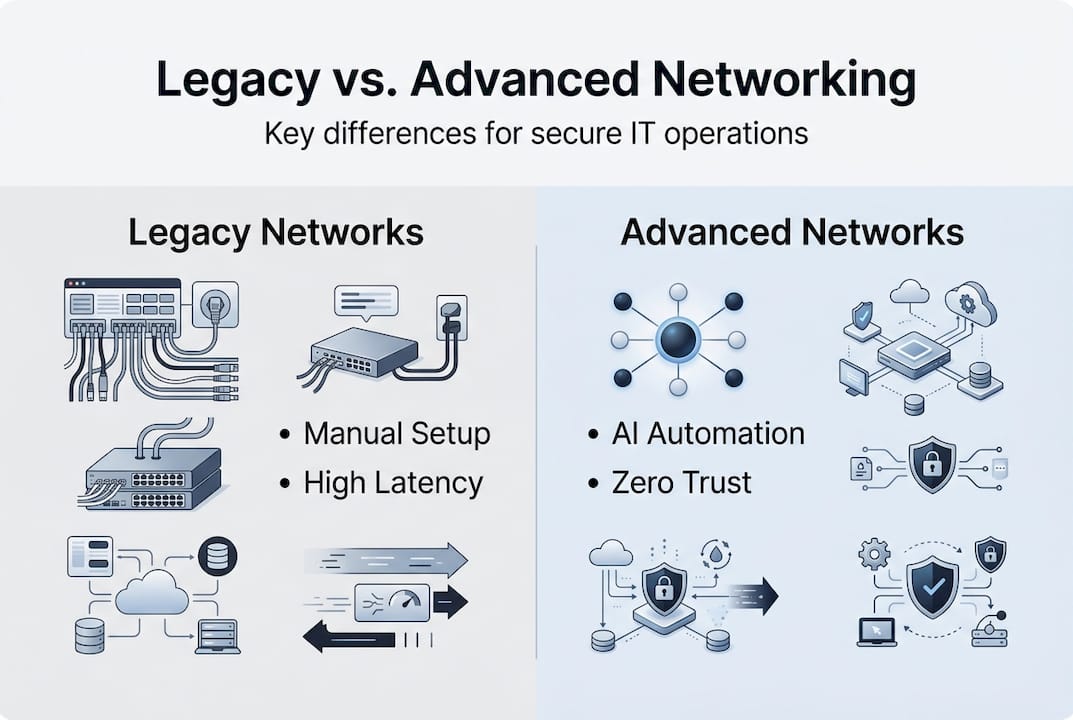
- Comparing legacy and advanced networking: Key differences and advantages
- Security revolution: Zero Trust, AI-driven defence, and sector adaptation
- Deploying and managing advanced networks: Practical considerations
- Our perspective: Balancing innovation with sector reality
- Explore next steps with expert IT support
- Frequently asked questions
Key Takeaways
| Point | Details |
|---|---|
| Agility and scale | Advanced networking solutions such as SDN and NFV make networks far more adaptable and scalable for new demands. |
| Better security | Zero Trust and AI-driven defences provide highly effective protection, drastically reducing incidents and improving detection rates. |
| Sector-tailored solutions | Different industries, like manufacturing and education, need specialised technologies such as TSN or VLAN segmentation for best results. |
| Measured implementation | Balanced deployment with strong governance is vital—technology alone can’t deliver results without skills and strategy. |
What defines advanced networking technologies?
The term ‘advanced networking technology’ covers a broad family of architectures and protocols, each solving a distinct set of problems that legacy systems cannot address. Understanding what each one does, and why it matters to your sector, is the first step towards a credible modernisation strategy.
Key technologies: SDN, NFV, Zero Trust, Edge Computing, TSN, 5G/6G slicing form the core of modern network design. Here is what each one delivers:
- Software-Defined Networking (SDN): Separates the control plane from the data plane, allowing centralised, programmable management of traffic flows. SDN and NFV together eliminate the rigid, box-by-box configuration that slows legacy networks.
- Network Functions Virtualisation (NFV): Replaces dedicated hardware appliances (firewalls, load balancers, routers) with software running on commodity servers, reducing capital expenditure and accelerating service deployment.
- Zero Trust: Operates on the principle of ‘never trust, always verify.’ Every user, device, and application must authenticate continuously, regardless of location. Zero Trust is particularly relevant for education, where guest devices and BYOD policies create complex access scenarios.
- Edge Computing: Pushes processing closer to the data source, reducing round-trip latency. Critical for manufacturing environments where real-time sensor data cannot afford cloud round-trips.
- Time-Sensitive Networking (TSN): An IEEE standard suite that guarantees deterministic packet delivery over Ethernet. In manufacturing, TSN enables precise synchronisation of robotic arms, PLCs, and conveyor systems on a single converged network.
- 5G and 6G network slicing: Creates virtualised, dedicated network segments with guaranteed quality-of-service parameters, enabling isolated traffic lanes for different applications or tenants.
What sets these designs apart from legacy architectures is programmability, automation, and granular policy control. Legacy networks are static; advanced networks adapt in real time to changing conditions and threats.
Pro Tip: When scoping a modernisation project, map each technology to a specific business outcome rather than deploying it for its own sake. TSN solves manufacturing determinism; SDN solves operational agility; Zero Trust solves access governance.
Comparing legacy and advanced networking: Key differences and advantages
Having clarified the technologies involved, it is essential to directly compare how these solutions outperform traditional networks across the metrics that matter most to IT managers.
| Parameter | Legacy networks | Advanced networks (SDN/NFV/AI/Zero Trust) |
|---|---|---|
| Latency | High, variable | Up to 40% lower, consistent |
| Operational expenditure | High (manual, hardware-heavy) | Up to 30% lower (automated, virtualised) |
| Threat surface | Broad, perimeter-only | Minimised, continuous verification |
| Configuration agility | Days to weeks | Minutes to hours |
| Scalability | Hardware-constrained | Software-defined, elastic |
| Visibility | Limited, siloed | Centralised, real-time analytics |
Adaptive network control uses AI/ML for real-time self-optimization, and the results are measurable: 40% better latency, 30% lower OpEx, and 68% enterprise adoption rates confirm that this is no longer an emerging trend but an established standard.
The practical implications differ by sector. In manufacturing, network jitter (unpredictable variation in packet delivery timing) can cause production line faults or safety incidents. Advanced architectures with TSN and edge computing eliminate this risk. In hospitality, guests roaming between access points expect zero interruption; legacy networks frequently drop sessions during handoffs, while advanced designs with seamless Layer 2 roaming and VLAN segmentation maintain continuity. In education, peak-density events such as examinations or lectures push legacy Wi-Fi to breaking point, whereas SDN-managed networks dynamically reallocate bandwidth.
“The shift from legacy to advanced networking is not a technology upgrade. It is an operational transformation that changes how IT teams manage, secure, and scale their infrastructure.”
Key advantages of advanced networking over legacy systems:
- Centralised performance optimisation through AI-driven analytics
- Automated threat response rather than manual incident handling
- Policy-based access control replacing static ACLs
- Elastic capacity scaling without hardware procurement cycles
- Unified visibility across wired, wireless, and cloud environments
For IT managers evaluating investment cases, the combination of OpEx reduction and security improvement creates a compelling financial argument alongside the operational one. A well-structured secure network design underpins both outcomes simultaneously.

Security revolution: Zero Trust, AI-driven defence, and sector adaptation
Performance is just one angle; security is equally transformed by advanced technologies. The evidence here is particularly striking for sectors that handle sensitive data or critical infrastructure.
AI-driven IDS in SDN/NFV/5G slices achieve 97.6% detection; Zero Trust reduces incidents 50%. These are not theoretical projections; they reflect deployments across enterprise and public sector environments. The Zero Trust model alone halves security incidents by eliminating implicit trust from internal network segments.
| Technology | Security gain | Sector relevance |
|---|---|---|
| Zero Trust | 50% reduction in incidents | Education, hospitality (BYOD, guest access) |
| AI-driven IDS | 97.6% threat detection accuracy | Manufacturing, education (high-value data) |
| SDN/NFV micro-segmentation | Lateral movement prevention | All sectors |
| 5G network slicing | Isolated traffic lanes | Manufacturing (OT/IT separation) |
Practical sector applications differ considerably. In education, network segmentation isolates student, staff, and administrative traffic, preventing a compromised student device from reaching HR or finance systems. In manufacturing, real-time AI-driven defence identifies anomalous OT traffic patterns before they cause equipment damage or production stoppages. In hospitality, granular user access policies ensure guests access only internet services, while staff systems remain protected on separate VLANs.
A structured approach to integrating modern security across sectors:
- Assess your current access model and identify where implicit trust exists within the network.
- Implement identity-based access controls using a Zero Trust framework, prioritising high-risk segments first.
- Deploy AI-driven intrusion detection on critical network segments, particularly where OT and IT traffic converge.
- Apply micro-segmentation via SDN to contain lateral movement in the event of a breach.
- Review and test policies quarterly, adjusting for new device types, user roles, and threat intelligence.
Pro Tip: Do not attempt to implement Zero Trust across the entire network simultaneously. Start with your highest-risk segment, validate the approach, then expand. The role of Zero Trust in reducing attack surface is cumulative; incremental rollout still delivers measurable security gains at each stage. Explore secure network designs that have been proven in similar sector environments before committing to a full deployment.
Deploying and managing advanced networks: Practical considerations
Understanding benefits is only the start. Success depends on robust deployment and ongoing management, and this is where many modernisation projects encounter difficulty.
A structured deployment follows four phases:
- Assessment: Audit existing infrastructure, document traffic flows, identify performance bottlenecks, and map security gaps. This phase informs every subsequent decision.
- Pilot: Deploy the chosen technology in a controlled environment, such as a single building, production line, or hotel wing. Measure outcomes against baseline metrics.
- Migration: Expand the solution progressively, maintaining fallback capability until the advanced network is fully validated.
- Optimisation: Use AI-driven analytics to continuously tune policies, traffic shaping, and security rules.
Common transition pitfalls to avoid:
- Underestimating staff training requirements for SDN controllers and Zero Trust policy management
- Failing to document legacy configurations before migration, creating rollback difficulties
- Overlooking wireless infrastructure compatibility with new SDN overlays
- Neglecting vendor interoperability testing in mixed-vendor environments
- Rushing OT integration without validating real-time performance guarantees
IT/OT convergence promising but challenges remain significant in real-time guarantees and jitter management, and hybrid architectures are emerging as the pragmatic solution for manufacturers who cannot afford production risk during full migration. These hybrids preserve deterministic OT performance while progressively introducing IT-side virtualisation.
Sector-specific nuances are important. Hospitality and education networks must handle VLAN roaming gracefully as users move between access points and buildings. Manufacturing networks require TSN-capable switches and validated cabling standards to guarantee determinism. Understanding these infrastructure challenges before deployment prevents costly rework.
For teams new to virtualised networking, a solid cloud networking guide provides essential context on how virtualisation principles translate from cloud to on-premises and hybrid environments.
Pro Tip: If you are introducing AI-based automation into network management, establish a governance framework before go-live. Define which decisions the AI can make autonomously, which require human approval, and how anomalous AI behaviour is detected and overridden. Explainability and auditability are not optional extras; they are operational requirements.
Our perspective: Balancing innovation with sector reality
There is a tendency in the networking industry to present advanced technologies as self-evidently beneficial, as though deploying SDN or Zero Trust automatically delivers the promised outcomes. Our experience working with organisations across education, manufacturing, and hospitality tells a more nuanced story.
Technology alone does not transform a network. Organisational readiness, staff capability, and cultural appetite for change are equally decisive. We have seen well-funded deployments underperform because IT teams lacked the skills to manage SDN controllers, or because operational teams resisted changes to familiar workflows.
The unexpected costs of transition are rarely discussed openly: retraining, interim performance degradation during migration, and the management overhead of hybrid environments all add to the real cost of modernisation. Practical strategies for implementation that account for these realities consistently outperform those that focus purely on technology selection.
Our view is that incremental, context-driven modernisation is usually smarter than wholesale replacement. Prioritise the technology that solves your most pressing problem today, validate it thoroughly, and build organisational competence before expanding scope. AI governance and ethics in network automation deserve serious attention now, not after a decision-making failure creates an incident.
Explore next steps with expert IT support
For teams ready to move from understanding to action, having the right partner makes a measurable difference to deployment outcomes and long-term network performance.

Re-Solution brings over 35 years of Cisco expertise to organisations in education, manufacturing, and hospitality. Whether you need a structured infrastructure audit to baseline your current environment, strategic guidance on technology selection, or hands-on deployment support, we provide tailored solutions rather than generic recommendations. Explore our IT infrastructure explained resource to build foundational knowledge, or access our detailed infrastructure knowledge base for deeper technical guidance. Contact us to discuss your specific requirements and start your modernisation journey with confidence.
Frequently asked questions
Which advanced networking technology should we prioritise first?
Begin with the technology that addresses your most urgent business outcome. Zero Trust reduces incidents 50%, making it the natural starting point for security-focused organisations, while SDN and NFV deliver the greatest agility and OpEx gains for teams managing complex, multi-site infrastructure.
Are there risks to adopting AI-based network controls?
Yes. AI automation introduces efficiency, but AI ethics and governance are now considered essential requirements, not afterthoughts. Organisations must define clear boundaries for autonomous decision-making and maintain human oversight to prevent errors or unintended consequences.
How do advanced technologies impact network OpEx and security?
Advanced networks consistently lower OpEx by 30% through automation and virtualisation, while simultaneously improving threat detection to 97.6% accuracy and halving security incidents in modern deployments.
What challenges are unique in educational and manufacturing networks?
Education networks face high-density peaks and complex roaming requirements that demand VLAN segmentation and roaming capabilities, while manufacturing environments require Time-Sensitive Networking to guarantee the deterministic control that production systems depend upon.
Recommended
- Secure network architecture: a practical guide for IT leaders
- Secure network design: proven examples for robust protection
- Clear Strategies to Tackle Network Infrastructure | Re-Solution
- What Is a Secure Network 2025? | Re-Solution