TL;DR:
- Only 0.5% of IT projects meet all success criteria of time, budget, and benefits.
- Proper methodology selection and outcome-driven leadership significantly improve project success rates.
- Strong stakeholder engagement, risk management, and power skills are essential for delivering value.
IT project failure is not an outlier. Only 0.5% of projects meet all three core success criteria: on time, within budget, and delivering intended benefits. For IT project managers in education and manufacturing, where budgets are constrained and operational continuity is essential, that statistic carries serious weight. This guide provides practical, actionable steps to improve how IT projects are scoped, managed, and delivered, drawing on proven methodologies, empirical benchmarks, and sector-specific insight for both educational institutions and manufacturing environments.
Table of Contents
- Understanding the IT project landscape
- Choosing the right project management methodology
- Planning for project success: stakeholder alignment and risk management
- Executing, monitoring and ensuring continuous improvement
- A fresh take: why outcome-driven leadership is the real secret of IT project success
- Connect your IT strategy to proven project outcomes
- Frequently asked questions
Key Takeaways
| Point | Details |
|---|---|
| Tailor methods to sector | The right project management approach depends on your sector’s unique challenges and compliance demands. |
| Prioritise risk management | Structured risk registers and compliance checks reduce surprises and improve outcomes. |
| Focus on communication | Strong leadership and clear communication consistently drive project success. |
| Measure success by value | Track actual business value, not just completed tasks, to judge real project impact. |
Understanding the IT project landscape
Before you can improve IT project outcomes, you need a clear picture of why so many projects struggle. The challenges are well-documented and consistent across industries.
According to McKinsey research, IT projects succeed only rarely: just 59% are completed within budget, 47% on time, and only 44% deliver the intended benefits. Large-scale projects with budgets exceeding £15 million are particularly vulnerable, running 45% over budget on average and delivering 56% less value than planned. These are not marginal shortfalls. They represent substantial losses in resources, staff productivity, and strategic momentum.
For education and manufacturing, the stakes are compounded by sector-specific pressures.
In education:
- IT projects often span multiple academic years, creating governance and continuity challenges
- Data protection requirements, including compliance with UK GDPR and safeguarding obligations, add regulatory complexity
- Procurement rules and public funding cycles restrict flexibility
- Stakeholder groups are numerous: governors, staff, students, parents, and local authorities all have differing priorities
In manufacturing:
- IT systems are frequently integrated with operational technology (OT) and production lines
- Downtime during deployment can halt production and trigger significant financial penalties
- Regulatory compliance requirements around traceability, quality control, and health and safety must be maintained
- Change resistance from the shop floor can undermine even technically sound projects
“Organisations with a formal Project Management Office (PMO) are 2.5 times more likely to deliver successful projects. Developing communication and leadership capabilities, often called power skills, correlates with a 7% higher success rate.”
These figures point to a clear conclusion. Technical competence alone does not determine project success. Structure, governance, and interpersonal leadership all play critical roles.
The proven project outcomes achieved by organisations that invest in structured delivery confirm this pattern. IT project managers who treat scope definition, risk management, and stakeholder communication as core disciplines, rather than administrative tasks, consistently outperform peers who focus solely on technical deployment.
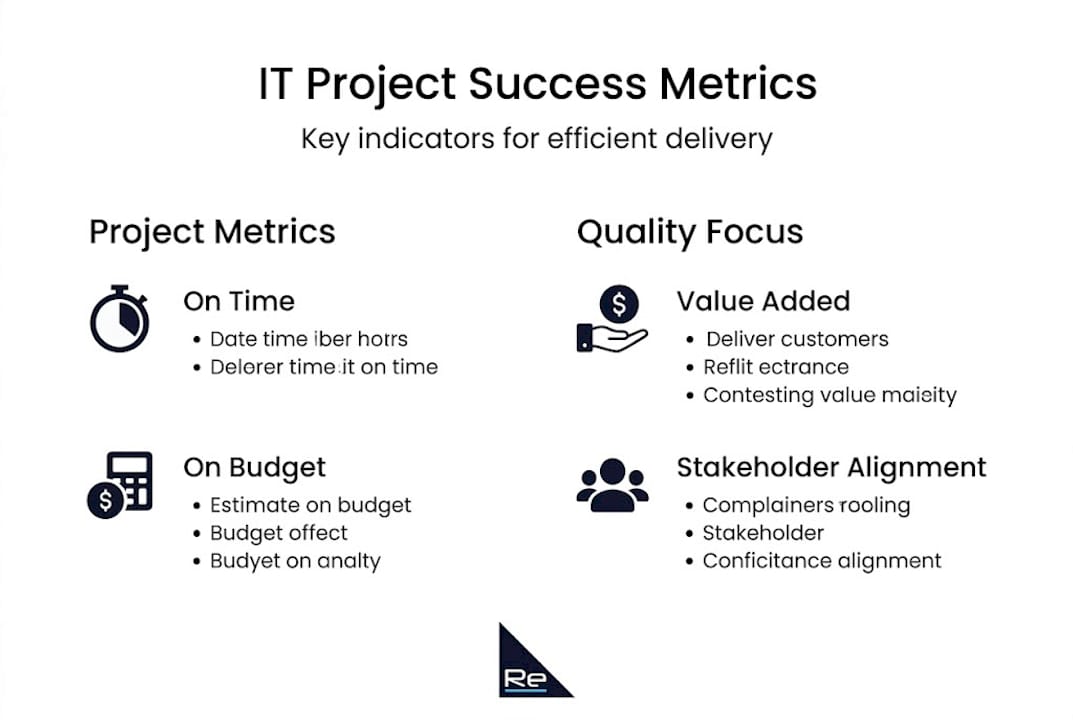
Tracking the right benchmarks matters too. Key metrics to monitor from project initiation include on-time delivery rate, budget variance, scope change frequency, and post-deployment benefit realisation. Applying optimisation strategies for IT leaders from the outset ensures these metrics are built into project governance rather than reviewed retrospectively.
Choosing the right project management methodology
Methodology selection is one of the most consequential decisions in IT project management, yet it is often made by default rather than design. The result is a mismatch between the project’s needs and the management approach applied, a leading cause of delays and overspend.
The main methodologies relevant to education and manufacturing IT projects are:
- PRINCE2: A structured, stage-based framework with defined roles, governance checkpoints, and formal risk management. Particularly suited to regulated environments.
- Waterfall: A sequential approach where each phase completes before the next begins. Best for fixed-scope, well-understood projects.
- Agile: An iterative approach that accommodates changing requirements through short delivery cycles called sprints. Effective when scope is likely to evolve.
- Lean/Six Sigma: Process-improvement frameworks that reduce waste and variance. Commonly applied in manufacturing environments to optimise workflows.
- Hybrid approaches: Combinations that blend the governance of PRINCE2 or Waterfall with the flexibility of Agile.
The right choice depends on the nature of your project, not on what is currently fashionable in project management circles.
| Methodology | Best suited for | Sector fit |
|---|---|---|
| PRINCE2 | Regulated, governance-heavy projects | Education, public sector |
| Waterfall | Fixed scope, defined requirements | Manufacturing compliance |
| Agile | Evolving requirements, iterative delivery | Both, with caveats |
| Lean/Six Sigma | Process efficiency, waste reduction | Manufacturing |
| Hybrid Waterfall-Agile | Complex deployments with some flexibility | Manufacturing IT |
For education, PRINCE2 provides structured governance that suits the sector’s regulated environment. It offers clear role assignments, stage-gate reviews that can align with academic term boundaries, and formal risk management processes that directly address data protection obligations. Schools and universities benefit from its auditability, particularly when projects involve public funding or third-party oversight.
For manufacturing, Hybrid Waterfall-Agile or PRINCE2 frameworks work well when physical infrastructure and compliance constraints are present. Lean/Six Sigma is valuable for projects focused on improving the efficiency of existing processes rather than deploying entirely new systems. Strict change control procedures are essential in manufacturing IT, where even minor unplanned modifications can disrupt production integration.

Regardless of sector, matching methodology to context is the single most reliable predictor of delivery success. Fixed-scope, compliance-driven projects favour Waterfall or PRINCE2. Projects with changing requirements favour Agile or hybrid models.
When customising IT solutions for specific organisational needs, the methodology must reflect the organisation’s culture, its regulatory environment, and the technical complexity of the systems being deployed. A primary school deploying a new network infrastructure has different governance needs to a manufacturer integrating IoT sensors with an ERP system. Recognising this distinction is where experienced project managers separate themselves from those who apply a one-size-fits-all approach.
For organisations in manufacturing, reviewing how peers have achieved results through manufacturing technology efficiency provides a useful baseline for methodology decisions and expected timelines.
Pro Tip: Schedule a retrospective at the end of each project phase, not just at project close. Regular retrospectives surface issues early, allow the team to course-correct, and build a documented library of lessons that improve future project planning across your organisation.
Planning for project success: stakeholder alignment and risk management
With the right methodology selected, disciplined preparation separates projects that deliver from those that drift. The planning phase is where the majority of project risk is either addressed or ignored.
Step 1: Define scope, goals, and KPIs
Start with a clear project scope statement that specifies what is included, what is excluded, and what constitutes project completion. Attach measurable KPIs to every objective. For IT projects in education and manufacturing, key KPIs should include on-time delivery rate, budget adherence, system uptime post-deployment, and measurable business value generated. Prioritising clear KPIs like on-time delivery and business value from the outset creates accountability and a shared definition of success.
Step 2: Map and engage stakeholders
Stakeholder mapping involves identifying every individual or group affected by the project, then categorising them by influence and interest. A simple two-by-two matrix, plotting influence against interest, helps prioritise engagement. High-influence, high-interest stakeholders require active management and regular communication. Low-influence, low-interest stakeholders need periodic updates only.
In education, stakeholder groups typically include: IT staff, teaching staff, the senior leadership team, governors, and in some cases students and parents. In manufacturing, key stakeholders span IT, operations, quality assurance, compliance, and the shop floor. Failure to engage operations teams early is one of the most common causes of manufacturing IT project failure.
Step 3: Build and maintain a risk register
A risk register is a living document that records identified risks, their likelihood, potential impact, and the mitigation action assigned to a named owner. Common risks in education IT projects include data protection breaches, safeguarding system outages, and procurement delays. In manufacturing, risks include production downtime during system switchover, integration failures with legacy OT systems, and supplier delays.
PRINCE2’s structured governance includes formal risk management processes that work well in both sectors. Review the risk register at every stage gate, not just at the start of the project.
Step 4: Confirm compliance requirements early
For education IT projects, UK GDPR, safeguarding obligations, and the Department for Education’s digital standards all apply. For manufacturing, ISO quality standards, industry-specific regulatory requirements, and health and safety legislation must be factored into planning. Identifying compliance requirements during planning, rather than discovering them mid-delivery, avoids costly rework. Reviewing education IT infrastructure guidance helps clarify which technical standards apply before project scope is finalised.
Step 5: Establish a feedback loop with stakeholders
Stakeholder alignment is not a one-time event. Build structured feedback touchpoints into the project plan, such as monthly steering group meetings, brief sprint reviews, or phase-end sign-off sessions. These create shared ownership and reduce the risk of late-stage scope disputes.
Pro Tip: Use a RACI matrix (Responsible, Accountable, Consulted, Informed) alongside your stakeholder map. It removes ambiguity about decision-making authority and prevents the bottlenecks that occur when project roles are unclear.
Executing, monitoring and ensuring continuous improvement
Careful planning only creates value when execution is equally disciplined. Active management during delivery is where many projects lose momentum or deviate from their intended course.
Establishing a monitoring rhythm
A structured review cadence keeps projects on track and provides early warning of emerging issues:
- Daily standups: Short team check-ins (15 minutes maximum) to surface blockers and confirm priorities.
- Weekly status reviews: Progress against milestones, budget burn rate, risk register updates, and any escalation items.
- Milestone reviews: Formal governance reviews at each major delivery checkpoint, with sign-off from the project sponsor or steering group.
- Phase-end retrospectives: Structured reviews of what worked, what did not, and what will change in the next phase.
Measuring outcomes rather than just outputs is essential at every review point. An IT system going live on time is an output. Users adopting it effectively and the organisation realising the anticipated efficiency gain is an outcome. Track both.
Managing scope change without derailing progress
Scope change is one of the most common causes of IT project overrun. Every requested change, no matter how small it appears, should go through a formal change control process. This means documenting the request, assessing the impact on time, budget, and risk, obtaining approval from the relevant authority, and updating project documentation before implementation.
In manufacturing especially, uncontrolled scope change can cascade through production schedules and compliance documentation. Strict change control is not bureaucracy. It is protection for the project, the team, and the organisation.
Embedding power skills across the project team
Structured PMO practices and power skills including communication, leadership, and problem-solving yield measurably better project outcomes. Power skills are not soft options. They are the practical behaviours that determine whether a technically capable team actually delivers.
Project managers in education and manufacturing should prioritise:
- Clear, consistent written communication with all stakeholder groups
- Proactive escalation of risks before they become incidents
- Recognition of team performance and individual contribution
- Transparent reporting that presents both progress and problems honestly
It is also worth noting that 59% of project managers are simultaneously managing between two and five projects. Overloading is a structural risk. Where possible, limit concurrent project ownership and ensure project managers have dedicated time for each active project, rather than splitting attention across too many competing priorities. Reviewing guidance on overcoming IT challenges can also help teams anticipate common execution pitfalls before they occur.
A fresh take: why outcome-driven leadership is the real secret of IT project success
Here is the uncomfortable truth that no methodology guide will tell you: most IT projects that fail do not fail because the team chose the wrong framework. They fail because leadership was focused on process compliance rather than outcome accountability.
PRINCE2 certificates and Agile certifications are necessary foundations, but they are not sufficient. The organisations that consistently deliver successful IT projects in education and manufacturing share one distinguishing characteristic: leaders who relentlessly tie every decision back to the value the project is supposed to create.
This means asking hard questions at every phase. Not “did we complete the stage gate?” but “are we still going to deliver the outcome we committed to?” It means being willing to reshape the project mid-delivery when circumstances change, rather than rigidly following a plan that no longer serves the original objective.
Addressing IT leadership challenges honestly, rather than avoiding difficult conversations, is what separates teams that learn from projects from those that simply complete them. Outcome-driven leadership creates accountability at every level. It also creates the kind of organisational trust that makes future projects easier to deliver, because stakeholders have seen that commitments are kept and results are real.
Connect your IT strategy to proven project outcomes
Delivering successful IT projects in education and manufacturing requires more than good intentions. It requires the right infrastructure, the right expertise, and a delivery partner who understands the sector context.
Re-Solution brings over 35 years of Cisco IT infrastructure experience to organisations across education and manufacturing. Whether you are planning a new network deployment, need a thorough network audit before a major project commences, or want to understand your current position by reading IT infrastructure explained, the team is equipped to support every stage of your IT project journey. For organisations facing specific deployment or governance hurdles, exploring practical guidance on overcoming IT infrastructure challenges is an excellent starting point.
Frequently asked questions
What is the best project management methodology for IT in education?
PRINCE2 is often the strongest choice for education IT projects because its structured governance, defined roles, and stage-based delivery align naturally with academic planning cycles and regulatory requirements.
How can manufacturing IT projects stay on schedule and under budget?
Hybrid Waterfall-Agile approaches combined with Lean/Six Sigma process thinking and strict change control give manufacturing IT projects the balance of structure and flexibility needed to meet compliance requirements without overrunning.
Why do so many IT projects fail to deliver expected value?
Poor methodology fit, unclear objectives, and weak communication are the primary causes. Only 0.5% of IT projects successfully meet all three success criteria of being on time, within budget, and delivering intended benefits simultaneously.
What are the most important KPIs for IT project managers?
On-time delivery, budget adherence, and post-deployment business value are the core KPIs. Prioritising stakeholder alignment and risk registers from the outset ensures these metrics are measured consistently throughout the project lifecycle.
How can teams improve communication and leadership in IT projects?
Investing in power skills alongside formal project management training is the most reliable approach. Developing communication and leadership capabilities within project teams correlates with a 7% higher project success rate, according to empirical benchmarking data.
Recommended
- Challenges in IT Infrastructure & How to Overcome | Re-Solution
- Drive hospitality success with innovative IT solutions
- Maximise manufacturing efficiency with modern IT solutions