
TL;DR:
- Traditional perimeter defenses are insufficient against modern internal and supply chain threats.
- Zero Trust Architecture verified requests and assumes breach to significantly reduce breaches.
- Leadership, governance, and continuous security practices are essential for resilient, compliant networks.
Traditional perimeter defences are no longer adequate. Organisations in education, manufacturing, and hospitality face threats that routinely bypass firewalls and VPNs, exploiting trusted internal access, compromised credentials, and unmanaged devices. Perimeter models fail modern threats, and the shift to continuous verification is no longer optional. This guide sets out the frameworks, controls, and sector-specific action steps IT managers need to build a resilient, compliance-ready security posture. From Zero Trust Architecture to NIST and CISA guidelines, every concept here is directly applicable to the environments you manage today.
Table of Contents
- Understanding the modern threat landscape and frameworks
- Zero Trust Architecture: Moving beyond boundaries
- Critical controls: From governance to technical enforcement
- Building your action plan: Application across sectors
- Our take: Where modern network security is headed
- Accelerate your network security transformation
- Frequently asked questions
Key Takeaways
| Point | Details |
|---|---|
| Move beyond perimeters | Today’s threat landscape requires abandoning legacy perimeter models in favour of frameworks like Zero Trust. |
| Prioritise governance and controls | Accountable leadership, continuous vulnerability management, and technical hardening are non-negotiable for compliance and security. |
| Sector-specific strategies matter | Tailor your action plan for the unique risks and requirements of your industry for maximum impact. |
| Continuous improvement is key | Regularly update, monitor, and adapt your network defences to stay ahead of threats and new standards. |
Understanding the modern threat landscape and frameworks
The assumption that a strong perimeter equals a secure network has been progressively dismantled. Attackers now exploit supply chain vulnerabilities, stolen credentials, misconfigured cloud resources, and insider threats, all of which operate entirely within what a traditional firewall considers “trusted” territory. Ransomware groups, for instance, increasingly target schools and hotels precisely because these environments mix guest or student access with sensitive operational systems, creating wide attack surfaces that perimeter tools cannot adequately protect.
For IT leaders in education, manufacturing, and hospitality, this is not an abstract concern. A university’s network might simultaneously carry student BYOD (Bring Your Own Device) traffic, research data, and financial systems. A factory floor may connect legacy operational technology (OT) equipment alongside modern IT systems. A hotel must balance guest Wi-Fi convenience with the security of payment and property management systems. In each case, the perimeter model creates dangerous blind spots.
The frameworks redefining network security
Two frameworks have become central reference points for organisations serious about modernising their security posture.
The NIST Cybersecurity Framework 2.0 provides the core structure for modern network security with five functions: Identify, Protect, Detect, Respond, and Recover. CSF 2.0 also introduces a sixth function, Govern, which underscores that cybersecurity is a leadership responsibility, not just a technical one. This is particularly relevant for sector heads and board-level stakeholders who may still view security as purely an IT matter.
The CISA Cross-Sector Cybersecurity Performance Goals (CPGs) 2.0 complement NIST by providing minimum baseline protections applicable across industries. These goals are practical and measurable, covering governance, multi-factor authentication (MFA), secure configuration, and vulnerability management.
| Security model | Approach | Key weakness | Compliance alignment |
|---|---|---|---|
| Classic perimeter | Trust internal, block external | Fails against insider threats and lateral movement | Limited; reactive |
| Zero Trust | Verify every request, assume breach | Integration complexity, higher initial cost | Strong; audit-ready |
| Framework-driven | Structured governance plus controls | Requires ongoing commitment | Full; supports NIST and CISA |
Governance first. Technology controls are only as effective as the policies and leadership accountability that back them. Every security framework, from NIST CSF 2.0 to CISA CPGs 2.0, places governance at the foundation. Security without executive ownership is a technical exercise, not an organisational defence.
Building your approach around a secure network architecture guide ensures that the strategic layer and the technical layer reinforce each other, rather than operating in isolation.
Zero Trust Architecture: Moving beyond boundaries
Zero Trust Architecture (ZTA) is not a single product. It is a security philosophy and a set of design principles that fundamentally change how access decisions are made. The two core tenets are: verify always and assume breach. No user, device, or application is trusted by default, regardless of where it sits on the network.
This matters because the traditional model grants significant trust once a user or device is inside the network. A compromised credential or infected device on a university campus can then move laterally across the entire network unchallenged. Under Zero Trust, every access request is evaluated against identity, device health, location context, and behaviour before access is granted, and that evaluation is continuous, not just at login.
The empirical case for Zero Trust
The evidence for Zero Trust is compelling. Zero Trust Architecture reduces breaches by 63%, improves mean time to detect (MTTD) by 40%, and reduces mean time to respond (MTTR) by 39% compared to perimeter-based models. These figures come from empirical analysis across manufacturing and other sectors, and they represent substantial risk reduction that IT leaders can present to board-level stakeholders.
| Metric | Perimeter model | Zero Trust | Improvement |
|---|---|---|---|
| Breach rate | Baseline | 63% lower | Significant |
| Mean time to detect (MTTD) | Baseline | 40% faster | Major |
| Mean time to respond (MTTR) | Baseline | 39% faster | Major |
Sector-specific adoption considerations
Implementing Zero Trust looks different depending on your environment. Here are the primary considerations by sector:
- Education: Student and staff BYOD makes device trust verification essential. Network Access Control (NAC) tools can enforce health checks before granting access. Segmentation between student, staff, and administrative networks is a critical first step.
- Manufacturing: OT/IT convergence creates unique risks. Legacy OT devices often cannot support modern authentication agents, so micro-segmentation and out-of-band monitoring become the primary Zero Trust mechanisms for those assets.
- Hospitality: Guest networks must be completely isolated from property management, payment, and back-office systems. Zero Trust Network Access (ZTNA) replaces traditional VPN for staff remote access, reducing the attack surface significantly.
Pro Tip: Start your Zero Trust journey with identity and network segmentation. These two controls deliver the highest risk reduction for the lowest initial investment, and they form the foundation on which all other Zero Trust components depend.
Explore how Zero Trust solutions can be applied to your specific environment, and understand the role of Zero Trust in long-term security strategy before committing to a specific implementation path.
Critical controls: From governance to technical enforcement
Adopting Zero Trust principles sets the strategic direction. But translating that direction into measurable, auditable security requires a clear set of technical and governance controls. This is where the CISA CPGs 2.0 become especially useful, as they define minimum baseline protections including governance, MFA, secure configuration, and vulnerability management applicable across sectors.

Governance and leadership accountability
Security posture is directly shaped by leadership culture. The CISA CPGs 2.0 make governance a baseline requirement, not an optional enhancement. This means organisations must designate clear ownership of cybersecurity risk, document policies, and ensure that executive leadership reviews and endorses the security programme regularly. For IT managers, this is an opportunity to elevate security conversations to the board level and secure the budget and authority needed to act effectively.
Must-have technical controls
The following controls represent the minimum viable security baseline for any organisation in education, manufacturing, or hospitality:
- Multi-factor authentication (MFA): Deploy MFA on all administrative accounts, remote access systems, and cloud services. Phishing-resistant MFA, such as FIDO2 keys, is preferable for high-privilege accounts.
- Secure configuration management: Remove default credentials, disable unnecessary services, and enforce hardened configuration baselines across all endpoints and servers.
- Vulnerability management: Maintain an asset inventory, run regular authenticated vulnerability scans, and remediate critical findings within defined timelines.
- Network segmentation: Separate sensitive systems, guest access, and operational technology networks to limit the blast radius of any compromise.
- Logging and monitoring: Centralise log collection through a SIEM (Security Information and Event Management) platform to enable rapid detection and investigation.
Server hardening: The practical steps
Server hardening per CIS Benchmarks and NIST SP 800-123 involves a structured set of configuration changes that reduce the attack surface of every server in your environment. The key steps include:
- Disable legacy protocols such as SMBv1, Telnet, and TLS 1.0/1.1, which are frequently exploited by attackers.
- Set firewalls to deny by default, allowing only explicitly required traffic through defined rule sets.
- Enable centralised SIEM logging on all servers to ensure audit trails are available and tamper-resistant.
- Deploy Endpoint Detection and Response (EDR) on all servers to provide behavioural monitoring and rapid containment capability.
- Enforce role-based access control (RBAC) and remove standing administrative privileges wherever possible, using just-in-time access where appropriate.
Pro Tip: Quarterly vulnerability scans and automated patching are critical for compliance evidence. Regulators and auditors increasingly expect documented, repeatable processes rather than one-time assessments. Automation reduces both risk and administrative burden simultaneously.
Applying these controls consistently across your environment, as detailed in network security best practices, bridges the gap between high-level frameworks and the day-to-day operations that determine your actual risk posture. Understanding IT infrastructure challenges across your sector also helps prioritise where controls are most urgently needed.
Building your action plan: Application across sectors
Frameworks and controls only deliver value when they are applied thoughtfully to your specific operational context. Education, manufacturing, and hospitality each carry distinct risk profiles, regulatory requirements, and infrastructure constraints. A generic approach will leave gaps. A sector-informed approach closes them.
Step-by-step: Evaluate, plan, and prioritise
Begin with a structured evaluation of your current security posture. Map your assets, identify your highest-value data and systems, and assess which threats are most likely to affect your environment. The CISA CPGs 2.0 provide a useful maturity scoring method: each goal can be rated as not implemented, partially implemented, or fully implemented, giving you a clear gap analysis from which to build your roadmap.
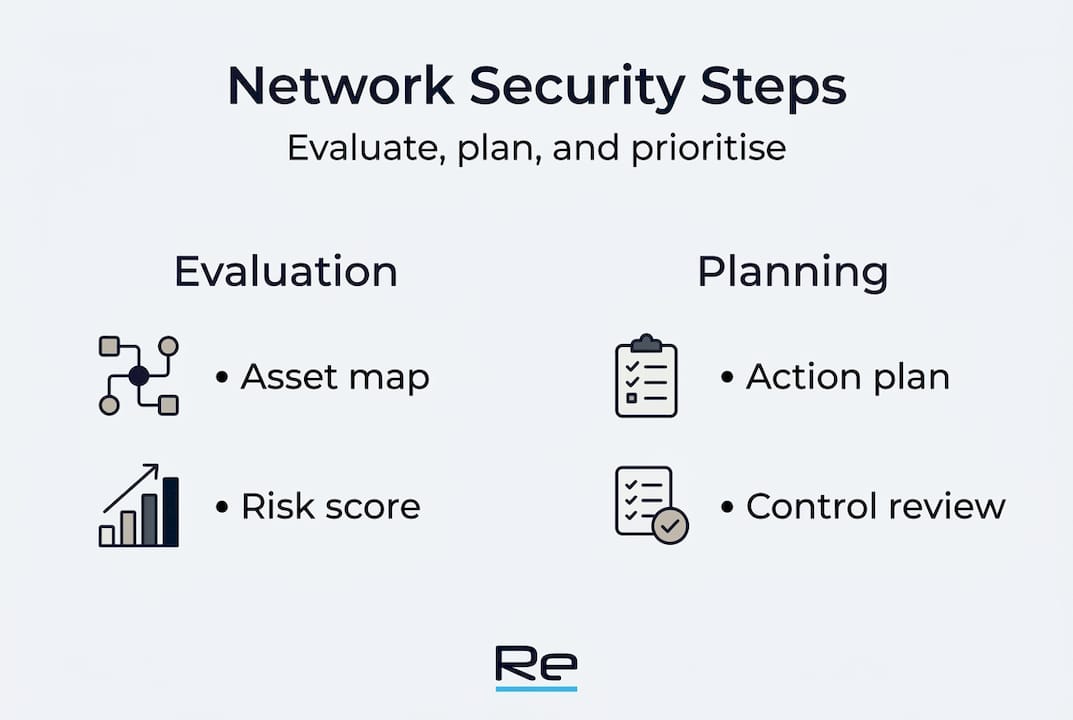
Prioritise controls based on the likelihood and impact of the threats you face, not on what is easiest to implement. In practice, this usually means prioritising MFA, network segmentation, and logging first, because these controls address the most common attack vectors with relatively low implementation complexity.
Education sector quick wins
- Enforce MFA for all staff and student access to institutional systems and cloud platforms.
- Implement NAC to validate device health before granting network access, particularly for BYOD devices.
- Segment the network between student, staff, research, and administrative zones.
- Deploy automated patch management to cover the large number of endpoints typical in educational environments.
- Conduct annual security awareness training with simulated phishing exercises tailored to the academic calendar.
Manufacturing sector quick wins
- Conduct an OT/IT asset inventory to identify all connected devices, including legacy systems that may lack modern security support.
- Create a dedicated OT network segment with strict controls governing what can communicate between OT and IT environments.
- Deploy out-of-band monitoring for OT assets that cannot support agents or active security tooling.
- Establish an incident response plan specifically for operational disruptions, not just data breaches, since downtime has direct financial consequences in manufacturing.
Hospitality sector quick wins
- Isolate guest Wi-Fi completely from back-office and payment systems using network segmentation and VLAN (Virtual Local Area Network) controls.
- Replace VPN-based staff remote access with ZTNA solutions to enforce identity and device checks on every session.
- Apply PCI DSS (Payment Card Industry Data Security Standard) requirements to all payment-adjacent systems and validate compliance with annual assessments.
- Implement automated monitoring for unusual access patterns on property management systems, which are frequent targets for financially motivated attackers.
Pro Tip: Industry collaboration significantly boosts threat intelligence. Joining sector-specific information sharing groups, such as education ISACs or manufacturing threat-sharing networks, gives your team early warning of threats targeting your industry and helps you prioritise defensive actions before incidents occur.
Embedding these controls into a broader technology strategy, informed by advanced networking technologies, ensures that security investments also support scalability and operational agility rather than creating friction.
Our take: Where modern network security is headed
Too many organisations are still operating perimeter-based models with a thin layer of additional controls bolted on, mistaking incremental improvement for genuine transformation. The frameworks covered in this guide are clear: the industry has moved, and organisations that delay adoption are not standing still, they are falling behind against a threat landscape that is accelerating.
What most guides miss is the cultural and management dimension. Technology alone cannot deliver security. A well-funded security programme that lacks executive ownership, clear accountability, and a workforce that understands its role will underperform relative to a leaner programme with strong governance and training. The NIST CSF 2.0’s introduction of the Govern function is a direct acknowledgement of this reality.
Compliance is also not security. Meeting a checklist of controls reduces risk, but true resilience requires continuous adaptation. The organisations that perform best under adversarial pressure are those that treat security as an ongoing operational discipline, not an annual audit exercise. Sector-specific risk intelligence, shared within industry communities, is an underused resource that can significantly sharpen your defensive prioritisation.
Review your current position against network security best practices and ask honestly whether your controls reflect where threats are today, not where they were five years ago.
Accelerate your network security transformation
Re-Solution has supported IT leaders across education, manufacturing, and hospitality in building compliant, resilient network security programmes for over 35 years. Whether you are beginning your Zero Trust journey, addressing a compliance gap, or seeking to modernise ageing infrastructure, our team brings the sector-specific expertise and Cisco technology experience to accelerate your outcomes.

Explore how our network solutions explained page outlines the right approach for your organisation, get a clear view of what modern IT infrastructure explained looks like in practice, or speak to our team about Network as a Service options that reduce capital expenditure whilst delivering managed security and compliance at scale. Get in touch to discuss your specific requirements.
Frequently asked questions
What is Zero Trust and why is it better than a perimeter model?
Zero Trust requires verification for every access request and assumes breaches are inevitable, drastically reducing breach rates compared to perimeter-based security. Empirically, ZTA reduces breaches by 63% and significantly improves detection and response times.
How can education and hospitality sectors meet compliance standards efficiently?
Implementing the CISA CPGs 2.0 controls such as MFA, secure configuration, and automated patching provides a strong compliance foundation applicable across sectors without requiring a complete infrastructure overhaul.
What are the most important steps for network server hardening?
Disable legacy protocols, enforce default-deny firewalls, centralise logging, and deploy endpoint detection and response according to CIS Benchmarks and NIST SP 800-123 best-practice standards.
How often should we review and update our network security controls?
Quarterly vulnerability scans and regular patch management are critical to maintaining effective and compliant controls, as CISA CPGs 2.0 guidance makes clear that documented, repeatable processes are now an auditor expectation.
Recommended
- Secure network architecture: a practical guide for IT leaders
- Tackling Network Security Challenges Guide | Re-Solution
- Network Security Best Practices Guide | Re-Solution
- Network Security Best Practices Guide | Re-Solution