TL;DR:
- Cloud networking is a virtual, software-driven infrastructure that manages connectivity across cloud, edge, and on-premises environments. It relies on components like VPCs, subnets, route tables, and security groups, replacing physical hardware with programmable virtual systems.
Cloud networking is defined as a software-driven, virtualised infrastructure that manages connectivity across on-premises data centres, edge locations, and cloud services. The standard industry term is Software-Defined Networking (SDN), and it sits at the core of every modern cloud network architecture. Technologies such as Virtual Private Cloud (VPC), SDN controllers, and cloud service models including IaaS, PaaS, and SaaS form the operational backbone of this approach. Providers like Cisco and AWS have built entire ecosystems around these principles, making the cloud networking definition inseparable from the tools and platforms that deliver it. For IT professionals and network administrators, understanding these foundations is the starting point for managing any hybrid or multicloud environment effectively.
What is cloud networking? Core components and architecture
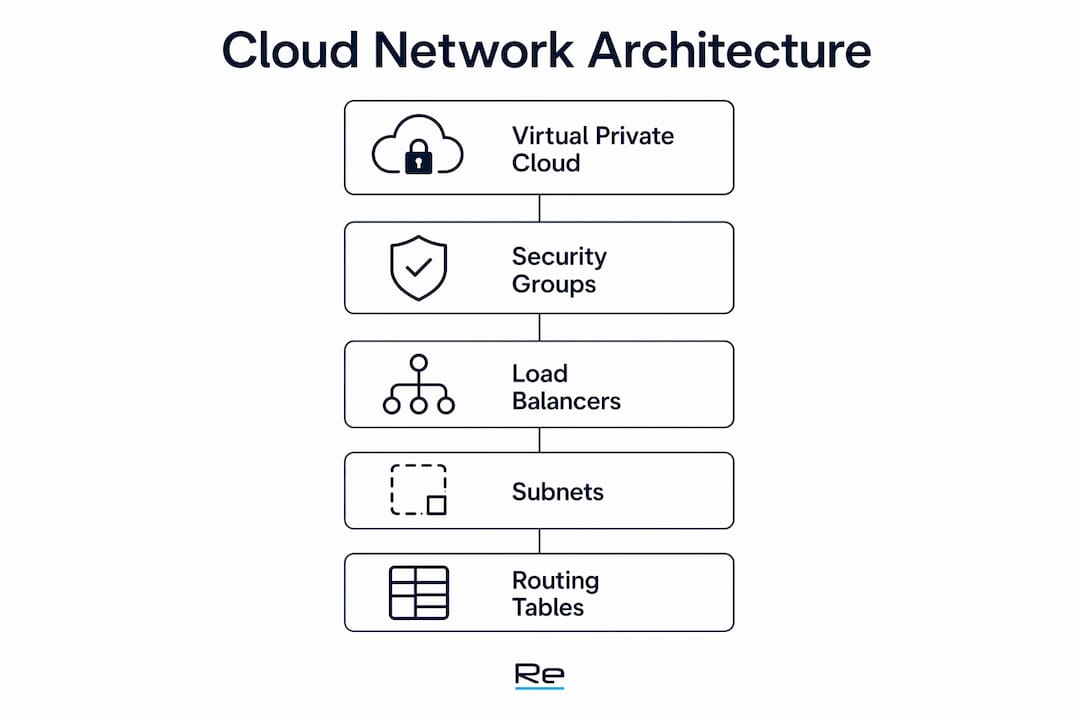
Cloud network architecture is built from a set of discrete, software-controlled components that replace physical hardware with virtual equivalents. Understanding each component’s role is non-negotiable before you configure anything in production.

The Virtual Private Cloud is the foundation. A VPC is an isolated virtual network within a public cloud, defined by a CIDR block that allocates the IP address range for all resources inside it. A /16 CIDR block provides approximately 65,000 IP addresses, while a /24 provides only 256. That difference has significant operational consequences, and choosing the wrong size at the outset creates problems that are difficult to fix later.
Within a VPC, subnets divide the address space into logical segments:
- Public subnets connect directly to an internet gateway, making them suitable for web servers and load balancers that need inbound traffic from the internet.
- Private subnets have no direct internet route. They host databases, application servers, and internal services that should never be publicly reachable.
- Route tables define where traffic flows between subnets, gateways, and external networks. Each subnet is associated with a route table that controls its outbound paths.
- Security groups act as virtual firewalls at the instance level. Unlike traditional firewall rules, security groups are stateful, meaning an inbound rule automatically permits the corresponding return traffic without requiring a separate outbound rule.
- NAT gateways allow resources in private subnets to initiate outbound internet connections, such as downloading software updates, without exposing those resources to inbound traffic.
- Virtual Network Functions (VNFs) replace physical appliances like routers and firewalls with software running on standard compute infrastructure.
Pro Tip: Size your VPC CIDR block generously from the start. A /16 costs nothing extra but gives you room to grow. A /24 that runs out of addresses mid-project forces a disruptive redesign.
Load balancers sit across public subnets and distribute incoming traffic across multiple instances, preventing any single resource from becoming a bottleneck. Together, these components form a cloud network architecture that is entirely software-defined, policy-driven, and repeatable through infrastructure as code.
How does cloud networking differ from traditional network management?
Cloud networking manages the connectivity layer using software-defined controls, which is fundamentally different from both traditional hardware-based networking and cloud computing as a concept. The distinction matters because IT professionals often conflate the three.
| Dimension | Traditional networking | Cloud networking |
|---|---|---|
| Control plane | Physical hardware (routers, switches) | Software-defined, centralised controller |
| Configuration | Manual CLI or GUI per device | Infrastructure as code, policy-driven |
| Scalability | Hardware procurement cycles | On-demand, minutes to provision |
| Connectivity model | Fixed topology | Dynamic, programmable topology |
| Failure domain | Physical appliance | Distributed, software-managed |
Cloud computing refers to the delivery of applications and services over the internet, covering platforms like Microsoft Azure, Google Cloud Platform, and AWS. Cloud networking, by contrast, manages the delivery layer that connects those services together and to your users. You can use cloud computing without understanding cloud networking, but you cannot run a production cloud environment securely without it.
“Adopting cloud networking requires embracing network infrastructure as code and policy-driven automation, which significantly reduces manual errors and operational effort compared to legacy configurations.” — Akamai
Hybrid cloud and multicloud environments add further complexity. SD-WAN solutions, including Cisco’s Meraki SD-WAN, extend software-defined control across branch offices and remote sites. SASE (Secure Access Service Edge) converges networking and security into a single cloud-delivered framework. Network as a Service (NaaS) abstracts the entire network stack, allowing organisations to consume connectivity as a managed subscription rather than owning and operating physical infrastructure. Each of these models depends on the same VPC, SDN, and security group foundations described above.
What are common pitfalls in configuring cloud networks?
Cloud network configuration failures follow predictable patterns. Knowing them in advance prevents the kind of outage that takes hours to diagnose.
-
Undersizing CIDR blocks. Resizing a VPC CIDR range after creation is often impossible or highly disruptive on major cloud platforms. A /24 with 256 addresses sounds adequate for a small deployment, but subnet overhead, reserved addresses, and future growth consume that space quickly. Plan for three to five times your current requirement.
-
Misunderstanding security group statefulness. Security group misconfigurations are a leading cause of connectivity failures in cloud environments. Engineers accustomed to traditional firewalls often add redundant outbound rules or, worse, open ports unnecessarily because they do not trust the stateful return traffic mechanism. Neither approach is correct.
-
Overlooking DNS. DNS misconfiguration is a leading cause of cloud connectivity failures, frequently misidentified as a network outage. Before checking firewall rules or route tables, verify that DNS resolution is working correctly for the affected resource. Most cloud platforms provide a built-in DNS resolver, but custom DNS configurations introduce additional failure points.
-
Ignoring private endpoints. Routing traffic from a private subnet through a NAT gateway to reach a cloud storage service adds latency and cost. Private endpoints keep that traffic on the cloud provider’s internal network, improving both performance and security posture.
-
Skipping monitoring from day one. Cloud networks generate detailed flow logs, DNS query logs, and security group event data. Configuring these from the initial deployment, rather than retrospectively after an incident, gives you the baseline needed to detect anomalies quickly.
Pro Tip: When troubleshooting a connectivity issue, follow this sequence: DNS resolution first, then security group rules, then route tables, then network ACLs. Most issues resolve at step one or two.
Effective cloud network health monitoring uses tools like AWS VPC Flow Logs, Azure Network Watcher, and Cisco’s network management platforms to provide continuous visibility. Reactive troubleshooting without these tools in place is significantly slower and less reliable.
What are the key benefits of cloud networking for IT infrastructure?
Cloud networking enables organisations to replace physical appliances with virtual network functions and automate management using infrastructure as code. The operational and commercial benefits of this shift are concrete and measurable.
- Dynamic scalability. Virtual networks provision in minutes rather than weeks. An organisation running a product launch can scale its load balancers and subnet capacity on demand, then reduce it immediately afterwards, paying only for what it uses.
- Granular security segmentation. Security groups and network ACLs allow IT teams to enforce least-privilege access at the individual resource level. A database instance in a private subnet can be configured to accept connections only from a specific application server, regardless of what else runs in the same VPC.
- Centralised control. SDN controllers provide a single management plane across multiple regions and cloud providers. This is particularly valuable in multicloud deployments where AWS, Azure, and Google Cloud Platform resources must communicate securely.
- Hybrid and multicloud flexibility. Cloud networking solutions connect on-premises data centres to cloud environments through dedicated connections or encrypted VPN tunnels, enabling workloads to move between environments without re-architecting the network.
- Disaster recovery and global reach. Traffic can be routed across geographically distributed regions using global load balancers. If one region fails, traffic fails over automatically to a healthy region, with no manual intervention required.
- Reduced operational overhead. Core networking proficiency for cloud has shifted from legacy hardware certifications to practical skills covering virtual networking functions and connectivity. Teams can manage complex, multi-region networks with smaller headcounts than equivalent physical deployments require.
The combination of pay-per-use resource allocation and infrastructure-as-code repeatability means that cloud network architecture delivers both cost efficiency and operational consistency. These are not theoretical advantages. They are the reason organisations across education, manufacturing, and logistics are migrating network management to cloud-based platforms.
Key takeaways
Cloud networking is the software-defined infrastructure layer that controls connectivity across cloud, edge, and on-premises environments, and getting the VPC design, CIDR sizing, and security group configuration right from the start determines whether that infrastructure performs reliably or fails under pressure.
| Point | Details |
|---|---|
| VPC design is foundational | Size CIDR blocks generously at the outset; resizing after deployment is often impossible. |
| Security groups are stateful | Inbound rules automatically permit return traffic, unlike traditional firewall rules. |
| DNS is the first troubleshooting step | Most cloud connectivity failures trace back to DNS misconfiguration, not network blocking. |
| Cloud networking differs from cloud computing | Cloud networking manages the connectivity layer; cloud computing manages application delivery. |
| Infrastructure as code reduces errors | Policy-driven automation cuts manual configuration mistakes and speeds up deployment. |
Why most IT teams underestimate cloud networking fundamentals
Having worked with IT teams across a range of sectors, I find the same pattern repeating. Engineers who are highly competent with physical infrastructure arrive in a cloud environment and immediately reach for familiar mental models. They treat security groups like stateful firewall appliances with complex rule sets. They allocate /24 subnets because that is what they used on-premises. They spend hours checking route tables when the actual problem is a DNS record pointing at a decommissioned IP address.
The uncomfortable truth is that cloud networking rewards those who invest time in the fundamentals before touching a production environment. Understanding VPC architecture and CIDR sizing is not advanced knowledge. It is the baseline. Teams that skip this step spend disproportionate time firefighting issues that should never have occurred.
The other misconception I encounter regularly is that cloud networking is simply cloud computing with a network tab open. It is not. Cloud computing is about what runs on the infrastructure. Cloud networking is about how that infrastructure communicates, who can reach what, and how traffic is controlled at every hop. Conflating the two leads to architectures where security is an afterthought rather than a design principle.
My practical recommendation is straightforward. Spend two to three weeks on VPC design, CIDR allocation, security group behaviour, and DNS before deploying anything production-facing. Treat the network as code from day one. Use version control for your infrastructure templates. And when something breaks, check DNS first.
— Jacob
How Re-solution supports cloud networking adoption
Re-solution brings over 35 years of Cisco infrastructure expertise to organisations building or migrating to cloud network environments. Whether you need a structured assessment of your current network or a fully managed cloud connectivity solution, Re-solution’s team works directly with IT professionals and network administrators to deliver outcomes that are technically sound and operationally sustainable.

From Network as a Service deployments to managed IT services that cover day-to-day cloud network operations, Re-solution provides the depth of Cisco-certified expertise that in-house teams often need to complement their own. If your organisation is working through the challenges of IT infrastructure design or cloud network adoption, Re-solution is the right partner to have in your corner.
FAQ
What is the cloud networking definition in simple terms?
Cloud networking is the use of software-defined, virtualised infrastructure to manage connectivity between on-premises systems, edge locations, and cloud services. It replaces physical network hardware with programmable virtual components controlled through a centralised software layer.
How does a VPC work in cloud networking?
A VPC is an isolated virtual network within a public cloud, defined by a CIDR block that allocates IP addresses to subnets, instances, and gateways. Public subnets connect to the internet via an internet gateway, while private subnets use NAT gateways for outbound-only access.
What is the difference between cloud networking and cloud computing?
Cloud computing delivers applications and services over the internet, while cloud networking manages the connectivity layer that controls how those services communicate. The two are complementary but address different parts of the infrastructure stack.
Why do security groups behave differently from traditional firewalls?
Security groups are stateful, meaning an inbound permission automatically allows the corresponding return traffic without an explicit outbound rule. Traditional firewall rules are stateless and require both directions to be defined separately.
What skills does cloud networking require for IT professionals?
Cloud networking proficiency centres on IP addressing, DNS, load balancing, security groups, and virtual network functions rather than legacy hardware certifications. These practical skills are achievable within a few weeks of focused study and hands-on practice.
Recommended
- Understanding Cloud Networking: Expert Guide | Re-Solution
- Understanding Cloud Networking: Expert Guide | Re-Solution
- Cloud connectivity explained: a 2026 guide for IT teams
- Cloud Network Advantages 2025 | Re-Solution