TL;DR:
- Connectivity planning for new builds is a mandatory process that ensures gigabit-capable infrastructure is installed before construction completes in England. Starting provider engagement early and sequencing infrastructure correctly prevents delays, costly rework, and compliance issues, while maintaining comprehensive digital records facilitates future upgrades and smart building integration.
Connectivity planning for new builds is defined as the process of designing, specifying, and installing gigabit-capable telecommunications infrastructure before construction completes. Under Approved Document R, this is not optional for English dwellings. It is a legal requirement. Getting it right from the outset protects your programme, your budget, and your building control sign-off. Getting it wrong means demolition work, provider delays, and failed inspections. This guide covers the regulatory standards, sequencing strategy, documentation requirements, and smart building considerations that property developers and project managers need to deliver compliant, future-ready buildings.
What are the regulatory requirements for connectivity planning for new builds?
Approved Document R (2022) mandates gigabit-ready infrastructure in all new English dwellings where planning permission was granted from 26 december 2022 onwards. The regulation specifies exact duct sizes, concentration point locations, and documentation requirements. Non-compliance blocks building control sign-off, which means no completion certificate and no legal occupation.
Technical standards at a glance
The core physical requirements are precise:
- External duct: minimum 40mm diameter, running from the property boundary to the dwelling
- Internal duct: minimum 32mm diameter, running through the building to the concentration point
- Concentration point: located near the electrical consumer unit for practical access
- As-built drawings: duct route plans submitted to building control for sign-off
- Provider coordination: engagement with network operators such as BT Openreach, Virgin Media O2, and CityFibre before works begin
The table below summarises the key compliance elements:
| Requirement | Specification |
|---|---|
| External duct diameter | 40mm minimum |
| Internal duct diameter | 32mm minimum |
| Concentration point location | Adjacent to electrical consumer unit |
| Documentation required | As-built duct route drawings |
| Applicable from | Planning permissions granted from 26 december 2022 |
Building Digital UK reports that as of february 2026, over 1 million premises are contracted under Project Gigabit, with 215,000 built. That figure illustrates how quickly the national network is expanding, and why early provider engagement is critical: availability varies by location and provider lead times are not uniform.
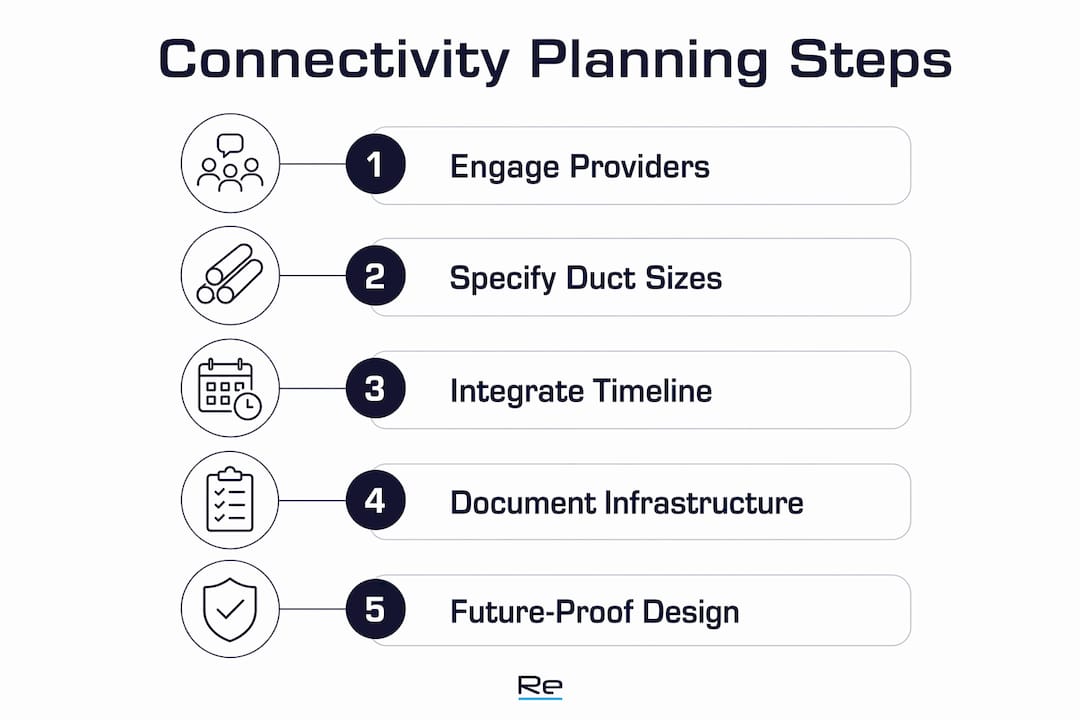
How to integrate connectivity planning into the new build project timeline
Connectivity failures most often result from poor schedule management, not poor technical design. Treating infrastructure as a schedule architecture, rather than a late-stage task, is the single most effective change a project manager can make.
The correct sequencing approach follows these steps:
- Initiate utility coordination during the entitlements phase. Contact BT Openreach, CityFibre, and other relevant providers before planning permission is finalised. Lead times from providers must guide your connectivity infrastructure timeline, not optimistic construction scheduling assumptions.
- Identify the longest-lead utilities first. Duct permits, wayleave agreements, and provider network extensions can take months. Map these dependencies before groundworks begin.
- Build schedule buffers for provider delays. Misaligned duct or cabinet installation risks inspection delays and costly rework. A buffer of four to six weeks on telecoms coordination is standard practice on well-managed sites.
- Complete horizontal infrastructure before vertical construction. Duct routes under slabs and through foundations must be in place before walls go up. Retrofitting after the structure is complete is expensive and disruptive.
- Sequence inspections around telecoms milestones. Building control inspections that require telecoms sign-off should be scheduled after duct installation is confirmed, not before.
Pro Tip: Assign a single point of contact for all telecoms provider coordination. Fragmented communication between site managers and providers is the most common cause of sequencing errors on multi-unit developments.
Developers who treat network infrastructure planning as a parallel workstream to civil works, rather than a downstream task, consistently avoid the delays that push completions past programme.

What does a comprehensive connectivity plan and handover package include?
A connectivity plan is not complete at practical completion. The UK Building Control 2026 consultation establishes that telecoms data must be handed over as accessible digital records to accountable persons, forming part of the building’s golden thread. This mirrors the approach already applied to mechanical, electrical, and plumbing life-safety evidence.
A complete handover package includes:
- As-built duct route drawings, showing exact pathways from boundary to concentration point
- Device and point schedules, listing all installed telecoms equipment, locations, and specifications
- Configuration records, covering any active network equipment installed during construction
- Provider correspondence, documenting engagement with BT Openreach, Virgin Media O2, or CityFibre
- Maintenance access notes, confirming how future occupants or managers can access concentration points
Telecoms deliverables should be managed like MEP life-safety evidence. This means traceable, version-controlled, and accessible to the accountable person throughout the building’s lifecycle, not just at handover.
Pro Tip: Use a common data environment such as Autodesk Construction Cloud or Procore to store telecoms records alongside structural and MEP documentation. This makes golden thread compliance straightforward and auditable.
The most expensive future connectivity issue is not the fibre itself. It is inaccessible or undocumented pathways. Maintaining accessible concentration points and traceable duct routes from day one eliminates the need for costly investigative works years later.
How can smart building connectivity and IoT gateways future-proof new builds?
Smart building connectivity extends well beyond gigabit broadband provision. IoT gateways act as interoperability bridges, connecting wireless field devices to wired building management systems using standard protocols such as BACnet and Modbus. This architecture allows developers to install a wired backbone during construction and add wireless sensors later, without invasive rewiring.
The practical benefits for new build projects are significant:
- Reduced installation cost: wireless sensors connect to a gateway rather than requiring individual cable runs to each device
- Protocol translation: gateways convert sensor data into BACnet or Modbus formats that existing building management systems can read
- Phased upgrades: additional IoT devices can be added post-occupation without structural works
- Local and cloud control: gateway architectures support both on-site building management and remote cloud-based monitoring
The table below compares traditional wired sensor installation with a gateway-based approach:
| Factor | Traditional wired sensors | IoT gateway architecture |
|---|---|---|
| Installation disruption | High, requires cable runs to each device | Low, wireless sensors connect to central gateway |
| Protocol compatibility | Limited to installed BMS protocol | Gateway translates to BACnet, Modbus, and others |
| Post-occupation upgrades | Requires rewiring | Add wireless devices without structural works |
| Upfront cost | Higher | Lower per additional device |
Gateway architectures reduce the need to hardwire every sensor, enabling scalable additions of wireless IoT devices integrated with wired building management systems. For developers building residential or commercial schemes with long operational lifespans, this is the architecture that keeps upgrade costs manageable. Re-solution’s guidance on designing smart buildings covers these architectural decisions in detail for UK development contexts.
What common mistakes arise in connectivity planning and how do you avoid them?
The most damaging mistakes in infrastructure planning for construction are not technical errors. They are process failures that occur before a single cable is pulled.
- Building without duct pathways. Missing or unusable duct pathways cause expensive retrofitting after completion. Approved Document R compliance requires early duct planning precisely to prevent demolition for later cable runs.
- Incomplete as-built documentation. Handover packages that omit duct route drawings or device schedules create compliance gaps and make future upgrades significantly harder.
- No schedule buffers for provider delays. Developers who assume providers will meet optimistic timelines consistently face inspection delays. Build the buffer in from the start.
- Ignoring smart building alignment. Installing a gigabit-capable duct without considering IoT gateway placement or building management system integration means a second round of infrastructure works within five years.
- Fragmented provider communication. Engaging BT Openreach, CityFibre, and Virgin Media O2 at different project stages, rather than concurrently, creates conflicts between external and internal works.
Pro Tip: Run a connectivity-specific design review at RIBA Stage 2. This is the last practical point to alter duct routes, concentration point locations, and provider engagement strategy without affecting the construction programme.
Re-solution’s IT solutions for property developers resource outlines how to align connectivity, security, and compliance requirements from the earliest design stages.
Key takeaways
Effective connectivity planning for new builds requires regulatory compliance, early provider engagement, and lifecycle documentation managed as a single integrated process from the outset.
| Point | Details |
|---|---|
| Comply with Approved Document R | Install 40mm external and 32mm internal ducts with a concentration point near the consumer unit. |
| Engage providers early | Contact BT Openreach, CityFibre, and Virgin Media O2 during the entitlements phase, not after groundworks begin. |
| Sequence infrastructure correctly | Complete horizontal duct installation before vertical construction to avoid costly rework. |
| Maintain a golden thread | Hand over traceable digital records of all telecoms infrastructure to the accountable person at completion. |
| Plan for IoT gateway integration | Design gateway-ready infrastructure during construction to enable phased smart building upgrades post-occupation. |
Why connectivity planning deserves a seat at the design table from day one
Having worked across a range of UK new build and infrastructure projects, the pattern I see most often is the same. Connectivity is treated as a utility afterthought, something to sort out once the structure is up. That assumption costs developers real money and real time.
The regulatory position under Approved Document R is clear enough. But the deeper issue is that connectivity infrastructure, once embedded in a building, is extraordinarily difficult to change. A duct route that misses a concentration point by two metres requires opening walls. A handover package that omits as-built drawings creates a compliance liability that sits with the accountable person for the building’s entire life.
What I find most developers underestimate is the sequencing dependency. Telecoms providers do not operate on construction timescales. BT Openreach and CityFibre have their own programme constraints, wayleave processes, and network extension lead times. If you start that conversation at RIBA Stage 4, you have already lost the window to influence the critical path.
The smart building dimension adds another layer. IoT gateway architectures, as used with systems like the Wattsense Bridge, genuinely change the economics of post-occupation upgrades. But only if the wired backbone and concentration points are positioned correctly during construction. Retrofitting gateway infrastructure into a completed building is not impossible. It is just expensive and disruptive in ways that are entirely avoidable.
My consistent advice is to treat connectivity planning as schedule architecture. Map the provider lead times, build the buffers, sequence the horizontal works, and maintain the documentation as a living record. The developers who do this deliver on programme. The ones who do not spend the last six weeks before completion managing avoidable crises.
— Jacob
Re-solution’s support for new build connectivity projects
Property developers and project managers working through the complexity of new build connectivity have a lot to coordinate. Regulatory compliance, provider engagement, infrastructure sequencing, and smart building readiness all need to come together before practical completion.

Re-solution brings over 35 years of Cisco IT infrastructure experience to connectivity and digital building projects across the UK. Whether you need support with IT infrastructure planning for a new development, a network audit, or guidance on smart building integration, Re-solution’s team works with developers and project managers to deliver compliant, future-ready infrastructure. Contact Re-solution to discuss your project’s connectivity requirements and get specialist support from the earliest design stages.
FAQ
What is Approved Document R and who does it apply to?
Approved Document R mandates gigabit-ready infrastructure in new English dwellings where planning permission was granted from 26 december 2022. It applies to all new residential buildings and specifies duct sizes, concentration point placement, and documentation requirements.
What duct sizes are required under Approved Document R?
External ducts must be a minimum of 40mm in diameter, running from the property boundary to the dwelling. Internal ducts must be a minimum of 32mm, terminating at a concentration point near the electrical consumer unit.
When should developers engage telecoms providers on a new build project?
Provider engagement should begin during the entitlements phase, before planning permission is finalised. BT Openreach, CityFibre, and Virgin Media O2 all have lead times that must be factored into the construction programme from the outset.
What is the golden thread in the context of telecoms infrastructure?
The golden thread refers to the requirement to maintain traceable, accessible digital records of all telecoms infrastructure throughout the building’s lifecycle. This includes as-built drawings, device schedules, and configuration records handed over to the accountable person at completion.
How do IoT gateways support future-proof connectivity in new builds?
IoT gateways connect wireless sensors to wired building management systems using protocols such as BACnet and Modbus, removing the need to hardwire every device. This enables phased addition of smart building technology post-occupation without structural works.
Recommended
- Network Infrastructure Planning Simplified | Re-Solution
- Network Infrastructure Planning Simplified | Re-Solution
- Streamline your school network planning workflow
- How to upgrade building network infrastructure