TL;DR:
- Securing network endpoints involves protecting devices like laptops, phones, servers, and IoT gadgets from threats and unauthorized access. It is essential for maintaining business resilience because compromised endpoints enable attackers to move laterally and cause extensive disruption.
Securing network endpoints is defined as the practice of protecting every device connected to an organisational network, including laptops, mobile phones, servers, and IoT devices, against unauthorised access, malware, and data theft. Endpoints are the most frequently exploited entry points in enterprise environments. Tools like Cisco Secure Endpoint, CrowdStrike Falcon, and Microsoft Intune, combined with frameworks such as NIST SP 800-207, form the foundation of modern endpoint protection. Understanding why secure network endpoints matter is not an abstract concern. Verizon reports that average business interruption following a major breach lasts 20 days, with ransom payments averaging over £300,000. That figure alone reframes endpoint security as a business continuity issue, not merely a technical one.
Why secure network endpoints: what makes them critical?
Network endpoints are any device that connects to an enterprise network and exchanges data with it. The category is broader than most teams initially account for. Common endpoint types include:
- Laptops and desktop computers used by employees in office and remote settings
- Smartphones and tablets, including personal devices under BYOD policies
- Servers, both on-premises and cloud-hosted, that process and store sensitive data
- IoT devices such as building sensors, printers, and industrial controllers
- Virtual machines and containers running within cloud infrastructure
Each of these device types interacts with sensitive data and enterprise resources, making them attractive targets. Endpoints are frequent targets for credential theft, ransomware, and data exfiltration precisely because user behaviour introduces risk. Phishing emails, malware downloads, and misconfigured devices all create exploitable gaps that attackers actively seek out.
The distributed nature of modern work amplifies this exposure. Endpoints frequently operate beyond traditional network boundaries due to remote work and cloud adoption. A laptop connected to a home broadband network or a public Wi-Fi hotspot sits outside the protections that a corporate firewall provides. This means the device itself must carry its own security controls, independent of where it connects.
How does endpoint security support network resilience?
Endpoint security is a direct enabler of business resilience. When an endpoint is compromised, the attacker gains a foothold from which to move laterally across the network, escalate privileges, and access critical systems. Limiting that foothold is the primary function of endpoint hardening. Endpoint hardening applies identity, configuration, and runtime protections at network boundaries to minimise both the attack surface and the blast radius when an incident occurs.
The connection between endpoint security and broader network security tools is direct. Endpoint Detection and Response (EDR) platforms feed alerts into Security Information and Event Management (SIEM) systems. Data Loss Prevention (DLP) tools rely on endpoint agents to monitor file transfers. Intrusion Detection Systems (IDS) and firewalls become significantly more effective when paired with endpoint telemetry that confirms device health and user context.
“Practical endpoint security is about business resilience: preventing and limiting operational disruption and costly ransomware impacts.” — Verizon
Pro Tip: Measure your endpoint security posture by tracking mean time to detect (MTTD) and mean time to respond (MTTR) per endpoint category. Gaps in these metrics reveal where your controls are weakest before an attacker finds them first.
Continuous detection and rapid response are what separate organisations that contain breaches quickly from those that face weeks of disruption. The financial impact of breaches is directly tied to how fast an organisation detects and isolates a compromised endpoint. Investing in detection capability reduces the duration and cost of incidents in measurable terms.

What are the key strategies for securing endpoint devices?
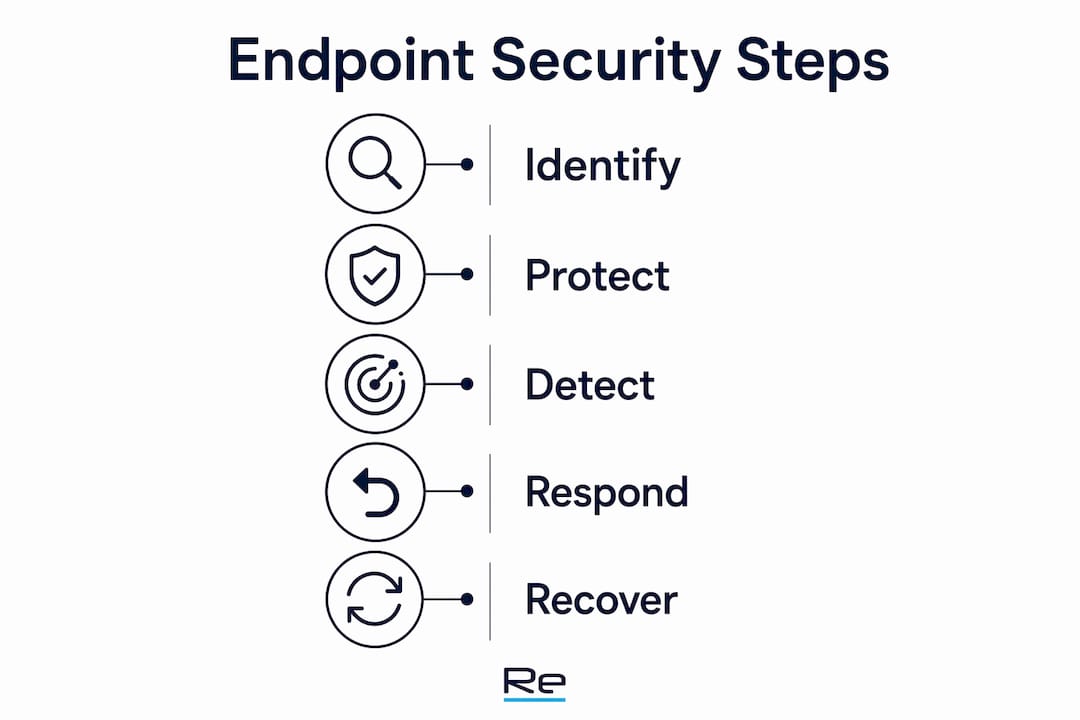
Effective endpoint protection is not a single product. Enterprise endpoint security must combine multiple layers because attackers exploit numerous pathways, and missing one layer risks full bypass. The core layers are:
- Antivirus and anti-malware for signature-based and behavioural threat detection
- Endpoint Detection and Response (EDR) for continuous monitoring, threat hunting, and incident response
- Managed Detection and Response (MDR) for organisations that require 24/7 expert oversight of endpoint telemetry
- Patch management to close known vulnerabilities before attackers exploit them
- Device control policies to restrict USB ports, external storage, and unauthorised peripherals
Beyond these layers, device posture assessment is a critical control. Platforms like Microsoft Intune and CrowdStrike Falcon evaluate whether a device meets baseline security requirements before granting access to corporate resources. If a device lacks current patches, an active EDR agent, or full-disk encryption, posture gating blocks or restricts its access automatically.
Endpoint security technology comparison
| Control | Primary function | Example tools |
|---|---|---|
| Antivirus / anti-malware | Signature and behavioural threat detection | Microsoft Defender, CrowdStrike Falcon |
| EDR | Continuous monitoring and incident response | CrowdStrike Falcon, Cisco Secure Endpoint |
| MDR | Managed 24/7 expert threat response | Cisco XDR, CrowdStrike Falcon Complete |
| Patch management | Vulnerability remediation | Microsoft Intune, Cisco Meraki Systems Manager |
| Device posture assessment | Compliance gating for network access | Microsoft Intune, CrowdStrike Falcon |
Handling BYOD endpoints requires additional controls. Unmanaged or stale endpoints represent the largest risk in hybrid environments. Posture gating based on patch level, encryption status, and EDR presence is the primary mechanism for limiting attacker foothold and preventing lateral movement across the network. Organisations that treat personal devices as fully trusted without posture checks create significant gaps in their network protection strategies.
Pro Tip: Apply microsegmentation alongside endpoint posture controls. Even if an endpoint is compromised, microsegmentation limits which systems an attacker can reach from that device, containing the incident to a smaller portion of your network.
How do Zero Trust principles integrate with endpoint security?
Zero Trust architecture treats every access request as untrusted by default, regardless of whether the request originates inside or outside the corporate network. NIST SP 800-207 defines per-session access with continuous monitoring of device posture as a core requirement. This means endpoint security is not a perimeter control. It is a policy input that determines whether access is granted, restricted, or denied for every individual session.
The endpoint signals that feed Zero Trust policy decisions include:
- Patch compliance status: is the operating system and software current?
- Security tooling presence: is an active EDR agent running on the device?
- Encryption state: is the device’s storage encrypted to the required standard?
- Certificate validity: does the device hold a valid identity certificate issued by the organisation?
- Behavioural anomalies: has the device exhibited unusual network or file activity recently?
Endpoint security is a core enabler for Zero Trust access decisions because these posture signals feed directly into policy engines. Without them, access decisions rely on identity alone, which is insufficient when credentials can be stolen. A Zero Trust model that lacks endpoint posture data makes access decisions with incomplete information.
Relying solely on network perimeter controls is insufficient in this model. Without endpoint security, lateral movement and breach impact increase dramatically. An attacker who compromises a device that passes only identity checks but fails posture checks should be blocked. Without endpoint data feeding the policy engine, that block never happens. Re-solution’s Zero Trust implementation services address exactly this integration between endpoint posture and access control policy.
The most common failure mode in Zero Trust deployments is incomplete endpoint coverage. Organisations deploy Zero Trust network access (ZTNA) tools but leave a subset of endpoints, typically legacy systems or BYOD devices, outside the posture assessment framework. Those unchecked devices become the path of least resistance for attackers. Closing that gap requires treating endpoint protection as a prerequisite for Zero Trust, not an optional add-on.
Key takeaways
Securing network endpoints is the foundational requirement for Zero Trust architecture, business resilience, and effective network security across hybrid and BYOD environments.
| Point | Details |
|---|---|
| Endpoints are the primary attack surface | Laptops, mobiles, IoT devices, and servers are the most exploited entry points in enterprise networks. |
| Multi-layer controls are non-negotiable | Combining AV, EDR, MDR, patch management, and posture gating prevents attackers from bypassing single-layer defences. |
| Endpoint posture feeds Zero Trust decisions | Device health signals like patch status and EDR presence determine whether access is granted per session under NIST SP 800-207. |
| BYOD and remote endpoints carry the highest risk | Unmanaged devices without posture gating enable lateral movement and significantly increase breach scope. |
| Fast detection limits financial damage | Reducing mean time to detect and respond directly cuts the duration and cost of ransomware and breach incidents. |
Endpoint security in 2026: what experience actually teaches
The conversation around endpoint security has matured considerably, but a persistent gap remains between what organisations deploy and what they actually monitor. In my experience working with IT teams across manufacturing, education, and logistics environments, the most common problem is not a lack of tools. It is a lack of integration between those tools and the access control decisions that matter.
Teams often deploy CrowdStrike Falcon or Microsoft Intune and consider the endpoint problem solved. The harder discipline is ensuring that posture data from those platforms actively gates access in real time, rather than sitting in a dashboard that someone reviews weekly. Endpoint security only delivers its full value when it is wired into your network access control and identity systems as a live policy input.
The shift to hybrid work has also changed the risk profile in ways that many security policies have not caught up with. A device that was compliant six months ago may have drifted out of compliance through missed patches, disabled agents, or changed configurations. Continuous posture evaluation, not point-in-time checks, is the only reliable approach. The endpoint security best practices that hold up in 2026 are built around continuous monitoring, not periodic audits.
The future challenge is endpoint diversity. As IoT devices, operational technology, and cloud workloads expand the definition of an endpoint, the posture assessment frameworks that work for Windows laptops will need to extend to device categories that have historically been unmanaged. That is where the next wave of endpoint risk will emerge, and teams that build posture assessment into their access control architecture now will be significantly better positioned to handle it.
— Jacob
How Re-solution supports endpoint and network security
Re-solution has over 35 years of experience delivering Cisco IT infrastructure and security services to organisations across education, manufacturing, and logistics. Endpoint security does not exist in isolation. It connects directly to network access control, identity management, and Zero Trust architecture, all of which require careful integration to function as a coherent defence.

Re-solution’s managed IT services cover the full scope of endpoint and network security, from initial infrastructure assessment through to ongoing monitoring and incident response. For organisations building or refining their security posture, Re-solution’s team provides practical guidance on IT infrastructure challenges and how to address them with Cisco-based solutions. Speak to the Re-solution team to assess where your endpoint security posture stands today.
FAQ
What is endpoint security in simple terms?
Endpoint security is the practice of protecting every device connected to a network, including laptops, phones, and servers, from threats such as malware, ransomware, and unauthorised access. It combines tools like antivirus software, EDR platforms, and patch management to keep devices secure.
Why are endpoints more vulnerable than other network components?
Endpoints are vulnerable because they interact directly with users, who introduce risk through phishing, malware downloads, and misconfiguration. They also frequently operate outside the corporate network perimeter, reducing the protection that traditional firewalls provide.
How does endpoint security relate to Zero Trust?
Under Zero Trust, as defined by NIST SP 800-207, endpoint posture signals such as patch status, encryption state, and EDR presence feed directly into per-session access decisions. Without endpoint security data, Zero Trust policy engines make access decisions with incomplete information.
What is the financial risk of poor endpoint security?
Verizon reports that average business interruption following a major breach lasts 20 days, with ransom payments averaging over £300,000. Effective endpoint security reduces both the duration and the financial impact of incidents through faster detection and containment.
What is the difference between EDR and MDR?
EDR (Endpoint Detection and Response) provides continuous monitoring and response capabilities managed by the organisation’s own security team. MDR (Managed Detection and Response) adds 24/7 expert oversight from an external provider, making it suitable for organisations without a dedicated security operations centre.
Recommended
- Secure network architecture: a practical guide for IT leaders
- Modern network security: A complete guide for IT leaders
- Network Security Best Practices Guide | Re-Solution
- Network Security Best Practices Guide | Re-Solution