TL;DR:
- Cloud connectivity links corporate data centers, branch offices, and end-user devices to cloud platforms securely and reliably. Choosing the appropriate connection type—VPN, SD-WAN, or private interconnect—based on workload criticality is essential for operational resilience. Organisational collaboration between network and cloud teams ensures effective management, reduces failures, and optimizes hybrid cloud deployment.
Cloud connectivity is defined as the network infrastructure and technologies that link corporate data centres, branch offices, and end-user devices to cloud platforms securely and reliably. In industry terms, this discipline sits within the broader field of hybrid WAN architecture, encompassing tools such as AWS Direct Connect, Azure ExpressRoute, SD-WAN, and Site-to-Site VPNs. With nearly 90% of organisations expected to use a hybrid cloud connectivity mix by 2027, the decisions IT teams make today about connection methods, architecture models, and redundancy will define operational resilience for years. This guide covers cloud connectivity explained from first principles through to practical implementation, giving IT professionals and decision-makers a clear framework for evaluating their options.
What are the main types of cloud connectivity and when to use each?
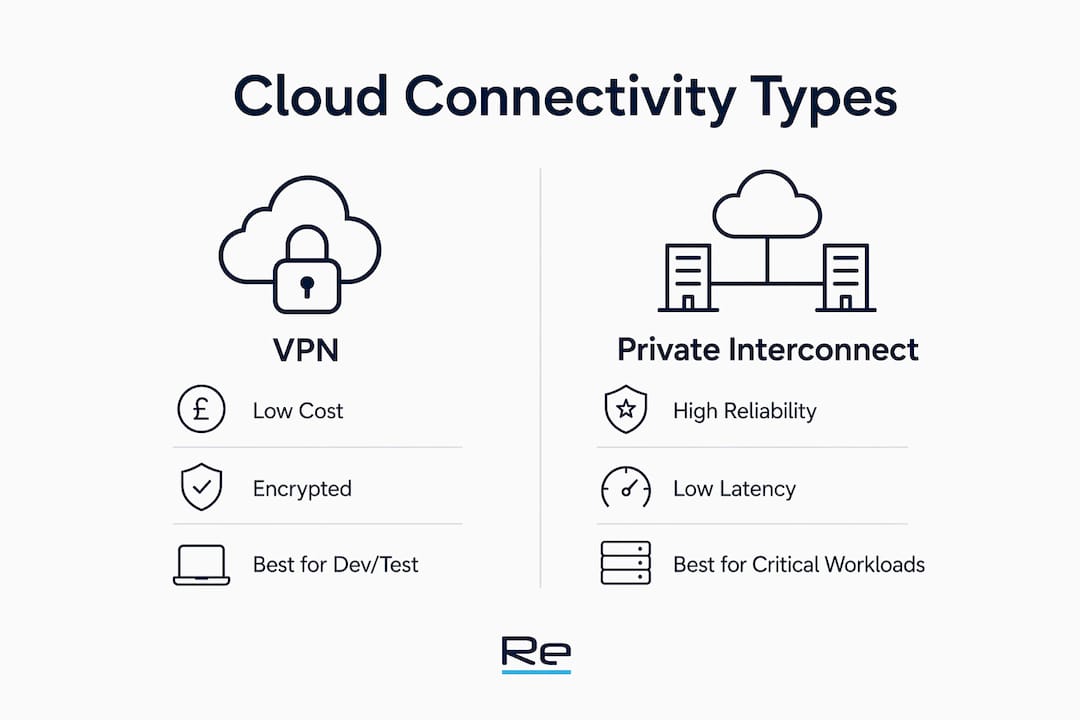
Cloud connectivity solutions are categorised into three tiers based on workload criticality: Site-to-Site VPNs for non-critical use cases, SD-WAN for intelligent multi-link optimisation, and dedicated private interconnects for mission-critical workloads. Selecting the wrong tier for a given workload is one of the most common and costly mistakes in enterprise cloud deployments.
Site-to-Site VPNs
Site-to-Site VPNs are the lowest-cost entry point for cloud connectivity. They tunnel encrypted traffic over the public internet, making them accessible and quick to deploy. However, VPNs over the public internet are unreliable for production workloads due to latency, jitter, and packet loss. They are appropriate for small branch offices, development environments, or disaster recovery failover paths, not for applications that require consistent throughput.
SD-WAN
SD-WAN sits in the middle tier. It uses software-defined policies to route traffic intelligently across multiple underlying links, including broadband, MPLS, and LTE. This gives IT teams application-aware routing without the cost of dedicated circuits. SD-WAN is well suited to distributed organisations with many sites, where cloud network advantages such as dynamic path selection and centralised policy management reduce operational overhead significantly.

Dedicated private interconnects
Dedicated private interconnects, including AWS Direct Connect and Azure ExpressRoute, provide a physical, private connection between on-premises infrastructure and a cloud provider’s network. These connections bypass the public internet entirely, delivering consistent latency, higher throughput, and stronger security guarantees. They are the correct choice for ERP systems, real-time analytics platforms, and any workload where network unpredictability carries a business cost.
| Connection type | Best use case | Reliability | Relative cost |
|---|---|---|---|
| Site-to-Site VPN | Dev/test, small branches | Low to medium | Low |
| SD-WAN | Multi-site enterprises | Medium to high | Medium |
| AWS Direct Connect / Azure ExpressRoute | Mission-critical production | High | High |
Pro Tip: Match your connectivity tier to workload criticality before procurement. Running a financial transaction platform over a public VPN is a design error, not a cost saving.
What are the advantages of cloud connectivity for organisations?
The cloud connection benefits that matter most to IT decision-makers fall into three categories: cost reduction, security improvement, and performance consistency. Understanding each in concrete terms helps justify investment to the board and shapes procurement decisions.
Cost reduction through private links
Switching from public internet egress to dedicated private connections produces measurable savings. Data egress costs drop from approximately $0.09 per gigabyte to $0.02 per gigabyte when organisations move to private links. For a business transferring several terabytes per month between on-premises systems and cloud storage, that difference compounds quickly into a significant annual saving.
Security and compliance
Dedicated private connectivity supports compliance by enabling consistent security policy enforcement and monitoring across the entire data path. Public internet connections introduce exposure to third-party routing infrastructure that organisations cannot audit or control. Private links remove that exposure and make it far easier to satisfy frameworks such as ISO 27001, PCI DSS, and the UK’s Cyber Essentials Plus. Pairing private connectivity with integrated security measures gives security teams a defensible, auditable perimeter.
Performance and operational efficiency
The advantages of cloud connectivity extend beyond cost and compliance. Private and SD-WAN connections reduce latency and eliminate the jitter that degrades voice, video, and database replication traffic. The key benefits of cloud computing are only fully realisable when the underlying network can deliver traffic predictably. A cloud-hosted ERP system running over a congested public internet connection will underperform its on-premises predecessor, undermining the business case for migration entirely.
The top cloud connectivity benefits for enterprise IT teams are:
- Predictable latency for latency-sensitive applications such as VoIP and real-time analytics
- Reduced egress costs by replacing public internet transfers with private link pricing
- Consistent security policy enforcement across hybrid and multi-cloud environments
- Simplified compliance through auditable, private data paths
- Higher throughput for large-scale data transfers and backup workloads
- Centralised visibility across all connection types through SD-WAN management planes
What are the best cloud connectivity architecture models?
How cloud connectivity works at scale depends heavily on the architecture model chosen. The two dominant patterns are hub-and-spoke and full mesh, and they serve very different organisational needs.
Hub-and-spoke architecture
A hub-and-spoke model centralises routing and policy enforcement, preventing exponential complexity as cloud environments grow. All spoke networks, whether branch offices, on-premises data centres, or cloud VPCs, connect to a central hub that applies consistent firewall rules, routing policies, and monitoring. This model is the correct starting point for most enterprises because it keeps management overhead linear rather than exponential.
Full mesh and its trade-offs
Full mesh architectures connect every node directly to every other node. This reduces latency between specific pairs of sites but creates a management burden that grows quadratically with each new site added. Full mesh is appropriate only for a small number of high-traffic, latency-critical site pairs, not as a general architecture pattern.
Best practices for resilient design
Follow these steps when designing a cloud connectivity architecture:
- Separate the control plane from the data plane. Routing decisions and policy enforcement should not share the same physical infrastructure as production traffic flows.
- Contract multiple carriers using physically distinct routes. Physical path diversity is crucial. Two cables running through the same conduit do not provide true redundancy, regardless of what the carrier’s SLA states.
- Deploy connections across multiple availability zones. AWS Direct Connect and Azure ExpressRoute both support redundant connections through separate physical locations.
- Automate provisioning where possible. Automated, private provisioning through platforms such as AWS Interconnect reduces deployment time from weeks to minutes and eliminates manual configuration errors.
- Centralise monitoring and alerting. A single pane of glass across all connection types gives operations teams the visibility needed to detect degradation before it becomes an outage.
Pro Tip: When configuring BGP across Direct Connect or ExpressRoute, set AS-Path prepending and Local Preference values explicitly on every session. Leaving these at defaults invites asymmetric routing, where outbound and inbound traffic take different physical paths, which breaks stateful firewalls and causes application failures that are extremely difficult to diagnose.
What technical challenges should IT teams anticipate?
Understanding cloud connectivity in production means preparing for failure modes that do not appear in vendor documentation. Several issues appear consistently across enterprise deployments and deserve specific attention.
MTU mismatches and TCP windowing
MTU mismatches between on-premises gateways and cloud network interfaces cause silent packet loss and throughput degradation. The problem is subtle because connections appear to establish normally but large transfers stall or fail intermittently. The standard fix is to set the MTU to 1,500 bytes consistently across all interfaces in the path, or to enable path MTU discovery and verify it is not being blocked by firewalls. TCP windowing issues compound this: if window sizes are not tuned for high-latency paths, throughput over long-distance connections will be a fraction of the available bandwidth.
BGP misconfiguration
BGP misconfiguration is a common root cause of cloud connectivity failures, often leading to network isolation. Incorrect AS-Path or Local Preference settings cause traffic to route through unintended paths, overloading some links while leaving others idle. In the worst cases, a BGP misconfiguration causes a complete loss of connectivity between on-premises and cloud environments with no obvious error in application logs.
Firewall and stateful traffic issues
Stateful firewalls track connection state for each flow. When asymmetric routing causes outbound and inbound packets to traverse different physical paths, the firewall sees only half of each connection and drops the traffic. This is a particularly common failure mode in hub-and-spoke designs where BGP tuning has not been applied correctly.
The most common failure modes and their mitigations are:
- MTU mismatch: Set MTU consistently at 1,500 bytes across all path segments and verify with end-to-end ping tests using the “do not fragment” flag
- BGP asymmetric routing: Apply explicit AS-Path and Local Preference values; use route maps to enforce consistent path selection
- Stateful firewall drops: Ensure symmetric routing through correct BGP policy; consider stateless inspection for transit traffic
- VPN throughput ceiling: Replace public VPN with SD-WAN or a dedicated private interconnect for workloads exceeding 100 Mbps sustained
- Carrier single point of failure: Contract a second carrier using a physically separate route and test failover quarterly
Key takeaways
Effective cloud connectivity requires matching connection type to workload criticality, enforcing physical path diversity, and centralising policy management across all hybrid environments.
| Point | Details |
|---|---|
| Match tier to workload | Use VPNs for dev/test, SD-WAN for multi-site, and private interconnects for production. |
| Private links cut costs | Switching to dedicated connections reduces egress costs from $0.09 to $0.02 per gigabyte. |
| Hub-and-spoke scales cleanly | Centralised routing prevents management complexity from growing exponentially with each new site. |
| BGP tuning is non-negotiable | Explicit AS-Path and Local Preference settings prevent asymmetric routing and firewall failures. |
| Physical diversity means separate routes | Two cables in the same conduit provide no real redundancy; contract distinct carrier paths. |
Why network and cloud teams must stop working in silos
From my experience working across enterprise IT deployments, the single biggest source of cloud connectivity failures is not a technology problem. It is an organisational one. Network teams and cloud teams are often managed separately, use different tooling, and speak different languages when it comes to routing, security policy, and change management. The result is that a cloud architect provisions a new VPC with one set of routing assumptions, and the network team configures the Direct Connect gateway with a completely different set. Neither team is wrong in isolation. Together, they create an outage.
Treating network and cloud as separate domains is obsolete. Integrated provisioning platforms that give both teams a shared view of the control plane reduce deployment time from weeks to minutes and eliminate the configuration drift that causes subtle, hard-to-diagnose failures. I have seen organisations spend weeks troubleshooting what turned out to be a BGP Local Preference value set by one team and overridden by another.
The organisations that get cloud connectivity right treat it as a shared discipline. They build joint runbooks, conduct joint failover tests, and use a single monitoring platform that surfaces both network and cloud telemetry in one place. That operational maturity is what separates a hybrid cloud environment that delivers on its business case from one that becomes a source of recurring incidents.
— Jacob
How Re-solution supports your cloud connectivity strategy
Re-solution has over 35 years of experience designing and managing Cisco IT infrastructure for organisations across education, manufacturing, logistics, and hospitality. Whether you are evaluating your first dedicated private interconnect or redesigning a multi-site SD-WAN deployment, Re-solution’s team brings the depth to get it right from the outset.
Re-solution’s Network as a Service offering covers design, provisioning, and ongoing management of cloud connectivity architectures, including BGP configuration, physical path diversity planning, and compliance-aligned security policy enforcement. For organisations that need a clear picture of their current state before making changes, Re-solution’s network audit service identifies gaps in redundancy, routing configuration, and security posture. To discuss your specific requirements, contact Re-solution directly or explore the IT infrastructure guidance available on the website.
FAQ
What is cloud connectivity in simple terms?
Cloud connectivity is the set of network technologies that link on-premises infrastructure to cloud platforms such as AWS, Azure, or Google Cloud. It includes VPNs, SD-WAN, and dedicated private circuits such as AWS Direct Connect and Azure ExpressRoute.
When should an organisation use a dedicated private interconnect?
Dedicated private interconnects are the correct choice for mission-critical production workloads where consistent latency, high throughput, and compliance-aligned security are required. VPNs over the public internet are only suitable for development, testing, or small branch scenarios.
How does SD-WAN differ from a traditional VPN?
SD-WAN uses software-defined policies to route traffic intelligently across multiple links, selecting the best path per application in real time. A traditional VPN creates a single encrypted tunnel over one connection with no dynamic path selection.
What causes most cloud connectivity outages?
BGP misconfiguration is one of the most common root causes of cloud connectivity failures, often resulting in network isolation or asymmetric routing that breaks stateful firewalls. MTU mismatches are the second most frequent cause of degraded performance.
How can organisations achieve true redundancy in cloud connectivity?
True redundancy requires contracting multiple carriers using physically distinct routes, not simply two cables from the same provider. Connections should also span separate availability zones within the cloud provider’s infrastructure to eliminate single points of failure.
Recommended
- Understanding Cloud Networking: Expert Guide | Re-Solution
- Understanding Cloud Networking: Expert Guide | Re-Solution
- Your expert guide to cloud-based infrastructure adoption
- Cloud Network Advantages 2025 | Re-Solution