
TL;DR:
- Managed networks outsourcing enables organizations to improve reliability, security, and scalability while freeing internal IT teams for strategic projects. Proactive monitoring, advanced security frameworks, and flexible deployment support operational continuity and growth without significant internal overhead. Treating managed services as a strategic partnership maximizes organizational value and enhances overall performance.
Managed networks are outsourced network management solutions where a specialist provider monitors, maintains, and secures your organisation’s entire network infrastructure on your behalf. For IT decision-makers in education and manufacturing, the benefits of managed networks go well beyond cost savings. They deliver operational continuity, advanced security, and the freedom for internal teams to focus on work that actually moves the organisation forward. With downtime costing enterprises an average of $5,600 per minute, the case for proactive, expert-led network management has never been stronger.
What are the core benefits of managed networks?
Managed network services, the recognised industry term for this model, give organisations access to continuous monitoring, incident response, and infrastructure management without building those capabilities entirely in-house. The provider takes responsibility for uptime, performance, and security posture across your sites. For a multi-site school trust or a manufacturing plant running production-critical systems, that shift in responsibility is significant.
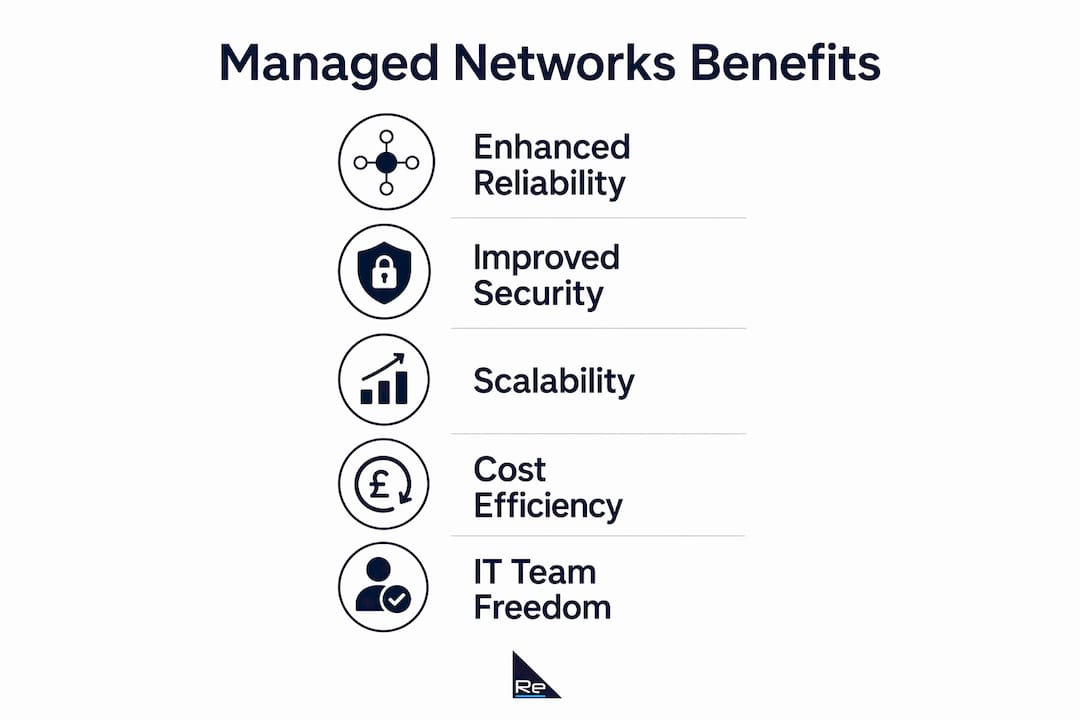
The advantages of managed networks fall into four clear categories:
- Reliability and uptime: Proactive monitoring catches faults before they become outages.
- Security: Specialist providers deploy advanced frameworks, including Zero Trust and NAC, that most internal teams cannot maintain alone.
- Scalability: Adding sites, users, or capacity does not require proportional increases in internal headcount.
- Strategic focus: Internal IT teams stop firefighting and start delivering value.
Each of these deserves a closer look, particularly in the context of education and manufacturing, where network failure carries direct operational and reputational consequences.
How do managed networks reduce downtime and improve reliability?
Downtime in a manufacturing environment stops production lines. In a school or university, it disrupts teaching, assessment platforms, and safeguarding systems. The financial and operational cost is immediate.
Managed network service providers address this through proactive detection rather than reactive repair. Tools such as SolarWinds Network Performance Monitor give providers real-time visibility across every node, switch, and access point. Predictive analytics and automation allow issues to be identified and resolved before users are affected at all. That is a fundamentally different model from waiting for a ticket to arrive.
The operational mechanics behind this reliability include:
- Repeatable incident playbooks: Providers use documented response procedures that reduce mean time to resolution (MTTR) and prevent the same fault recurring. Lower MTTR and fewer recurring incidents are a consistent outcome of managed service delivery.
- 24/7 monitoring: Coverage outside business hours is standard, which matters enormously for manufacturing sites running shift patterns or schools with out-of-hours systems.
- SLA-backed guarantees: Contractual uptime commitments, typically above 99.9%, create accountability that internal teams managing their own infrastructure simply cannot replicate.
Pro Tip: When evaluating providers, ask specifically for documented incident response protocols and historical SLA performance data. A provider confident in their reliability will share this without hesitation.
Transitioning from reactive to proactive management is the single biggest operational shift managed networks deliver. For organisations where connectivity is mission-critical, that shift is not optional.
What security improvements do managed networks provide?
Security is where the gap between managed and unmanaged networks is most stark. Around 78% of SMBs struggle to maintain up-to-date expertise in areas such as Zero Trust security and AI-driven threat detection. That figure reflects a structural problem: the threat landscape evolves faster than most internal teams can track.
Managed network providers solve this by employing specialists whose entire focus is security. They deploy and maintain frameworks that would be prohibitively expensive to build internally:
- Zero Trust Network Access (ZTNA): Every user and device is verified before gaining access, regardless of location. Re-solution’s Cisco Zero Trust solutions are a practical example of how this model is delivered at scale for education and manufacturing clients.
- Network Access Control (NAC): Devices are assessed for compliance before connecting. Re-solution’s implementation of Cisco Access Manager enforces this automatically across distributed sites.
- Continuous threat monitoring: Advanced monitoring and mitigation tools strengthen your security posture without requiring you to build a 24/7 security operations centre internally.
For educational institutions handling student data under UK GDPR, and manufacturers protecting intellectual property and operational technology (OT) networks, this level of security management is not a luxury. Organisations looking to understand their compliance obligations in depth can also benefit from working with specialist partners such as CISO Safe, who focus specifically on cybersecurity compliance.
Pro Tip: Specify your compliance requirements, including UK GDPR, Cyber Essentials, or sector-specific standards, before engaging any managed provider. The right provider will map their service directly to your obligations.
How do managed networks support scalability and flexibility?
Growth creates network complexity. A school trust acquiring new academies, or a manufacturer opening a second production facility, faces the same challenge: how do you extend reliable, secure connectivity without doubling your IT overhead?
Managed networks handle this through a model that scales without linear cost increases. The key mechanisms are:
- Capital expenditure to operational expenditure: Outsourcing network operations converts unpredictable capital spend into predictable monthly costs. Budgeting becomes straightforward, and finance teams can plan accurately.
- Multi-site standardisation: Providers deploy consistent configurations across all locations, reducing the risk of security gaps or performance inconsistencies between sites.
- Staged migration: New sites or technologies can be brought under managed service incrementally, avoiding the disruption of a full cutover.
- Remote diagnostics: Providers can identify and often resolve faults at remote locations without sending an engineer, which is particularly valuable for manufacturing sites in industrial areas or schools spread across a county.
The drivers for outsourcing managed networks are scalability, resilience, and strategic alignment, not simply cost reduction. That distinction matters when you are making the case internally for why managed connectivity is the right model for your organisation’s growth trajectory.
Pro Tip: Before signing a managed services contract, confirm that the provider’s change governance process aligns with your operational requirements. Misaligned escalation procedures are a common source of friction in multi-site deployments.
For practical guidance on planning infrastructure that supports this kind of growth, Re-solution’s network infrastructure planning guide is a useful starting point.
How do managed networks free internal IT teams for strategic work?
The hidden cost of DIY network management is not the hardware or the software licences. It is the time your most capable people spend on tasks that do not advance your organisation’s goals.

DIY network management consistently underestimates total costs when you factor in staff time, training, certification, talent retention, and the opportunity cost of every hour spent on routine maintenance rather than strategic projects. When those hidden costs are included, managed services deliver a clearer ROI than most organisations initially expect.
The comparison below illustrates the practical difference:
| Area | DIY Network Management | Managed Network Services |
|---|---|---|
| Monitoring | Reactive, business hours only | Proactive, 24/7 coverage |
| Incident response | Dependent on staff availability | SLA-backed, documented playbooks |
| Vendor management | Internal team responsibility | Handled by provider |
| Compliance | Internal resource burden | Provider-managed with reporting |
| Staff focus | Infrastructure upkeep | Strategic and business-critical projects |
Managed services augment rather than replace internal IT teams, handling routine monitoring, vendor management, and compliance tasks so your people can focus on projects that create genuine value. In education, that might mean deploying new learning technologies. In manufacturing, it could mean integrating IoT sensors into production systems.
Internal teams freed from infrastructure upkeep consistently prioritise innovation and business-critical projects. That is not an incidental benefit. It is the strategic argument for why managed network services belong in your long-term IT planning.
Pro Tip: Map your internal team’s current time allocation before approaching a managed provider. Knowing exactly how many hours per week are spent on routine network tasks gives you a concrete baseline for measuring the value of outsourcing.
Key takeaways
Managed network services deliver the most value when organisations treat them as a strategic model, not simply an outsourcing arrangement for routine tasks.
| Point | Details |
|---|---|
| Downtime prevention is measurable | Proactive monitoring and SLA-backed uptime commitments reduce costly outages that average $5,600 per minute in enterprise settings. |
| Security expertise is built in | Managed providers deploy Zero Trust and NAC frameworks that most internal teams cannot maintain without significant additional investment. |
| Scalability without overhead | Converting capital expenditure to predictable operational costs makes multi-site growth financially manageable and operationally consistent. |
| Internal teams gain strategic capacity | Offloading routine monitoring and vendor management allows IT staff to focus on innovation and business-critical projects. |
| Provider fit matters as much as features | Aligning change governance and escalation processes with your operational needs prevents friction in complex, distributed environments. |
Why i think most organisations underestimate the strategic case
Having worked with IT teams across education and manufacturing for many years, I have noticed a consistent pattern. Organisations evaluate managed network services primarily on price and uptime guarantees. They compare monthly costs against what they currently spend on infrastructure and staff, and they make a decision based on that narrow calculation.
That approach misses the more important question: what does your internal IT team actually do when they are not managing the network? In my experience, the answer is usually “not as much as they should be doing.” Not because they lack capability, but because the volume of routine network tasks leaves little room for anything else.
The schools and manufacturers that get the most from managed connectivity are the ones that treat the transition as an organisational change, not just a technical one. They define what their internal team will do differently once the infrastructure burden is lifted. They set expectations with their managed provider around governance and escalation before the contract is signed. And they revisit those expectations regularly.
The technical benefits, uptime, security, scalability, are real and well-documented. But the organisations that see the greatest return are the ones that use the freed capacity deliberately. If you are considering managed network services, start by asking your team what they would build or improve if they had 20% more time. That answer should shape your provider brief.
— Jacob
How Re-solution supports managed network decisions
Re-solution has over 35 years of experience delivering Cisco IT infrastructure and managed IT services to organisations across education, manufacturing, and beyond. The approach is consultative: Re-solution works with your team to understand your sites, your growth plans, and your compliance obligations before recommending a solution.

For multi-site organisations managing complex, distributed networks, Re-solution’s expertise in Cisco infrastructure, Network as a Service (NaaS), and security frameworks means you get a provider that understands both the technical and operational dimensions of managed connectivity. Whether you are starting from a network audit or planning a full managed service transition, Re-solution can help you build a model that fits. Explore IT infrastructure fundamentals to understand your options, or get in touch directly to discuss your requirements.
FAQ
What are managed network services?
Managed network services are outsourced solutions where a specialist provider monitors, maintains, and secures an organisation’s network infrastructure on an ongoing basis, typically under a service level agreement.
Why choose managed IT services over managing networks in-house?
DIY network management underestimates total costs including staff time, training, and downtime risk. Managed services deliver a clearer return on investment when all hidden costs are factored in.
How do managed networks improve security for schools and manufacturers?
Managed providers deploy advanced frameworks such as Zero Trust and NAC continuously, giving organisations access to specialist security expertise that would be prohibitively expensive to build internally.
What is the difference between managed networks and NaaS?
Managed networks refer broadly to outsourced network management, while Network as a Service (NaaS) is a specific delivery model where network capabilities are provided on a subscription basis, often including hardware, software, and management as a single service.
How quickly can a managed network provider respond to outages?
Response times depend on the SLA agreed with the provider, but leading managed network service providers use predictive analytics and automated detection to identify and resolve issues before users are affected, often without any visible disruption.
Recommended
- Effective network access management for schools in 2026
- Advantages of private networks for business in 2026
- Network improvement strategies list: 2026 guide for IT teams
- Meraki Wireless