TL;DR:
- Effective infrastructure lifecycle management involves continuous planning, monitoring, and regular asset reviews to optimize asset value and control costs. Implementing a centralized asset register, standard benchmarks, automation, and integrating financial planning helps organizations prevent costly reactive decisions and extend asset lifespans. Proper discipline and technology support ensure operational continuity and long-term success across both IT and physical infrastructure projects.
Infrastructure lifecycle management is the structured process of governing assets from initial planning through to decommissioning, designed to maximise value, control costs, and maintain operational continuity. Whether you are overseeing Cisco network equipment in a manufacturing facility, managing server estates across a university campus, or planning digital building infrastructure for a housing association, the same core principles apply. This guide to infrastructure lifecycle management covers every phase, from strategic planning to end-of-life disposal, with practical frameworks and technology tools to support informed decision-making. Understanding the lifecycle of infrastructure is not optional for organisations that want to avoid reactive procurement and unplanned downtime.
What are the key stages of the infrastructure lifecycle?
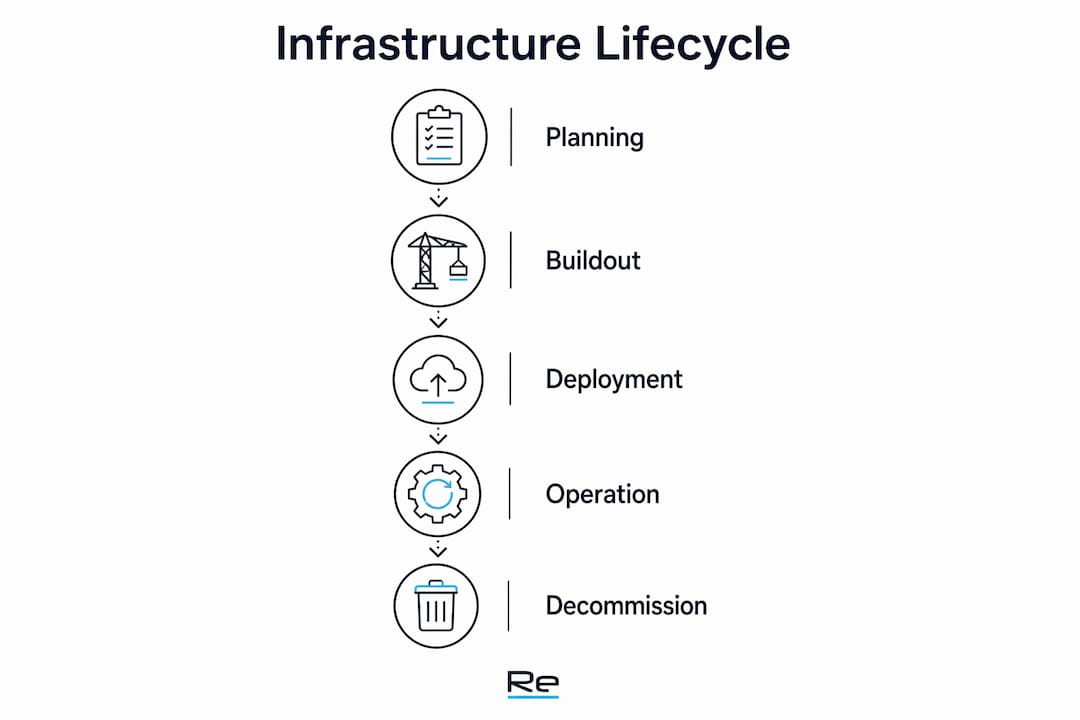
The infrastructure lifecycle is defined by five core stages that feed into each other as a continuous cycle, not a one-time linear process.
-
Strategic Planning. This phase sets capacity requirements, technology roadmaps, and financial models. Skipping strategic planning is the most expensive mistake in infrastructure management, leading to operational failure and financial inefficiency. Decisions made here determine the cost trajectory for years ahead.
-
Design and Buildout. Engineers translate the strategic plan into technical specifications, procurement lists, and deployment schedules. For IT infrastructure, this includes network topology, security architecture, and hardware selection. For large physical infrastructure, this phase involves structural engineering, regulatory approvals, and multi-stakeholder coordination.
-
Operations and Monitoring. Once deployed, assets enter the longest phase of their lifecycle. The operations phase focuses on preventive maintenance, real-time monitoring, and lifecycle cost management. Digital monitoring tools predict maintenance needs and track energy consumption, reducing reactive interventions.
-
Optimisation and Modernisation. Assets rarely remain fit for purpose without periodic review. This stage involves firmware updates, capacity adjustments, technology refresh planning, and performance benchmarking. Organisations that embed optimisation into regular operations avoid the costly cliff-edge of deferred maintenance.
-
Decommissioning and Refresh. End-of-life assets must be retired in a controlled manner. This includes data sanitisation, compliance documentation, hardware disposal, and procurement of replacement assets. Security and regulatory risks are highest at this stage if the process is not formally managed.
Pro Tip: Use date ranges rather than single dates to manage phase transitions. Overlapping planning and buildout phases by four to six weeks prevents gaps in operational continuity, as recommended in lifecycle phase management guidance.
The infrastructure development stages above apply to both IT and physical infrastructure, though the timescales differ significantly. IT assets typically cycle every four to six years. Large infrastructure projects require lifecycle management spanning 50 to 100 years, involving multi-billion-pound funding and multi-stakeholder coordination.

How can organisations manage infrastructure assets effectively?
Effective infrastructure lifecycle management depends on a centralised system of record. Without one, IT teams spend excessive time on manual asset discovery during refresh cycles, producing inaccurate forecasts and reactive procurement decisions.
A complete asset inventory must include:
- Acquisition dates to calculate age against lifecycle assumptions
- Warranty and support expiry dates to flag assets approaching end-of-support
- Firmware and software versions to identify security and compliance gaps
- Location and ownership data to assign accountability across departments
- Refresh cycle assumptions aligned to asset category standards
Industry standard lifecycle assumptions set four years for workstations, five years for servers, and six years for network equipment. These benchmarks allow organisations to forecast capital expenditure up to three years ahead, turning reactive spend into planned investment.
Pro Tip: Build your asset register in a tool that integrates with your monitoring platform. Manual spreadsheets break down at scale. Platforms like Ardoq or ServiceNow provide the real-time visibility needed for accurate lifecycle forecasting.
Integrating FinOps into lifecycle management aligns refresh cycles with business financial plans, improving cost control and avoiding emergency procurement. This means scheduling hardware refresh conversations alongside annual budgeting cycles, not after assets have already failed.
| Asset Category | Standard Lifecycle | Forecast Horizon |
|---|---|---|
| Workstations | 4 years | 3 years ahead |
| Servers | 5 years | 3 years ahead |
| Network Equipment | 6 years | 3 years ahead |
| Physical Infrastructure | 50–100 years | Multi-decade planning |
Automation also plays a critical role. Infrastructure as code platforms such as HashiCorp Terraform standardise deployment and governance, providing a single system of record and enabling continuous optimisation across environments. This removes configuration drift and reduces the manual overhead of managing distributed assets.
What are the common mistakes in infrastructure lifecycle management?
The most damaging errors in the project infrastructure lifecycle are predictable and preventable. Organisations that understand these pitfalls gain a significant operational and financial advantage.
-
Skipping the planning phase. Organisations that move directly to procurement without a capacity plan or technology roadmap consistently overspend on CapEx and underprovision for future demand. Strategic planning aligns financial models with operational requirements before a single purchase order is raised.
-
Relying on manual asset discovery. Without a centralised asset inventory, IT teams cannot accurately forecast refresh timelines. Manual discovery during refresh cycles produces errors, delays, and missed warranty expirations.
-
Ignoring lifecycle review in operations. Lack of lifecycle review in day-to-day operations leads to unplanned downtime and ballooning capital costs. Embedding lifecycle reviews into monthly or quarterly reporting prevents this pattern.
-
Underestimating decommissioning risks. Data sanitisation failures at end-of-life create compliance and security exposures. Organisations operating under GDPR or sector-specific regulations face significant penalties if decommissioning is not formally documented. Re-solution’s guidance on infrastructure compliance challenges covers this in detail.
-
Reactive procurement cycles. Buying replacement assets only after failure drives up costs and extends downtime. Planned procurement, informed by lifecycle assumptions and a live asset register, eliminates this pattern entirely.
“Lifecycle management should be treated as a continuous loop rather than a linear process, with ongoing optimisation and refresh built into every operational phase.” — Aptly Tech, Data Center Lifecycle Management
For organisations managing physical infrastructure, the challenges scale considerably. Projects spanning 50 to 100 years require specialised digital tools for monitoring, maintenance scheduling, and long-term financial modelling. Standard IT asset management platforms are not sufficient for this category. Refer to data centre operational continuity resources for guidance on maintaining uptime across extended infrastructure lifecycles.
How do digital tools support infrastructure lifecycle management?
Modern digital tools transform infrastructure lifecycle analysis from a periodic manual exercise into a continuous, automated process. The right technology stack covers provisioning, monitoring, financial modelling, and end-of-life planning from a single operational view.
| Capability | Traditional Approach | Modern Digital Approach |
|---|---|---|
| Asset tracking | Spreadsheets, manual audits | Real-time CMDB, automated discovery |
| Provisioning | Manual configuration | Infrastructure as code (e.g., HashiCorp Terraform) |
| Monitoring | Reactive alerts | Continuous observability, predictive analytics |
| Financial planning | Annual budget reviews | FinOps integration, rolling refresh forecasts |
| Physical infrastructure | Paper-based records | Digital twin modelling, 3D visualisation |
Infrastructure as code is the most significant shift in IT lifecycle management over the past decade. HashiCorp Terraform and similar platforms automate resource provisioning, enforce governance policies, and maintain a consistent system of record across cloud, on-premises, and hybrid environments. This eliminates configuration drift, a common cause of security vulnerabilities and performance degradation.
Consolidated dashboards provide visibility across the full asset estate, supporting audit trails and compliance reporting. For organisations in regulated sectors such as education or healthcare, this visibility is not optional. It is a governance requirement.
Digital twin technology is particularly valuable for large physical infrastructure projects. A digital twin creates a real-time virtual model of a physical asset, enabling engineers to simulate maintenance scenarios, predict failure points, and optimise energy consumption without physical intervention. For infrastructure with a 50 to 100-year lifecycle, this capability reduces long-term maintenance costs substantially.
Re-solution’s approach to network infrastructure planning incorporates these principles, providing structured guidance for organisations at any stage of their lifecycle journey.
What practical steps implement effective lifecycle management?
Translating lifecycle theory into operational practice requires a structured approach. These steps apply whether you are starting from scratch or formalising an existing process.
-
Build a comprehensive asset inventory. Catalogue every asset with acquisition date, warranty status, firmware version, and assigned owner. This is the foundation of all subsequent lifecycle decisions.
-
Establish standard lifecycle assumptions. Adopt the industry benchmarks of four years for workstations, five years for servers, and six years for network equipment. Adjust these based on your operational environment and vendor support commitments.
-
Embed lifecycle review in regular operations. Schedule quarterly reviews of asset age, warranty expiry, and refresh timelines. Tie these reviews to budget planning cycles so that capital expenditure decisions are made proactively.
-
Adopt infrastructure as code for provisioning. Automate deployment and configuration management to eliminate manual errors and maintain governance consistency across environments.
-
Monitor warranty and support expiry proactively. Assets operating beyond vendor support are security liabilities. Flag assets approaching end-of-support at least 12 months in advance to allow for planned procurement.
-
Align finance, operations, and IT teams. Lifecycle management fails when it is treated as an IT-only function. Finance teams need refresh forecasts to plan CapEx. Operations teams need uptime data to schedule maintenance windows. Cross-functional alignment produces better outcomes for all three.
Pro Tip: When building your lifecycle assumptions, review your IT infrastructure investment case alongside vendor end-of-life schedules. Cisco, for example, publishes end-of-sale and end-of-life notices well in advance, giving you a reliable external reference point for refresh planning.
Understanding the types of IT infrastructure you are managing is a prerequisite for setting accurate lifecycle assumptions. Network infrastructure, compute, storage, and security systems each have distinct refresh cycles and risk profiles.
Key takeaways
Effective infrastructure lifecycle management requires a centralised asset register, standard refresh assumptions, FinOps integration, and continuous review across all five lifecycle stages.
| Point | Details |
|---|---|
| Plan before you procure | Strategic planning prevents CapEx overruns and capacity mismatches that cost significantly more to fix later. |
| Centralise your asset data | A real-time system of record eliminates manual discovery errors and supports accurate three-year forecasting. |
| Apply standard lifecycle benchmarks | Use four years for workstations, five for servers, and six for network equipment as your baseline refresh assumptions. |
| Treat lifecycle as a continuous loop | Embed optimisation and review into regular operations rather than treating decommissioning as a one-off event. |
| Align finance and IT planning | FinOps integration ensures refresh cycles match business financial cycles, reducing reactive and unplanned spend. |
Why most organisations get lifecycle management wrong
In my experience working with organisations across education, manufacturing, and hospitality, the most common failure is not technical. It is organisational. Teams treat the infrastructure lifecycle as a project with a start and end date, rather than as an ongoing operational discipline.
The consequences are predictable. Assets run past their support window because no one flagged the expiry date. Refresh projects arrive as emergencies rather than planned investments. Finance teams are surprised by CapEx requests that should have been visible 18 months earlier. The firefighting becomes normalised, and the root cause, the absence of a structured lifecycle process, goes unaddressed.
What I have found actually works is deceptively simple: a live asset register, quarterly lifecycle reviews, and a standing agenda item in budget planning meetings. The technology matters less than the discipline. HashiCorp Terraform and Ardoq are excellent tools, but they deliver value only when the underlying process is sound.
The other insight that most guides miss is the financial dimension. Lifecycle management is not just an IT function. It is a capital planning function. When IT and finance teams share the same asset data and refresh forecasts, procurement becomes planned and predictable. That shift alone reduces infrastructure costs materially over a three to five-year horizon.
If you take one thing from this article, make it this: start with the asset inventory. Everything else, forecasting, budgeting, compliance, and refresh planning, depends on knowing exactly what you have and how old it is.
— Jacob
How Re-solution supports your infrastructure lifecycle
Re-solution has over 35 years of experience helping organisations across education, manufacturing, logistics, and hospitality manage their Cisco IT infrastructure from initial planning through to refresh and beyond.

Whether you need a structured network audit to establish your current asset baseline, or guidance on building a lifecycle management framework for your Cisco estate, Re-solution provides the expertise and tools to make it happen. The team works across managed services, Network as a Service, and infrastructure surveys to give you the visibility and control that effective lifecycle management demands. Explore Re-solution’s IT infrastructure fundamentals resource to understand how these principles apply to your specific environment, or contact the team directly to discuss your requirements.
FAQ
What is infrastructure lifecycle management?
Infrastructure lifecycle management is the structured process of planning, deploying, operating, optimising, and decommissioning assets to maximise value and control costs. It applies to both IT systems and large-scale physical infrastructure.
How long does an infrastructure lifecycle typically last?
IT assets such as workstations typically have a four-year lifecycle, while servers last five years and network equipment six years. Large physical infrastructure projects can span 50 to 100 years, requiring specialised long-term planning tools.
Why is strategic planning the most critical lifecycle phase?
Skipping strategic planning is the most expensive mistake in infrastructure management, as it leads to capacity mismatches, unplanned CapEx, and operational failures that are far costlier to resolve after deployment.
What is a system of record in infrastructure lifecycle management?
A system of record is a centralised, real-time asset inventory that captures acquisition dates, warranty status, firmware versions, and ownership data. It is the foundation for accurate lifecycle forecasting and planned procurement.
How does FinOps improve infrastructure lifecycle management?
FinOps aligns infrastructure refresh cycles with business financial planning cycles, converting reactive emergency procurement into predictable capital expenditure. This improves cost control and reduces unplanned downtime across the asset estate.
Recommended
- Why invest in IT infrastructure: a 2026 guide
- Guide to sustainable IT infrastructure in 2026
- Types of IT infrastructure: a 2026 guide for IT teams
- How to Future-Proof IT Infrastructure for 2025 | Re-Solution