TL;DR:
- Network capacity planning involves continuously measuring and forecasting network resource needs to ensure performance and prevent saturation. It relies on percentile metrics, multi-dimensional analysis, and a cyclical workflow that adapts to business changes, with accurate telemetry forming its foundation. Most failures occur when plans are based on inaccurate data or treated as one-off projects instead of ongoing processes.
Network capacity planning is defined as the continuous process of measuring, analysing, and forecasting network resource requirements to maintain reliable performance and prevent bottlenecks. Unlike a one-time audit, this discipline runs in cycles, using tools such as Prometheus, Domotz, and Kentik to track demand, model growth, and trigger upgrades before saturation occurs. This network capacity planning guide covers the full workflow IT engineers need: from baselining and monitoring through to forecasting, modelling, and ongoing optimisation. The goal is a network that scales with your organisation rather than one that fails under pressure.
What are the essential metrics in network capacity planning?
Effective capacity planning for networks begins with measuring the right things. Average utilisation alone is insufficient because it masks transient peak usage that can disrupt services. A link running at 40% average may spike to 95% for 30 seconds every hour. Those spikes are invisible in averages but very visible to users.
The metrics that matter most fall into two categories: utilisation and saturation. Separating these metrics provides better alerts and scaling triggers. Utilisation measures the percentage of capacity in use. Saturation measures work that is queued and waiting. Both must be tracked across CPU, memory, storage, and network interfaces.
Key metrics to collect and monitor include:
- Average utilisation: Baseline reference across interfaces and links
- Peak utilisation: The highest recorded usage within a defined window
- p95 and p99 percentiles: Percentile statistics show how frequently the network operates near capacity, guiding timely upgrade decisions
- Burstiness: The ratio of peak to average, indicating how spiky traffic patterns are
- Congestion events: Packet drops, retransmissions, and queue depth spikes
Alert thresholds should be calibrated to these metrics. Common alert thresholds include bandwidth utilisation above 60% as a warning, above 80% as critical, latency increasing by 50%, and connection counts nearing 80% of device limits. These thresholds trigger timely upgrades and prevent saturation from becoming an outage.
Tools such as Prometheus with Node Exporter collect this telemetry continuously. Domotz provides network-wide visibility across devices and interfaces. IBM SevOne applies percentile analysis to identify near-capacity events that averages would miss entirely.
Pro Tip: Use p95 and p99 percentile metrics as your primary upgrade trigger rather than average utilisation. A link at 45% average with a p99 of 92% is a link that needs attention now, not at the next quarterly review.
How does the network capacity planning workflow operate?
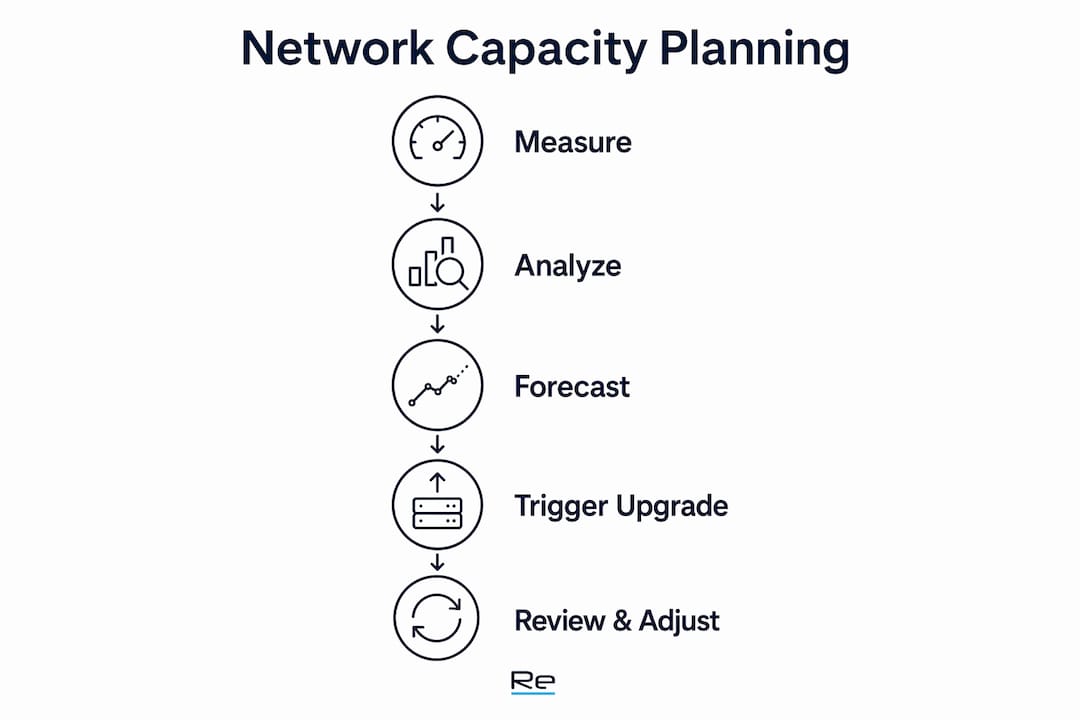
Network capacity planning is a continuous 5-step process involving baselining, monitoring, forecasting, modelling, and optimisation. Each step feeds the next, and the cycle repeats as the network and business evolve. Treating it as a one-off project is the most common mistake IT teams make.
Here is how the workflow operates in practice:
-
Baseline network performance. Document current bandwidth consumption, device inventory, topology, and traffic patterns across all links and segments. Tools like Domotz and Prometheus automate much of this discovery. A solid baseline is the reference point against which all future change is measured.
-
Monitor continuously. Collect traffic and utilisation data over time, covering full business cycles including seasonal peaks, month-end processing, and product launches. Continuous monitoring via network monitoring techniques reveals patterns that a point-in-time snapshot cannot.
-
Analyse trends and forecast demand. Apply trend analysis to historical data to project future requirements. Factor in business drivers: planned headcount growth, new applications, cloud migrations, and site expansions. This step converts raw telemetry into a forward-looking demand model.
-
Model and simulate changes. Before committing to upgrades, simulate the impact of proposed changes. This includes adding links, reconfiguring segments, or introducing load balancers. Modelling validates that a proposed design will meet demand under both normal and peak conditions.
-
Implement changes and optimise. Deploy validated changes and return to step one. The cycle is continuous. As Kentik’s framework describes, actionable capacity plans define runway to saturation per link group with upgrade triggers for each, turning monitoring data into a prioritised operational backlog.
The cyclical nature of this process is what separates proactive network management from reactive firefighting. Each iteration produces a more accurate model and a more stable network.
What best practices optimise capacity planning for networks?

The central trade-off in capacity planning is cost versus risk. Over-provisioning wastes capital. Under-provisioning causes outages. Measured data combined with deliberate trade-off analysis between cost and capacity produces better outcomes than either extreme.
Sizing with headroom
Capacity design should use actual peak utilisation plus a headroom buffer. With a 6Gbps peak, a 20% headroom implies planning for approximately 7Gbps capacity. This buffer absorbs unexpected spikes without triggering saturation. The headroom percentage should reflect the volatility of the traffic: stable, predictable workloads need less buffer than bursty, unpredictable ones.
Beyond bandwidth: multi-dimensional planning
Bandwidth is not the only constraint. Capacity planning must account for non-bandwidth constraints such as CPU load, latency, packet loss, and session limits to meet SLA targets. A link with spare bandwidth but a saturated firewall CPU will still drop connections. Planning must be multi-dimensional.
The table below summarises the key planning dimensions and their associated risks:
| Dimension | Risk if Ignored | Monitoring Metric |
|---|---|---|
| Bandwidth utilisation | Link saturation and packet loss | p95/p99 percentile utilisation |
| CPU load | Firewall and router drops | CPU utilisation per device |
| Session limits | Connection refusals | Active session count vs. maximum |
| Latency and jitter | Poor application performance | Round-trip time and jitter variance |
| Wi-Fi contention | Wireless throughput degradation | Channel utilisation and retry rate |
Upgrade triggers and runway
Define upgrade triggers before you need them. A runway to saturation calculation per link group tells you how many weeks or months remain before a link hits its critical threshold at the current growth rate. This converts monitoring data into a prioritised upgrade backlog rather than a reactive alarm.
Pro Tip: Prioritise runway-to-saturation projections over simple utilisation reports in your weekly capacity review. A link at 55% utilisation with a 6-week runway to critical threshold needs a purchase order today, not a note in next quarter’s review.
Ai-assisted planning: proceed with caution
AI tools are entering the capacity planning space. AI-powered capacity planning requires consistent, reliable data collected over full business cycles to generate useful recommendations. Insufficient or inconsistent data leads to inaccurate outputs. Before enabling any AI-assisted forecasting, verify that your telemetry is complete, consistent, and covers at least one full annual business cycle.
How does capacity planning support enterprise network performance?
Enterprise networks are not static. Application deployments, cloud migrations, mergers, and seasonal demand shifts all change traffic patterns. Effective network infrastructure planning integrates capacity management directly into change management processes, so no significant change goes live without a capacity impact assessment.
Practical steps for enterprise IT teams include:
- Load and stress testing before deployment. Load testing combined with vigilant monitoring improves capacity planning by catching unexpected traffic scenarios in real time. Test new applications against the network before they reach production.
- Align alerts with business events. Tune alert thresholds to reflect known demand spikes, such as financial year-end processing or peak retail periods. Static thresholds miss context; dynamic thresholds account for it.
- Use load balancers and CDNs to distribute demand. Distributing traffic across multiple paths or edge nodes reduces pressure on individual links and improves resilience. This is a core network performance optimisation technique for high-traffic environments.
- Coordinate with application and infrastructure teams. Capacity planning fails when it operates in isolation. Network engineers need advance notice of planned application changes, new SaaS deployments, and site expansions to model their impact accurately.
- Review and adjust continuously. Demand evolves. A capacity plan that was accurate six months ago may be dangerously out of date today. Schedule formal capacity reviews at least quarterly, and trigger ad hoc reviews whenever a significant business or infrastructure change is planned.
Reliable telemetry is the foundation of all of this. Trusted capacity monitoring relies on continuous, repeatable telemetry feeds from critical devices with consistent metrics to avoid baseline drift before automation or modelling steps. Without consistent data, every forecast is guesswork.
Key takeaways
Effective network capacity planning requires continuous measurement, percentile-based alerting, multi-dimensional analysis, and a cyclical workflow that keeps pace with business change.
| Point | Details |
|---|---|
| Use percentile metrics | Track p95 and p99 utilisation to catch spikes that averages hide. |
| Apply headroom to peak usage | Add at least 20% above measured peak when sizing capacity. |
| Plan beyond bandwidth | Account for CPU, session limits, latency, and Wi-Fi contention. |
| Define runway to saturation | Convert monitoring data into a prioritised upgrade backlog with clear triggers. |
| Integrate with change management | Assess capacity impact before every significant infrastructure or application change. |
Why most capacity plans fail before they start
Most capacity planning failures I have seen share a common root cause: the plan was built on the wrong data. Teams reach for historical averages or, worse, for imagined worst-case scenarios with no empirical basis. Organisations often err by building to imagined peak demand rather than measured current data with considered headroom, causing inefficiency or outages. Both outcomes are avoidable.
The second failure mode is treating capacity planning as a project rather than a process. A team runs a thorough baseline exercise, produces a detailed report, and then files it. Six months later, a new application deployment saturates a link that the report flagged as healthy. The data was accurate at the time. The process stopped.
What actually works is building capacity review into the operational rhythm of the IT team. Not as a quarterly fire drill, but as a standing agenda item with live dashboards, defined thresholds, and clear ownership. When a link’s runway to saturation drops below eight weeks, someone is accountable for raising a purchase order. That accountability is what separates teams that stay ahead of demand from those that spend their time recovering from outages.
On AI-assisted planning: the technology is genuinely useful, but only when the data underneath it is trustworthy. I have seen teams rush to automate forecasting before their telemetry was consistent across all devices. The outputs were confidently wrong. Get the data right first. Automate second.
— Jacob
How Re-solution supports your network capacity strategy
Re-solution has over 35 years of experience delivering Cisco IT infrastructure and network solutions to organisations across education, manufacturing, hospitality, and logistics. Capacity planning is not a standalone exercise. It sits within a broader programme of infrastructure design, monitoring, and managed services that Re-solution delivers as a trusted Cisco partner.

Whether you need a structured network audit to establish your baseline, ongoing managed monitoring to track utilisation trends, or expert guidance on sizing and upgrade planning, Re-solution provides the depth of experience to do it properly. Explore Re-solution’s IT infrastructure services or speak directly with the team to discuss your specific capacity planning requirements.
FAQ
What is network capacity planning?
Network capacity planning is the continuous process of measuring, analysing, and forecasting network resource requirements to maintain performance and prevent saturation. It covers bandwidth, CPU, session limits, latency, and other constraints across the full infrastructure.
How often should capacity planning be reviewed?
Capacity plans should be reviewed at least quarterly, with additional reviews triggered by significant infrastructure or application changes. Continuous monitoring with defined alert thresholds provides real-time visibility between formal reviews.
What metrics should i prioritise in capacity monitoring?
Prioritise p95 and p99 percentile utilisation over averages, as percentile statistics reveal how frequently the network operates near capacity. Also track saturation metrics such as CPU load, session counts, and queue depth alongside bandwidth utilisation.
What headroom should i build into capacity designs?
A 20% headroom above measured peak utilisation is a widely used starting point. For a link with a 6Gbps peak, this means planning for approximately 7Gbps of capacity to absorb unexpected demand spikes without hitting saturation.
How does AI improve network capacity planning?
AI tools can identify trends and generate forecasts faster than manual analysis, but they require consistent, reliable telemetry collected across full business cycles to produce accurate recommendations. Incomplete or inconsistent data leads to unreliable outputs.
Recommended
- Network Infrastructure Planning Simplified | Re-Solution
- Network Infrastructure Planning Simplified | Re-Solution
- Best Practices for Network Design Explained | Re-Solution
- Network improvement strategies list: 2026 guide for IT teams