TL;DR:
- Establishing a performance baseline allows IT teams to measure improvements and validate network optimizations effectively.
- Hardware upgrades and configuration adjustments, such as fibre optic cabling and TCP/IP tuning, provide significant and measurable performance gains.
- Ongoing monitoring, traffic management, and regular reviews are essential for sustaining optimal network performance and avoiding configuration drift.
Network performance enhancement is the systematic process of optimising hardware, configurations, and traffic management to increase throughput, reduce latency, and maintain reliable connectivity across organisational networks. For IT professionals and network administrators, this is not a one-time project. It is a continuous discipline that directly affects application reliability, user productivity, and security posture. The core techniques span TCP/IP stack tuning, Quality of Service (QoS) configuration, AI-driven analytics, and infrastructure modernisation. Understanding how to enhance network performance means knowing which levers to pull first and how to measure whether they are working.
How can establishing a performance baseline improve your network optimisation efforts?
Without a performance baseline, IT teams cannot reliably measure whether any optimisation has succeeded. Baseline data gives you a factual reference point. Every subsequent change can then be validated against it.
The key metrics to capture are:
- Latency: Round-trip time between endpoints, measured in milliseconds
- Throughput: Actual data transfer rates across links, compared against theoretical maximums
- Bandwidth utilisation: Percentage of available capacity consumed at peak and off-peak periods
- Packet loss: The proportion of packets that fail to reach their destination
- Jitter: Variation in packet delivery times, which directly affects voice and video quality
Tools like SNMP (Simple Network Management Protocol), NetFlow telemetry, and platforms such as Paessler PRTG or SolarWinds NPM collect this data continuously. The distinction between periodic snapshots and continuous telemetry matters. Periodic snapshots miss transient spikes. Continuous telemetry captures the full picture, including short-lived congestion events that cause real user impact but disappear before a manual check.
Baseline data also informs capacity planning. If your core uplinks are consistently running at 80% utilisation during business hours, you have a documented case for an upgrade before performance degrades. Without that data, the conversation with budget holders is speculative.
Pro Tip: Set alert thresholds at 70% of your baseline capacity limits, not 90%. Waiting until you are near saturation leaves no room to respond before users are affected.
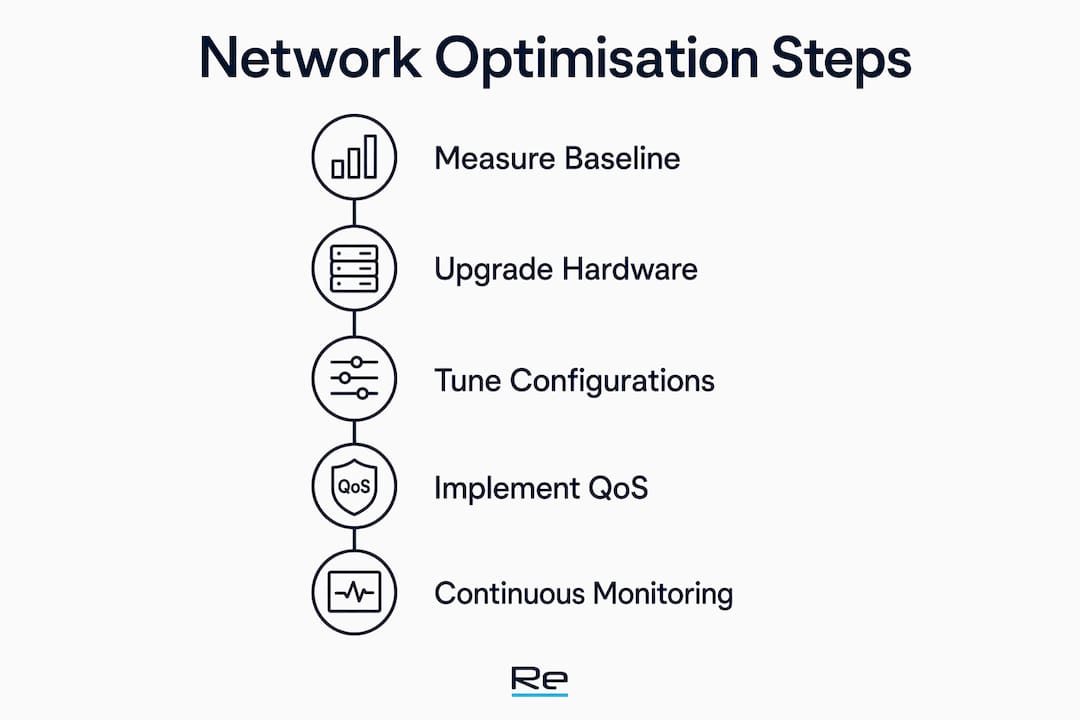
Once your baseline is established, revisit it quarterly. Traffic patterns shift as applications change, headcounts grow, and new services are deployed. A baseline from 18 months ago is not a reliable reference for today’s network. For a structured approach to this process, the Re-solution guide to monitoring network health covers the practical steps in detail.
What hardware upgrades and configuration changes most effectively enhance network performance?
Modernising physical infrastructure is one of the highest-impact steps you can take to increase network performance. Ageing routers and switches operating on older standards create hard ceilings on throughput that no amount of software tuning can overcome.

Infrastructure upgrades worth prioritising
| Upgrade Area | Performance Impact | Key Consideration |
|---|---|---|
| Fibre optic cabling | Eliminates copper bandwidth limits | Essential for inter-building links |
| Wi-Fi 6 / Wi-Fi 6E access points | Higher throughput, lower latency in dense environments | Requires compatible client devices |
| Multi-gigabit switching | Supports 2.5G, 5G, and 10G to the edge | Reduces core bottlenecks |
| Next-generation firewalls | Inspection at line rate without throughput penalty | Cisco Firepower, Palo Alto Networks |
| SD-WAN capable routers | Dynamic path selection across WAN links | Reduces dependency on single ISP |
Beyond the hardware itself, TCP/IP stack configuration delivers measurable gains without capital expenditure. BBR congestion control and CAKE queue management reduce ping latency by 42% and improve web page load times by 15%. In practical terms, that translates to idle ping dropping from 63.3ms to 36.6ms and time-to-first-byte improving from 382.7ms to 322.6ms. These are not marginal gains. They are the kind of improvements users notice directly.
TCP Fast Open is another configuration worth enabling. It reduces the overhead of the TCP handshake by allowing data to be sent during the initial connection setup, cutting round-trip requirements for short-lived connections such as API calls and web requests.
QoS configuration is equally important. Traffic segmentation and load balancing significantly improve throughput and reliability by isolating critical application traffic from general browsing or backup jobs. VLANs provide the logical separation needed to apply these policies cleanly. A manufacturing site running both operational technology (OT) traffic and corporate IT traffic on the same flat network is a performance and security risk that VLAN segmentation resolves directly.
Smart routing with interface-adaptive TCP settings based on Round-Trip Time (RTT) further optimises latency. Automatic failover between WAN links, combined with congestion control algorithm selection per interface, means your network adapts to changing conditions rather than waiting for an administrator to intervene.
Pro Tip: When upgrading switches, prioritise the access layer first. Core switches rarely cause bottlenecks. It is the edge where users connect that most often limits real-world performance.
For a step-by-step approach to planning these changes, Re-solution’s resource on upgrading building network infrastructure provides practical guidance tailored to organisational environments.
How can traffic management and software tools improve network reliability and efficiency?
Software-centric optimisation techniques address how data flows across your existing infrastructure. They do not require hardware replacement and can deliver significant gains when applied correctly.
Core traffic management techniques
-
Traffic shaping: Prioritising critical applications allocates bandwidth based on business need rather than first-come rules. A VoIP call gets guaranteed bandwidth. A software update download does not compete with it at peak hours.
-
Caching and CDN integration: Caching frequently accessed files locally eliminates repeated retrieval over the network. Content Delivery Networks (CDNs) such as Cloudflare or Akamai serve static assets from geographically closer nodes, reducing latency for end users and cutting WAN bandwidth consumption.
-
Software-Defined Networking (SDN): SDN separates the control plane from the data plane, allowing dynamic resource allocation through a centralised controller. Cisco DNA Centre is a widely deployed example. It enables policy changes across the entire network from a single interface, without touching individual device configurations.
-
AI-driven analytics and zero-touch optimisation: AI-driven platforms like NetOptimizer automate network adjustments, increase operational efficiency, and reduce capital expenditure by fully utilising existing assets through predictive ML analysis. This matters because it shifts the optimisation burden from reactive troubleshooting to proactive adjustment.
-
Network orchestration and automation: Tools such as Ansible, Cisco NSO, and Terraform enable configuration management at scale. A change that would take a team days to roll out manually across 200 devices can be executed in minutes with tested automation playbooks.
The combination of these approaches addresses a common failure mode in organisational networks: traffic that is technically within capacity limits but poorly distributed. Upgrading infrastructure to support automation and AI is now considered essential for meeting both performance and security demands simultaneously. The two objectives are no longer separate workstreams.
Maximising the utility of existing multi-vendor network assets through analytics and orchestration can also defer costly capital expenditure. For organisations managing tight budgets, this is a practical way to extend the life of current infrastructure while still improving performance outcomes.
What are the best practices for ongoing monitoring, troubleshooting, and avoiding common optimisation mistakes?
Network performance optimisation is never truly complete. Complexity grows with time, and traffic patterns evolve as business needs change. Treating optimisation as a one-off project is the most common and costly mistake IT teams make.
Sustained performance requires the following practices:
- Continuous metric tracking: Monitor latency, throughput, packet loss, and error rates in real time. Tools like Cisco ThousandEyes, Paessler PRTG, and Zabbix provide the visibility needed to catch degradation before users report it.
- Proactive bottleneck identification: Use flow data (NetFlow, sFlow, or IPFIX) to identify which applications, users, or devices are consuming disproportionate bandwidth. Act on that data before it becomes a crisis.
- Iterative configuration reviews: Incremental optimisation is an ongoing process. Schedule quarterly reviews of QoS policies, routing tables, and firewall rules. What was appropriate six months ago may no longer reflect current traffic patterns.
- Wireless channel management: Continuous latency monitoring and automatic channel assignment improve wireless coverage and reduce interference. Wireless networks are particularly susceptible to environmental changes that degrade performance over time.
- Security integration: Performance and security must be managed together. A misconfigured access control list (ACL) or an overloaded intrusion prevention system (IPS) can throttle legitimate traffic as effectively as a hardware bottleneck.
Common configuration errors to avoid include overlapping VLAN assignments, asymmetric routing that causes traffic to take inefficient paths, and QoS policies that are defined but never validated against actual traffic. Each of these can silently degrade performance for months before anyone identifies the cause.
Pro Tip: Run a network audit before and after any major configuration change. A structured audit creates an evidence trail and makes it far easier to roll back if something goes wrong.
Re-solution’s top network monitoring techniques resource covers the specific tools and workflows that support this kind of continuous oversight in organisational environments.
Key takeaways
Effective network performance optimisation requires a continuous, layered approach combining baseline measurement, hardware modernisation, traffic management, and ongoing monitoring.
| Point | Details |
|---|---|
| Baseline before optimising | Measure latency, throughput, and bandwidth utilisation before making any changes. |
| Hardware upgrades deliver hard gains | Fibre, Wi-Fi 6, and TCP/IP tuning produce measurable throughput and latency improvements. |
| QoS and traffic shaping are non-negotiable | Prioritise critical application traffic to maintain reliability during peak usage periods. |
| AI and automation reduce manual overhead | Platforms like NetOptimizer and Cisco DNA Centre enable proactive, zero-touch adjustments. |
| Optimisation is iterative, not one-off | Schedule quarterly reviews and treat network performance as an ongoing operational discipline. |
Where most IT teams get network optimisation wrong
After working with organisations across education, manufacturing, and logistics, the pattern I see most often is this: a team invests in good hardware, deploys it correctly, and then stops. The network runs well for six months. Then application traffic shifts, a new SaaS platform gets adopted, or headcount doubles in one building, and performance quietly degrades. Nobody notices until users start complaining.
The uncomfortable truth is that most network performance problems I encounter are not hardware failures. They are configuration drift and monitoring gaps. QoS policies that were set up for a previous application stack. Routing tables that were never updated after a WAN change. Wireless access points that were installed and never had their channel assignments reviewed.
The organisations that genuinely maintain strong network performance treat it the way they treat security patching: as a scheduled, recurring operational task with clear ownership. They have dashboards. They have thresholds. They have someone whose job it is to act on the data, not just collect it.
The shift toward AI-driven platforms is genuinely useful here, not because AI replaces good engineering judgement, but because it removes the manual effort of correlating data across dozens of devices. That frees engineers to focus on the decisions that actually require expertise. Balancing capital expenditure against operational efficiency is also more achievable when you can demonstrate, with data, that your existing infrastructure is being fully utilised before requesting budget for new kit.
If I were advising a network administrator starting this process today, I would say: get your monitoring in place first. Everything else follows from having reliable, continuous data about what your network is actually doing.
— Jacob
How Re-solution supports network performance enhancement
Re-solution brings over 35 years of Cisco infrastructure expertise to organisations that need more than generic advice. Whether you are planning a full infrastructure refresh or looking to extract more performance from existing assets, Re-solution’s network audit services provide the structured assessment needed to identify exactly where performance is being lost and what changes will deliver the greatest return.

For organisations considering a managed approach to ongoing performance and connectivity, Re-solution’s Network as a Service offering covers monitoring, optimisation, and infrastructure management under a single, predictable model. From education campuses to manufacturing facilities, Re-solution designs and manages networks that are built to perform under real operational conditions. Get in touch to discuss your specific requirements.
FAQ
What is the first step to optimise network performance?
Establish a performance baseline by measuring current latency, throughput, and bandwidth utilisation. Without this data, you cannot determine whether any subsequent change has improved performance.
How does QoS improve network performance?
QoS allocates bandwidth based on business priority rather than first-come rules, ensuring critical applications such as VoIP and video conferencing maintain consistent performance even during peak usage.
What is the role of AI in network performance optimisation?
AI-driven platforms analyse traffic patterns and automate configuration adjustments in real time, reducing manual intervention and enabling proactive performance management across complex multi-vendor environments.
How often should network performance be reviewed?
Network performance should be reviewed on a continuous basis using monitoring tools, with formal configuration audits conducted at least quarterly to account for changing traffic patterns and business requirements.
Can software tuning replace hardware upgrades?
Software tuning such as BBR congestion control and QoS configuration delivers measurable gains, but it cannot overcome hard physical limits. Both approaches are needed for sustained performance improvement.
Recommended
- Network improvement strategies list: 2026 guide for IT teams
- How to Optimize Networks for Peak Performance 2025 | Re-Solution
- Peak network performance: smart optimisation strategies