TL;DR:
- Access control determines who can access specific resources and what actions they can perform within a system. It is essential for security, enforcing least privilege, and supporting compliance with regulations like GDPR and ISO 27001. Effective management involves role-based models, regular reviews, automation, and integrating with frameworks like Zero Trust.
Access control is the security process that determines who is authorised to access specific resources and what actions they are permitted to perform within a system or organisation. It sits at the heart of every credible cybersecurity strategy, governing everything from which employees can open a database to which devices can connect to a corporate network. Authentication and access control are distinct: authentication verifies identity, while access control enforces permissions. Both must be strong to protect systems effectively. Frameworks such as Role-Based Access Control (RBAC), Zero Trust architecture, and the Canadian Centre for Cyber Security’s baseline controls all treat access control as a foundational security requirement, not an optional layer.
What is access control and how does it differ from authentication?
Access control is defined as the set of policies, technologies, and processes that regulate which users, devices, or systems can access specific resources and what they can do once access is granted. The term covers both physical access (entry to buildings or server rooms) and logical access (permissions within software, networks, and data systems). Understanding this distinction matters because organisations often invest heavily in one without adequately addressing the other.

Authentication verifies identity by confirming that a user is who they claim to be, typically through passwords, biometrics, or multi-factor authentication (MFA). Access control then takes over, determining what that verified identity is actually allowed to do. A system with strong authentication but weak access control remains vulnerable. If a compromised account holds excessive privileges, an attacker gains access to far more than they should.
The role of access control extends beyond simply locking doors. It enforces the principle of least privilege, limits lateral movement within a network, and creates an auditable record of who accessed what and when. These capabilities are central to compliance with regulations such as GDPR, ISO 27001, and sector-specific standards in education, manufacturing, and healthcare.
What are the main types of access control systems?
RBAC, DAC, and MAC are the three foundational models used to define permissions in modern systems. Each takes a different approach to who sets permissions and how they are enforced.
Role-Based Access Control (RBAC) assigns permissions based on job function rather than individual identity. A finance manager inherits the permissions associated with that role automatically. RBAC is the most scalable and commonly deployed model in production environments, and Canadian cybersecurity standards specifically encourage its use to simplify permission management across organisations of all sizes.
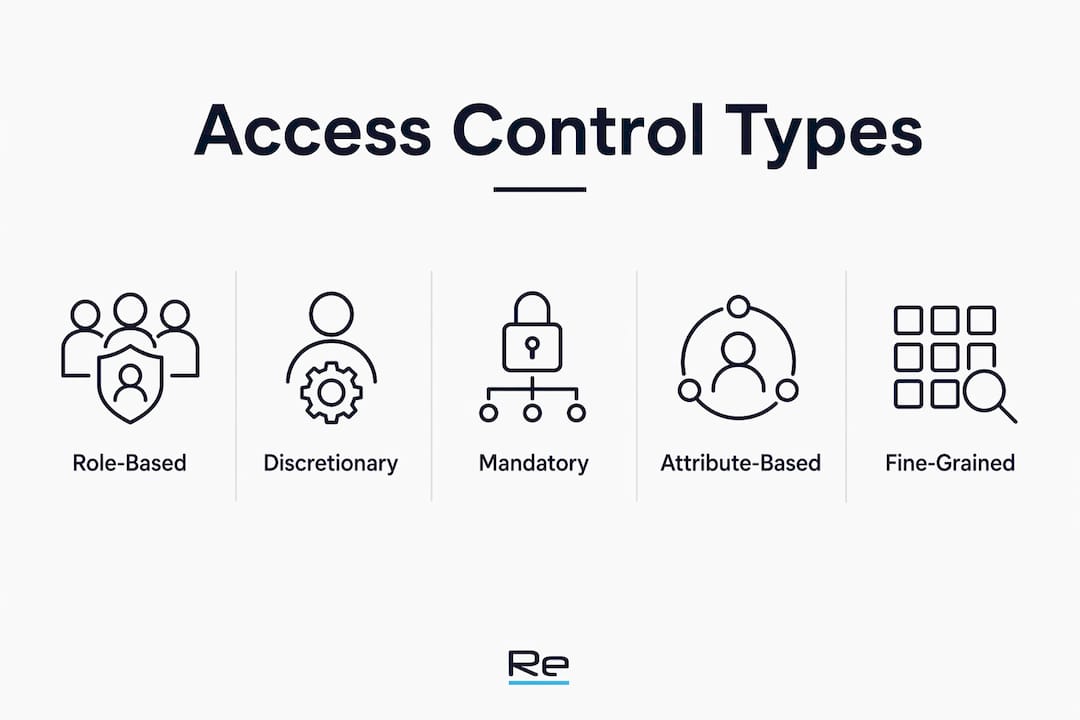
Discretionary Access Control (DAC) allows resource owners to set permissions themselves. A file owner can grant or restrict access to other users at their discretion. DAC is flexible but introduces risk: individual decisions are inconsistent and difficult to audit at scale.
Mandatory Access Control (MAC) enforces permissions through a central authority, typically based on security classifications. Users cannot override or delegate access. MAC is common in government and defence environments where strict data separation is non-negotiable.
Beyond these three, fine-grained models like ABAC evaluate dynamic context such as user location, device type, or time of day before granting access. Attribute-Based Access Control (ABAC) complements RBAC in complex environments where a single role is insufficient to capture nuanced permission requirements. Relationship-Based Access Control (ReBAC) goes further, granting access based on the relationship between a user and a resource, which is particularly useful in social platforms and collaborative tools.
| Model | Who sets permissions | Best suited for | Key limitation |
|---|---|---|---|
| RBAC | Administrators via roles | Most organisations | Less flexible for complex scenarios |
| DAC | Resource owners | Small teams, file sharing | Inconsistent, hard to audit |
| MAC | Central authority | Government, defence | Rigid, high administrative overhead |
| ABAC | Policy engine (dynamic) | Complex enterprises | More complex to configure |
| ReBAC | Relationship graph | Collaborative platforms | Requires sophisticated modelling |
Pro Tip: Start with RBAC and map your permissions to job functions before your organisation grows. Retrofitting access control onto an existing environment with hundreds of ad-hoc user permissions is significantly more time-consuming than building it correctly from the outset.
Why is access control important for security?
Inadequate access control is among the leading causes of data breaches and insider threats, particularly when users hold excessive access rights. This means that even without a sophisticated external attack, an organisation can suffer a serious breach simply because the wrong person had access to the wrong system. Privilege abuse, whether intentional or accidental, is one of the most preventable security failures.
The principle of least privilege is the direct countermeasure. It states that every user, process, or device should hold only the minimum permissions required to perform its function. Applying this principle consistently reduces the blast radius of any compromise. If an attacker gains access to a low-privilege account, they cannot escalate to sensitive systems without encountering additional controls.
Access control also plays a central role in Zero Trust architecture, which requires verifying every access request regardless of user location or network. Zero Trust treats no user or device as inherently trustworthy, even those already inside the network perimeter. Access control is the mechanism that enforces this verification at every step, limiting the impact of compromised credentials and phishing attacks. You can explore how Re-solution approaches this through their Zero Trust security framework.
The compliance case is equally strong. GDPR requires organisations to demonstrate that personal data is accessible only to authorised personnel. ISO 27001 mandates documented access control policies. Sector-specific frameworks in education and manufacturing add further requirements. Strong access control policies are not just good practice. They are a legal and contractual obligation for most organisations operating in the UK today.
It is worth noting that access control tools complement but do not replace firewalls or intrusion detection systems. They specifically regulate who can do what within systems, while perimeter defences handle external threats. Both layers are necessary.
What are the core components of an access control system?
Access control involves three core components: identification, authentication, and authorisation. Failing any one of these steps blocks resource access entirely, which is precisely the intended behaviour.
The process works as follows:
- Identification — The user or device presents a claimed identity, such as a username, employee ID, or device certificate.
- Authentication — The system verifies that claimed identity using credentials: a password, a hardware token, biometric data, or a combination through MFA.
- Authorisation — Once identity is confirmed, the system checks what permissions that identity holds and grants or denies the requested action accordingly.
- Access enforcement — The access control system applies the policy decision in real time, permitting or blocking the action at the resource level.
- Audit and logging — Every access event is recorded, creating a trail for compliance reporting, incident investigation, and periodic access reviews.
In practice, these steps are handled by technologies including Active Directory, LDAP directories, Identity and Access Management (IAM) platforms, and network access controllers (NAC). Physical access control systems use badge readers, biometric scanners, and PIN pads to enforce the same three-step process at building entry points. Logical and physical controls increasingly integrate, particularly in sectors such as manufacturing and logistics where both facility and system access must be managed together.
How can organisations implement and manage access control effectively?
Effective implementation begins with a clear mapping of roles to permissions. Rather than assigning access user by user, group permissions by job function and apply them at the role level. RBAC reduces errors and administrative overhead by removing the need for per-user decisions, and it makes periodic reviews far more manageable.
Key practices for ongoing management include:
- Conduct regular access reviews. Permissions accumulate over time as users change roles or take on temporary responsibilities. Scheduled quarterly or bi-annual reviews catch privilege creep before it becomes a liability.
- Automate onboarding and offboarding. Manual processes leave gaps. When an employee joins, their role should trigger automatic provisioning. When they leave, access should be revoked immediately and completely.
- Use centralised IAM for third-party users. Centralised B2B IAM systems automate access for partners, vendors, and contractors, preventing the lingering access risks that manual provisioning creates. Ad-hoc access for external users is one of the most common and overlooked vulnerabilities.
- Integrate with Zero Trust frameworks. Access control policies should feed directly into your Zero Trust architecture, ensuring that every request is evaluated against current context, not just historical permissions.
- Document your access control policies. Written policies create accountability, support compliance audits, and give IT teams a clear reference point when handling exceptions or disputes.
Pro Tip: Avoid granting access based on individual requests without a formal approval workflow. Even well-intentioned exceptions accumulate into a permission structure that nobody fully understands. A simple ticketing process for access requests pays dividends during audits and incident investigations.
For organisations managing network access controllers or deploying Cisco-based infrastructure, Re-solution’s team can provide structured guidance on aligning your access control framework with current security standards.
Key takeaways
Effective access control requires the right model, consistent enforcement, and regular review to protect systems and meet compliance obligations.
| Point | Details |
|---|---|
| Define before deploying | Map roles and permissions to job functions before assigning access to individuals. |
| RBAC as the default | Role-Based Access Control is the most scalable model for most organisations and reduces administrative errors. |
| Least privilege is non-negotiable | Users should hold only the minimum access required; excessive permissions are a primary breach vector. |
| Authentication alone is insufficient | Strong identity verification must be paired with equally strong permission enforcement to be effective. |
| Automate access lifecycle management | Centralised IAM systems prevent privilege creep and close the gaps left by manual provisioning. |
Access control in 2026: what I have seen working and what still fails
Having worked across IT infrastructure projects in education, manufacturing, and logistics, the pattern I see most often is this: organisations invest in authentication and then assume the hard work is done. They deploy MFA, tighten password policies, and consider the job complete. Access control, the enforcement of what authenticated users can actually do, gets treated as an afterthought.
The consequences are predictable. A teacher at a school has read access to every student record because nobody reviewed permissions after a role change three years ago. A contractor at a manufacturing site retains VPN access six months after their engagement ended because offboarding was manual and incomplete. These are not exotic attack scenarios. They are routine findings in security audits.
What I have found genuinely effective is the combination of RBAC and a formal access review cycle. Small organisations in particular benefit from adopting RBAC early, before permissions become tangled. It is far easier to build a clean role structure with twenty users than to untangle one with two hundred. The practical examples of secure access solutions that Re-solution documents reflect exactly this: structured, role-based frameworks that scale without creating management debt.
The shift towards context-aware controls through ABAC and Zero Trust is real and necessary, particularly for organisations with remote workforces or complex partner ecosystems. But the fundamentals still matter most. Get the role structure right, automate the lifecycle, and review regularly. The organisations that do this consistently are the ones that avoid the breaches that make headlines.
— Jacob
How Re-solution can support your access control strategy
Re-solution brings over 35 years of Cisco infrastructure expertise to access control and security management. Whether you are deploying RBAC for the first time, integrating access control into a Zero Trust framework, or managing a complex multi-site environment across education or manufacturing, Re-solution’s team provides structured, practical support. Their managed IT services cover the full access control lifecycle, from initial design and policy documentation through to ongoing monitoring and access reviews. For organisations looking to understand where their current infrastructure stands, Re-solution’s IT infrastructure assessment provides a clear starting point. Contact Re-solution to discuss a bespoke access control review for your organisation.
FAQ
What is access control in simple terms?
Access control is the process of deciding who is allowed to access specific systems, data, or physical spaces and what they are permitted to do once access is granted. It enforces security policies after a user’s identity has been verified.
What is the difference between authentication and access control?
Authentication confirms who a user is, while access control determines what that user is allowed to do. A system with strong authentication but weak access control remains vulnerable if users hold excessive permissions.
What are the main types of access control?
The three foundational types are Role-Based Access Control (RBAC), Discretionary Access Control (DAC), and Mandatory Access Control (MAC). More advanced models include Attribute-Based Access Control (ABAC) for context-aware decisions in complex environments.
Why is access control important for compliance?
Regulations including GDPR and ISO 27001 require organisations to restrict access to sensitive data to authorised personnel only. Documented access control policies and regular access reviews are standard requirements in most compliance audits.
What is privilege creep and how does access control prevent it?
Privilege creep occurs when users accumulate permissions over time beyond what their current role requires. Regular access reviews and automated IAM systems prevent this by enforcing least privilege and revoking unnecessary access promptly.
Recommended
- Network Access Controller Guide | Secure Network | Re-Solution
- Network Access Controller Guide | Secure Network | Re-Solution
- Examples of secure access solutions for IT managers
- Effective network access management for schools in 2026