TL;DR:
- Cybersecurity compliance involves implementing security controls and providing ongoing evidence to meet legal and regulatory standards. Organizations must map controls across frameworks like GDPR, ISO 27001, NIST CSF, and SOC 2, ensuring continuous monitoring and clearly assigning ownership. Effective programs rely on operationally tested incident response plans, accurate scope definition, and disciplined evidence collection to succeed in audits and real incidents.
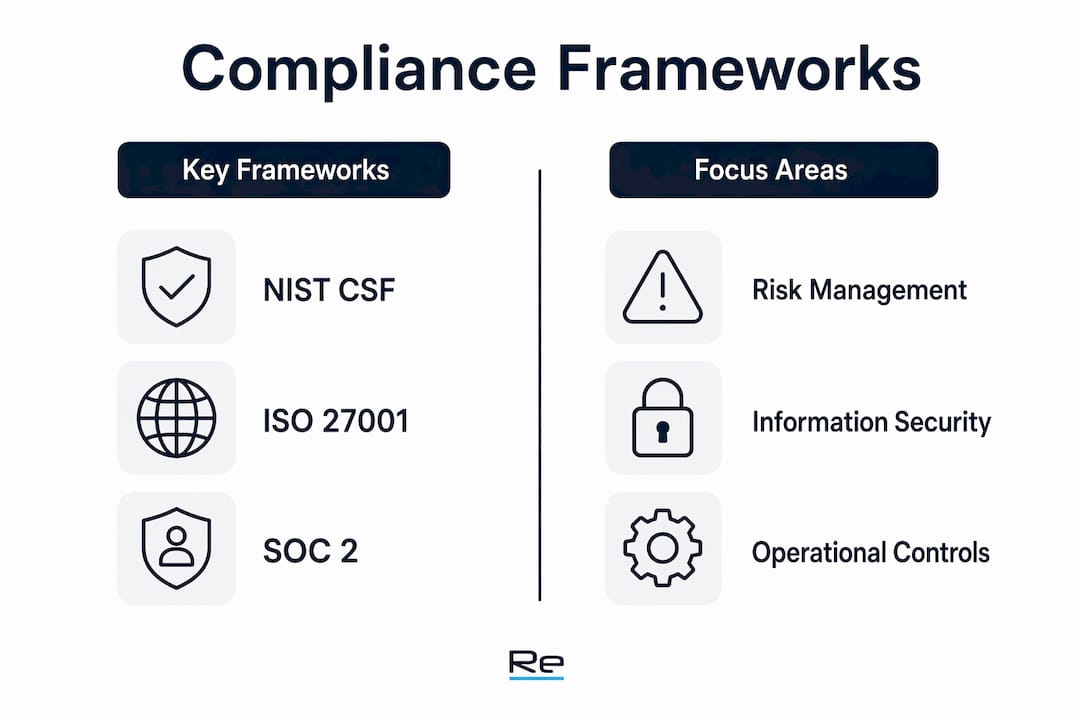
Cybersecurity compliance is the organisational process of meeting defined laws, standards, and contractual obligations by implementing required security controls and generating proof that those controls operate effectively. For compliance officers and IT managers, this means translating external mandates such as GDPR, ISO/IEC 27001, NIST CSF, and SOC 2 into documented policies, technical configurations, and audit-ready evidence. Understanding the cybersecurity compliance basics is no longer optional. Regulators across the UK, EU, and US are tightening enforcement, and organisations that cannot demonstrate control effectiveness face significant financial and reputational consequences.
What are the key cybersecurity compliance frameworks and how do they compare?
Cybersecurity compliance is defined as the accountability layer that enforces externally defined standards through supporting audit logs, access reviews, and training records. Each major framework approaches this accountability differently, and most organisations must satisfy more than one simultaneously.
The NIST Cybersecurity Framework 2.0 organises security activities into six core functions: Govern, Identify, Protect, Detect, Respond, and Recover. The addition of “Govern” in version 2.0 reflects a growing expectation that cybersecurity accountability sits at board level, not just within IT teams. This makes NIST CSF particularly useful as an internal risk management structure, even for organisations whose primary obligation is a different standard.
ISO/IEC 27001 is the internationally recognised certification for information security management systems. It operates on a three-year certification cycle, with annual surveillance audits sampling ongoing process operation and a full recertification at the end of the cycle. Organisations that focus solely on documentation risk failing surveillance audits, because auditors assess whether processes are actually running, not just whether policies exist on paper.
SOC 2 Type II evaluates the operating effectiveness of controls over an observation window of 3 to 12 months. This is a meaningful distinction from the point-in-time Type I assessment. A Type II report gives customers and partners far greater confidence that controls are consistently applied, not simply in place at the moment of audit.
The table below summarises the primary frameworks compliance officers encounter most frequently.
| Framework | Scope | Primary focus | Audit cycle | Evidence type |
|---|---|---|---|---|
| NIST CSF 2.0 | US-aligned, widely adopted globally | Risk management lifecycle | Self-assessed or third-party | Policies, risk registers, logs |
| ISO/IEC 27001 | International | ISMS certification | 3-year cycle, annual surveillance | Documented controls, process records |
| SOC 2 Type II | US service organisations | Trust service criteria | 3 to 12-month observation | Continuous operational evidence |
| PCI DSS | Payment card industry | Cardholder data protection | Annual assessment | Technical scans, audit logs |
| GDPR | EU data subjects globally | Personal data protection | Ongoing regulatory obligation | DPIAs, breach records, consent logs |
PCI DSS applies to any organisation that processes, stores, or transmits payment card data, regardless of sector. GDPR applies wherever personal data of EU residents is processed, making it relevant to virtually every UK and European organisation regardless of size.
What technical controls and obligations does compliance require?
Most compliance frameworks share a common set of technical and administrative controls. Understanding these overlaps is where compliance officers can gain real efficiency. The following controls appear across GDPR, ISO 27001, NIST CSF, and SOC 2 in some form.
- Access control and identity management. Multi-factor authentication (MFA) is a baseline requirement across nearly every current standard. Role-based access control (RBAC) and the principle of least privilege reduce the attack surface and simplify access reviews during audits.
- Data protection. Encryption of data at rest and in transit is required under GDPR and expected under ISO 27001 Annex A controls. Data classification policies determine which data receives which level of protection and are essential for scoping compliance obligations accurately.
- Incident detection and continuous monitoring. SIEM platforms, intrusion detection systems, and log aggregation tools generate the evidence that auditors examine. Monitoring cannot be switched on only before an audit. Continuous evidence collection, including access reviews and change management artefacts, is what demonstrates consistent control operation.
- Risk assessments and vendor risk management. ISO 27001 and NIST CSF both require documented risk assessments at defined intervals. Third-party suppliers who handle sensitive data must be assessed as part of your risk register, not treated as outside your compliance boundary.
- Policy documentation and employee training. Acceptable use policies, incident response plans, and data handling procedures must exist in writing and be reviewed regularly. Employee training records are among the most commonly requested artefacts during audits.
Pro Tip: Map each control you implement to every framework it satisfies simultaneously. A single MFA deployment, for example, addresses NIST CSF Protect, ISO 27001 Annex A 8.5, and SOC 2 Logical Access criteria at once. This unified control architecture reduces audit duplication and cuts the time your team spends producing evidence for multiple assessments.
For sector-specific obligations in education and manufacturing, Re-Solution’s IT compliance practical guide covers the additional controls those industries typically require.
How should organisations handle incident reporting timelines?
Incident reporting is where compliance theory meets operational pressure. The timelines are short, the legal consequences of missing them are severe, and the information required is often incomplete at the point when notification is due.

GDPR Article 33 requires breach notification within 72 hours of becoming aware of a personal data breach. Critically, notification must be made even if the full investigation is not complete. The notification must document the facts known, the likely consequences, and the remedial actions taken or planned. This means your incident response plan must define precisely what “becoming aware” means operationally, because that definition starts the clock.
NIS2 introduces a multi-stage reporting obligation: an early warning within 24 hours, a full incident notification within 72 hours, and a final report within one month. Essential entities face fines of up to EUR 10 million or 2% of global annual turnover for non-compliance. That financial exposure makes pre-built escalation workflows a business necessity, not a best-practice recommendation.
The New York Department of Financial Services (NYDFS) cybersecurity regulation similarly requires 72-hour reporting, with the added expectation of 24/7 detection capability and documented decision workflows. Organisations operating across multiple jurisdictions must reconcile these overlapping timelines carefully.
To build a workable incident response process, structure it around the following steps:
- Define “awareness” in writing. Specify the conditions under which an incident is confirmed and the notification clock begins. Ambiguity here is the most common cause of missed deadlines.
- Assign escalation ownership. Name the individuals responsible for each stage of notification. Do not rely on informal communication chains under time pressure.
- Build a decision tree. Create a documented flowchart that classifies incident severity and maps it to the applicable regulatory notification requirement.
- Pre-draft notification templates. Regulatory notifications follow a predictable structure. Templates reduce drafting time when hours matter.
- Test the process. Run tabletop exercises at least annually. Untested workflows fail under real incident conditions.
Pro Tip: Treat your incident response playbook as a living document reviewed after every real incident and every tabletop exercise. Regulators examining post-breach compliance will look at whether your process was followed, not just whether it existed.
How to build a cybersecurity compliance programme that works
Building a programme that satisfies multiple frameworks without creating unsustainable overhead requires deliberate design from the outset. Ad hoc compliance, where teams respond to each audit requirement separately, produces duplication, evidence gaps, and staff fatigue.
The practical steps below reflect what a well-structured programme looks like in operation.
- Scope your obligations accurately. Identify which regulations and standards apply based on the data you process, the systems you operate, and the jurisdictions you serve. Over-scoping wastes resources; under-scoping creates legal exposure.
- Conduct a gap analysis against each applicable framework. Compare your current controls against the requirements of GDPR, ISO 27001, NIST CSF, or whichever standards apply. Document what exists, what is partially implemented, and what is absent.
- Map controls to shared domains. Access management, encryption, logging, and incident response appear in virtually every framework. Implementing each control once and mapping it to multiple standards is the most efficient path to multi-framework compliance.
- Establish continuous monitoring. Automated log collection, scheduled access reviews, and vulnerability scanning generate the evidence base that auditors require. Manual, periodic evidence gathering is not sufficient for SOC 2 Type II or ISO 27001 surveillance audits.
- Assign ownership explicitly. Every policy and every control must have a named owner responsible for its operation and evidence production. Compliance programmes without clear ownership produce inconsistent evidence and fail under scrutiny.
The table below outlines a practical ownership model for core compliance domains.
| Compliance domain | Typical owner | Evidence produced |
|---|---|---|
| Access control | IT Manager | Access review logs, MFA reports |
| Data protection | Data Protection Officer | Encryption records, DPIAs |
| Incident response | Security Lead | Incident logs, notification records |
| Vendor risk | Procurement or IT | Supplier assessments, contracts |
| Employee training | HR and IT jointly | Training completion records |
Regular management reviews, at least quarterly, keep the programme aligned with changes in the organisation’s risk profile and any updates to applicable regulations. Embedding cybersecurity awareness across the organisation supports the cultural dimension that technical controls alone cannot address.
Key takeaways
Cybersecurity compliance requires implementing defined security controls, producing continuous evidence of their operation, and meeting statutory reporting obligations across frameworks such as GDPR, ISO 27001, NIST CSF, and SOC 2.
| Point | Details |
|---|---|
| Define compliance scope precisely | Identify applicable frameworks based on data type, systems, and jurisdiction before implementing any controls. |
| Map controls across frameworks | A single MFA or logging deployment can satisfy requirements across NIST CSF, ISO 27001, and SOC 2 simultaneously. |
| Collect evidence continuously | Auditors assess consistent control operation, not just point-in-time snapshots. Automate log collection and access reviews. |
| Pre-build incident response workflows | GDPR, NIS2, and NYDFS all impose 72-hour reporting windows. Pre-defined decision trees and templates are operationally necessary. |
| Assign named ownership | Every control and policy must have a responsible owner to produce consistent, audit-ready evidence. |
Why compliance programmes fail before the audit begins
After working with organisations across education, manufacturing, and logistics, the pattern I see most often is not a lack of controls. It is a lack of evidence that those controls ran consistently. Teams implement MFA, configure their SIEM, and write their incident response plan. Then, when an auditor asks for six months of access review logs, the records are incomplete or were never collected in a structured way.
SOC 2 Type II is particularly unforgiving here. The observation period is the audit. If your controls were not operating and being documented throughout that window, no amount of last-minute preparation will close the gap. The same logic applies to ISO 27001 surveillance audits, which sample process operation rather than reviewing documentation in isolation.
The incident reporting timelines in GDPR and NIS2 expose a different gap. Most organisations have an incident response policy. Far fewer have operationally tested it under realistic time pressure. The 72-hour clock under GDPR starts when your organisation becomes aware of a breach, and “aware” is a defined concept that your response plan must specify. Without that definition, your team will spend the first hours of an incident debating whether the clock has started rather than acting.
My honest view is that compliance should be treated as the floor, not the ceiling. Meeting GDPR or ISO 27001 requirements does not mean your organisation is secure. It means you have met a defined minimum. The organisations that use compliance as a foundation for a stronger security programme, rather than treating it as a box-ticking exercise, are the ones that hold up under real incident conditions.
— Jacob
How Re-solution supports your compliance and security posture

Re-solution has supported organisations across education, manufacturing, and hospitality in building IT infrastructure that underpins compliance requirements. With over 35 years of experience as a Cisco partner, Re-solution designs and manages network and security architectures that generate the continuous evidence compliance frameworks demand. Whether you need a structured approach to IT infrastructure for compliance or a managed service that maintains your security controls and audit readiness throughout the year, Re-solution provides the technical depth and sector knowledge to support your programme. Speak to the team to discuss your specific compliance obligations and how your infrastructure can be aligned to meet them through managed IT services built for your environment.
FAQ
What does cybersecurity compliance mean?
Cybersecurity compliance means meeting applicable legal, regulatory, and contractual obligations by implementing required security controls and producing evidence that those controls operate effectively. It covers frameworks such as GDPR, ISO 27001, NIST CSF, and SOC 2.
Which frameworks apply to UK organisations?
UK organisations most commonly need to address GDPR for personal data processing, ISO/IEC 27001 for information security management, and NIST CSF as a risk management structure. Sector-specific obligations such as PCI DSS apply where payment card data is processed.
How long does a SOC 2 Type II audit take?
SOC 2 Type II assesses controls over an observation period of 3 to 12 months, making it a sustained commitment rather than a single-point assessment. Organisations must collect and retain operational evidence throughout the entire observation window.
What is the GDPR breach notification deadline?
GDPR Article 33 requires notification to the relevant supervisory authority within 72 hours of becoming aware of a personal data breach. Notification must include known facts, likely consequences, and remedial actions, even if the investigation is still ongoing.
How do you start building a compliance programme?
Start by scoping your obligations based on the data you process, the systems you operate, and the jurisdictions you serve. Conduct a gap analysis against each applicable framework, then map controls to shared domains to reduce duplication across multiple standards.
Recommended
- Integrated security solutions: Boost connectivity and compliance
- Your Guide to Cybersecurity Essentials 2025 | Re-Solution
- How to Create Cybersecurity Awareness 2025 | Re-Solution