TL;DR:
- Network automation replaces manual CLI tasks with software-driven, repeatable workflows to improve reliability and scalability. Core principles like configuration as code, idempotency, and structured data models underpin safe, effective automation practices across diverse network environments. Utilizing tools such as NETCONF, RESTCONF, Python libraries, and Ansible—alongside gradual adoption—ensures secure, validated deployment aligned with fundamental networking knowledge.
Network automation is defined as the use of software, scripts, and APIs to programmatically manage network device configuration, monitoring, and troubleshooting, replacing manual CLI-driven processes with repeatable, reliable workflows. The industry term for this discipline is programmatic network management, though “network automation” is the widely adopted working term across Cisco, Ansible, and Python communities alike. Understanding the network automation fundamentals covered here will help you reduce manual errors, manage infrastructure at scale, and adopt tools like NETCONF, RESTCONF, Ansible, and Python with confidence. Whether you are managing a campus network in education or a distributed infrastructure in manufacturing, the principles remain consistent and directly applicable.
What are the core principles behind network automation fundamentals?
Network automation moves away from manual CLI toward software-driven processes that apply configuration changes programmatically across dozens or hundreds of devices simultaneously. Four foundational concepts underpin every reliable automation workflow.

Configuration as code treats network configurations as reusable, version-controlled files rather than one-off CLI commands typed into a terminal. You store these files in a tool like Git, which means every change is tracked, reviewable, and reversible. This approach transforms network management into a discipline closer to software development, where peer review and audit trails are standard practice.
Idempotency is the principle that automation scripts produce consistent results regardless of how many times they run. An idempotent playbook checks the current state of a device and applies only the differences needed to reach the desired state, rather than blindly appending commands. This prevents configuration drift, which is one of the most common sources of network instability in manually managed environments.
The distinction between declarative and imperative automation matters significantly in practice:
- Declarative automation defines the desired end state. You specify what the network should look like, and the tool determines how to get there. Ansible’s resource modules operate this way.
- Imperative automation specifies each step in sequence. Python scripts using Netmiko often follow this model, sending commands one at a time.
- Version control with Git supports collaboration, change tracking, and rollback across both approaches.
- Testing and validation confirm that changes produce the expected state before and after deployment.
- Rollback planning defines a clear path to revert changes if validation fails, which is non-negotiable in production environments.
Pro Tip: Start every automation project by committing your baseline device configurations to Git. This gives you a known-good reference point before any automated change is applied, and it costs almost nothing to set up.
How do NETCONF and RESTCONF support reliable automation?
Model-driven protocols like NETCONF and RESTCONF increase reliability and reduce fragility compared to screen-scraping CLI output. Both protocols rely on YANG data models to structure configuration and operational data, which means you interact with well-defined schemas rather than parsing unpredictable text strings.
NETCONF runs over SSH on TCP port 830 and uses XML for data encoding. It is session-oriented and supports Remote Procedure Calls (RPCs). RESTCONF, by contrast, uses HTTPS (typically port 443) with JSON or XML and maps directly to REST API principles. The choice between them depends on your tooling preferences and the capabilities of your target devices.
| Feature | NETCONF | RESTCONF |
|---|---|---|
| Transport | SSH (port 830) | HTTPS (port 443) |
| Data format | XML | JSON or XML |
| Interaction model | Session-based RPC | Request/response REST |
| Transaction support | Yes (candidate datastore, commit, rollback) | Limited |
| Best suited for | Complex transactional changes | Web-friendly, stateless operations |
The NETCONF candidate datastore workflow is particularly valuable for production safety. You stage changes in a candidate datastore, validate them, and only commit once validation passes. If something is wrong, you roll back without touching the running configuration. Not all devices support candidate commits, so capability discovery must be the first step in any NETCONF workflow.
RESTCONF HTTP methods map directly to configuration actions: GET reads, POST creates, PUT replaces, PATCH modifies, and DELETE removes. Resource paths reflect the YANG schema, so you target specific configuration sections with precision rather than replacing entire config blocks.
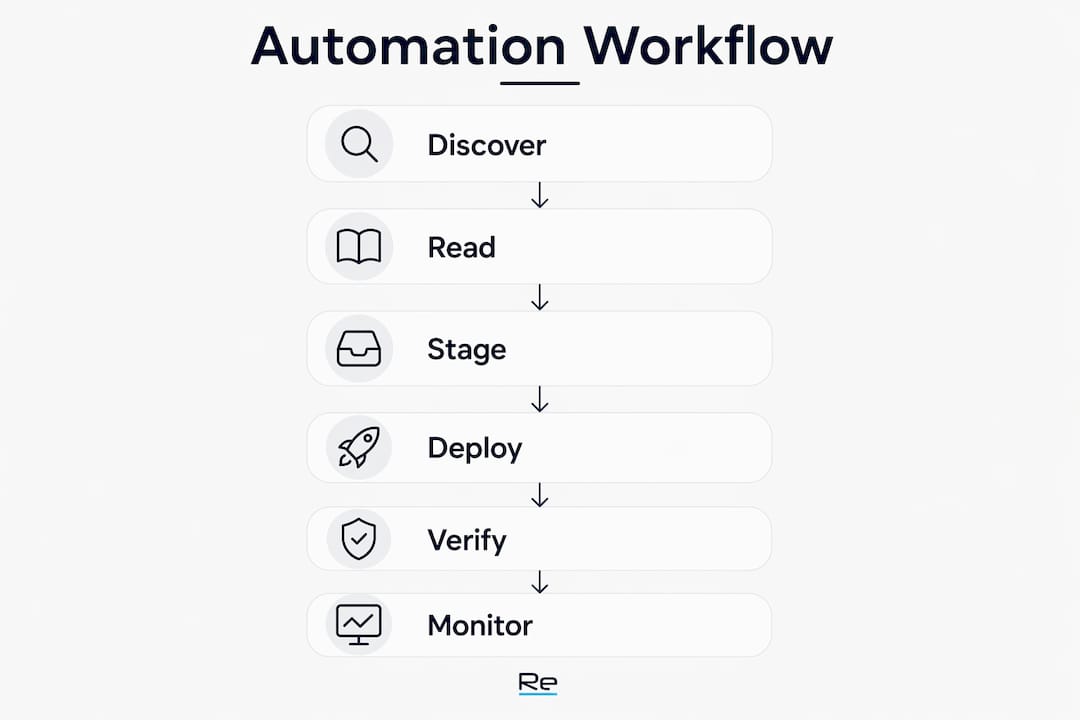
The standard automation workflow across both protocols follows six steps: discover device capabilities, read current configuration and state, stage proposed changes, validate against schema and business rules, commit, and verify the resulting state. Treating configuration updates as lifecycle transactions with validation and rollback built in is what separates professional automation from ad hoc scripting.
Pro Tip: Before writing a single line of automation code against a new device, send a NETCONF "get-capabilitiesRPC or a RESTCONFGET` to the capabilities endpoint. Knowing exactly what the device supports prevents hours of debugging later.
What tools and languages are essential for network automation?
Python is the dominant language for network-specific automation tasks, supported by a mature ecosystem of libraries purpose-built for network device interaction. The three most widely used are:
- Netmiko: Simplifies SSH connections to multi-vendor devices and handles the quirks of different CLI implementations. Suitable for imperative scripting where you need direct command control.
- NAPALM (Network Automation and Programmability Abstraction Layer with Multivendor support): Provides a vendor-neutral API for retrieving facts, comparing configurations, and deploying changes across platforms including Cisco IOS, Junos, and EOS.
- Nornir: A Python framework for running tasks concurrently across large device inventories. Unlike Ansible, Nornir keeps everything in Python, which suits teams who prefer code over YAML.
Ansible sits alongside Python as the most accessible entry point for teams new to automation. Its agentless architecture connects to devices over SSH or API without requiring software installation on managed nodes. Ansible resource modules manage logical constructs such as VLANs, interfaces, and BGP neighbours rather than raw CLI commands, which produces idempotent, readable playbooks. The ios_config module, for example, automates configuration backups with configurable filename and directory options, making it a low-risk first automation task with immediate operational value.
For validation, Cisco’s pyATS and Genie frameworks are the standard tools for test execution and structured output parsing. pyATS manages test execution and reporting; Genie provides parsers that convert show command output into structured Python objects. Together, they transform automation from a deployment mechanism into a verifiable process where you can assert that BGP sessions are established, interface states match expectations, and routing tables contain the correct prefixes. For teams exploring secure infrastructure testing at scale, combining pyATS with isolated test environments reduces the risk of validation affecting production traffic.
Pro Tip: Use Ansible for configuration management and Genie parsers for state verification. Running a pyATS job after every Ansible playbook execution gives you automated proof that the change achieved its intended outcome.
How can IT teams safely adopt and scale network automation?
Gradual, strategic adoption avoids pitfalls in legacy or mixed environments. The following sequence reflects best practice for teams moving from manual operations to a mature automation capability.
- Assess your environment. Catalogue your device types, operating system versions, and management interfaces. Identify which devices support NETCONF, RESTCONF, or only CLI. This inventory shapes every subsequent decision.
- Identify high-volume, low-risk tasks. Configuration backups, VLAN provisioning, and interface description updates are ideal starting points. They deliver immediate value and carry minimal risk if something goes wrong.
- Build and test in a lab first. Use a dedicated testbed that mirrors production topology. Tools like NetBox combined with pyATS enable reproducible regression tests against a centralised inventory, so you validate workflows before they touch live infrastructure.
- Maintain hybrid operations initially. Hybrid manual-automated workflows mitigate risk and allow teams to build confidence incrementally. Keep manual procedures documented and available until automation is proven stable.
- Conduct a risk assessment for each new automation task. Define what a failure looks like, how you will detect it, and how you will roll back. A network infrastructure checklist covering compliance and verification requirements is a practical starting point for this process.
- Expand progressively. Once backups and health checks are stable, move to more complex workflows such as BGP policy changes or ACL management. Prioritise the tasks that currently consume the most engineer time or generate the most errors.
- Retain human oversight for sensitive changes. Automated approval gates, peer review of playbooks in Git, and mandatory validation steps keep humans in the loop for high-impact operations until confidence in the automation is fully established.
Networking fundamentals remain essential throughout this process. Understanding routing protocols, VLAN architecture, and access control policies makes your data models accurate and your validation logic meaningful. Automation amplifies your existing knowledge; it does not replace it.
Key takeaways
Network automation delivers consistent, scalable network management only when built on idempotency, model-driven protocols, and a structured adoption strategy.
| Point | Details |
|---|---|
| Idempotency prevents drift | Automation scripts must converge on the desired state, not append commands blindly. |
| NETCONF for transactions | Use NETCONF’s candidate datastore and commit/rollback for safe, staged configuration changes. |
| Python and Ansible complement each other | Use Python libraries like Netmiko and NAPALM for flexibility; use Ansible resource modules for idempotent, readable playbooks. |
| Validate with pyATS and Genie | Structured output parsing confirms that changes achieved their intended outcome, not just that they ran without error. |
| Adopt gradually and test first | Start with low-risk tasks, build in a lab, and maintain hybrid operations until automation is proven stable. |
Why fundamentals matter more than tools in 2026
The tools in this space change faster than most engineers can track. Ansible releases new network collections quarterly, Python libraries gain new vendor support with each version, and Cisco continues to extend NETCONF and RESTCONF capabilities across its IOS XE portfolio. What does not change is the underlying logic: idempotency, transactional safety, structured data models, and validation before commit.
In my experience, the engineers who struggle most with automation are not those who lack Python skills. They are the ones who skip the fundamentals and jump straight to copying playbooks from GitHub without understanding what idempotency means or why candidate datastores exist. When something breaks in production at 2am, that foundational knowledge is the only thing that gets you to a clean rollback quickly.
The balance between automation and manual oversight is also frequently underestimated. Automation is not a binary switch. The most effective teams I have seen treat it as a spectrum, automating the repetitive and error-prone while keeping experienced engineers in the loop for changes that carry genuine business risk. That balance shifts over time as confidence grows, but it never disappears entirely.
If you are starting out, focus on understanding YANG data models and NETCONF workflows before you write a single Ansible playbook. That depth of understanding pays dividends across every tool you will ever use. Pair that with sound network infrastructure planning from the outset, and your automation programme will scale without accumulating technical debt.
— Jacob
How Re-Solution can support your network automation programme
Re-Solution brings over 35 years of Cisco infrastructure expertise to organisations looking to adopt network automation safely and effectively. Whether you are in education, manufacturing, or hospitality, the path from manual CLI management to a reliable, programmatic network requires careful planning, the right tooling, and experienced guidance at each stage.

Re-Solution’s services cover IT infrastructure planning and deployment, including the integration of automation technologies with your existing Cisco environment. From initial audits and network surveys through to ongoing managed services and Network as a Service (NaaS), Re-Solution provides the technical depth and practical support to make automation work in your specific environment. Explore Re-Solution’s network solutions and automation capabilities to understand how a structured, expert-led approach can reduce operational overhead and improve network reliability across your organisation.
FAQ
What is network automation?
Network automation is the use of software, scripts, and APIs to manage network device configuration, monitoring, and troubleshooting programmatically, replacing manual CLI commands with repeatable, consistent workflows.
What are the main tools used in network automation?
The most widely used tools include Python libraries such as Netmiko, NAPALM, and Nornir for scripting; Ansible for agentless, idempotent playbook-based management; and Cisco’s pyATS and Genie for test execution and validation.
What is the difference between NETCONF and RESTCONF?
NETCONF is session-based over SSH using XML and supports transactional commits with rollback; RESTCONF uses HTTPS with JSON or XML and follows REST API principles, making it better suited to web-friendly, stateless automation workflows.
How do I start with network automation safely?
Begin by automating low-risk, high-volume tasks such as configuration backups using Ansible’s ios_config module, test all workflows in a lab environment before production deployment, and maintain manual fallback procedures until automation is fully validated.
Why is idempotency important in network automation?
Idempotency means an automation script produces the same result regardless of how many times it runs, preventing configuration drift and making it safe to re-run playbooks without risk of unintended cumulative changes.
Recommended
- Harness advanced networking technologies for secure IT
- Network Infrastructure Planning Simplified | Re-Solution
- Network Infrastructure Planning Simplified | Re-Solution
- Understanding Cloud Networking: Expert Guide | Re-Solution