TL;DR:
- An IoT network connects devices via various protocols to collect and analyze data for business applications. Its architecture involves four layers: perception, network, processing, and application, each requiring careful independent design. Effective deployment also depends on selecting appropriate topology, security segmentation, and scalable capacity planning to support growth.
An IoT network is a structured system of interconnected devices that communicate through various connectivity methods to collect, transmit, and process data. The term “IoT network” is the informal shorthand; the recognised industry term is an Internet of Things communications infrastructure, encompassing everything from sensors and gateways to cloud platforms and application dashboards. For IT professionals and business leaders in manufacturing, logistics, education, and hospitality, understanding how these networks are built and governed is the difference between a deployment that scales and one that fails under load.
IoT devices generate many small, bursty transmissions rather than the continuous, high-bandwidth traffic typical of user devices. This distinction matters because it means standard enterprise network assumptions do not apply. A factory floor with 2,000 sensors behaves nothing like an office with 200 laptops, and the network architecture must reflect that from day one.
What is IoT network architecture?
Standard IoT architecture uses four distinct layers, each with a defined role in moving data from a physical device to a business decision. Understanding these layers is the foundation for any serious IoT deployment.
-
Perception layer. This is where data originates. Sensors, actuators, RFID tags, cameras, and embedded controllers sit at this layer. A temperature probe on a cold-chain lorry, a motion detector in a smart building, or a vibration sensor on a production line are all perception-layer devices. Their job is to observe the physical world and convert observations into digital signals.
-
Network layer. This layer carries data from devices to processing systems. It encompasses the connectivity technologies and protocols that move information: Wi-Fi, 5G, LTE, Bluetooth, Zigbee, LoRaWAN, and Ethernet all operate here. Protocol selection at this layer directly determines latency, power consumption, and coverage range for the entire deployment.
-
Processing layer. Raw data arrives here for analysis, filtering, and storage. Processing happens either at the edge (on a gateway or local server close to the devices) or in the cloud (on platforms such as AWS IoT Core, Microsoft Azure IoT Hub, or Google Cloud IoT). Edge processing reduces latency; cloud processing offers greater compute capacity and long-term storage.
-
Application layer. This is where processed data becomes useful. Dashboards, APIs, alerts, and automated workflows sit here. A warehouse management system receiving real-time stock-level updates, or a building energy management platform adjusting HVAC based on occupancy data, are application-layer outputs.
These four layers interact continuously. A sensor reads a value, the network layer carries it to a gateway, the processing layer filters and analyses it, and the application layer acts on the result. Disruption at any layer degrades the entire chain, which is why IoT network architecture planning must address each layer independently.
How do IoT network types compare by range and power?

IoT networks are categorised into four main coverage types: PAN, LAN, WAN, and LPWAN. Each serves different ranges, data rates, and power profiles, and selecting the wrong category is one of the most common and costly mistakes in IoT deployments.
| Network type | Range | Typical protocols | Power use | Best use case |
|---|---|---|---|---|
| PAN (Personal Area Network) | Up to 10 metres | Bluetooth, Zigbee, Z-Wave | Very low | Wearables, smart home devices, short-range sensors |
| LAN (Local Area Network) | Up to 100 metres | Wi-Fi, Ethernet | Moderate to high | Indoor deployments, warehouses, campus environments |
| WAN (Wide Area Network) | National or global | LTE, 5G, NB-IoT | High (cellular) | Mobile assets, vehicles, remote monitoring |
| LPWAN (Low Power Wide Area Network) | Up to 15 km | LoRaWAN, Sigfox, LTE-M | Very low | Smart meters, agriculture, asset tracking |
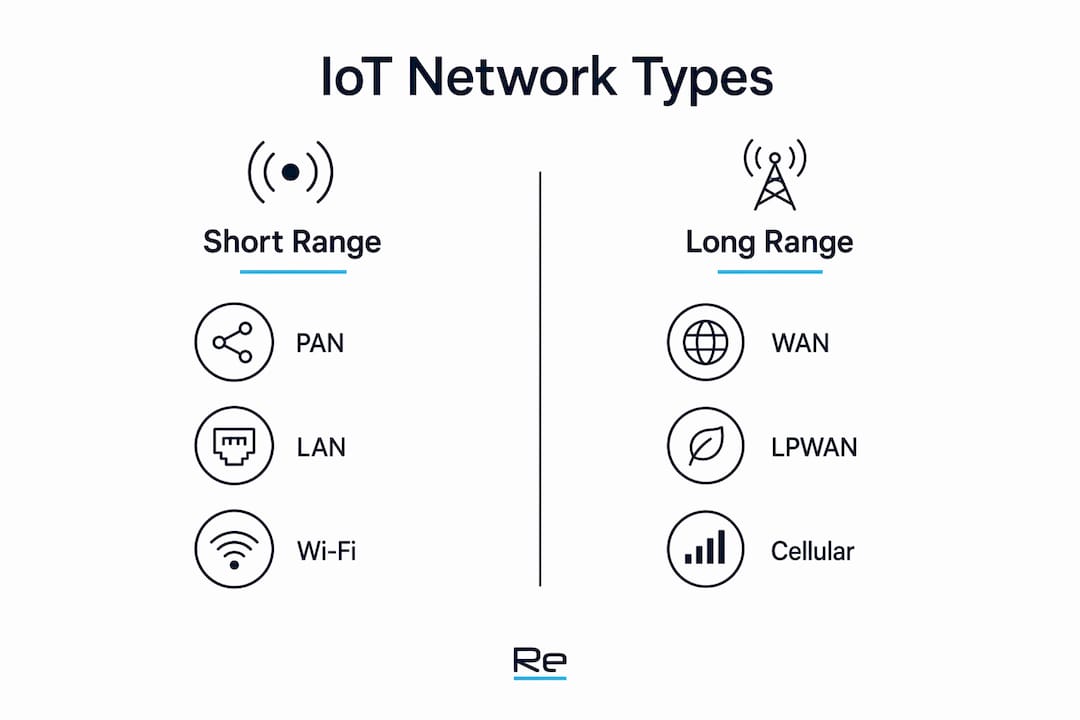
Bluetooth and Zigbee are the dominant PAN protocols for short-range, battery-powered devices. Wi-Fi suits high-throughput indoor deployments but draws significant power, making it unsuitable for battery-operated field sensors. Cellular LTE and 5G deliver national coverage but carry higher data costs and power demands. LPWAN technologies such as LoRaWAN are specifically engineered for devices that transmit small payloads infrequently over long distances on a single battery charge lasting years.
Choosing connectivity is about matching bandwidth, latency, and cost to device telemetry needs, not simply picking the most powerful network. A soil moisture sensor reporting once per hour needs LoRaWAN, not 5G. Getting this match right from the outset prevents expensive retrofitting later.
What are the main IoT network topologies?
Network topology defines how devices connect to each other and to the wider infrastructure. The three most relevant topologies for IoT are star, mesh, and hybrid.
Star topology connects all devices to a central hub or gateway. It is straightforward to manage and troubleshoot because every device has a single, predictable path. The critical limitation is a single point of failure: if the central hub goes offline, the entire network loses connectivity. Star topologies suit controlled indoor environments where the hub can be made highly available, such as a server room or a managed network cabinet.
Mesh topology allows devices to relay data through each other, creating multiple redundant paths. This delivers excellent fault tolerance and extends coverage without additional infrastructure. The trade-off is increased power consumption on relay nodes, which shortens battery life and raises operational costs over time. Mesh is well-suited to large industrial sites, smart city deployments, and environments where laying cable is impractical.
Hybrid architectures blend both approaches. A typical industrial deployment might use a star topology within each production zone, with mesh connectivity linking zones across a large facility. This balances manageability with resilience.
Protocol choice interacts directly with topology. MQTT (Message Queuing Telemetry Transport) is the dominant protocol for star and hybrid IoT architectures because it is lightweight and designed for unreliable networks. CoAP (Constrained Application Protocol) suits resource-constrained devices communicating over UDP. Matching protocol to topology and device capability is a design decision that affects reliability at scale.
- Star: Simple management, single point of failure, suited to controlled environments.
- Mesh: High redundancy, extended range, higher power draw on relay nodes.
- Hybrid: Balances manageability and resilience, common in industrial and campus deployments.
- MQTT: Lightweight, publish-subscribe model, ideal for unreliable or intermittent connections.
- CoAP: Designed for constrained devices, uses UDP, suited to low-power mesh nodes.
Pro Tip: When specifying topology for a new IoT deployment, map battery replacement cycles against relay node positions in mesh designs. A node that doubles as a relay may need its battery replaced three times more frequently than a leaf node, which has a direct impact on maintenance costs.
How should IoT networks be deployed in practice?
IoT networks incorporate three primary communication models: device-to-device, device-to-gateway, and device-to-cloud. Each suits different environments and scales, and most enterprise deployments use a combination.
-
Device-to-cloud. Devices connect directly to a cloud platform such as AWS IoT Core or Azure IoT Hub. This model suits devices with reliable, always-on connectivity and removes the need for on-premises gateway infrastructure. The limitation is latency: a device waiting for a cloud round-trip to trigger a local action is unsuitable for time-sensitive industrial control.
-
Device-to-gateway. Devices connect to a local gateway that aggregates data, translates protocols, and forwards processed information upstream. Gateways are the workhorses of enterprise IoT. They handle protocol translation between Zigbee or LoRaWAN devices and IP networks, apply local filtering to reduce bandwidth consumption, and maintain local operation if the WAN link drops.
-
Edge computing. Edge computing reduces latency and bandwidth use by processing data close to the devices. In a manufacturing context, an edge server on the factory floor can detect a machine anomaly and trigger a shutdown in milliseconds, without waiting for a cloud response. This is critical in safety-sensitive or real-time control applications.
-
Hybrid models. Most mature deployments combine edge processing for latency-sensitive tasks with cloud processing for analytics, reporting, and long-term storage. This balances operational resilience with analytical capability.
Integration with upstream cloud platforms requires reliable routing, firewall policies, and sometimes store-and-forward behaviour to handle intermittent connectivity. A gateway that buffers data locally during a WAN outage and synchronises when connectivity is restored is far more operationally reliable than one that simply drops data.
Pro Tip: Plan capacity for future device additions before go-live. Capacity planning for seasonal spikes and device growth is critical to avoiding network downtime during scaling. A network designed for 500 devices that receives 1,500 within 18 months will degrade without headroom built into the original design.
For guidance on aligning deployment architecture with your existing infrastructure, Re-solution’s network solutions guide covers connectivity selection in practical terms.
What are the benefits and challenges of IoT networks?
IoT networks deliver measurable operational value across manufacturing, logistics, smart cities, and hospitality. The benefits are concrete, but so are the challenges, and both deserve equal attention from IT leaders.
Key benefits:
- Real-time data from sensors enables faster, evidence-based decisions. A logistics operator tracking vehicle location and temperature simultaneously can intervene before a cold-chain breach occurs, not after.
- Automation reduces manual intervention. Smart building systems that adjust lighting and HVAC based on occupancy data cut energy consumption without requiring staff input.
- Predictive maintenance, enabled by vibration and thermal sensors on production equipment, reduces unplanned downtime in manufacturing environments.
Key challenges:
- Security exposure is the most significant risk. Segmenting devices into separate trust zones contains faults and reduces the blast radius of a breach. Flat networks without segmentation create a direct path from a compromised sensor to core business systems. For a deeper view of this risk, Re-solution’s guidance on IoT security covers trust zone design in detail.
- Device diversity creates management complexity. A single deployment may include devices from dozens of manufacturers running different firmware versions, operating systems, and communication protocols.
- Scalability requires forward planning. Adding devices to a network not designed for growth causes congestion, increased latency, and reliability issues.
The most successful IoT deployments treat the network as a governed infrastructure asset, with defined security policies, lifecycle management, and capacity reviews, rather than an ad-hoc collection of connected devices.
Key takeaways
Effective IoT network design requires matching connectivity type, topology, and deployment architecture to the specific demands of the devices and use cases involved.
| Point | Details |
|---|---|
| Four-layer architecture | Every IoT network spans perception, network, processing, and application layers, each requiring independent design decisions. |
| Match connectivity to device needs | Selecting LoRaWAN, Wi-Fi, or 5G depends on range, power budget, and data rate requirements, not on which technology is newest. |
| Topology trade-offs are real | Star topologies are simple but fragile; mesh topologies are resilient but power-hungry. Hybrid designs balance both for industrial use. |
| Segmentation is non-negotiable | Flat IoT networks create direct security exposure. Trust zone separation is a baseline requirement, not an optional enhancement. |
| Plan for growth from day one | Capacity planning for device additions and seasonal spikes prevents costly redesigns and operational disruption during scaling. |
Why IoT network governance is the real challenge
Having worked with IT teams across manufacturing, education, and logistics, the pattern I see most often is this: organisations treat IoT as a device procurement exercise rather than a network governance challenge. They buy the sensors, connect them to the existing Wi-Fi, and wonder why the network degrades six months later.
The architecture decisions that matter most, topology selection, segmentation, protocol choice, and capacity headroom, are made at the start or not at all. Retrofitting segmentation into a flat network with 800 live devices is a painful and expensive process. Getting it right at the design stage costs a fraction of the remediation.
I am also watching the emergence of AI orchestration layers with genuine interest. Platforms that use machine learning to dynamically adjust routing, predict device failures, and optimise power consumption across a mesh network represent a meaningful step forward. The AI orchestration layer concept is moving from research into production deployments, and IT leaders planning multi-year IoT programmes should factor it into their architecture roadmaps now.
Software-defined networking applied to IoT, where policy and topology are managed centrally through software rather than per-device configuration, is the direction the industry is heading. Organisations that build their IoT networks on programmable, policy-driven infrastructure today will adapt far more easily to that future than those locked into static configurations.
— Jacob
How Re-solution supports IoT network infrastructure

Re-solution brings over 35 years of Cisco infrastructure expertise to IoT network design, deployment, and management. Whether you are planning a first IoT deployment or rearchitecting an existing network to support device growth, Re-solution’s team provides the technical depth to get the design right from the outset.
From managed IT services that cover ongoing network monitoring and security to infrastructure consultancy covering architecture, segmentation, and capacity planning, Re-solution works with organisations in manufacturing, education, logistics, and hospitality. Explore the IT infrastructure pages to understand how Re-solution approaches IoT-ready network design for your sector.
FAQ
What is an IoT network in simple terms?
An IoT network is a system of physical devices connected through communication technologies to exchange data automatically. Devices range from industrial sensors and smart meters to building management systems and logistics trackers.
What are the four layers of IoT architecture?
The four layers are the perception layer (devices and sensors), the network layer (connectivity protocols), the processing layer (edge or cloud computing), and the application layer (dashboards and automated workflows).
Which IoT network type is best for long-range, low-power devices?
LPWAN technologies such as LoRaWAN and LTE-M are designed specifically for long-range, low-power deployments. They support devices that transmit small data payloads infrequently, often running on a single battery for several years.
Why is network segmentation important in IoT deployments?
Segmentation places devices into separate trust zones, limiting the spread of faults and containing the impact of a security breach. A flat, unsegmented IoT network creates a direct path from a compromised device to core business systems.
What is the difference between edge computing and cloud computing in IoT?
Edge computing processes data locally, close to the devices, reducing latency and maintaining operation during WAN outages. Cloud computing offers greater analytical capacity and long-term storage but introduces latency unsuitable for real-time control applications.
Recommended
- IoT security explained for IT decision-makers
- IT Infrastructure Explained Simply | Re-Solution
- Network optimisation explained: Smart strategies for IT leaders