TL;DR:
- Effective access control depends on comprehensive audits, linking HR data to group-based policies, and managing policies as code. Ongoing governance, including regular reviews and clear ownership, is essential to maintain security and compliance. Many failures occur when organizations treat access control as a one-time technical setup rather than a living, actively managed system.
Access control is defined as the process of determining who can access which systems, data, and resources within an organisation, and enforcing those decisions consistently. Getting this right sits at the heart of every credible security posture. Frameworks such as NIST SP 800-63 and Zero Trust both treat access control implementation as a foundational requirement, not an optional layer. Compliance obligations under GDPR, HIPAA, and SOC 2 make the stakes even higher. This guide gives IT professionals a practical, step-by-step path to establish effective access controls that hold up under audit and scale with the organisation.
What do you need before establishing access controls?
Preparation determines whether your access control implementation succeeds or collapses under its own weight. Organisations that skip the assessment phase routinely discover orphaned accounts and privilege creep as the primary vectors for breaches. Cleaning up the existing environment before layering on new controls is not optional.

The preparatory work falls into three areas:
1. Conduct a comprehensive access and entitlement audit
Map every existing permission, account, and system access across the organisation. Pay particular attention to orphaned accounts from former employees, service accounts with excessive rights, and shadow IT applications that bypass central controls. This audit produces the baseline you need to design meaningful access control policies.
2. Establish your identity provider and HR integration
Your Identity Provider (IdP), whether that is Microsoft Entra ID, Okta, or a comparable platform, must connect directly to your HR system. Linking IdP to HR makes the HR system the authoritative source for employment status, department, and role. Without this link, group membership becomes stale the moment someone changes role or leaves the organisation.
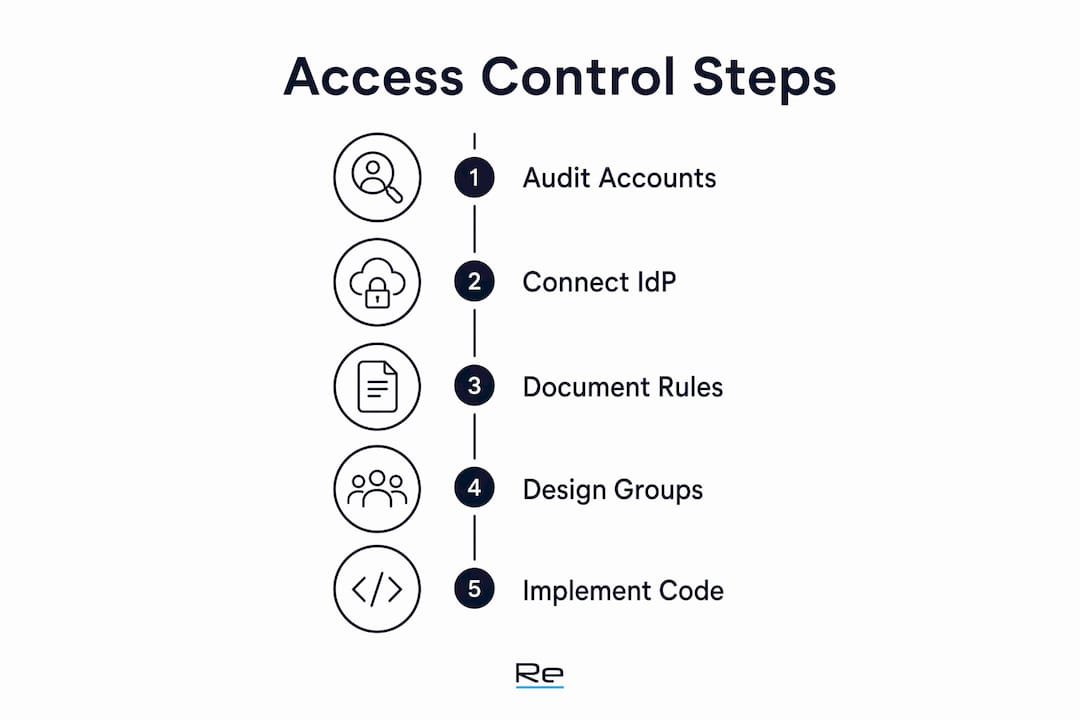
3. Document your regulatory requirements
List every compliance framework that applies to your organisation. GDPR, HIPAA, and SOC 2 each carry specific requirements around who can access personal data, audit logging, and access reviews. Document these requirements before you design a single policy.
The table below summarises the tools and documentation you need before implementation begins.
| Category | What you need |
|---|---|
| Identity infrastructure | IdP connected to HR system |
| Audit tooling | Entitlement management or IAM audit platform |
| HR system | Authoritative source for role and status data |
| Compliance documentation | Mapped regulatory requirements per system |
| Access inventory | Full list of systems, data classifications, and current permissions |
Pro Tip: Run your entitlement audit against your HR system simultaneously. Any account that has no matching active employee record is an orphaned account and should be disabled immediately.
How do you design a group-based access control structure?
Group-based access control (GBAC) is the most practical model for organisations with 100–1,000 employees. It assigns permissions to groups rather than individuals, which means a single role change in the HR system can update access across dozens of applications automatically.
A well-designed GBAC structure follows these steps:
- Define your group taxonomy. Mid-market organisations typically start with 20–40 groups mapped directly to HR attributes such as department, job role, location, and employment type. Keeping the number manageable prevents the structure from becoming unworkable.
- Map groups to HR attributes. Each group should correspond to a specific combination of HR data fields. For example, a group called “Finance-UK-Permanent” would include all permanent employees in the UK finance department. This precision prevents over-provisioning.
- Automate lifecycle events. Connect group membership changes to HR lifecycle triggers: joiners, movers, and leavers. When an employee moves from finance to operations, the HR system update should automatically remove them from finance groups and add them to the relevant operations groups. Manual steps here are where errors accumulate.
- Layer context-aware policies on top of groups. Base group membership on HR attributes, then add contextual conditions such as device health status, network location, or time of access. A finance employee accessing payroll data from an unmanaged device on a public network should face additional authentication requirements, regardless of their group membership.
- Reserve ABAC for edge cases. Attribute-Based Access Control (ABAC) adds flexibility but also complexity. Use it only where group-based rules genuinely cannot meet the requirement.
The key principle is that groups handle the bulk of provisioning, and context handles the exceptions.
Pro Tip: Avoid creating groups for individuals or one-off projects. If a group has fewer than three members, it is almost certainly a sign that you need a different approach, such as a time-limited access request workflow instead.
Organisations that align their network access policy workflow with HR data from the outset find that ongoing maintenance drops significantly compared to manually managed permission sets.
How do you implement access control policies as code?
Defining access control policies as code is the practice of writing IAM rules in structured formats such as JSON, YAML, or HCL, and managing them through version control systems like Git. Policy-as-code delivers auditability and prevents configuration drift, two problems that plague manually managed environments.
The core benefits of this approach are:
- Version control. Every policy change is tracked, attributed to a specific engineer, and reversible. This is essential for SOC 2 and ISO 27001 audit trails.
- Consistency. Automation tools such as Terraform and Ansible apply policies identically across every environment, eliminating the “works in dev, broken in prod” problem that manual configuration creates.
- Reduced human error. Automated provisioning linked to HR data removes the manual steps where over-privileged accounts most commonly appear.
- Permission guardrails. Organisational-level guardrails prevent even administrators from granting permissions that violate security policy. This is a critical control that many organisations overlook until an audit exposes the gap.
The table below shows how policy-as-code compares to manual policy management across key dimensions.
| Dimension | Policy-as-code | Manual management |
|---|---|---|
| Auditability | Full version history in Git | Dependent on individual record-keeping |
| Consistency | Enforced by automation | Varies by engineer |
| Speed of change | Minutes via pipeline | Hours or days |
| Drift detection | Automated | Reactive, often post-incident |
| Compliance evidence | Generated automatically | Assembled manually |
Pro Tip: Start with a read-only policy-as-code pipeline before moving to automated enforcement. This lets you validate that the policies match your intent without risking production access disruptions.
Centralising identity management and enforcing guardrails at the organisational level means that even a misconfigured administrator account cannot grant permissions beyond what policy allows. That single control eliminates an entire category of insider threat and misconfiguration risk. For teams exploring how security and compliance align with infrastructure design, this is where the investment pays off most clearly.
How do you maintain access controls through governance and auditing?
Establishing access controls is a one-time event. Maintaining them is an ongoing discipline. Compliance regulations require organisations to document access requirements, map them to specific systems and teams, and review them regularly through a designated governance group. Without that structure, access control policies drift out of alignment with both the organisation and the regulatory environment.
A sustainable governance model includes the following elements:
- Assign clear ownership. Every system and data classification should have a named owner responsible for reviewing access requirements when regulations change or the organisation restructures.
- Schedule periodic access certifications. Quarterly or semi-annual reviews where managers confirm that their team members still require the access they hold. This catches privilege creep before it becomes a breach vector.
- Monitor continuously. Deploy tooling that flags anomalous access patterns in real time, such as a user accessing systems outside their normal working hours or from an unusual location.
- Audit for orphaned accounts and shadow IT. Run automated scans against your IdP and HR system to identify accounts with no active HR record, and applications in use that are not centrally managed.
- Update policies when standards change. GDPR guidance, HIPAA rules, and NIST publications are updated periodically. Your governance group must track these changes and update access control policies accordingly.
A phased IAM rollout that begins with assessment, moves to standardisation, and then implements automated workflows is the structure that most organisations find sustainable. The governance layer is what keeps that structure functioning after the initial deployment.
Pro Tip: Assign a specific individual, not a team, as the owner of each compliance mapping. Shared ownership means no one acts when a regulation changes. Named ownership means accountability is clear.
Understanding how access control fits within broader IT security measures helps governance teams prioritise their review cycles and allocate resources where the risk is highest.
Key takeaways
Effective access control implementation requires a structured sequence: audit first, design a group-based model linked to HR data, enforce policies as code, and sustain the system through named governance ownership.
| Point | Details |
|---|---|
| Audit before you build | Identify orphaned accounts and over-privileged users before deploying new controls. |
| Link IdP to HR | Make the HR system the authoritative source for group membership and lifecycle changes. |
| Use 20–40 groups | Map groups directly to HR attributes to keep the structure manageable and accurate. |
| Define policies as code | Use JSON, YAML, or HCL with tools like Terraform to enforce consistency and auditability. |
| Assign named governance owners | Shared ownership of compliance mappings leads to gaps; named individuals create accountability. |
Where most access control projects go wrong
The single most common failure I see is treating access control as a purely technical project. Teams deploy an IdP, configure some groups, and consider the job done. Six months later, a leaver’s account is still active, a contractor has admin rights to a production database, and no one can explain why.
The fix is not more technology. It is treating the HR system as the source of truth from day one. Dynamic, contextual access decisions grounded in real-time identity data are what Zero Trust actually means in practice. Static role assignments that no one reviews are the opposite of that.
The second failure is complexity for its own sake. ABAC is a powerful model, but I have watched organisations spend months building attribute-based policies that a well-designed group structure would have handled in a week. Start simple. Add complexity only where the business requirement genuinely demands it.
The third failure is ignoring guardrails. Without organisational-level guardrails, even well-intentioned administrators can grant permissions that violate least privilege. Policy-as-code with enforced guardrails is not bureaucracy. It is the mechanism that keeps your access control model honest over time.
The organisations that get this right share one characteristic: they treat access control as a living system, not a deployment milestone.
— Jacob
Re-solution’s approach to access control implementation
Re-solution brings over 35 years of Cisco infrastructure expertise to access control deployments across education, manufacturing, and hospitality sectors. Whether you need a full IT infrastructure assessment to baseline your current permissions, or a managed service to automate provisioning and policy enforcement, Re-solution’s team works with your existing environment rather than replacing it wholesale.
Re-solution’s managed IT services cover the full lifecycle: from initial entitlement audits and IdP integration through to ongoing compliance monitoring and access certification support. If your organisation needs to align access control policies with GDPR, SOC 2, or sector-specific regulations, Re-solution provides the technical depth and compliance knowledge to get there. Contact Re-solution to discuss your access control requirements and find out how a structured implementation can reduce your risk exposure from day one.
FAQ
What is the first step to establish access controls?
The first step is a comprehensive access and entitlement audit. This uncovers orphaned accounts, over-privileged users, and shadow IT before any new controls are deployed.
How many groups should a mid-market organisation use?
Mid-market organisations with 100–1,000 employees typically start with 20–40 groups mapped directly to HR attributes such as department, job role, and employment status.
What does policy-as-code mean for access control?
Policy-as-code means writing IAM rules in structured formats such as JSON, YAML, or HCL and managing them through version control tools like Terraform or Ansible, which ensures consistency and a full audit trail.
How does Zero Trust relate to access control?
Zero Trust treats every access request as untrusted by default, requiring continuous verification based on identity, device health, and location rather than relying on static role assignments or network perimeter trust.
How often should access control policies be reviewed?
Access certifications should run at least quarterly, with continuous monitoring in place to flag anomalous access patterns between formal review cycles.
Recommended
- Overview of access control systems: a 2026 guide
- Understanding firewall security: a 2026 guide
- Effective network access management for schools in 2026
- What is access control? A clear guide for 2026