TL;DR:
- Secure access involves controlling how authorized individuals and workloads access IT resources through identity verification and policy enforcement. It has evolved from broad network controls to identity-aware, application-specific enforcement like ZTNA and secretless methods, reducing lateral movement risk. Continuous governance, including regular access reviews and adherence to frameworks like NIST SP 800-207, is essential for maintaining a strong security posture.
Secure access is defined as the controlled process by which authorised entities, whether human users or machine workloads, are granted entry to IT resources through verified identity, policy enforcement, and contextual checks. The industry term for this discipline is access governance, though “secure access” is the widely used operational shorthand across IT security teams. Explaining secure access matters because poor governance creates measurable risk: 97% of non-human identities carry excessive privileges, broadening the attack surface across every environment they touch. Frameworks such as NIST SP 800-207 (Zero Trust Architecture), NIST CSF 2.0, and the OWASP Non-Human Identity Top 10 all treat access governance as a foundational control, not an optional layer. Understanding where your organisation stands against these standards is the first step toward meaningful risk reduction.
What are secure access methods and how have they evolved?
Secure access methods have moved from broad network-level controls to granular, identity-aware enforcement at the application layer. This shift reflects a fundamental change in how organisations think about trust.
The evolution follows a clear progression:
-
Traditional VPNs. A VPN creates an encrypted tunnel between a remote device and the corporate network. Once connected, users typically gain access to large network segments. That broad access is the core weakness. A compromised VPN credential gives an attacker lateral movement across the same segments a legitimate user can reach.
-
Zero Trust Network Access (ZTNA). ZTNA enforces access per request, verifying identity, device posture, and context before granting entry to a specific application. The shift from VPN to ZTNA reduces risk by limiting access to individual apps rather than whole network segments. A user authenticated for a finance application cannot reach HR systems simply because they are on the same network.
-
Network Access Control (NAC). NAC evaluates device health and compliance status before allowing any connection. It works alongside ZTNA by ensuring that only devices meeting defined security posture requirements can participate in the network at all.
-
Secretless access. This method removes reliance on static, long-lived credentials entirely. Secretless access verifies machine identity at runtime and issues ephemeral authorisations, eliminating the risk of credential reuse or secret sprawl across service accounts and automated workloads.
-
Secure Access Service Edge (SASE). SASE converges networking and security into a single cloud-delivered framework. It combines ZTNA, secure web gateways, and cloud access security broker capabilities, applying consistent policy regardless of where users or workloads are located.
Pro Tip: Do not treat ZTNA as a VPN replacement alone. Its real value is enforcing least-privilege access at the application layer, which requires identity-aware policies built before deployment, not after.
The practical implication is clear. Legacy methods grant access and then trust. Modern methods verify continuously and grant the minimum access required for each specific task.

What key frameworks and security controls underpin secure access?
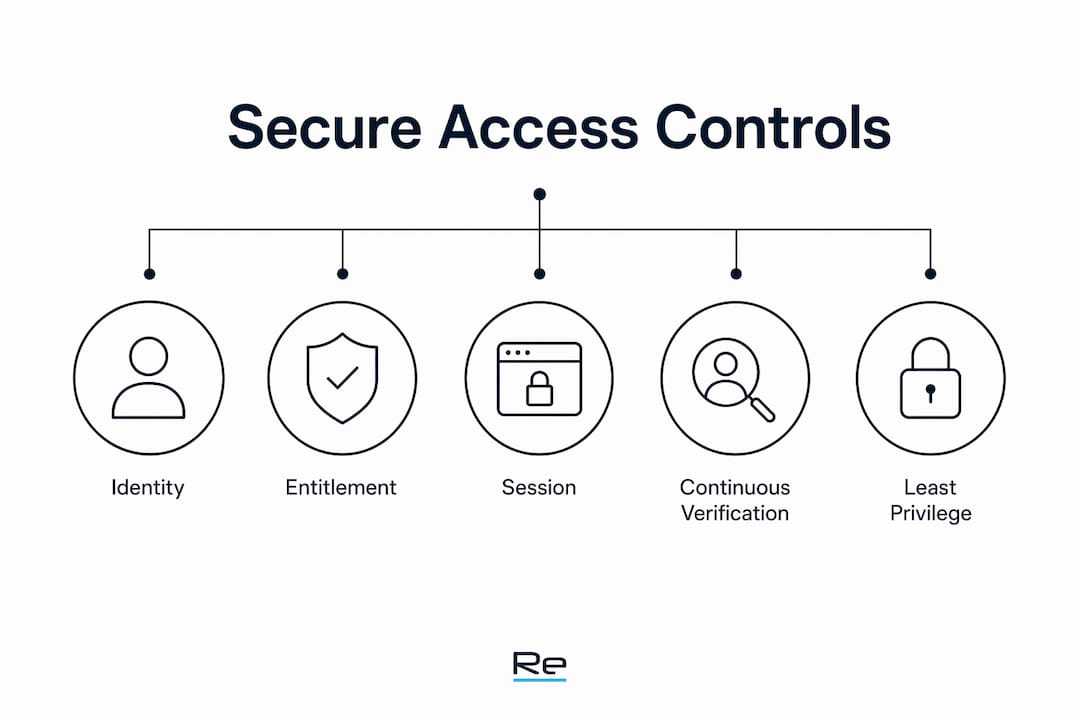
Secure access rests on a set of well-defined controls that, when applied together, create a defensible and auditable access posture.
Authentication versus authorisation
These two concepts are distinct and both are required. Authentication proves identity. Authorisation determines what that identity is permitted to do. Most security failures stem from flawed authorisation rather than authentication. That means verifying who someone is counts for little if their entitlements are not tightly scoped.
Core controls for secure access
- Multi-factor authentication (MFA). MFA requires two or more verification factors before granting access. It is the baseline control recommended by NIST CSF 2.0 and is non-negotiable for any privileged or remote access scenario.
- Identity proofing and device posture. Access decisions should incorporate device health checks alongside identity verification. A valid user on a compromised device represents a threat, not a trusted connection.
- Least privilege. Every user and workload receives only the permissions required for their specific task. Access control models such as Role-Based Access Control (RBAC), Attribute-Based Access Control (ABAC), and Mandatory Access Control (MAC) each provide mechanisms for enforcing least privilege at different levels of granularity.
- Just-in-time (JIT) elevation. Privileged access is granted on demand for a defined period and revoked automatically. This eliminates standing privileges that remain active long after they are needed.
- Session logging and audit trails. Every access event should be logged with sufficient detail to support forensic investigation. Accountability requires evidence, and evidence requires logging.
Pro Tip: Map your existing controls to NIST SP 800-207 before selecting new technology. The framework identifies gaps in policy, not just tooling, which is where most access failures originate.
The identity-centric access model that underpins these controls is now the recognised standard for modern IT security. Perimeter-based thinking, where the firewall is the primary defence, no longer reflects how resources are accessed or where threats originate.
How does secure access governance differ from secure remote access and privileged access?
These three terms are frequently conflated, and that confusion leads to real gaps in protection. Each addresses a different layer of the access problem.
Secure remote access is about connectivity control. It governs how users connect to resources from outside the corporate perimeter. Technologies like ZTNA and VPN sit in this category. The question secure remote access answers is: can this entity reach the network or application?
Governed privileged access is about entitlement and session control. It governs what privileged accounts can do once they are inside a system. Privileged Access Management (PAM) tools, JIT elevation, and command restriction sit in this category. The question governed privileged access answers is: what can this entity do, and for how long?
Secure access governance spans both. It is the overarching discipline that manages human and non-human identities with evidenceable accountability across connectivity and entitlement layers.
The consequences of conflating these concepts are significant:
- Teams that focus only on remote access controls leave privileged entitlements ungoverned inside the perimeter.
- Teams that focus only on PAM may have strong session controls but weak authentication at the network boundary.
- Neither approach alone satisfies the requirements of NIST SP 800-207 or ISO 27001 access control clauses.
Practical governance controls that bridge both layers include:
- Short-lived credentials that expire after a defined session window.
- Session recording for privileged access, with approval workflows for sensitive commands.
- Automated access reviews that flag and remove stale entitlements on a defined schedule.
- Separation of duties controls that prevent a single account from holding both administrative and audit permissions.
A secure network tunnel alone does not equal secure access. Session governance and least-privilege enforcement are required to limit lateral movement once a connection is established.
What are practical strategies for achieving and maintaining secure access?
Achieving secure access is not a one-time project. It is a continuous programme of policy, technology, and review. The following steps reflect what works in practice for IT and security management teams.
-
Inventory and classify all resources and identities. You cannot govern what you cannot see. Only 5.7% of organisations have full visibility into their service accounts. Start with a complete inventory of users, service accounts, devices, and applications, then classify each by sensitivity and risk.
-
Define identity-aware, resource-specific policies. Generic policies that apply the same rules to all users create unnecessary risk. Policies should specify who can access which resource, from which device type, under which conditions, and for how long.
-
Implement MFA and continuous context verification. MFA at login is the minimum. Continuous verification during a session, checking device posture or location changes, catches threats that static authentication misses. Explore identity and device verification approaches that align with Zero Trust principles.
-
Adopt secretless techniques for machine identities. Long-lived hardcoded credentials are a critical pitfall. Replace static API keys and service account passwords with runtime identity verification and ephemeral authorisations wherever possible.
-
Conduct regular access reviews and remove stale entitlements. Access accumulates over time. Users change roles, projects end, and contractors leave. Automated access reviews on a quarterly cycle prevent privilege accumulation from becoming a standing vulnerability.
-
Centralise logging and monitoring. All access events, successful and failed, should feed into a centralised Security Information and Event Management (SIEM) system. Centralised logging supports both real-time detection and post-incident investigation. Re-solution’s network monitoring guidance covers practical approaches to visibility across complex environments.
-
Balance security controls with operational efficiency. Overly restrictive access policies create friction that drives users to workarounds. Design access workflows that are secure by default but do not impede legitimate work. JIT elevation, for example, adds a brief approval step rather than permanently blocking access.
Pro Tip: Run a tabletop exercise simulating a compromised service account before deploying new access controls. The exercise will surface policy gaps that documentation reviews miss.
The access control framework you choose matters less than the consistency with which you apply and review it. Governance discipline, not technology alone, determines whether secure access holds under pressure.
Key takeaways
Secure access governance requires continuous enforcement across identity, entitlement, and session layers, not a single technology deployment.
| Point | Details |
|---|---|
| Define before you deploy | Map identities, resources, and entitlements before selecting access control technology. |
| ZTNA replaces broad network trust | Zero Trust Network Access limits each session to a specific application, reducing lateral movement risk. |
| Authorisation failures dominate | Most access breaches stem from excessive entitlements, not weak authentication. |
| Non-human identities need governance | Service accounts and workloads carry the same risk as human users and require the same controls. |
| Governance is continuous | Quarterly access reviews, session logging, and JIT elevation sustain secure access over time. |
The identity-centric shift most teams underestimate
After working across IT infrastructure and security projects for many years, the pattern I see most consistently is this: organisations invest heavily in perimeter controls and then treat everything inside as trusted. That assumption is the root cause of most significant access failures I have encountered.
The move to identity-centric access models is not simply a technology upgrade. It requires a change in how teams think about trust. Every connection, whether from a human user, a service account, or an automated pipeline, should be treated as untrusted until verified. That principle sounds straightforward, but applying it consistently across hybrid environments, legacy systems, and cloud workloads is genuinely difficult.
The non-human identity problem is particularly underappreciated. Service accounts accumulate permissions quietly, and most teams have no clear picture of what those accounts can reach. The privileged access controls that work well for human users often do not extend to machine workloads at all.
Secretless and ephemeral access techniques represent the most promising direction for reducing this risk at scale. They are not yet universally adopted, but the trajectory is clear. Governance mindset, applied consistently across both human and machine identities, is what separates organisations that manage access risk from those that discover it after an incident.
— Jacob
How Re-solution supports your secure access programme
Re-solution brings over 35 years of Cisco infrastructure expertise to secure access challenges across education, manufacturing, hospitality, and logistics environments.

Whether you are assessing your current access posture, moving from legacy VPN to Cisco Zero Trust solutions, or building a governance programme that covers both human and non-human identities, Re-solution provides the consulting and managed services to support each stage. The team also delivers SASE implementations that converge networking and security into a single, policy-driven framework. For organisations that need a structured starting point, Re-solution’s network access controller guidance outlines how to apply access controls consistently across complex environments. Contact Re-solution to arrange a bespoke assessment of your access governance posture.
FAQ
What is secure access in IT security?
Secure access is the controlled process by which authorised users and devices are granted entry to IT resources through identity verification, policy enforcement, and contextual checks. It combines authentication, authorisation, and session governance to protect data and systems from unauthorised use.
What is the difference between ZTNA and a VPN?
A VPN grants broad network access once a user authenticates, while ZTNA enforces access per request at the application level, verifying identity, device posture, and context each time. ZTNA significantly reduces lateral movement risk compared to traditional VPN architectures.
Why do most secure access failures involve authorisation rather than authentication?
Authentication confirms identity, but authorisation determines what that identity can do. Excessive or poorly scoped entitlements are far more common than weak identity proofing, and they create larger attack surfaces that are harder to detect and remediate.
What is secretless access and why does it matter?
Secretless access removes static, long-lived credentials from machine-to-machine communication by verifying identity at runtime and issuing ephemeral authorisations. This eliminates secret sprawl and credential reuse, which are among the most exploited vulnerabilities in automated workloads.
How often should organisations review access entitlements?
Access reviews should run on at least a quarterly cycle, with automated flagging of stale or excessive permissions between cycles. Regular reviews prevent privilege accumulation, which is one of the most common and least visible access risks in enterprise environments.
Recommended
- IT security measures list: 2026 guide for IT teams
- Secure network architecture: a practical guide for IT leaders
- Examples of secure access solutions for IT managers
- Essential Guide: How to Secure Sensitive Data Fast | Cisco Cloud, Security & Datacenter Experts