TL;DR:
- IoT connects building systems into a data-driven ecosystem that enhances energy efficiency, security, and occupant comfort. Proper integration requires focus on network infrastructure, cybersecurity, and collaboration between IT and facility teams for successful smart building deployment. Without unified IoT infrastructure, buildings risk falling behind regulatory standards, tenant demands, and operational resilience.
The role of IoT in smart buildings is to connect every building system, from HVAC and lighting to access control and energy metering, into a single, data-driven ecosystem. Industry research shows that building automation systems reduce overall energy consumption by 20–40% and peak demand by 15–30%. For facility managers and building owners, that is not a marginal gain. It is the difference between a building that reacts to problems and one that prevents them entirely.
How does IoT technology enhance energy efficiency in smart buildings?
IoT technology in buildings delivers its greatest measurable return through energy management. A building automation system (BAS) integrates HVAC, lighting, metering, and utilities under centralised control, replacing manual schedules with real-time, sensor-driven decisions.
The energy savings are well documented. Comprehensive BAS deployments reduce overall energy consumption by 20–40% and cut peak demand by 15–30%. HVAC-specific AI control can yield savings of 30–70% in climate control alone. Investment recovery typically occurs within 3–6 years for properly implemented systems.
Key applications that drive these results include:
- Occupancy-based HVAC control: CO2 and motion sensors adjust ventilation and temperature only when spaces are occupied, eliminating waste in empty zones.
- Adaptive lighting: Daylight harvesting sensors dim or switch off artificial lighting when natural light is sufficient. Smart lighting deployments have achieved energy savings as high as 73.2%.
- Peak demand management: IoT platforms shift non-critical loads away from peak tariff periods, reducing electricity costs without affecting occupant comfort.
- Renewable integration: Real-time generation data from solar panels feeds directly into the BAS, allowing the building to prioritise on-site energy before drawing from the grid.
Continuous monitoring is what separates a smart building from a building with timers. Sensors generate a constant stream of data that AI algorithms use to anticipate demand rather than simply respond to it. Predictive optimisation via unified data platforms shifts management from reactive alarms to anticipating equipment failures and occupancy patterns before they become problems.
Pro Tip: Before deploying new sensors, audit your existing BAS for data gaps. Many buildings already have sensors installed but lack the middleware to surface that data centrally. Connecting existing hardware through an IoT gateway is often faster and cheaper than a full replacement.
How does IoT improve security and safety in smart buildings?
IoT-enabled security goes well beyond CCTV cameras and key fobs. Modern smart building platforms integrate access control, surveillance, fire alarms, intruder detection, and emergency response systems into a single management layer. That integration enables automated alerting, cross-system correlation, and faster incident response.
Specific security capabilities that IoT delivers include:
- Real-time access monitoring: Every door event, credential use, and tailgating alert is logged and visible in a central dashboard.
- Automated lockdown protocols: A fire alarm trigger can simultaneously release magnetic door locks, alert emergency services, and send occupant notifications without manual intervention.
- Video analytics: AI-powered cameras detect unusual behaviour patterns, such as loitering or perimeter breaches, and raise alerts before an incident escalates.
- Predictive maintenance for safety systems: Sensor data from fire suppression equipment and emergency lighting flags degradation before a compliance failure occurs.
Cybersecurity is the dimension that many facility managers underestimate. Connecting building systems to a network expands the attack surface considerably. Security must be integrated from the beginning with zero trust architecture, encrypted communication, and compliance with IEC 62443-4-2 to protect expanded attack surfaces. Failure to prioritise cybersecurity early creates costly liabilities that are difficult to remediate after deployment.
Zero trust architecture means no device or user is trusted by default, even inside the network perimeter. Every connection is verified, every session is monitored, and access is granted on a least-privilege basis. For a building with hundreds of IoT endpoints, this model is the only credible baseline.
Pro Tip: Treat your building network as you would a corporate IT network. Segment IoT devices onto dedicated VLANs, enforce certificate-based authentication, and schedule quarterly network security reviews to catch configuration drift before it becomes a vulnerability.
How does IoT improve occupant comfort and indoor environmental quality?
Occupant comfort is a measurable outcome, not a subjective preference. IoT sensors monitoring CO2 levels, humidity, temperature, and occupancy enable dynamic adjustments that keep indoor environmental quality within defined parameters throughout the day.

The evidence for IoT’s impact on comfort is strong. IoT-enabled systems improve occupant comfort by over 20% on average, and advanced personalisation models achieve improvements up to 90% in some environments. That figure reflects what becomes possible when buildings respond to individual occupant preferences rather than fixed schedules.
The four primary comfort levers that IoT controls are:
- Thermal comfort: Personalised algorithms adjust zone temperatures based on occupancy data, time of day, and historical preference profiles, rather than a single building-wide setpoint.
- Air quality: CO2 and volatile organic compound (VOC) sensors trigger fresh air intake when levels rise, directly supporting cognitive performance and reducing sick-building complaints.
- Lighting quality: Circadian lighting systems adjust colour temperature and intensity throughout the day to align with natural light cycles, reducing eye strain and improving alertness.
- Acoustic environment: Occupancy sensors can trigger white noise systems or alert facilities teams to unusually high noise levels in areas designated for focused work.
Balancing comfort with energy efficiency is where IoT earns its complexity. A building that keeps every zone at the occupant’s ideal temperature will not achieve 40% energy savings. The practical answer is zoning: high-precision control in occupied areas, reduced conditioning in unoccupied ones. IoT makes that granularity possible at scale.
Pro Tip: Commission a baseline indoor air quality survey before deploying comfort sensors. Without a baseline, you cannot demonstrate improvement to occupants or report against WELL Building Standard benchmarks.
What are the key implementation considerations for facility managers?
Deploying IoT in an existing building does not require replacing every system. Overlay IoT deployments use gateways and sensors to retrofit existing HVAC, boilers, and lighting without replacing hardware. This approach lowers entry costs and accelerates adoption for buildings with legacy infrastructure.
The most common implementation pitfalls are:
- Data silos: Systems that do not share data cannot deliver integrated intelligence. A lighting system that does not communicate with HVAC cannot coordinate occupancy responses.
- Fragmented integration: Deploying IoT sensors without a unified platform means data sits in separate dashboards, requiring manual correlation and defeating the purpose of automation.
- Underestimating network requirements: Connectivity is the primary bottleneck for realising smart building benefits. Without unified data flow, IoT systems remain fragmented and cannot provide intelligent automation.
Network infrastructure is the foundation that everything else depends on. 5G, indoor small cells, and Wi-Fi 6 all have roles depending on building size, layout, and use case. A network infrastructure plan should be completed before any IoT hardware is specified, not after.
Collaboration between IT and facilities teams is equally critical. Facility managers need to work closely with IT departments to ensure IoT data is actionable, secure, and reliable. This gap is one of the most common adoption hurdles in practice. IT teams understand network security and data architecture; facilities teams understand operational requirements and equipment lifecycles. Neither group can deliver a functioning smart building without the other.
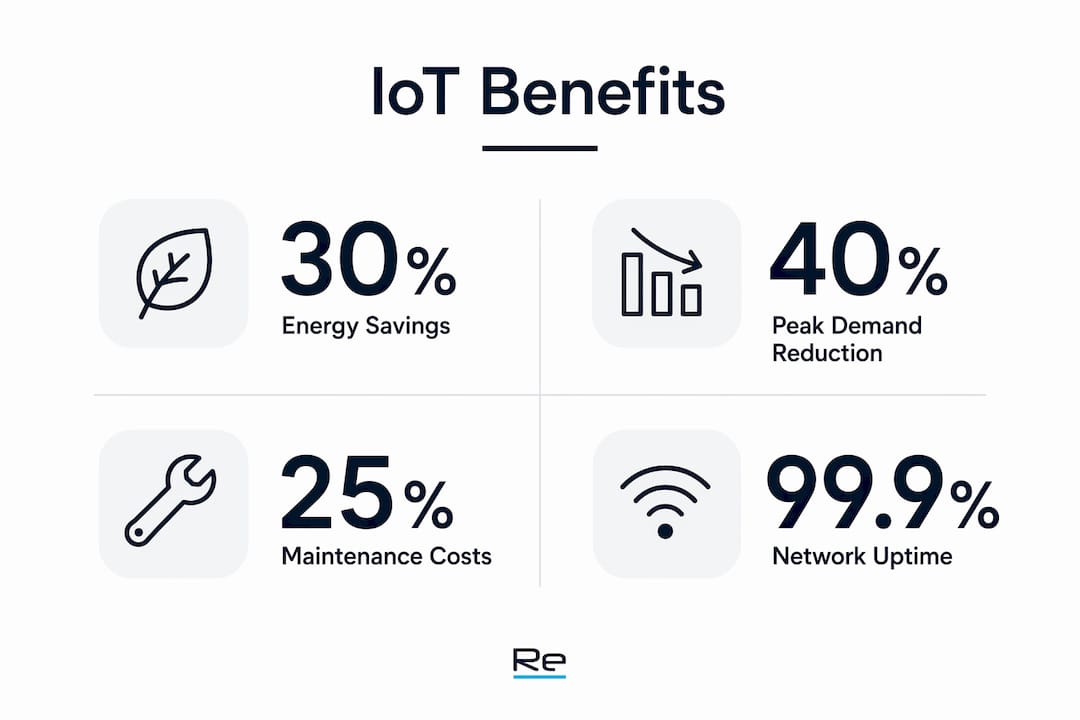
AI-integrated building automation platforms accelerate deployment and upgrade times by up to 40% and include native redundancy to ensure continuous uptime during maintenance or outages. That resilience matters in buildings where downtime affects occupants directly.
Pro Tip: Plan for phased upgrades rather than a single large deployment. Start with energy metering and occupancy sensing, prove the data value, then extend to HVAC control and access integration. Phasing reduces risk and builds internal confidence in the technology.
How does IoT align with sustainability and regulatory objectives?
Buildings account for roughly 40% of global greenhouse gas emissions. That single figure explains why regulators, investors, and tenants are all applying pressure on building owners to demonstrate measurable decarbonisation progress.
IoT-enabled building automation directly supports compliance with a growing body of regulation:
- EPBD (Energy Performance of Buildings Directive): Requires EU member states to mandate smart readiness indicators and near-zero energy standards for new and renovated buildings.
- LL97 (Local Law 97, New York City): Imposes carbon intensity limits on large buildings, with financial penalties for non-compliance from 2024 onwards.
- BREEAM and WELL Building Standard: Both frameworks reward buildings that demonstrate measurable environmental and occupant health performance, which IoT data makes possible.
IoT platforms generate the granular, time-stamped energy and environmental data that these frameworks require. Automated ESG reporting exports reduce the manual burden on facilities teams and improve data accuracy for audits. Smart buildings also serve as foundational infrastructure for broader smart city initiatives, influencing energy, health, transportation, and urban sustainability at a systemic level.
The shift from siloed building systems to a unified, AI-powered ecosystem is essential for decarbonisation and operational resilience. Regulatory pressure will only intensify through 2030, and buildings without IoT infrastructure will face increasing difficulty meeting compliance thresholds cost-effectively.
Key takeaways
IoT in smart buildings delivers the greatest value when connectivity, cybersecurity, and cross-system integration are treated as foundational requirements rather than afterthoughts.
| Point | Details |
|---|---|
| Energy savings are substantial | BAS with IoT reduces energy consumption by 20–40% and peak demand by 15–30%. |
| Cybersecurity is non-negotiable | Zero trust architecture and IEC 62443-4-2 compliance must be built in from the start. |
| Connectivity determines success | Network infrastructure planning must precede IoT hardware specification. |
| Overlay deployments reduce barriers | IoT gateways retrofit legacy systems without full hardware replacement. |
| Regulatory pressure is accelerating | Buildings must generate auditable energy and carbon data to meet EPBD, LL97, and ESG requirements. |
The part most guides leave out
The conversation about smart buildings tends to focus on hardware: sensors, cameras, thermostats, and access readers. What actually determines whether a building becomes genuinely intelligent is the network underneath it.
I have seen buildings with hundreds of thousands of pounds worth of IoT hardware installed, producing data that sits in three separate vendor dashboards with no integration between them. The HVAC system does not know the building is empty. The lighting does not respond to occupancy. The energy data cannot be exported for ESG reporting. The hardware works. The building does not.
The IT/OT gap is real and it is underestimated. Operational technology teams know their equipment. IT teams know their networks. Neither group typically has deep fluency in the other’s domain, and the integration layer between them is where most smart building projects stall. Closing that gap requires deliberate collaboration from the project’s earliest stages, not a handover meeting six months into deployment.
My honest view is that by 2030, buildings without unified IoT infrastructure will face a genuine competitive disadvantage. Tenants will demand comfort data. Investors will require carbon reporting. Regulators will mandate smart readiness. The buildings that have invested in smart building connectivity now will meet those requirements with data they already collect. The ones that have not will be retrofitting under pressure, at higher cost, and with less time to prove compliance.
Start with the network. Get the data flowing. Everything else follows.
— Jacob
How Re-solution supports smart building IoT projects
Smart building IoT projects succeed or fail at the network layer. Re-solution brings over 35 years of Cisco infrastructure experience to building connectivity projects, helping facility managers and property owners design networks that can carry the data load IoT demands.

Whether you are planning a new build or retrofitting an existing property, Re-solution’s team can audit your current infrastructure, identify connectivity gaps, and design a network architecture that supports BAS integration, IoT sensors, and cybersecurity compliance from day one. Start with Re-solution’s IT infrastructure guide to understand the technical foundations, or contact the team directly to discuss your building’s specific requirements. For buildings facing IT infrastructure challenges, Re-solution provides structured assessments that translate technical complexity into a clear upgrade path.
FAQ
What is the role of IoT in smart buildings?
IoT connects building systems such as HVAC, lighting, access control, and energy metering into a unified platform, enabling automated control, real-time monitoring, and data-driven decision-making. The result is measurable improvements in energy efficiency, security, and occupant comfort.
How much energy can IoT building automation save?
Building automation systems with IoT integration reduce overall energy consumption by 20–40% and peak demand by 15–30%, with HVAC-specific AI control delivering savings of up to 70% in climate control.
What cybersecurity standards apply to smart building IoT?
IEC 62443-4-2 is the baseline cybersecurity standard for building automation systems. Zero trust architecture and encrypted device communication are the recommended implementation approaches for protecting IoT endpoints.
Do older buildings need full system replacement to adopt IoT?
No. Overlay IoT deployments use gateways to retrofit existing HVAC, boilers, and lighting with sensors, enabling smart building upgrades without replacing legacy hardware.
How does smart building IoT support sustainability compliance?
IoT platforms generate the time-stamped energy and carbon data required by frameworks such as EPBD, BREEAM, and LL97, enabling automated ESG reporting and reducing the manual burden on facilities teams.
Recommended
- Smart Building Technologies Enhance Security | Re-Solution
- Connectivity planning for new builds: a developer’s guide
- Designing Smart Buildings with Security | Re-Solution