
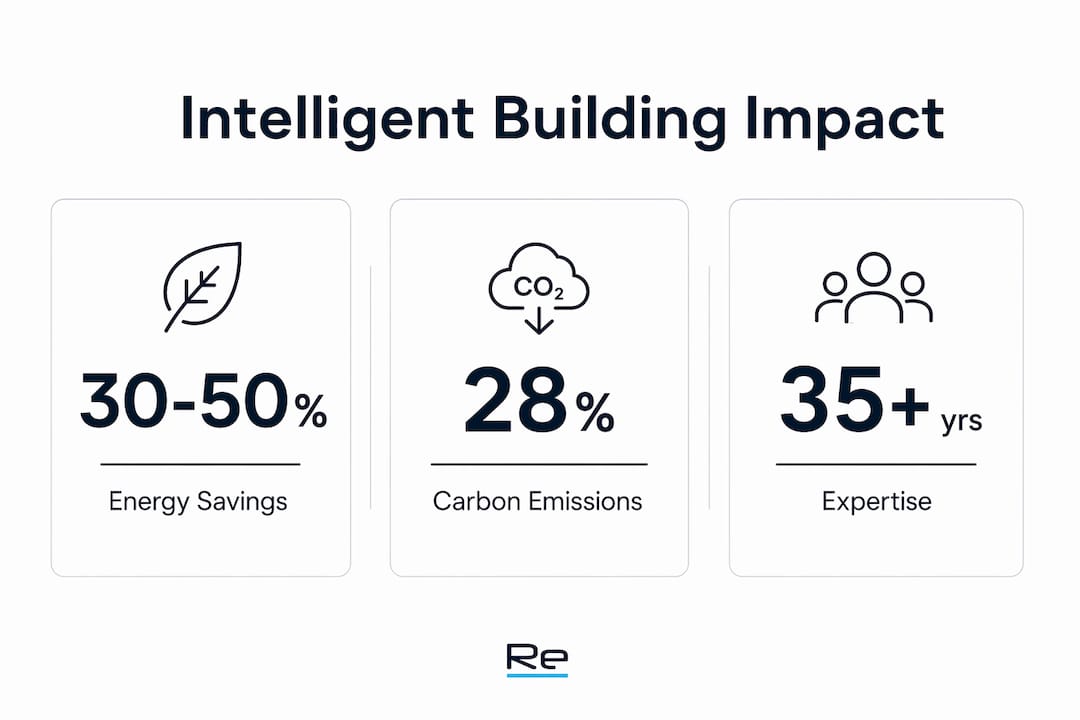
Intelligent building systems deliver energy savings of 30–50% in commercial buildings compared to the 5–15% achievable through isolated upgrades. For UK facility managers and property owners, that gap represents a fundamental shift in how buildings perform, not just a marginal efficiency gain. Beyond energy, these systems reduce operational costs, support predictive maintenance, and measurably improve occupant comfort and productivity.
Key impacts at a glance:
- Energy savings: Integrated systems achieve up to 2.37 kWh/sq. ft. in optimal scenarios, far exceeding single-system upgrades
- Payback periods: AI-driven optimisation systems deliver ROI with payback periods ranging from 1.1 to 5.8 years, with a median of approximately 3.45 years
- Operational performance: Predictive maintenance reduces unplanned downtime and lowers repair costs across HVAC, lighting, and security systems
- Occupant benefits: Automated climate control, air quality monitoring, and adaptive lighting directly support productivity and wellbeing
- UK compliance: Buildings must align with the UK’s net zero commitments and evolving building regulations, making intelligent systems a compliance asset as much as an operational one
- Core infrastructure: Platforms such as IBM Maximo Real Estate and Facilities and network hardware such as Cisco Meraki Switches form the backbone of many UK deployments
What do intelligent building systems actually consist of?
An intelligent building system (IBS) is a built environment that enables physical and digital interaction between occupants, operators, and building infrastructure at a level that traditional buildings cannot match. Where a connected building simply links systems together, an IBS optimises building performance, operational efficiency, and the occupant experience through data-driven automation and centralised control.
The architecture typically layers three tiers: physical devices and sensors at the edge, a building management system (BMS) or building automation system (BAS) in the middle, and cloud-based analytics and management platforms at the top. Integrated building systems connect HVAC, lighting, security, and energy management under centralised monitoring, replacing the siloed, independently operated equipment found in most legacy buildings.
Core components and their roles:
| Component | Primary role |
|---|---|
| IoT sensors | Collect real-time data on occupancy, temperature, air quality, and energy use |
| Building Management System (BMS) | Centralises control and automates responses across all connected systems |
| AI analytics engine | Identifies patterns, predicts faults, and optimises energy scheduling |
| HVAC systems | Adjust heating, ventilation, and cooling based on occupancy and external conditions |
| Lighting controls | Automate brightness and colour temperature by zone and time of day |
| Network infrastructure (e.g. Cisco Meraki Switches) | Provides the secure, high-availability backbone for device communication |
| Energy management platform (e.g. IBM Maximo Real Estate and Facilities) | Tracks asset performance, maintenance schedules, and energy consumption |
| Security and access control | Integrates cameras, sensors, and access systems into a unified monitoring layer |
Interoperability is the critical design challenge. Systems built on open protocols such as BACnet or MQTT communicate across vendors, while proprietary platforms often require middleware to bridge legacy equipment. The role of networking in smart buildings is therefore foundational: without a reliable, secure network layer, even the most capable sensors and analytics tools cannot deliver consistent results.
How do intelligent building systems cut energy costs?
Integrated systems achieve 30–50% energy savings in existing commercial buildings that would otherwise be inefficient. The mechanism is occupancy-based control combined with real-time monitoring and predictive energy scheduling. Rather than running HVAC and lighting on fixed timetables, an IBS reads actual occupancy patterns, weather forecasts, and utility rate signals, then adjusts consumption continuously.

| Energy-saving mechanism | Typical application |
|---|---|
| Occupancy-based HVAC control | Reduces heating and cooling in unoccupied zones automatically |
| Daylight-responsive lighting | Dims artificial lighting when natural light is sufficient |
| Demand response integration | Curtails peak loads in response to grid signals, reducing peak tariff exposure |
| Fault detection and diagnostics | Identifies simultaneous heating and cooling, blocked airflow, and inefficient equipment |
| Predictive energy scheduling | Shifts non-critical loads to off-peak periods based on tariff forecasting |
In the UK context, demand response capability is increasingly relevant. As the National Grid moves towards a more dynamic, renewables-heavy grid, buildings that can respond automatically to grid signals will avoid peak pricing and support grid stability. An IBS with grid-responsive controls can shift flexible loads such as pre-cooling or battery charging to periods of high renewable generation, reducing both cost and carbon intensity.
Statistic: Buildings with AI-driven energy optimisation achieve payback periods ranging from 1.1 to 5.8 years, with a median of approximately 3.45 years, making the financial case clear for most commercial portfolios.
One important caveat: the sensors, network switches, controllers, and gateways that enable building intelligence add a continuous baseload to the building’s energy consumption. This infrastructure draws power 24 hours a day regardless of whether the lights are on. Facility managers must account for this overhead when modelling net savings, particularly in smaller buildings where the ratio of infrastructure cost to floor area is less favourable.
How predictive maintenance transforms facility management
AI-based predictive maintenance reduces unplanned downtime and lowers maintenance costs by identifying equipment degradation before it causes failure. Traditional reactive maintenance waits for a fault to occur; scheduled preventive maintenance replaces parts on a calendar basis regardless of actual condition. Predictive maintenance uses sensor data and machine learning to intervene only when the data indicates a genuine risk, which reduces both emergency call-out costs and unnecessary part replacements.
Key operational improvements delivered by predictive maintenance in intelligent buildings:
- Early fault detection: Sensors identify anomalies such as a fan drawing excess current or a chiller operating outside normal temperature ranges before failure occurs
- Reduced repair costs: Addressing a developing fault costs a fraction of emergency replacement, particularly for HVAC plant
- Extended asset life: Continuous monitoring prevents the cumulative wear caused by undetected inefficiencies
- Streamlined work orders: Platforms such as IBM Maximo Real Estate and Facilities automatically generate prioritised work orders when sensor thresholds are breached
- Remote diagnostics: Facility teams can assess and often resolve issues without a site visit, reducing labour costs and response times
A practical UK example: the Burj Khalifa’s Honeywell-managed system reduced total maintenance hours for mechanical assets by 40% and improved availability to near 100% through continuous HVAC monitoring. While that is a high-profile international case, the same principle applies directly to UK commercial estates. A mid-sized office portfolio running IBM Maximo alongside networked sensors can consolidate maintenance scheduling, reduce contractor call-outs, and demonstrate compliance with planned preventive maintenance obligations under UK lease terms.
| Maintenance approach | Trigger | Cost profile |
|---|---|---|
| Reactive | Equipment failure | High: emergency labour, expedited parts |
| Scheduled preventive | Calendar interval | Medium: unnecessary replacements, labour overhead |
| Predictive (AI-driven) | Sensor-based condition data | Low: targeted intervention, minimal downtime |

Does an intelligent building actually improve occupant experience?
The short answer is yes, and the business case for occupant-focused investment is stronger than most energy-only analyses suggest. Research from Arcadis found that the true value of intelligent buildings often emerges in improved business metrics such as reduced absenteeism and higher productivity, surpassing the direct savings on energy or real estate costs.
Automated climate control adjusts temperature and ventilation in response to real-time occupancy and external weather, removing the manual thermostat conflicts that affect productivity in open-plan offices. Air quality monitoring tracks CO₂ levels, humidity, and particulate matter, triggering ventilation increases before occupants notice any discomfort. Adaptive lighting systems adjust colour temperature and brightness by zone and time of day, supporting circadian rhythms and reducing eye strain during long working hours.
User experience enhancements delivered by intelligent building systems:
- Personalised environment settings via desk-level controls or mobile applications
- Space utilisation data that informs desk booking, meeting room allocation, and occupancy planning
- Automated visitor management and access control integrated with building security
- Real-time energy and comfort dashboards visible to occupants, supporting an energy-conscious culture
- Faster fault resolution through automated alerts, reducing the time occupants spend in uncomfortable conditions
The smart building technology connection between comfort and commercial performance is well established. Buildings that demonstrably support occupant wellbeing attract and retain tenants more effectively, command higher rental premiums, and report lower churn. For property owners, that translates directly into asset value.
UK case studies: intelligent building systems in practice
The Crystal, London (Siemens)
The Crystal in Royal Victoria Dock draws 20% of its power from roof-mounted solar panels and uses IoT sensors to continuously monitor energy consumption across all systems. Its lighting adjusts automatically throughout the day to conserve energy, and the building consistently operates as one of the most energy-efficient large structures in the UK. Key outcomes:
- Solar generation covering a fifth of total energy demand
- Continuous IoT-based monitoring across HVAC, lighting, and security
- Recognised as a benchmark for sustainable intelligent building design in the UK
Empire State Building retrofit (New York, referenced for UK application)
Though US-based, this project is widely cited by UK property professionals as a retrofit model. The 102-storey building was retrofitted with a building management system and smart sensors targeting a 38% reduction in energy consumption and $4.4 million in annual energy cost savings. The lesson for UK facility managers is that intelligent systems are not exclusively for new builds. Retrofitting existing stock with networked sensors and a modern BMS delivers measurable returns without full redevelopment.
Government of Canada Smart Buildings Initiative (referenced for public-sector parallels)
The Canadian federal programme demonstrates the public-sector application of intelligent building principles directly relevant to UK government estate managers. The system collects thousands of data points every few minutes, covering temperature, pressure, and energy consumption across building systems, then identifies inefficiencies such as simultaneous heating and cooling or fans drawing excess energy. Outcomes include lower energy costs, reduced greenhouse gas emissions, and earlier fault diagnosis at lower remediation cost.
What does the research say about ROI and strategic adoption?
The economic case for intelligent building systems is well supported by recent systematic analysis. AI-driven building energy optimisation delivers payback periods from 1.1 to 5.8 years across a range of building types and climates, with a median of 3.45 years. That range reflects the variability in building size, baseline efficiency, and the scope of technology deployed.
RICS advises against deploying every available technology indiscriminately. The more productive approach is to match the level of intelligence to the specific needs of the space and the capacity of the team responsible for operating it. A building with a small facilities team and limited IT resource will not extract full value from a highly complex, multi-vendor system. Tailoring the solution to operational reality consistently outperforms maximum-specification deployments.
Pro Tip: Before specifying any intelligent building technology, map the actual usage patterns of each space and the maintenance capacity of your facilities team. Deploying occupancy sensors in a building where staff cannot act on the data adds cost without adding value.
The hidden energy overhead of sensors, network switches, and controllers running continuously is an under-recognised factor in ROI calculations. Facility managers who model net savings without accounting for this baseload risk overestimating returns, particularly in smaller buildings. Cybersecurity and interoperability also require dedicated budget lines. RICS identifies these as major failure points in mature intelligent building deployments, requiring secure network infrastructure and careful technical planning from the outset.
UK regulations and compliance affecting intelligent building systems
UK buildings face a growing body of regulation that makes intelligent systems a compliance requirement as much as a performance choice. The UK’s legally binding net zero target for 2050, supported by interim carbon budgets under the Climate Change Act 2008, places direct pressure on commercial building operators to demonstrate measurable emissions reductions.
The Minimum Energy Efficiency Standards (MEES) already prohibit the letting of commercial properties below an EPC rating of E, with proposals to raise the threshold to B by 2030 under current government consultations. Intelligent building systems that deliver documented energy reductions directly support EPC improvement programmes and protect lettable status. The UK Building Regulations Part L (Conservation of Fuel and Power) sets performance standards for new builds and major refurbishments, and compliance increasingly requires the kind of metered, verifiable performance data that only a connected BMS can provide.
The UK GDPR and the Data Protection Act 2018 apply directly to occupancy data, access logs, and any personally identifiable information collected by building sensors. Facility managers must ensure that data collection is proportionate, that retention periods are defined, and that occupants are informed. The smart building technologies security and compliance dimension is therefore inseparable from the technical deployment.
What barriers make implementation difficult in UK buildings?
Legacy infrastructure is the most common barrier. Most UK commercial buildings were constructed before networked building systems existed, and their electrical, mechanical, and IT infrastructure was not designed for integration. Retrofitting requires either complex middleware to bridge proprietary protocols or a phased replacement of legacy equipment, both of which add cost and project risk.
Budget allocation presents a structural challenge. Capital expenditure on intelligent systems competes with more visible refurbishment priorities, and the financial benefits, particularly occupant productivity gains, are harder to quantify in a traditional capex approval process. The IT infrastructure challenges associated with intelligent building deployments, including network capacity, Power over Ethernet (PoE) infrastructure, and cybersecurity architecture, are frequently underestimated at the planning stage.
Skills gaps compound the problem. Operating a mature intelligent building system requires facility staff who understand both the physical building and the digital layer. Many UK facilities teams have strong mechanical and electrical expertise but limited experience with network management, data analytics, or cybersecurity. Without investment in training or managed service support, complex systems are often operated at a fraction of their capability.
Interoperability between systems from different vendors remains technically demanding. Open standards such as BACnet, Modbus, and MQTT reduce but do not eliminate integration complexity, and proprietary platforms from major vendors frequently require custom integration work. Organisations that do not define interoperability requirements at the procurement stage often find themselves locked into single-vendor ecosystems that limit future flexibility.
Environmental and sustainability impacts beyond energy savings
Operational emissions account for 28% of all global energy-related carbon emissions, and intelligent building systems address this directly by reducing consumption across HVAC, lighting, and plug loads. For UK property owners with net zero commitments, that reduction is not incidental; it is the primary mechanism through which buildings contribute to decarbonisation targets.
The sustainability impact extends beyond direct energy use. Intelligent systems support water conservation through sensor-based monitoring of consumption and leak detection. Waste reduction benefits from space utilisation data that informs procurement and catering decisions in large commercial buildings. Air quality monitoring reduces the health burden associated with poor indoor environments, which carries both a human cost and a productivity cost for occupying organisations.
Integration with on-site renewable generation, principally solar photovoltaic, is increasingly standard in new UK intelligent building projects. A building management system that can read solar generation forecasts, battery state of charge, and grid tariff signals will automatically shift flexible loads to periods of high generation, maximising self-consumption and reducing grid import. This capability directly supports the UK’s Smart Export Guarantee framework and positions buildings as active participants in grid balancing rather than passive consumers.
Data security and privacy in intelligent building systems
Every connected device in an intelligent building is a potential entry point for a cyber attack. The attack surface of a fully integrated building, covering HVAC controllers, access control systems, IP cameras, occupancy sensors, and energy management platforms, is considerably larger than a conventional IT network. Cybersecurity and interoperability issues are identified as major failure points in mature intelligent building systems, requiring secure network infrastructure from the outset rather than as a retrofit.
Network segmentation is the foundational security control. Building operational technology (OT) networks should be isolated from corporate IT networks using VLANs and firewall policies, preventing a compromise of one system from propagating to another. Cisco Meraki Switches support this architecture natively, providing centralised policy management and visibility across both OT and IT segments from a single dashboard. Firmware update management, default credential replacement, and certificate-based authentication are baseline requirements that many deployments still overlook.
Privacy obligations under UK GDPR require that occupancy data, access logs, and any biometric data collected by building systems are processed lawfully, stored securely, and retained only as long as necessary. A data protection impact assessment (DPIA) is advisable for any deployment that involves tracking individual movement or behaviour within a building. Facility managers who treat data governance as an afterthought rather than a design requirement expose their organisations to both regulatory risk and reputational damage.
Pro Tip: Engage your IT security team at the design stage of any intelligent building project. Retrofitting network segmentation and access controls after deployment is significantly more expensive and disruptive than building them in from the start.
Key takeaways
Intelligent building systems deliver their greatest value when the technology is matched to the building’s actual usage patterns, the operational capacity of the facilities team, and a clearly defined compliance and sustainability objective.
| Point | Details |
|---|---|
| Energy savings are substantial | Integrated systems achieve 30–50% energy savings, far exceeding the 5–15% from isolated upgrades. |
| Payback periods are predictable | AI-driven optimisation delivers payback in 1.1–5.8 years, with a median of approximately 3.45 years. |
| Occupant value exceeds energy savings | Productivity and absenteeism improvements often outweigh direct energy cost reductions in total return. |
| Baseload overhead must be modelled | Sensors and network devices add continuous power consumption that must be included in net savings calculations. |
| Security requires design-stage planning | Cybersecurity and interoperability are the most common failure points; network segmentation and access controls must be built in from the outset. |

How Re-solution supports intelligent building deployments
Re-solution brings over 35 years of Cisco infrastructure expertise to intelligent building projects across the UK. As a trusted Cisco partner, Re-solution designs and deploys the network layer that underpins every intelligent building function, from Cisco Meraki Switches providing secure network switching for OT and IT environments, to Network as a Service models that reduce capital expenditure and shift infrastructure management to a predictable monthly cost.
For facility managers and property owners planning an intelligent building deployment or upgrade, Re-solution’s IT infrastructure guidance and infrastructure audit services provide the technical foundation to specify, deploy, and operate connected building systems with confidence. Whether you are retrofitting a legacy estate or specifying connectivity for a new development, Re-solution’s team can assess your current infrastructure, identify gaps, and design a network architecture that supports your building’s performance and compliance objectives.
Contact Re-solution to discuss your building’s network and connectivity requirements.
Recommended
- Designing Smart Buildings with Security | Re-Solution
- Smart Building Technologies Enhance Security | Re-Solution
- Smart building technology for operational efficiency