Up to 90% of successful cyberattacks and a large portion of data breaches originate at endpoint devices. That single figure reframes the entire conversation about where organisations should concentrate their security investment. The average cost of a data breach now stands at USD 4.44 million, and with remote working and BYOD policies expanding the device estate far beyond the traditional network perimeter, endpoints have become the primary attack surface for every organisation. Prioritising endpoint security is no longer a discretionary line item; it is the foundational decision that determines how well everything else in your security programme performs.
Key reasons to act now:
- Endpoints are the entry point for the vast majority of attacks, including ransomware, phishing, and fileless malware.
- Remote and hybrid working has dissolved the old network perimeter, making device-level protection the only reliable control.
- Regulatory frameworks including GDPR impose significant penalties for breaches that adequate endpoint controls could have prevented.
- Early detection at the endpoint limits lateral movement and contains the blast radius of any compromise.
- Automated endpoint controls reduce the operational burden on stretched IT teams.
What does endpoint security actually cover?
Endpoint security is the discipline of protecting every device that connects to an organisational network: laptops, smartphones, servers, IoT sensors, point-of-sale terminals, and any other connected asset. If it connects, it can be targeted. Understanding what endpoint protection involves is the starting point for building a credible defence.
The technology stack spans several distinct layers:
- Antivirus and next-generation antivirus (NGAV): Traditional antivirus matches known malware signatures. NGAV adds behavioural analysis, machine learning, and cloud-based threat intelligence to catch threats with no known signature, including fileless malware that resides in memory rather than on disk.
- Endpoint Protection Platforms (EPP): An EPP combines NGAV with web filtering, device control, application whitelisting, and patch management in a single management console. It focuses on prevention, stopping known threats before they execute.
- Endpoint Detection and Response (EDR): EDR continuously monitors device activity, collecting telemetry and flagging anomalous behaviour. When a threat bypasses prevention controls, EDR gives security teams the forensic data to investigate, contain, and remediate.
- Extended Detection and Response (XDR): XDR pulls signals from endpoints, identity, email, network, and cloud into a unified view, enabling correlation across attack surfaces that EDR alone cannot see.
- Patch management and device control: Automated patching closes known vulnerabilities before attackers exploit them. Device control governs removable media and peripheral access.
The critical distinction is between prevention (EPP, NGAV) and detection and response (EDR, XDR). Effective endpoint security requires both. Prevention reduces the volume of incidents; detection and response limits the damage when prevention is bypassed.
Key benefits of prioritising endpoint security for organisations
The business case for endpoint security extends well beyond avoiding breaches. Organisations that treat endpoint protection as a strategic priority gain measurable advantages across risk, compliance, and operations.
- Reduced breach frequency and severity: Continuous monitoring and behavioural detection catch threats earlier in the attack chain, before they escalate into full incidents. Early containment directly reduces recovery costs and operational downtime.
- Support for remote and hybrid working: Endpoint agents protect devices regardless of location, extending consistent security controls to staff working from home, client sites, or public networks. The protection travels with the device.
- Regulatory compliance: GDPR, the Network and Information Systems (NIS) Regulations, and sector-specific frameworks such as those governing financial services all require demonstrable controls over data access and device security. Endpoint security provides the audit trail and policy enforcement those frameworks demand.
- Operational resilience: Automated response capabilities, such as isolating a compromised device without manual intervention, keep incidents contained and reduce the window of exposure.
- Visibility across the device estate: A centralised management console gives IT teams an accurate, real-time inventory of every endpoint, its patch status, and its security posture. That visibility is the prerequisite for any credible risk management programme.
What endpoint threats should organisations be most concerned about?
The threat landscape targeting endpoints is broad, but several categories account for the majority of incidents organisations face.
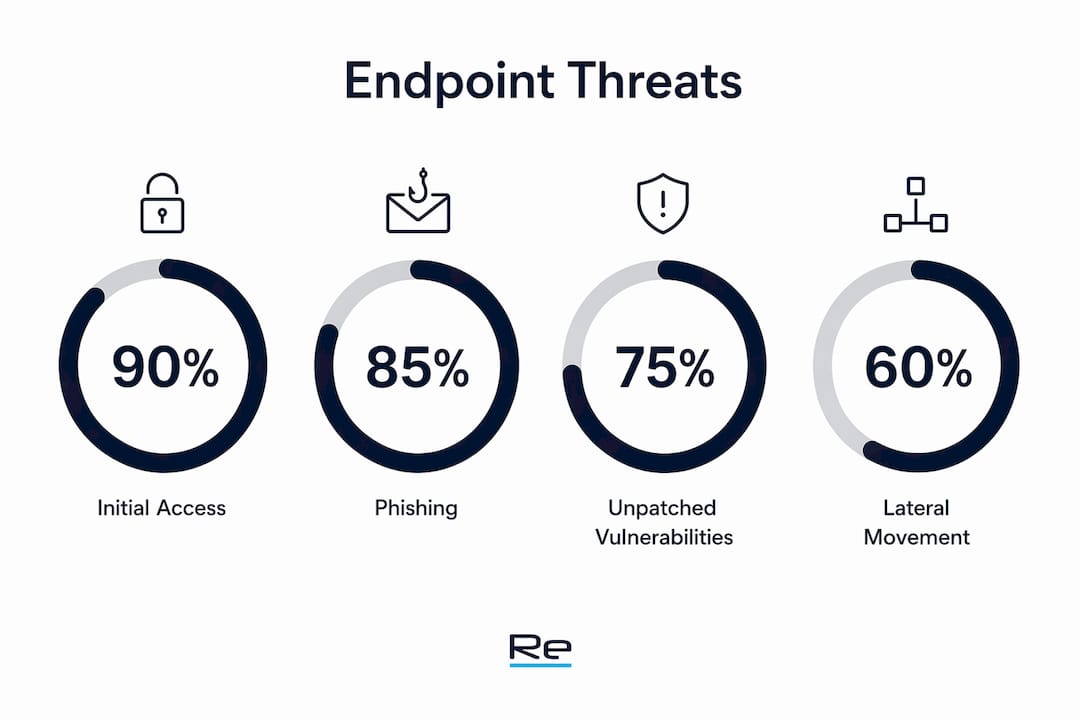
Phishing and credential harvesting remain the most common initial access vector. Attackers target individual users because human behaviour is harder to patch than software. A single click on a malicious link can hand an attacker valid credentials and a foothold inside the network.

Fileless malware is particularly difficult to detect with signature-based tools because it targets endpoints by injecting malicious scripts into legitimate processes, leaving no file on disk. NGAV and behavioural monitoring are the primary controls against this class of threat.
Unpatched vulnerabilities are among the most reliable attack vectors. Manual patching processes create gaps across large, diverse device estates, and attackers actively scan for outdated software. Automation is the only practical answer at scale.
Unmanaged and BYOD devices introduce risk that is difficult to quantify. Personal devices connecting to corporate resources may lack agent deployment, run outdated operating systems, or carry pre-existing malware. Network access control (NAC) and conditional access policies help contain this exposure, but only if they are consistently enforced.
Lateral movement after initial compromise is how contained incidents become major breaches. Attackers escalate from a single compromised endpoint by moving across the network, harvesting credentials, and reaching high-value assets. Network segmentation alongside endpoint protection is the control that limits this progression.

How endpoint security fits into your wider cybersecurity strategy
Endpoint security does not operate in isolation. Its value multiplies when it is integrated with identity management, cloud security, and data protection controls. Treating it as a standalone tool rather than a layer within a broader architecture leaves significant blind spots.
The most effective architecture combines EPP, EDR, and XDR so that prevention, detection, and cross-domain correlation work together. Behavioural-based alerting, rather than volume-based alerting, reduces the alert fatigue that causes genuine threats to be missed. Prioritising alerts by risk level rather than treating every notification equally is what separates a functional security operation from one that is permanently overwhelmed.
Key integration principles:
- Align endpoint access controls with identity and privilege management so that a compromised account cannot traverse the network unchallenged.
- Connect endpoint telemetry to a SIEM or XDR platform to enable cross-domain threat correlation.
- Automate patch management through your RMM platform to eliminate the manual gaps that device sprawl creates.
- Apply network segmentation so that lateral movement from a compromised endpoint is contained to a limited zone.
- Enforce least privilege access to reduce the damage any single compromised account can cause.
Integrating endpoint and network security also supports a Zero Trust architecture, where continuous verification of device health is required before access to corporate resources is granted.
Pro Tip: If your team cannot realistically provide 24/7 analyst coverage, a Managed Detection and Response (MDR) service converts your EDR detections into operational responses. MDR analysts investigate alerts, validate threats, and take containment action before escalating to your team, which means detections do not accumulate unattended overnight.
Re-solution’s perspective on making endpoint security a strategic priority
Re-solution has spent over 35 years working with organisations across education, manufacturing, hospitality, and logistics to build IT infrastructure that is both functional and secure. That experience consistently surfaces the same pattern: organisations that treat endpoint security as a tactical afterthought pay for it when an incident occurs, while those that embed it into their infrastructure design from the outset maintain far greater resilience.
Several principles guide Re-solution’s approach to endpoint security prioritisation:
- Automation over manual processes: Device sprawl makes manual patching and inventory management unworkable beyond a certain scale. Re-solution designs endpoint programmes around automated patch management and continuous device discovery, so coverage does not degrade as the estate grows.
- Balancing security with productivity: Overly restrictive endpoint controls drive users to circumvent them. Re-solution’s configurations aim for the minimum friction necessary to enforce the required security posture, keeping staff productive while maintaining control.
- Addressing the skills gap through managed services: Most IT teams do not have dedicated security analysts available around the clock. Re-solution’s managed security services extend expert coverage without requiring organisations to build an internal security operations centre.
- Sector-specific compliance requirements: Education institutions face data protection obligations around student records; hospitality businesses handle payment card data; manufacturers protect operational technology. Re-solution maps endpoint controls to the specific compliance requirements of each sector.
Endpoint security is the layer that determines whether a phishing email becomes a minor incident or a major breach. Organisations that invest in layered endpoint protection, automated response, and continuous monitoring consistently contain threats faster and recover with less disruption than those relying on perimeter controls alone. The question is not whether to prioritise endpoint security, but how quickly the programme can be made operational.
For organisations assessing where endpoint security fits within their broader infrastructure, Re-solution’s IT infrastructure guidance provides a practical starting point for understanding how device security integrates with network, cloud, and compliance requirements. You can also explore managed IT security services to understand how external expertise can extend your team’s capability without adding headcount.
Key takeaways
Endpoint security is the single most critical layer in any organisational cybersecurity programme, because up to 90% of successful cyberattacks and 70% of data breaches originate at devices that are often outside traditional network controls.
| Point | Details |
|---|---|
| Endpoints are the primary attack vector | Up to 90% of successful cyberattacks and 70% of data breaches originate at endpoint devices, making device-level protection the highest-priority control. |
| Financial risk is quantified | The average cost of a data breach is USD 4.44 million, according to the IBM report, giving IT leaders a concrete figure to anchor investment decisions. |
| Prevention and response must coexist | EPP handles known threats; EDR handles what bypasses prevention. Deploying both is the minimum viable architecture. |
| Integration amplifies protection | Connecting endpoint security with identity, cloud, and SIEM platforms closes the blind spots that isolated tools leave open. |
| Automation is operationally necessary | Manual patching and device management do not scale; automated processes are the only way to maintain consistent coverage across a growing estate. |
Recommended
- Why secure network endpoints: a guide for IT teams
- What is endpoint protection? A clear guide to safeguarding data
- Modern network security: A complete guide for IT leaders
- Network security investment: reduce risk and protect your enterprise